30 Must-Know Time Tracking Statistics in 2026
Explore the latest time tracking statistics for 2026, including productivity trends, AI insights, remote work data, and workforce analytics.

The way you track work hours and measure productivity has changed significantly over the last few years. Growing remote work, AI- powered workflows, and increasing operational demands have pushed businesses to rely more on smarter time tracking software and workforce analytics tools. This guide explores the latest time tracking statistics for 2026, along with key insights into productivity, AI trends, employee accountability, and modern workplace efficiency.
Productivity and Time Waste Statistics
Even though your team looks busy throughout the day, the actual hours spent working are frequently much less productive than you may expect. Meetings, distractions, multitasking, and constant tool-changing quietly consume a large portion of the workday without adding any significant output. The time tracking statistics listed here illustrate how productivity gaps and wasted time affect daily operations across modern workplaces.
1. The Average Office Worker Is Productive for Just 2 Hours And 53 Minutes A Day
A survey by Vouchercloud, conducted across nearly 2,000 full-time office workers, found that the average workday runs well under three hours of actual focused output. The remaining hours of the standard eight-hour workday go to social media scrolling, news browsing, casual conversations, snack breaks, and other non-work activities.
Source: Vouchercloud
2. 82% of Workers Have No Formal Time Management System
According to research compiled by Zippia, only 18% of workers use a dedicated time management system. The remaining 82% rely on to-do lists, email inboxes, or no system at all, while 25% simply handle whatever feels most urgent at the moment. This highlights a larger productivity issue because unstructured workdays often lead to inconsistent results and poor visibility into how teams use work hours. They also make it harder to identify which tasks actually add value and which activities quietly consume productive time.
Source: Zippia
3. Workers Spend 51% Of Their Workday on Low-Value or No-Value Tasks
Workers spend more than half of their workday on tasks that contribute little to meaningful output. Much of that time goes into administrative work, unnecessary back-and-forth communication, repeated check-ins, and low-priority activities that fill schedules without driving real progress. This is where productivity tracking and time tracking software become important. They help you identify which tasks consume the most work hours and which activities actually contribute to productivity, efficiency, and business outcomes.
Source: Inc
4. A Single Workplace Interruption Costs 23 Minutes of Focused Work
Research by Gloria Mark at the University of California, Irvine, found that workers need an average of 23 minutes and 15 seconds to regain focus after a single interruption. The same study also found that interruptions and task switching happen roughly every three minutes during the workday. Frequent notifications, meetings, and unexpected requests continue to reduce deep focus, making time tracking much more important for understanding where productive work hours actually go.
Source: University of California, Irvine
5. Workplace Distractions Cost U.S. Businesses $588 Billion Every Year
Workplace distractions cost U.S. businesses an estimated $588 billion every year through lost productivity, delayed tasks, avoidable errors, and repeated work. Constant notifications, unnecessary meetings, multitasking, and interruptions continue reducing focus across the workday, but many businesses still lack clear visibility into how teams actually use their time.
Source: Reuters
Without clear visibility, distractions and unproductive activity often go unnoticed.
Try Time Champ to monitor time usage, analyze activity patterns, and keep daily workflows more organized and focused.
Time Tracking Benefits Statistics
Most conversations about time tracking stop at "it helps with productivity." But the numbers go deeper than that. When you look at what changes after a team switches to structured tracking, the impact shows up across payroll, revenue, project delivery, and even how your team feels about the work. Here is what the research says.
6. Accurate Time Tracking Cuts Payroll Errors in Half
Payroll errors continue to cause significant financial and operational issues for many businesses due to incorrect hours worked, missed overtime payments, and incorrect timesheet entries. Businesses that integrate timekeeping directly with payroll systems are up to 44% less likely to have payroll-related errors and beat revenue targets by 7% than those that integrate the two separately. The integration of work logs, attendance data, and payroll processes can increase accuracy, minimize manual intervention, and simplify payroll management across teams.
Source: Pancea
7. Businesses Lose Nearly 20% of Billable Hours Without Time Tracking
A significant portion of billable work hours often goes unrecorded when teams rely on manual tracking methods or incomplete timesheets. Missed billable hours directly impact profitability, project budgeting, and revenue forecasting. Structured time tracking helps improve billing accuracy by providing clearer visibility into how work hours are allocated across projects and tasks.
Source: Cloudcoach
8. Structured Time Tracking Delivers Up To 3x to 10x ROI In the First Year
Businesses using structured time tracking software often see a return on investment between 3x and 10x within the first year, with many recovering implementation costs within just a few months. The savings usually come from multiple areas at once. These include reduced payroll errors, improved billable hour tracking, fewer project overruns, and less administrative time spent managing manual timesheets and reporting. Better visibility into work hours and productivity also helps businesses make faster operational decisions and improve overall efficiency.
Source: Airmason
9. Employees Cannot Accurately Estimate How They Spend Their Day
Stanford research cited in productivity studies found that 83% of knowledge workers struggle to accurately estimate where their work hours go without tracking tools. This leads to hidden productivity loss and poor workload planning. Businesses also struggle to identify time-wasting activities and balance workloads properly. Over time, this can reduce overall team efficiency and operational clarity.
Source: Stanford Research Summary on Time Tracking
10. Remote Workers Gain Nearly 29 Extra Productive Minutes Per Day
Studies show remote employees often achieve higher focused work time when organizations use structured productivity and time tracking systems. Better visibility into work hours helps teams reduce distractions, improve daily planning, and maintain accountability without constant supervision. It also helps you identify workload gaps early and keep remote projects moving on schedule.
Source: WeWorkRemotely
Ready to upgrade how you track and use your time?
Ready to upgrade how you track and use your time?Dive into our blog for the must-have features every team should know
Time Tracking Challenges Statistics
Many teams still struggle with inaccurate timesheets, inconsistent tracking habits, privacy concerns, and low adoption when managing work hours and productivity data. The time tracking statistics in this section highlight some of the most common challenges businesses continue facing with modern time tracking systems.
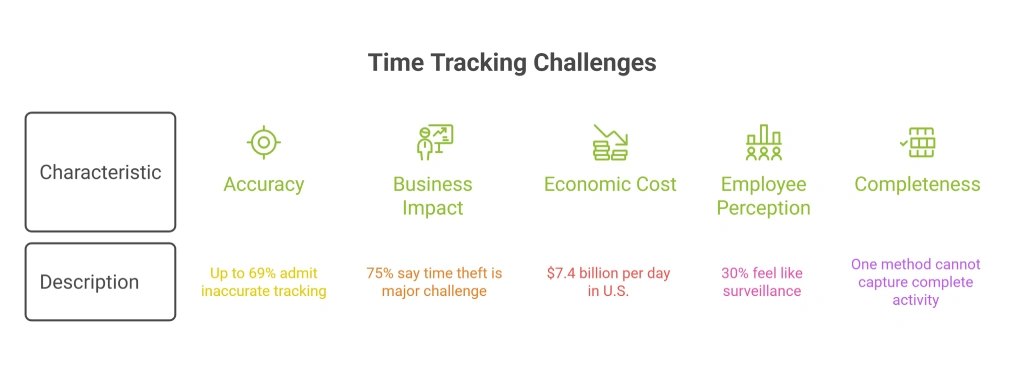
11. Up To 69% Of Employees Admit They Do Not Track Their Time Accurately
Around 69% of employees admit they do not log work hours accurately, often forgetting tasks, estimating hours later, or placing work under the wrong categories. Inaccurate time entries create problems across budgeting, project planning, workload visibility, and productivity metrics because decisions often depend on the reliability of that data.
Source: Forbes
12. About 75% of businesses say time theft is a major challenge
Surveys of employers, including data compiled by HR and time management research sources, indicate that roughly 75% of companies report time theft (such as buddy punching, long breaks, or falsified hours) as a persistent problem. This behavior can cost organizations tens of billions of dollars annually in lost productivity and payroll leakage.
Source: Fierce
13. Inaccurate Time Tracking Can Cost the U.S. Economy About $7.4 Billion Per Day
Inaccurate employee timesheets contribute to nearly 50 million lost work hours every year in the U.S., adding up to an estimated $7.4 billion in daily economic losses. Small mistakes in time entries, missed hours, and incorrect task logging often create much larger operational and financial problems over time, especially across large teams and hourly work environments.
Source: Zoho
14. 30% of workers say time tracking feels like surveillance
Around 30% of workers say time tracking feels like surveillance, while 26% say it adds stress or pressure to the workday, and 28% say it makes them hesitate to take necessary breaks. The pressure appears even higher in remote and hybrid work environments, where 35% of remote workers say tracking increases stress compared to 24% of fully in-office workers. These numbers show how strongly workplace perception affects the success of time tracking because systems that feel overly watchful can negatively affect comfort, focus, and day-to-day work patterns.
Source: Buddy Punch Survey
15. One Tracking Method Cannot Capture the Complete Work Activity
A multi-case study published on ScienceDirect found that relying on a single time tracking method often fails to capture offline work, overtime activity, or task switching accurately. This creates gaps in productivity analysis and project reporting. It also leads to incomplete visibility into how much time is actually spent on deep work versus interruptions. In many cases, short tasks and informal work updates remain unrecorded, which affects overall workload accuracy and planning decisions.
Source: ScienceDirect
Time tracking becomes harder when teams rely on manual logs and scattered workflows.
Explore our blog to understand the common tracking challenges affecting modern teams.
Time‑tracking Adoption and Market Trends Statistics
The time tracking software market has grown far beyond a small HR technology category. Businesses across different industries and team sizes now use time tracking tools to improve productivity, workforce visibility, payroll accuracy, and project management. The statistics in this section show how quickly adoption continues growing across global markets and modern workplaces.
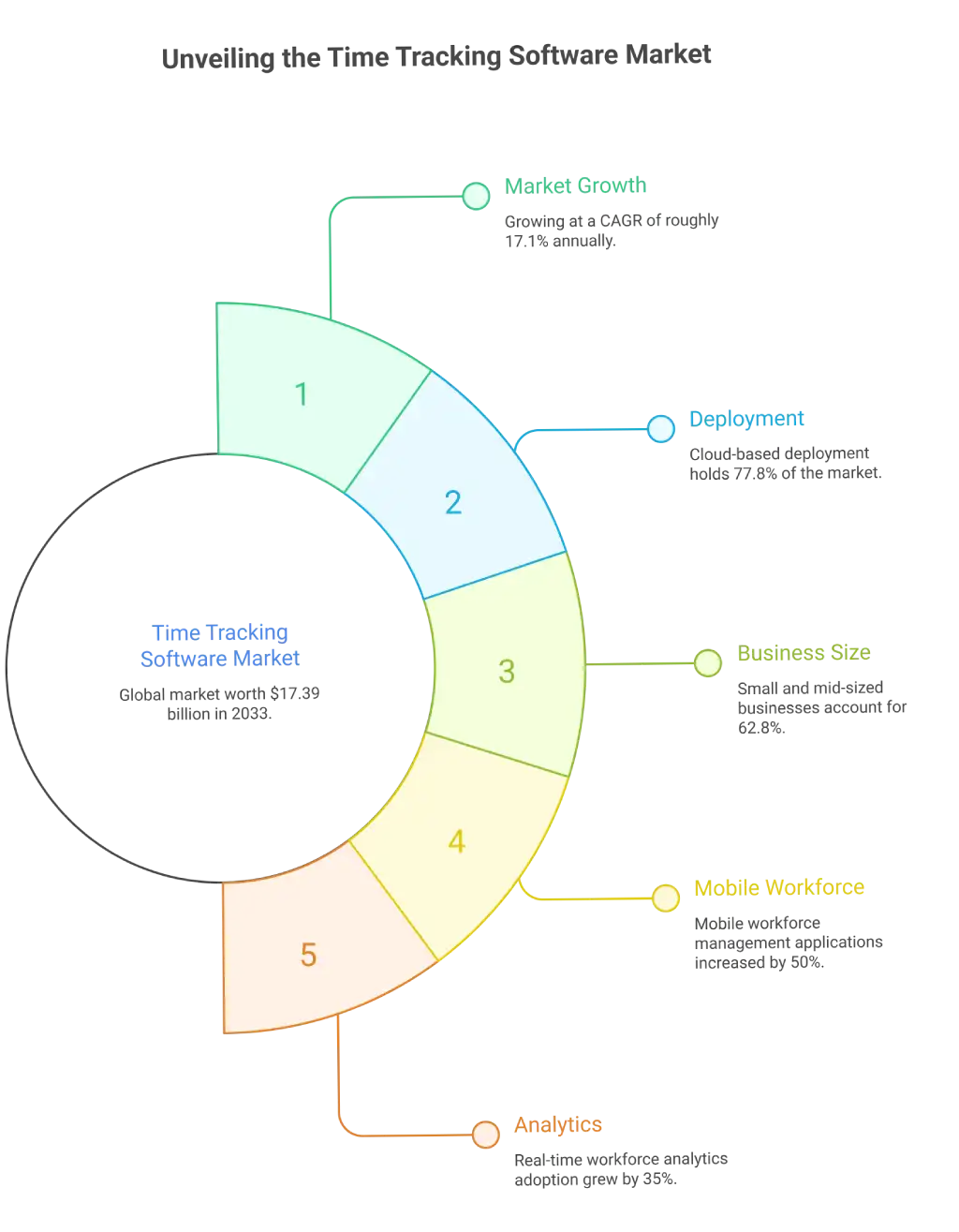
16. The Global Time Tracking Software Market Was Worth $17.39 Billion in 2033
The global time tracking software market reached an estimated value of $6.13 billion in 2025 and could grow to $17.39 billion by 2033 at a CAGR of 14.2% between 2026 and 2033. Growing remote work and distributed teams continue driving this growth. Increasing demand for productivity analytics and rapid digital transformation are also pushing businesses away from manual methods of tracking work hours and workforce operations.
Source: Grand View Research
17. The Market for Time‑tracking Software Is Growing at A CAGR of Roughly 17.1% Over the Next Decade
The time tracking software market could grow by USD 4.05 billion between 2024 and 2029 at a CAGR of 17.1%. Growing demand for workforce management and productivity visibility continues driving this expansion as businesses look for better ways to track employee work hours and improve operational efficiency. The increasing use of AI and machine learning in time tracking tools is also changing how businesses manage teams by supporting automated tracking, smarter reporting, and advanced analytics.
Source: Technavio
18. North America Remains the Largest Regional Market for Time‑tracking Software, But Asia-Pacific Is Growing the Fastest
North America continues to hold the largest share of the time tracking software market, while the Asia Pacific region is growing at the fastest rate. Rapid digital adoption among SMEs, expanding gig economy platforms, and increasing labor compliance initiatives across governments continue driving this growth. Because of this shift, many software vendors are now building features and solutions that better match regional workforce structures and compliance requirements in emerging markets.
Source: Straits Research
19. Cloud-Based Deployment Holds 77.8% Of the Time Tracking Software Market
Cloud-based deployment now makes up 77.8% of the global time tracking software market, while hybrid deployment models continue growing at a CAGR of 16.2%. Businesses increasingly prefer cloud-based systems because they allow teams to track work hours across laptops, mobile devices, and tablets with easier access and better flexibility. Platforms like Time Champ’s time tracking software are built around this growing shift toward cloud-based workforce management.
Source: Mordor Intelligence
20. Small and Mid-sized Businesses Now Account For 62.8% Of the Time Tracking Software Market
Modern time tracking software has become much more accessible for smaller teams because businesses no longer need complex implementation processes or dedicated IT support to start using it. Easier setup, flexible pricing, and faster onboarding continue driving adoption among SMEs, which now account for 62.8% of global market revenue while also growing at a CAGR of 12.5%.
Source: Mordor Intelligence
21. Mobile Workforce Management Applications Have Increased Adoption by 50%
Field teams and remote employees now rely more on mobile apps to log work hours and update task progress in real time, contributing to a 50% increase in adoption. Time tracking no longer happens only from office desktops at the end of the day because employees can now record tasks directly from mobile devices while working on-site or on the move. This shift has also improved tracking accuracy by reducing delays in manual time entry.
Source: Global Growth Insights
22. Real-Time Workforce Analytics Adoption Has Grown by 35% Across Organizations
Organizations are increasingly using real-time workforce analytics to monitor work hours, project activity, and productivity as work happens, contributing to a 35% increase in adoption. Instead of relying only on past reports, businesses can now use live workforce data to identify workload issues, track project progress, and respond faster to operational changes.
Source: Global Growth Insights
AI and workforce analytics are changing how teams track time and monitor daily activity
.Read our blog to explore the future of time tracking and employee productivity tracking.
Time Tracking Statistics for Remote and Hybrid Teams
If your team works across different locations and schedules, maintaining visibility into work hours, productivity, and daily operations becomes much harder without the right systems in place. Remote and hybrid work environments have pushed businesses to rely more on time tracking and workforce visibility tools to improve accountability, collaboration, and operational clarity.
23. About 60% Of Companies with Remote or Hybrid Teams Use time-tracking Or Monitoring Software
A recent report shows that around 60% of organizations with primarily remote or hybrid workforces rely on employee-monitoring or time-tracking tools to log hours, activity, or attendance. This marks a sharp rise compared to pre-pandemic levels and reflects how companies now want clearer visibility into work done outside the office, even though it often raises privacy and trust concerns.
Source: Forbes
24. 85% Of Leaders Believe Remote and Hybrid Teams Deliver Similar Performance Levels
Around 85% of leaders believe remote and hybrid teams perform at levels similar to in-office teams when businesses support them with clear workflows and proper systems. However, research also shows employees spend only 49% of their work hours on core tasks, while the remaining time goes into meetings, emails, administrative work, and other low-priority activities. These numbers show that work location is not the main challenge because scattered workflows and inefficient task management often reduce overall efficiency across the workday.
Source: Microsoft
25. Employee Tracking Exposed Over 50 Hours of Non-work Activity
Karlee Basse, a remote accountant at Reach CPA, filed a wrongful termination case against the company and requested $5000 in compensation. During the case, activity tracking records showed that she had spent more than 50 work hours on non-work-related activities, which later resulted in a court order requiring repayment of $2459.89 in wages. The case highlights how accurate time tracking and activity monitoring can provide better visibility into remote work hours and accountability.
Source: North Country Public Radio
26. 69% of Remote Workers Experience Burnout from Digital Communication Tools
Around 69% of remote workers report higher burnout levels caused by constant digital communication through emails, chats, video calls, and collaboration platforms. Continuous notifications and ongoing online interactions often create mental fatigue over time. This highlights the growing need for healthier work boundaries and better digital wellness practices in remote work environments.
Source: Forbes
Remote and hybrid work continue pushing teams toward smarter time tracking systems.
Explore our blog to see the remote work trends shaping modern workplaces.
Future Trends in Time Tracking
Here are the latest trends and technologies changing how teams track time, monitor productivity, and manage workforce visibility.
27. Gartner Predicts 40% of Enterprise Apps Will Include Task-Specific AI Agents by the End of 2026
According to a Gartner press release from August 2025, 40% of enterprise applications will include integrated task-specific AI agents by the end of 2026, up from less than 5% in 2025. For time tracking, the software your team uses every day will not just log hours. It will also flag unusual patterns, predict project delays, auto-categorize tasks, and highlight work insights without manual reporting. The gap between teams using AI-driven tracking and those still relying on manual time entry will continue to grow.
Source: Gartner
28. Frontier AI Models Now Solve 77.3% Of Real-world Task Benchmarks
Modern AI systems can now handle 77.3% of real-world task benchmarks, especially in areas like language processing, coding, and data analysis. However, they still struggle with some basic human-level tasks such as understanding visual information, handling multi-step planning, and managing simple real-world interactions. This shows that businesses should evaluate AI tools based on specific use cases instead of assuming they can handle every type of task accurately without human oversight.
Source: Stanford
29. 42% of Enterprise-Scale Companies Have Already Deployed AI in Their Business
Many organizations have moved beyond experimenting with AI and now use it in their daily operations to improve efficiency and reduce manual effort. This shift is also shaping the future of time tracking, where businesses increasingly rely on AI for automatic time capture, productivity insights, and smarter workforce analysis.
Source: IBM
30. Generative AI Lifts Productivity By 14% And Helps Close Skill Gaps
When teams use generative AI tools, overall output increases by around 14% on average. The greatest improvements often come from less experienced employees. AI helps them complete writing, research, and problem-solving tasks faster and with better consistency. This also helps reduce skill gaps across teams while improving onboarding, daily workflows, and task efficiency. As AI becomes more integrated into work environments, combining it with proper time tracking and productivity visibility can help you better understand how AI tools affect work hours and overall performance.
Source: National Bureau of Economic Research
Improve Time Tracking Accuracy and Visibility with Time Champ
Tracking work hours accurately becomes much harder when teams rely on manual timesheets, scattered reports, or inconsistent logging habits. Without clear visibility into how teams use work hours across tasks, projects, and daily operations, identifying productivity gaps, workload imbalances, and inefficient workflows often turns into guesswork.
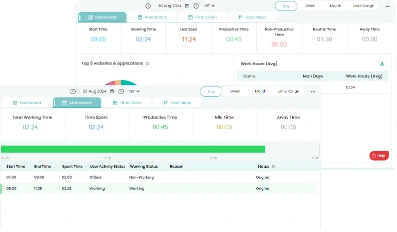
Using the right time tracking system helps you simplify that process. Time Champ is an employee time tracking and monitoring software with workforce intelligence features that help you track work hours, monitor productivity trends, analyze app usage, manage attendance, and review detailed work logs from one place. Automated time tracking and real-time insights help you understand work patterns more clearly and make better operational decisions.
Tracking time becomes easier when everything stays connected in one system.
Start using Time Champ to automate time tracking, review detailed work logs, and improve time visibility across your team.
Conclusion
Time tracking statistics clearly show how work habits, productivity, and workplace technology continue to change across industries. Businesses are moving toward smarter and more automated ways to track time, manage teams, and understand how teams complete work. From AI-powered tools to remote work trends, these insights help you see where modern workplaces are heading and why accurate time tracking matters more than ever.

Thasleem Shaik

Table of Content
 Productivity and Time Waste Statistics
- Time Tracking Benefits Statistics
- Time Tracking Challenges Statistics
- Time‑tracking Adoption and Market Trends Statistics
- Time Tracking Statistics for Remote and Hybrid Teams
- Future Trends in Time Tracking
- Improve Time Tracking Accuracy and Visibility with Time Champ
- Conclusion
Related Blogs

Explore 17 frequently asked questions about time tracking tools, including productivity, remote work, payroll, monitoring, features, and business benefits.
Anjali | May 19, 2026
Discover how remote team communication and accountability improve with time tracking, helping teams build trust, visibility, and better work habits.
Anjali | May 19, 2026
Looking for the best freelance time tracking software? Explore the top free and paid tools to track work hours, manage projects, and improve productivity.
Guna Lakshmi | May 18, 2026
Get answers to the most common questions about automated time tracking, including accuracy, privacy, productivity benefits, reporting, and team management.
Anjali | May 14, 2026
Time tracking software vs manual timesheets: compare accuracy, cost, effort, and ROI to pick the right solution for improving your team's productivity.
Jahnavi Pulluri | May 15, 2026
Want to boost productivity? Uncover 20 time tracking best practices that can transform your workflow and help you achieve more with less effort.
Guna Lakshmi | July 01, 2025


 4.7/5 avg.
Ready to Manage Your Workforce Smarter?
Join our family of 1500+ companies using smart insights to redefine workforces!

Free Trial
No Credit Card Required