Time Tracking for Remote Team Communication & Accountability
Discover how remote team communication and accountability improve with time tracking, helping teams build trust, visibility, and better work habits.

Do you feel unsure about what your remote team is working on throughout the day, even when they complete the tasks on time? In remote teams, communication gaps often build slowly through delayed updates, unclear ownership, inconsistent availability, and limited visibility in daily work.
Time tracking helps remote teams improve visibility into work patterns, strengthen communication clarity, and build accountability without constant follow-ups or micromanagement. Here, you’ll learn how time tracking affects work habits, strengthens remote team coordination, promotes trust, and supports healthier remote collaboration.
How Time Tracking Encourages Better Work Habits and Accountability
Most remote teams do not struggle because employees avoid work, the real issue is not having a clear visibility into how work is progressing each day. Here you’ll learn how time tracking improves remote team communication, accountability, and daily work habits effectively.
Capturing Daily Work Patterns
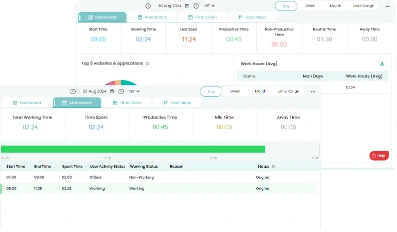
Time tracking software automatically records how employees spend their work hours throughout the day. It tracks project time, task activity, app usage, attendance, idle periods, and work sessions in real-time. Teams can get a clearer picture of how work is actually happening without relying on memory or manual updates.
Turning Activity into Clear Visibility
As the data builds over time, work patterns become easier to understand. You can identify which projects need more attention, where the delays occur repeatedly, and whether workloads are fairly distributed across the team. This helps remote teams make effective decisions with clearer operational visibility.
Creating Better Team Conversations
One of the biggest advantages of time tracking is the quality it creates in conversations. You can discuss work with a better context, identify blockers earlier, and provide support when it is needed. Employees can also benefit from clearer discussions around priorities, project expectations, and workload challenges.
Encouraging Better Work Habits
Once teams clearly understand where problems occur, it becomes easier to improve work habits and collaboration. This helps employees communicate delays sooner, so that you can resolve workload issues faster, and projects move forward without any misunderstandings. The actual advantage lies in using these insights to enhance teamwork, communication, and accountability over time.
5 Ways Time Tracking Improves Communication in Remote Teams
Communication gaps in remote teams often start when you and your employees lack clear visibility into ongoing work, priorities, and workload changes. Here are some practical ways to improve day-to-day communication in remote teams.

1. Reduces Unnecessary Status Meetings
Spend less time on repetitive status meetings by giving your teams better visibility into task progress, completed work, and active projects. Time tracking reduces constant follow-ups and helps your teams focus more on planning, collaboration, and problem-solving without repeatedly sharing updates.
2. Improves Cross-Time Zone Coordination
Coordinate more smoothly across different time zones by understanding employee schedules, productive work hours, and availability patterns. Time tracking helps your remote teams avoid delays caused by unclear schedules and improves communication across distributed teams.
3. Supports Better Burnout Conversations
Identify workload pressure early by monitoring signs like overloaded schedules, excessive work hours, and fewer breaks. Time tracking helps you to create healthier conversations around workload balance and allows teams to address burnout risks before they affect performance.
4. Helps Schedule Meetings Smarter
Protect productive work hours by scheduling meetings during less distracting times. Time tracking helps your remote teams understand when employees usually handle deep work, collaboration tasks, or client communication, making it easier to balance focus time and communication.
5. Makes Feedback Clearer and Objective
Discuss performance with better clarity using visible work patterns without any assumptions or personal opinions. Time tracking provides you with better visibility into deadlines, completed tasks, and workload distribution, helping remote employees receive more practical and constructive feedback.
Improve communication and accountability across your remote teams
Track work progress clearly with Time Champ
5 Ways Time Tracking Improves Accountability in Remote Teams
Accountability becomes difficult to maintain when remote teams have no visibility of their daily work progress. Below are some practical ways time tracking helps remote teams improve accountability in the workplace.

Removes Unnecessary Work Proof Discussions
Remote employees often feel frustrated when they repeatedly need to explain their daily work. Time tracking creates clear visibility into completed tasks, project activity, and work hours, helping you understand progress without constant follow-ups. This reduces unnecessary tension and helps your team focus more on work.
Creates Better Workload Transparency
Workload imbalances are difficult to identify in remote teams without proper visibility. Remote team time tracking helps you understand how work is distributed across employees and projects, making it easier to balance responsibilities and reduce long-term workload pressure.
Helps Identify Productivity Gaps Early
Small inefficiencies can quietly affect remote team performance when no one clearly sees where time is being lost. Time tracking helps you identify distractions, repeated delays, multitasking issues, and underestimated workloads early, allowing your remote teams to resolve problems before they affect deadlines and collaboration.
Supports More Accurate Client Billing
Accurate billing becomes challenging for remote agencies and service-based businesses without proper time visibility. Time tracking helps you maintain clear records of billable hours, project effort, and completed tasks, improving invoicing transparency and reducing billing disputes.
Encourages Greater Personal Ownership
Time tracking helps employees become more aware of how they manage tasks, priorities, and deadlines throughout the day. As work visibility improves, employees naturally take greater ownership of their responsibilities without requiring constant supervision.
3 Trust Issues You Need to Prevent When Using Time Tracking
Trust plays a major role when dealing with time tracking in remote teams. Here you’ll see the most common trust issues that many companies face with time tracking and how to prevent them with better communication, transparency, and clear data usage.
Avoid Tracking Employees Without Clear Communication
Issue: One of the biggest mistakes that organizations make is implementing time tracking without informing employees about its purpose. When employees suddenly notice activity monitoring, screenshots, or work tracking without clear communication, it creates discomfort and distrust. Many employees start feeling like the system is built to watch them, not to support their work.
Solution: Communicate openly from the beginning about what will be tracked, why the data matters, and how it helps you improve workload management, project visibility, and team coordination. When employees clearly understand the purpose, they are more likely to trust the system.
Give Employees Visibility into Their Own Data
Issue: Trust issues arise when you only have access to all the information about your employees' performance, but the employees remain unaware of what is being tracked. This creates one-sided visibility as the employees feel evaluated, while they understand nothing about the criteria of evaluation.
Solution: Give employees access to their own dashboards, productivity reports, and work summaries. When employees can review their own work data, they better understand their schedules, priorities, and work habits. Shared visibility creates a more balanced and transparent work environment.
Do Not Judge Performance Without Full Context
Issue: Time tracking data alone does not completely explain the real situation behind work. An employee may spend extra time on a task because of technical issues, client revisions, meetings, or unexpected project changes. If you depend only on numbers without understanding the situation, employees can feel misunderstood and unfairly judged.
Solution: Use time tracking data as the starting point for conversations, not final judgments. Ask questions, understand blockers, and discuss workload challenges before making conclusions. This helps you to solve problems more effectively while protecting trust and communication within your remote teams.
Improving Remote Team Communication and Accountability with Time Champ
Managing remote teams becomes harder when you lack clear visibility into work progress, employee workload, and daily team activity. Delayed updates, constant follow-ups, and uneven workloads can slowly affect communication, accountability, and team collaboration.
Time Champ is an employee monitoring tool with advanced workforce intelligence features that help solve these challenges by providing deeper visibility into how work actually happens. With features like automatic time tracking, app and website usage tracking, productivity analytics, idle time detection, workload insights, attendance tracking, project time monitoring, and real-time productivity reports, managers can understand work patterns without relying on constant supervision. Time Champ also helps teams improve communication through shared visibility, clearer work tracking, better workload management, and more informed conversations around productivity, performance, and accountability.
Reduce communication gaps and unnecessary follow-ups
Use Time Champ to manage remote teams with better visibility
Conclusion
Strong remote teams are built on effective communication, collaboration, and accountability. When you and your employees lack visibility in daily work, small communication gaps can create confusion, trust issues, and delays across the team. This is why time tracking becomes more valuable to improve transparency, collaboration, and work coordination. With a proper approach, remote team communication and accountability can become easier to achieve through conversations and better work habits, which helps your teams stay aligned and productive without constant follow-ups.

Anjali

Table of Content
 How Time Tracking Encourages Better Work Habits and Accountability
- 5 Ways Time Tracking Improves Communication in Remote Teams
- 5 Ways Time Tracking Improves Accountability in Remote Teams
- 3 Trust Issues You Need to Prevent When Using Time Tracking
- Improving Remote Team Communication and Accountability with Time Champ
- Conclusion
Related Blogs

Learn how to calculate employee productivity ratio using formulas, examples, benchmarks, and practical tips to improve team performance across departments.
Anjali | May 14, 2026
Learn how automated time tracking improves team productivity, reduces manual work, builds trust, and delivers smarter workforce insights for managers today.
Anjali | May 15, 2026
Struggling with remote work productivity challenges? Learn what’s slowing your team down and how to improve focus, communication, and performance.
Guna Lakshmi | Apr 15, 2026
Avoid common remote team management mistakes that hurt productivity. Learn how to handle communication, collaboration, and efficiency challenges effectively.
Jahnavi Pulluri | Mar 15, 2025
Learn effective remote team alignment strategies to enhance communication, boost productivity, and keep your team connected.
Thasleem Shaik | Mar 13, 2025
Understand the role of productivity tracking in remote work and how it improves team clarity, workload balance, and performance with real insights.
Thasleem Shaik | May 01, 2026


 4.7/5 avg.
Ready to Manage Your Workforce Smarter?
Join our family of 1500+ companies using smart insights to redefine workforces!

Free Trial
No Credit Card Required