Remote Work Productivity Challenges and Solutions
Struggling with remote work productivity challenges? Learn what’s slowing your team down and how to improve focus, communication, and performance.

Your team is remote. But are they really productive? Anyone weighing this decision usually starts with our enterprise employee monitoring guide for the full landscape.
It’s a question many HR leaders, managers, and business owners keep thinking about. Everything may look fine on the surface, but the real story is often hidden beneath it. People show up to calls. Tasks get completed. But something feels off. Output is inconsistent. Engagement is slipping. Your best people seem checked out.editorjs
That’s where remote work productivity challenges arise. The good news? Every challenge your remote workforce is facing has a practical solution. This guide walks you through the most common remote work problems and tells you exactly what you can do to fix them.
What Is Remote Work Productivity and Its Importance
Remote work productivity measures how effectively your employees deliver results when they work outside a traditional office. It is about how much your team actually accomplishes during those hours, whether they are hitting goals, collaborating well, and contributing meaningfully to your business outcomes.
Why should you care? Because the financial stakes are high. But when remote work goes wrong, the cost is real. Teams miss deadlines. Communication breaks down. Good employees quit. That is why solving remote work productivity challenges is a business priority.
Top Remote Work Productivity Challenges and Strategies to Solve Them
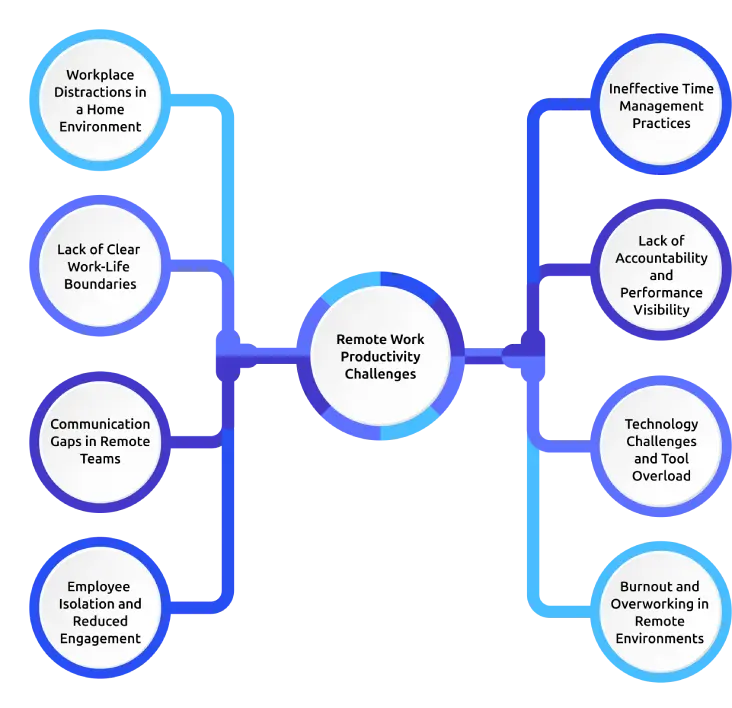
Remote work brings flexibility, but it also comes with challenges that can quietly affect your team’s performance. Understanding these problems and solving them early helps you build a more productive and engaged workforce.
Workplace Distractions in a Home Environment
Your employees are working at home, where they also live. That means they are surrounded by children, household chores, personal obligations, and digital distractions at all times. Unlike an office environment, which sends clear social signals about professional behavior, home doesn’t give you those reminders.
As an employer, here is what you can do to help:
- Offer a home office stipend to help employees set up a dedicated, distraction-minimized workspace. Even a small budget for a desk, headphones, or a room divider makes a measurable difference.
- Set clear focus-hour norms, define times in the day when employees should not be expected to respond to messages, so they can do deep work without interruption.
- Provide access to productivity tools like Time Champ that help employees block distractions during work sessions.
Lack of Clear Work-Life Boundaries
One of the biggest problems in remote work is when employees keep working even after their work hours end. Some struggle to mentally start their workday because home does not feel like a professional environment. In fact, Burnout and anxiety are among the top concerns of the modern workforce, and blurry work-life boundaries are a major cause of it. When your employees are burned out, they deliver lower-quality work, make more mistakes, and eventually leave.
Here is what your organization can do:
- Create a clear after-hours communication policy. Define expectations around response times outside of business hours. Send a strong signal that employees are not expected to be available 24/7.
- Train your managers to respect boundaries. If managers message late at night, employees may feel they have to respond, even if it’s not required.
- Encourage employees to build end-of-day rituals, such as closing the laptop, going for a walk, or doing a quick shutdown review. Share these practices in your team culture so they become normalized.
Communication Gaps in Remote Teams
Communication breakdowns are one of the top reasons remote teams underperform. In an office, your team picks up on tone, body language, and facial expressions. In a remote environment, all of that disappears, replaced by text messages that are easy to misread and emails that go unanswered.
Here is what you can do to help:
- Create clear rules for team communication. Decide which tool to use for urgent messages, project updates, important decisions, and casual chats so everyone knows where to go. This helps people stay updated without needing to be online all the time.
- Hold a weekly team meeting with a clear plan. Keep it short; around 30 minutes is enough.
Employee Isolation and Reduced Engagement
When employees start working remotely, they miss the social side of the office. No team lunches, no quick chats, and no shared feeling of working together. Over time, this can make them feel disconnected, and that can affect their performance. According to Gallup's workplace research, employees who have a best friend at work are seven times more likely to be engaged.
Here is how to build a connection into your remote culture:
- Launch a Virtual Buddy Program: Pair new hires with a buddy who can answer questions and help them feel welcomed, even if they never meet in person.
- Schedule Regular Non-Work Check-ins: Monthly virtual team socials or even just an open video call where no work is discussed. These feel small, but they build the social bonds that drive engagement.
- Recognize Employees Publicly and Consistently: A simple shout-out in a team channel carries enormous weight when remote employees rarely receive informal praise.
Ineffective Time Management Practices
Office life naturally gives structure to the day with fixed meetings, lunch breaks, and team presence. But in remote work, that structure is missing, so many people find it hard to manage their time. Because of this, they spend more time replying to messages, joining too many meetings, and doing low-value work that doesn’t really matter.
Here is what you can do as an employer to support better time management across your team:
- Provide time management training specifically designed for remote workers.
- Reduce unnecessary meetings. Check your regular meetings and see if they are really needed. If there is no clear agenda or decision to make, cancel them or replace them with updates that people can read or watch later.
- Encourage your team to schedule focused work time on their calendar and respect it just like any other meeting.
Lack of Accountability and Performance Visibility
Without physical presence, many managers feel like they have lost visibility into what their teams are actually doing. This creates a dangerous fork in the road: either accountability disappears entirely, or managers overcompensate with micromanagement and surveillance tools that damage morale.
Here is how to build a results-focused accountability culture:
- Define clear, measurable goals for every team member using OKRs (Objectives and Key Results) or SMART goals. Employees cannot be accountable for targets they cannot see.
- Use project management tools like Asana, Time Champ, or Jira to create transparent visibility into who is working on what, without requiring constant status updates.
- Train your managers to have honest performance conversations early. In a remote environment, underperformance is easier to hide and harder to address. Do not wait until the quarterly review.
Finding it hard to keep your team aligned remotely?
Time Champ gives you clear visibility into remote teams' work hours and activity.
Technology Challenges and Tool Overload
Your remote workforce depends entirely on technology to function. That means every tech failure, like a slow VPN, a dropped video call, or a software outage, can directly impact business output.
Here is what to do:
- Audit your tools every six months. Ask: Which tools are the team actually using? Which ones overlap in functionality?
- Choose platforms that integrate with each other to reduce context-switching and keep information centralized.
- Set a company standard for which tool is used for what. Document it. Include it in onboarding. Enforce it consistently across teams.
Burnout and Overworking in Remote Environments
Here is a statistic that should concern every business leader. According to the World Health Organization (WHO), overwork is responsible for more than 745,000 deaths in 2016 globally. Remote burnout is especially dangerous because it is invisible. You cannot see the exhaustion on your team member's face during a video call the way you would if you passed them in the hallway.
As an employer, burnout prevention needs to be a policy, and you can do this:
- Establish clear after-hours boundaries at the organizational level. State explicitly that employees are not expected to respond to messages outside of core hours.
- Track vacation day usage across your team. If someone has not taken time off in months, your manager should check in proactively.
Effective Strategies to Improve Remote Work Productivity
You know what the problems are. Now here is your action plan. These strategies are not abstract ideas; they are practical steps your organization can take right now.
Provide a Home Office Budget
A small stipend for a proper desk, chair, and headset pays for itself within weeks in recovered productivity. Set a clear reimbursement policy. Let employees choose what works best for their space. This simple investment signals that you take remote work seriously, and employees notice.
Create a Remote Onboarding Program
The first 90 days shape a new employee’s entire journey in the company. For remote employees, this time is even more important. Build a clear onboarding plan that covers job tasks and also your communication tools, team culture, and remote work rules. Assign a buddy to every new employee. Check in with them every week for the first three months.
Create a Remote Work Policy Document
Write down your remote work expectations clearly. Include working hours, communication rules, response time, meeting behavior, and security practices. Make sure everyone can access it. Review it every six months. A clear policy removes confusion and improves both productivity and accountability.
Move to Outcome-based Performance Management
Stop measuring how long your employees work and start measuring what they complete. Set clear goals for each team member every quarter. Review their progress every week. Appreciate good results in front of the team. This approach motivates top performers, helps you spot low performance early, and builds trust that keeps your best employees engaged in a remote work environment.
Check and Simplify Your Communication Channels
Choose one main tool for each type of communication and make it clear to everyone. Use one place for urgent messages, another for project updates, and another for casual chats. Follow these rules consistently, especially at the leadership level. When leaders don’t follow the set channels, the rest of the team will do the same.
Train your Managers for Remote Leadership
Managing remote teams is a different skill from managing in-person teams. Invest in training that covers remote communication, flexible workflows, digital performance management, and virtual team building.
Make Employee Wellbeing a Measurable Business Metric
Run employee feedback surveys every quarter. Track eNPS (Employee Net Promoter Score). Keep an eye on how many employees leave by choice. Look for early signs like more sick leaves, less participation in meetings, and slower replies. Treat these signs as important business data, because they are. Companies that take care of employee well-being early perform better than those that act only after problems grow.
The Future of Remote Work and Productivity Trends
Companies that build strong systems for remote work now will have a big advantage in hiring, keeping employees, and getting better results in the coming years.
Here are the remote work trends you should watch:
- AI is reshaping remote productivity. AI tools are taking over repetitive tasks, summarizing meetings, drafting communications, and managing schedules. Organizations that equip their remote teams with AI tools will outpace those that do not.
- Companies that follow flexible work are growing faster. Leading remote companies like GitLab and Automattic have built their entire work system around this approach.
- Results-only work environments (ROWE) are becoming more popular. In this model, employees are judged only on outcomes. For knowledge-based roles, this approach improves engagement, reduces employee turnover, and leads to better performance.
How Time Champ Helps Improve Remote Work Productivity
Managing a remote team becomes much easier when you have the right visibility and control in place. That’s where Time Champ helps. It is a workforce intelligence and employee monitoring software that gives you a clear view of how your team spends their time, without micromanaging. You can track work hours, monitor productivity, and identify distractions that may be affecting performance.
With features like activity tracking, focus time insights, and real-time visibility, you can:
- Track work hours accurately without manual effort
- Monitor productivity trends to understand who needs support
- Identify distractions and unproductive habits early
- Get real-time visibility into ongoing work without interrupting employees
Time Champ helps you create a more structured and focused work environment, even when your team is fully remote. You can make better decisions using actual data instead of assumptions. Teams can manage their time better, stay focused during work hours, and avoid unnecessary burnout caused by poor planning.
Over time, this leads to stronger accountability, better performance, and a healthier work culture where employees feel supported. If you want your remote team to stay productive, aligned, and engaged, having a tool like Time Champ in place makes a real difference.
Are you struggling to track your remote team’s productivity?
Time Champ helps you monitor employee work and boost performance accurately!
Conclusion
Your remote team's productivity challenges are not a failure, they’re a sign that your work setup needs to adapt. When work shifts from the office to home without proper systems, then distractions, communication issues, isolation, and burnout can arise. The good news is that every one of these challenges has a clear, practical solution. With the right strategies, tools, and support in place, you can turn these obstacles into opportunities and build a remote team that is focused, connected, and consistently productive.

Guna Lakshmi

Table of Content
-
 What Is Remote Work Productivity and Its Importance
-
Top Remote Work Productivity Challenges and Strategies to Solve Them
-
Effective Strategies to Improve Remote Work Productivity
-
The Future of Remote Work and Productivity Trends
-
How Time Champ Helps Improve Remote Work Productivity
-
Conclusion
Related Blogs
Discover how remote employee tracking can enhance data leak prevention strategies while maintaining privacy and compliance with global regulations.
Thasleem Shaik | Jan 17, 2025
Learn effective tips to know if your remote employees are working for ensuring productivity and accountability.
Shabana Shaik | Oct 26, 2024
Learn how to detect employee monitoring software, identify the key signs on your computer, and understand what to do if your activity is being monitored.
Anjali | Apr 13, 2026
Help your remote employees stay productive and stress-free with simple and effective strategies to reduce work-related pressure and improve well-being.
Jahnavi Pulluri | Mar 12, 2025
Discover the best ways to introduce productivity monitoring in your organization smoothly and effectively.
Thasleem Shaik | Mar 18, 2025
How do remote teams keep customers happy? Explore how round-the-clock support and seamless service can boost satisfaction.
Jahnavi Pulluri | Mar 12, 2025


 4.7/5 avg.
Ready to Manage Your Workforce Smarter?
Join our family of 1500+ companies using smart insights to redefine workforces!

Free Trial
No Credit Card Required