Remote Employee Tracking and Data Leak Prevention Guide
Learn how remote employee tracking and DLP work together to prevent data leaks, secure remote teams, and support privacy, compliance, and safer workflows.
Remote employee tracking and data leak prevention work together to help you monitor how remote teams handle sensitive information and stop unauthorized data exposure before it turns into a security incident. Numentis research reports that nearly 70% of employees admitted to accidentally sharing sensitive company data while working from home, highlighting how difficult it is to detect risky behavior without centralized visibility into remote work activity.
In this guide, you will learn about the data leak risks unique to remote work, security controls that reduce exposure, the balance between employee privacy and monitoring, and the compliance requirements you must follow when managing remote teams.
Why Tracking and DLP Belong in the Same Toolset
You may still manage remote employee tracking and data leak prevention through separate systems. One platform tracks productivity and employee activity, while another monitors data movement and security risks. This separation creates gaps because both systems rely on the same behavioral signals, including app usage, file access, login activity, downloads, and unusual work patterns.
Remote employee tracking becomes more effective when combined with DLP visibility in a single toolset. The same action that looks like normal productivity behavior in one context can signal a potential data leak in another. For example, repeated file downloads after work hours may indicate overtime work or suspicious data movement. When tracking and DLP tools work separately, it becomes harder to detect insider risks early.

Did You Know?
A 2025 insider risk report found that 76% of organizations experienced insider incidents in the past 12 months, showing how quickly internal security risks are growing in remote and hybrid environments.
What Are the 5 Data Leak Risks Unique to Remote Work
Remote work creates more opportunities for sensitive company data to get exposed through unsecured devices, risky user behavior, and weak security practices. Below are the five most common data leak risks in remote work environments and the security measures that help you reduce them.
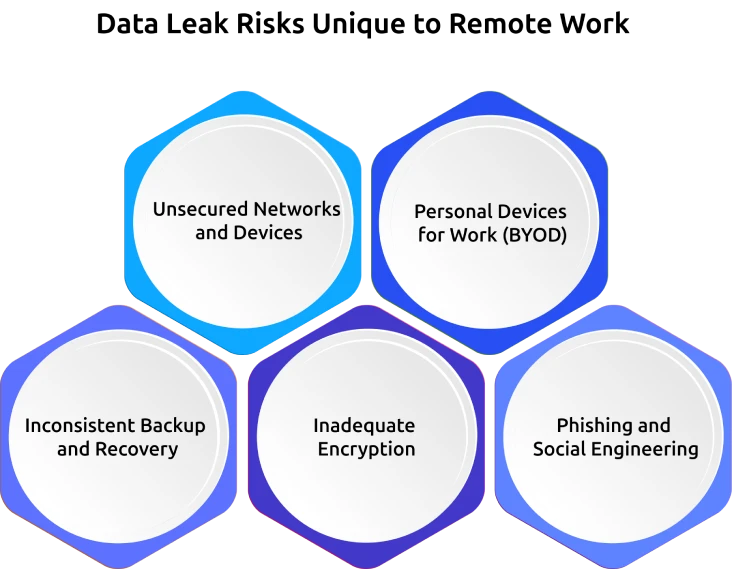
1. Unsecured Networks and Devices
- Employees working from home with Wi-Fi or public internet connections can unknowingly expose company data to attackers through insecure networks and unprotected devices.
- Using VPNs, secure network policies, device monitoring, and encrypted connections helps you to reduce unauthorized access and protect sensitive business data.
2. Personal Devices for Work (BYOD)
- Personal laptops, smartphones, and tablets often lack proper security updates, antivirus protection, and encryption, making company data more vulnerable to leaks.
- Implementing BYOD security policies, endpoint protection, and access controls helps you to secure work data across personal devices.
3. Inconsistent Backup and Recovery
- Remote employees sometimes store files on personal drives or unmanaged cloud accounts, increasing the risk of permanent data loss after a cyberattack or device failure.
- Centralized backups, automated recovery systems, and secure cloud storage help you to restore critical data quickly during security incidents.
4. Inadequate Encryption
- Sensitive files and communications become easier to intercept when you fail to enforce encryption across devices, apps, and remote connections.
- Applying encryption both at rest and in transit helps you to secure confidential information even if systems or accounts become compromised.
5. Phishing and Social Engineering
- Remote employees frequently receive phishing attempts through email, messaging apps, SMS, and fake login pages designed to steal credentials or company data.
- Multi-factor authentication (MFA), employee security training, and real-time threat monitoring help to reduce phishing-related data leaks and account compromises.
Concerned about data leaks in your remote team?
Time Champ helps you monitor employee activity and spot unusual behavior early.
How Can You Implement Unified Tracking and DLP Strategies?
Remote employee tracking and data leak prevention work best when organizations combine employee activity visibility with strong security controls. A unified approach helps you identify risky behavior faster, reduce blind spots, and respond to potential data leaks before they become serious incidents.
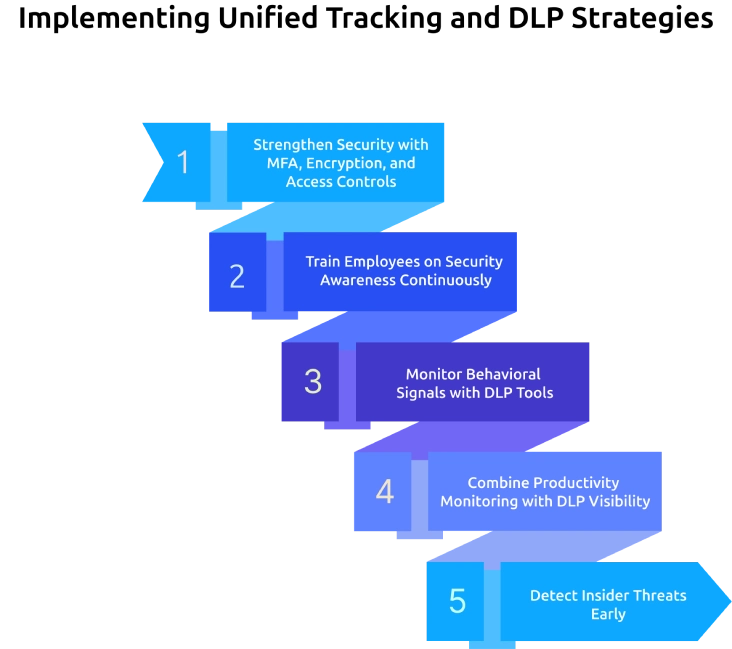
1. Strengthen Security with MFA, Encryption, and Access Controls
Start by enabling multi-factor authentication (MFA) across every work application, including cloud storage, collaboration tools, and remote access platforms. Encrypt sensitive data both at rest and in transit so attackers cannot easily access exposed information. Review your employee access permissions regularly and follow least privilege access policies to limit unnecessary exposure to confidential files.
2. Train Employees on Security Awareness Continuously
Conduct regular phishing simulations and security awareness sessions to help employees recognize suspicious emails, fake login pages, and social engineering attempts. Create clear data handling policies so employees understand how to store, share, and protect sensitive information while working remotely. Since human error contributes to most security incidents, continuous training helps you to reduce accidental data leaks significantly.
3. Monitor Behavioral Signals with DLP Tools
Implement DLP systems that monitor file access, downloads, uploads, copy-paste activity, and unusual data transfers across remote devices. Configure automated alerts to identify suspicious behavior such as large file downloads, repeated access attempts, or unauthorized sharing activity. Use behavioral analytics and UEBA tools to detect anomalies that traditional rule-based DLP systems often miss.
4. Combine Productivity Monitoring with DLP Visibility
Use a unified system that connects employee activity tracking with data protection monitoring without managing separate tools. This approach helps you view productivity behavior, application usage, file movement, and security alerts from one dashboard. Unified visibility reduces blind spots and helps you understand whether unusual activity is harmless or a potential data leak risk.
5. Detect Insider Threats Early
Track unusual employee behavior patterns such as after-hours access, repeated downloads, or attempts to open restricted files. Set up anomaly detection rules that flag risky activity before sensitive information leaves the organization. Combining insider threat monitoring with remote employee tracking and data leak prevention helps you identify internal risks faster and respond before incidents escalate.
What Legal Compliance Rules Apply to Remote Employee Monitoring?
Remote employee tracking and data leak prevention require you to follow privacy and data protection laws that control how you collect, monitor, store, and use employee data. If you fail to follow these regulations, you might face legal penalties, compliance violations, and loss of employee trust.
1. Obtain Employee Consent Before Monitoring
Many countries and regions require organizations to inform employees before monitoring workplace activity. Under GDPR, you must clearly explain what data they collect, why they collect it, and how long they retain it through a documented privacy notice. In the United States, the Electronic Communications Privacy Act (ECPA) allows monitoring on company-owned systems, but organizations should still communicate monitoring policies clearly to employees.
2. Follow the Regional Data Protection Regulations
Different countries enforce different rules for employee data collection and monitoring. Regulations such as GDPR (Europe), CCPA (California), PIPEDA (Canada), and LGPD (Brazil) require organizations to follow principles like data minimization, purpose limitation, transparency, and controlled data retention. Remote employee tracking systems should only collect necessary information and store it securely based on regional compliance requirements.
3. Maintain Audit Trails for Compliance Reviews
Organizations handling sensitive customer, financial, or healthcare data must maintain detailed audit logs for compliance reviews and investigations. Regulations such as HIPAA, SOX, and PCI DSS require businesses to track who accessed specific data, when access occurred, and what actions were performed. Strong audit trails also support remote employee tracking and data leak prevention by improving visibility into employee activity and potential security incidents.
How Time Champ Unifies Remote Tracking and Data Leak Prevention
Time Champ is an employee monitoring software, along with complete workforce intelligence features, designed to give remote teams visibility and data leak protection from a single dashboard. The platform tracks app usage, website activity, productivity patterns, and file access behavior to help you understand how employees work while also identifying potential security risks. It can flag unusual file transfers, repeated downloads, unauthorized access attempts, and after-hours activity before those actions turn into serious data exposure incidents.
Time Champ combines productivity insights with behavioral DLP visibility using the same activity data, helping you reduce blind spots between separate monitoring tools. Its UEBA-style anomaly detection identifies suspicious behavior patterns while two-way dashboards improve transparency and maintain employee trust. The platform also supports audit trails for compliance requirements such as GDPR, HIPAA, CCPA, and SOX, while configurable monitoring controls allow you to adjust tracking intensity based on your team’s needs.
Finding it hard to manage remote productivity and data security together?
Time Champ gives you employee monitoring and data protection insights in one simple dashboard.
Conclusion
Remote work increases flexibility, but it also creates more opportunities for data leaks, insider risks, and security blind spots. Relying on disconnected monitoring and DLP tools makes it harder to detect risky behavior early and respond before sensitive information gets exposed. Combining remote employee tracking with behavioral monitoring, access controls, employee training, and data protection strategies, you can strengthen security without disrupting productivity. A unified approach gives you clearer visibility into employee activity, improves compliance readiness, and helps your organization reduce both accidental and intentional data leaks across distributed teams.

Anjali

Table of Content
 Why Tracking and DLP Belong in the Same Toolset
- What Are the 5 Data Leak Risks Unique to Remote Work
- How Can You Implement Unified Tracking and DLP Strategies?
- What Legal Compliance Rules Apply to Remote Employee Monitoring?
- How Time Champ Unifies Remote Tracking and Data Leak Prevention
- Conclusion
Related Blogs
Data loss costs more than you think. Learn what causes it, how employee monitoring reduces data exfiltration risk, and how to protect your business.
Thasleem Shaik | Apr 17, 2026
Employee monitoring software can catch insider data breaches early, if you configure it right. See what it catches, what it misses, and how to roll it out.
Jahnavi Pulluri | Apr 16, 2026
Compare the best employee monitoring apps for BYOD devices, with privacy controls, security features, pricing, and use cases for remote and hybrid teams.
Shabana | Apr 28, 2026
Your perimeter won't stop insiders. Learn how real-time insider threat monitoring, anomaly detection, SIEM, and response workflows work together to prevent risk.
Jahnavi Pulluri | Apr 14, 2026
Learn how to choose the right remote employee monitoring software with the right features, scalability, and usability to manage remote teams effectively.
Guna Lakshmi | Apr 14, 2026
Learn the pros and cons of employee monitoring and discover when monitoring improves productivity and when it creates workplace risks.
Guna Lakshmi | May 06, 2026


 4.7/5 avg.
Ready to Manage Your Workforce Smarter?
Join our family of 1500+ companies using smart insights to redefine workforces!

Free Trial
No Credit Card Required