Future of Employee Productivity Tracking: 8 Trends for 2026
Explore 8 key trends shaping the future of employee productivity tracking, including AI, workforce intelligence, hybrid work, and wellbeing analytics.
Tracking productivity used to mean counting hours and mouse clicks. In 2026, that approach can't keep up with AI tools, hybrid teams, and outcome-driven leadership. This guide walks through the eight trends reshaping how organizations measure work in 2026 and beyond, with the data and decisions you need to plan around them.
What Is Reshaping the Future of Employee Productivity Tracking?
The future of employee productivity tracking looks different because three shifts arrived at the same time: AI tools changed how daily work happens, hybrid work removed the office as the unit of measurement, and employees now expect transparency about what organizations track. Together, these forces are pushing productivity tracking from activity logs toward outcome-based workforce intelligence.
Struggling to understand what actually drives productivity across your teams?
Use Time Champ to track work patterns, improve visibility, and make smarter productivity decisions with real-time workforce insights.
What Are the 8 Trends Shaping the Future of Employee Productivity Tracking?
The way organizations track productivity is changing quickly. Activity logs and timesheet data alone no longer help you fully understand whether your team delivers meaningful results. Work environments, technology, and employee expectations continue to evolve, which also changes how organizations measure productivity, performance, and operational efficiency. Here, I have gathered eight major trends reshaping employee productivity tracking and workforce intelligence that you need to understand today.
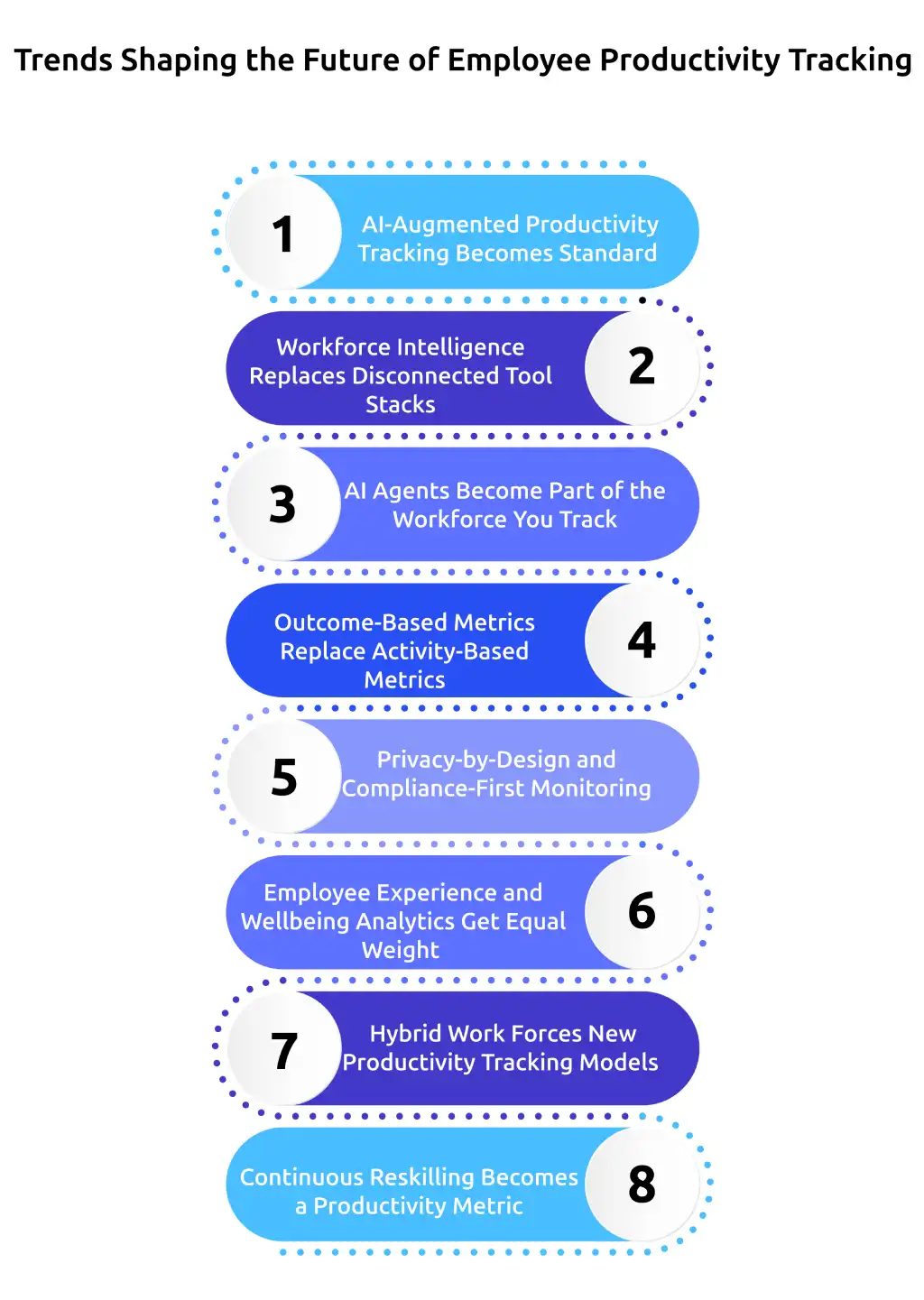
Trend 1: AI-Augmented Productivity Tracking Becomes Standard
- AI now helps organizations track productivity, analyze workflows, and identify performance trends more accurately.
- Modern AI-powered tools can summarize work patterns, detect unusual activity, identify focus drops, and generate productivity reports automatically.
- According to the Federal Reserve Bank of St. Louis, employees using generative AI saved an average of 5.4% of their work hours, which equals nearly 2.2 hours per week in a standard work schedule.
- As AI-powered employee productivity tracking continues growing, organizations also need clear policies for what AI measures, flags, and reports.
Trend 2: Workforce Intelligence Replaces Disconnected Tool Stacks
- Many organizations still use separate tools for time tracking, project management, communication, reporting, and employee monitoring, which makes productivity data harder to manage.
- Organizations now prefer unified workforce intelligence platforms that combine productivity tracking, workforce analytics, operational insights, and employee activity data in one place.
- Workplace technology usage also continues to grow rapidly. ChatGPT.combecame the fifth most-visited website by total hours used, while usage increased by 145% year over year.
- Modern workforce intelligence trends now focus on connected systems that help you track productivity, user behavior, workload patterns, and operational performance from a single dashboard.
Trend 3: AI Agents Become Part of the Workforce You Track
- AI agents now handle tasks like content creation, workflow automation, document summarization, request handling, and internal operations across many organizations.
- Tools like Microsoft Copilot, ChatGPT, and custom AI bots are changing how organizations measure productivity and work output.
- According to CNBC, Salesforce reported that AI agents handled 129 million tasks in one quarter while automating 96% of support cases internally.
- Modern employee productivity tracking now includes tracking AI-generated work, monitoring how teams use AI tools, and understanding how AI affects overall productivity and workflow efficiency.
Trend 4: Outcome-Based Metrics Replace Activity-Based Metrics
- Traditional productivity tracking focused mainly on keystrokes, mouse movement, logged hours, and screen activity instead of actual work outcomes.
- Organizations now prefer outcome-based productivity metrics that measure project completion, work quality, goal achievement, and operational efficiency.
- According to India Today, employees stay truly productive for only 2 hours and 53 minutes during a standard 8-hour workday. Distractions consume a large part of the remaining work hours.
- Modern employee productivity tracking now focuses more on completed work, productivity metrics and KPIs, output quality, and business goals instead of only measuring screen activity or logged time.
Trend 5: Privacy-by-Design and Compliance-First Monitoring
- Privacy regulations, AI governance rules, and transparency expectations now directly affect how organizations monitor productivity and workforce activity.
- According to the European Commission, the EU AI Act will fully apply from August 2, 2026. AI-powered monitoring tools may fall under high-risk AI system requirements.
- According to Ogletree Deakins, non-compliance penalties under the EU AI Act can reach up to 35 million euros or 7% of global annual turnover.
- Ethical employee monitoring also helps organizations protect sensitive business data and reduce insider risks. According to the Ponemon Institute Insider Risk Report, the average annual insider risk cost reached $19.5 million per organization.
Understanding employee monitoring laws and addressing common employee monitoring myths also helps organizations build more transparent and trusted monitoring practices across teams.
Trend 6: Employee Experience and Wellbeing Analytics Get Equal Weight
- Organizations now understand that burnout, workload pressure, and work fatigue directly affect productivity, engagement, and long-term performance.
- According to Meditopia for Work, teams with high burnout levels show 18% to 20% lower productivity and reduced work performance.
- According to Speakwise, organizations lose nearly $322 billion globally each year due to burnout-related turnover and productivity losses.
- Modern employee productivity tracking software now includes focus time analysis, workload balance, meeting load monitoring, after-hours activity trends, and employee well-being insights alongside traditional productivity metrics.
Trend 7: Hybrid Work Forces New Productivity Tracking Models
- The biggest challenge for organizations today is no longer where employees work. The real challenge is understanding productivity clearly across remote, office, and hybrid work environments.
- Hybrid work has now become a long-term work model across many industries. According to Gallup, 53% of remote-capable employees work in hybrid arrangements, while 27% work fully remotely and only 20% work completely on-site.
- Effective hybrid productivity tracking systems support cross-device monitoring and flexible work environments. They also help you track asynchronous work patterns without depending on constant visibility.
- 83% of employees said asynchronous work improved their productivity. As hybrid and asynchronous work continues expanding, organizations need productivity tracking models that reflect how work actually happens across flexible and distributed teams.
For a deeper look at how hybrid work statistics continue changing workforce planning, the data shows a clear pattern. Flexible work has become the standard, and productivity tracking tools now need to support that shift properly.
Trend 8: Continuous Reskilling Becomes a Productivity Metric
- Productivity is no longer measured only by current performance. Organizations now also evaluate whether employees continue building the skills needed for future work environments and changing technologies.
- According to the World Economic Forum Future of Jobs Report, 39% of core workforce skills are expected to change or become outdated by 2030. The report also found that 63% of organizations consider skill gaps the biggest barrier to business transformation.
- This shift changes how organizations approach workforce analytics for productivity. Strong performance today may not be enough if employees do not continue adapting to new tools, technologies, and work requirements.
- According to the PwC AI Jobs Barometer, employees with advanced AI skills earn 56% more than employees without those skills. This trend shows how quickly demand for AI-related capabilities continues to grow across industries.
Trying to manage productivity across changing work environments?
Use Time Champ to monitor productivity, support hybrid teams, and track work progress with real-time insights.
How To Prepare for the Future of Productivity Tracking?
The trends above already affect how organizations measure productivity, monitor workflows, and manage workforce performance. The first step is reviewing whether your current monitoring tools help you understand meaningful work outcomes or whether they only collect basic activity data. Modern employee productivity tracking now requires better visibility into productivity patterns, collaboration, wellbeing, compliance, and AI-driven workflows.
You also need to focus on transparency before expanding any monitoring strategy. Create a clear employee monitoring policy that explains what your organization monitors, why you collect that data, how you use it, and who can access it. At the same time, prepare your systems for AI adoption, hybrid work, workforce analytics, and compliance requirements. Organizations that combine workforce intelligence, wellbeing insights, and productivity analytics in a transparent way build stronger trust and make better operational decisions over time.
How Time Champ Helps You Lead the Future of Productivity Tracking?
Productivity tracking becomes difficult when your data stays scattered across different tools and reports. You may see attendance in one system, productivity trends in another, and workload data somewhere else without a clear understanding of how work actually happens across your teams. Time Champ solves this by bringing productivity tracking, workforce insights, workload visibility, and workflow activity into one connected platform. It gives you visibility into productivity patterns, focus time, application usage, workload balance, and workflow activity from a single connected platform.
Time Champ is an employee monitoring software with built-in workforce intelligence that helps you understand productivity beyond screen activity and logged hours. You can track productivity trends in real time, identify workflow gaps earlier, monitor hybrid teams, review operational insights, and make faster decisions using connected workforce analytics. The platform also supports transparency through clear reporting, productivity dashboards, and workforce visibility without creating unnecessary complexity for your teams.
Conclusion
The future of employee productivity tracking is no longer limited to screen activity and logged hours. You now need clearer visibility into work quality, productivity patterns, wellbeing, and overall workforce performance to understand how your teams actually work. As AI, hybrid work, and workforce intelligence continue to reshape modern work environments, focusing on transparent and insight-driven productivity tracking will help you improve operational decisions and support long-term growth.
Want a smarter way to track productivity across your teams?
Try Time Champ free for 7 days and see how productivity tracking works in your team.

Thasleem Shaik

Table of Content
 What Is Reshaping the Future of Employee Productivity Tracking?
- What Are the 8 Trends Shaping the Future of Employee Productivity Tracking?
- How To Prepare for the Future of Productivity Tracking?
- How Time Champ Helps You Lead the Future of Productivity Tracking?
- Conclusion
Related Blogs
Learn how AI-powered workplace productivity monitoring affects employee data privacy, compliance, transparency, accountability, and trust in organizations.
Jahnavi Pulluri | May 11, 2026
Understand how AI productivity tracking turns activity data into real insights. Explore use cases, benefits, and how to choose the best tool for your team.
Guna Lakshmi | May 06, 2026
The AI employee monitoring software goes beyond basic tracking. It predicts risks, reveals patterns, and gives you real clarity to lead your team better.
Shabana Shaik | Apr 17, 2026
Learn what AI in the workforce is, why it matters, and how to manage it effectively. Also, explore its pros and cons to strengthen productivity and performance.
Shabana Shaik | Feb 11, 2026
Learn why AI is rising in the workplace, explore real examples, key benefits, challenges & how to use AI effectively to enhance productivity & performance.
Thasleem Shaik | Feb 11, 2026
Improve ROI with productivity tracking software by reducing wasted time, recovering billable hours, and improving workforce efficiency.
Guna Lakshmi | May 11, 2026


 4.7/5 avg.
Ready to Manage Your Workforce Smarter?
Join our family of 1500+ companies using smart insights to redefine workforces!

Free Trial
No Credit Card Required