Time Champ > Blog > AI in the Workplace: Benefits, Examples & How to Use > Content
AI in the Workplace: Benefits, Examples & How to Use
Learn why AI is rising in the workplace, explore real examples, key benefits, challenges & how to use AI effectively to enhance productivity & performance.

AI in the workplace is transforming how teams perform tasks, but many organizations struggle to turn AI initiatives into real, measurable results. Without clarity on where and how to apply AI, efforts often remain scattered, underused, or misaligned with business goals.
In this blog, you learn how to use AI to solve real workplace challenges in a clear and practical way. It explains where AI fits into daily work, how it supports better decisions, and how teams across roles can apply it without added complexity. The goal is to help you use AI in a way that improves efficiency and leads to outcomes that make a real difference to work and results.
Why Is AI Rising in the Workplace?
AI is rising in the workplace because it helps organizations work faster, reduce manual effort, and make smarter decisions. Research shows that 86.5% of employees use AI in the workplace, applying it to everyday tasks such as writing, research, data handling, and planning to support their daily work. Adoption is accelerating as teams integrate AI directly into the tools they use every day and rely on it to support routine work. This shift shows that AI is no longer experimental. It is becoming a regular part of how modern teams operate.
AI is reshaping the workforce by actively changing how employees carry out work, not just how quickly they complete tasks. As AI becomes part of daily workflows, roles increasingly combine human judgment with tool-assisted execution. Work shifts toward strategic thinking, creativity, and problem-solving, while AI handles repetitive tasks more efficiently. As a result, productivity expectations, role definitions, and long-term career paths continue to evolve across industries.
What Are the Examples of AI in the Workplace?
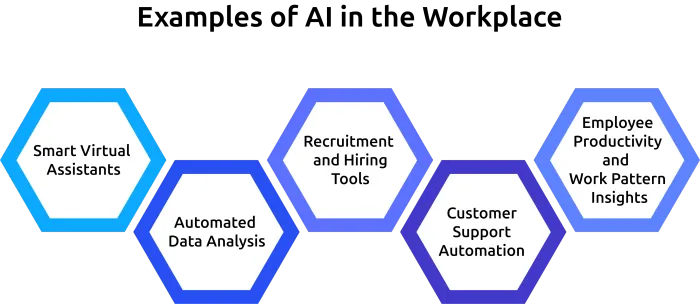
AI is already part of everyday work across many roles and industries. From automating routine tasks to supporting faster decisions, it shows up in practical, easy-to-use ways. The examples below show how workplaces actively use AI to improve efficiency, accuracy, and overall work quality.
1. Smart Virtual Assistants
AI-powered assistants help handle daily work faster by drafting emails, summarizing documents, scheduling meetings, and answering internal questions. They reduce manual work and assist teams in responding fast without the need to alternate between various tools.
2. Automated Data Analysis
AI systems analyze large volumes of data to identify patterns, trends, and risks that are easy to miss manually. Businesses use these insights for performance tracking, forecasting, and decision-making, enabling faster and more accurate conclusions.
3. Recruitment and Hiring Tools
AI reviews resumes, matches candidates to job roles, and schedules interviews. This accelerates the recruitment process, ensures fair evaluation during initial screening, and enables recruiters to pay more attention to candidates' engagement and final evaluations.
4. Customer Support Automation
Chatbots and AI-driven support systems handle common queries, ticket routing, and follow-ups. They provide faster responses, reduce support workload, and improve customer satisfaction without replacing human support entirely.
5. Employee Productivity and Work Pattern Insights
AI helps track work patterns, detect productivity gaps, and highlight unusual activity trends. These insights support better planning of the work, improve the team performance, and fair evaluation, based on the real work data.
These examples demonstrate how teams actively use AI in everyday work to improve efficiency, accuracy, and decision-making across roles and industries.
Struggling to understand where work time really goes?
Use Time Champ to gain clear visibility into daily productivity.
What Are the Benefits of AI in the Workplace?
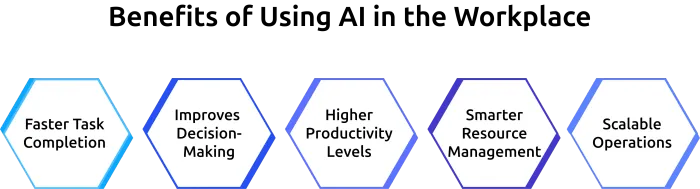
AI actively improves work processes by cutting manual effort and clarifying everyday decisions. It supports faster execution, stronger decision-making, and better use of time and resources. Below are the key benefits that show why AI has become an essential part of modern workplaces.
1. Faster Task Completion
AI accelerates routine work such as data entry, reporting, and documentation without sacrificing accuracy. Tasks that once took hours now finish in minutes, keeping work moving without delays. Faster turnaround times help teams meet deadlines and maintain consistent output.
2. Improves Decision-Making
AI processes large data sets and highlights meaningful patterns that support informed choices. You gain a clearer view of performance trends, risks, and opportunities, enabling you to make timely, data-driven decisions that are more reliable across all functions.
3. Higher Productivity Levels
Automation of repetitive tasks and the elimination of redundant functions make work processes easier. Employees spend less time switching between tasks and correcting errors. Productivity increases naturally as work stays focused and organized.
4. Smarter Resource Management
AI tracks work patterns, time usage, and workload distribution and shows how teams use resources. You gain clarity on capacity, utilization, and workload balance. This enables better allocation, prevents overload, and reduces inefficiencies.
5. Scalable Operations
AI helps you handle increasing workloads without needing more staff or resources. It automates repetitive tasks, monitors processes, and supports consistent output, so your team can focus on higher-value work. As operations expand, AI keeps work flowing smoothly, prevents bottlenecks, and helps you scale without losing control or quality.
What Are the Challenges of AI in the Workplace?
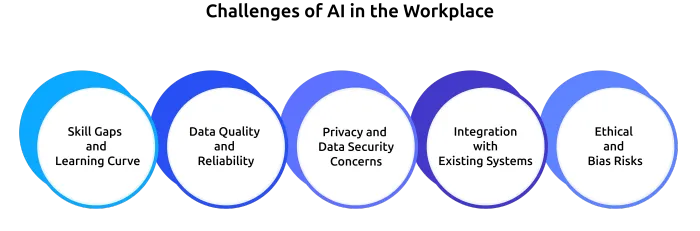
AI can boost efficiency and improve decision-making, but implementing it comes with real challenges that can affect outcomes if not managed carefully. You need to Understanding the pros and cons of AI helps set realistic expectations and apply AI in a responsible, effective way.
1. Skill Gaps and Learning Curve
AI adoption often demands new skills that your teams may not already have. Training takes time, and adjusting to new tools can slow work in the early stages. Without adequate training and guidance, it can take longer for your team to achieve noticeable productivity improvements.
2. Data Quality and Reliability
AI systems depend heavily on accurate and well-structured data. Poor data quality can lead to incorrect insights and unreliable outcomes. Maintaining clean and consistent data becomes an ongoing responsibility, supported by secure enterprise AI governance practices.
3. Privacy and Data Security Concerns
Workplace AI often processes sensitive employee and business information. Poor controls could increase the risks of data misuse or unauthorised access. Strong security practices are essential to maintain trust and compliance. Organizations looking to address this at scale are increasingly turning to private AI for enterprise solutions that keep data within controlled environments.
4. Integration with Existing Systems
Introducing AI into established workflows is not always seamless. Incompatibility with existing tools may cause delays and extra expenses. Careful planning and step-by-step rollout reduce disruption and make adoption smoother.
5. Ethical and Bias Risks
AI models can reflect biases present in training data. This may affect hiring, evaluations, or decision-making if not monitored carefully. Regular audits and transparent usage help reduce these risks.
Finding it hard to turn AI insights into real workplace action?
Use Time Champ to connect AI insights with real work patterns and make clearer decisions.
How to Use AI Effectively in the Workplace?
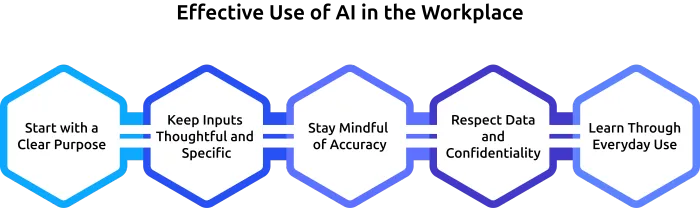
AI delivers the most value when you use it with clear intent and structure. A clear approach helps you apply AI where it truly supports decision-making, efficiency, and everyday execution. The following best practices show how to use AI in a way that strengthens outcomes without adding complexity.
1. Start with a Clear Purpose
Begin by defining what needs improvement, such as reducing repetitive work, analyzing data, or drafting content. A clear purpose helps AI deliver relevant and reliable outcomes. Without direction, results often lack focus and consistency.
2. Keep Inputs Thoughtful and Specific
The quality of output depends on the quality of input. Clear instructions, relevant context, and defined expectations help AI deliver useful results. Vague requests usually lead to generic answers that don’t add real value.
3. Stay Mindful of Accuracy
AI accelerates work, but it’s not always right. Any results from AI, whether for reports, decisions, or communications, need thorough checking to avoid errors and misinformed actions. Treat AI-generated content as a starting point, not a final decision.
4. Respect Data and Confidentiality
Use AI tools responsibly by sharing only approved and appropriate information. Protecting sensitive business data and internal knowledge reduces risk and ensures compliance. Clear usage boundaries help maintain trust and data integrity.
5. Learn Through Everyday Use
Your teams don’t need advanced training to get value from AI. With regular, practical use, it becomes easier to see where AI supports everyday tasks and where human judgment still matters. Over time, this hands-on use helps teams use AI more intentionally and efficiently within their workflow.
How Time Champ Supports Smarter AI Use at Work?
AI delivers real value when you can act on insights showing how employees spend time, how tasks progress, and where they waste effort. The majority of organizations already possess an abundance of data, and the actual challenge is how that data relates to the daily work and decision-making. Without this clarity, AI outputs remain interesting on paper but difficult to apply in practice.
Time Champ addresses this gap by acting as a workforce intelligence platform that turns daily work activity into clear, usable insight. You can track how employees spend time, how attendance affects output, how tasks move forward, and where work slows down in real time. This gives you a realistic view of how work actually flows across teams, not just how it looks on reports.
With this visibility, AI-driven insights become practical and relevant. You can plan work more effectively, distribute workloads fairly, and spot early signs of burnout or attrition risk before they escalate. This makes AI insights practical, helping you assign work fairly and make decisions based on actual work patterns.
Conclusion
AI in the workplace delivers real value when it supports how work actually happens, not assumptions. When you use AI with clear intent and reliable data, it helps you work more efficiently, make better decisions, and stay focused on what matters most. The strongest impact comes from using AI with purpose, where it brings clarity, reduces friction, and helps teams do their best work.
Ready to make decisions based on how work actually happens?
Try Time Champ, an AI-driven workforce intelligence platform built to turn real work data into clear, confident decisions.

Thasleem Shaik

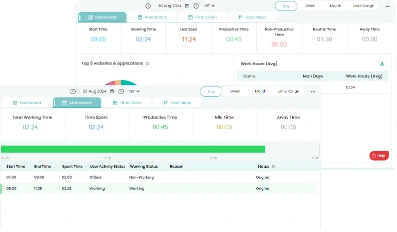
Table of Content
-
 Why Is AI Rising in the Workplace?
-
What Are the Examples of AI in the Workplace?
-
What Are the Benefits of AI in the Workplace?
-
What Are the Challenges of AI in the Workplace?
-
How to Use AI Effectively in the Workplace?
-
How Time Champ Supports Smarter AI Use at Work?
-
Conclusion
Related Blogs
Uncover the chaos of a day without time tracking. Explore how managers struggle with productivity, accountability, and team coordination in this insightful read.
Jahnavi Pulluri | October 25 2024
Learn about employee privacy rights, how to protect personal information, and balance company needs with privacy laws.
Jahnavi Pulluri | September 18 2024
Struggling to improve your remote workplace? Uncover six powerful strategies to boost productivity, enhance collaboration, and keep your team engaged!
Tarun Kumar | March 14 2025
Learn how workplace discipline shapes career growth, enhances job performance, and builds a culture of responsibility and excellence in the workplace.
Jahnavi Pulluri | February 23 2024
Organize your workplace with these best productive tips. Boost efficiency, reduce clutter, and optimize your work environment today!
Sai Keerthi Uppala | February 22 2025
Boost your workforce productivity with a data-driven approach of workplace analysis. Learn how the Time Champ software helps your company.
Mounika Sai | July 25 2023


 4.7/5 avg.
Ready to Manage Your Workforce Smarter?
Join our family of 1500+ companies using smart insights to redefine workforces!

Free Trial
No Credit Card Required