Measuring Employee Productivity: A Complete Guide
Want to simplify measuring employee productivity? Explore common challenges and effective approaches to improve team performance.
Being busy doesn't always mean being productive. Your employees may spend the entire day in meetings, responding to emails, and switching between tasks, but without clear productivity metrics, it's difficult to know what was truly achieved. That's why measuring employee productivity is essential.
If you're wondering how to measure employee productivity, this guide explains the process, why it matters, the best ways to measure it, common challenges, and the tools that can simplify the process.
What Is Employee Productivity Measurement?
Employee productivity measurement is the process of evaluating how effectively employees use their time, skills, and resources to produce meaningful results. It helps you understand whether work is contributing to business goals by measuring both the quantity and quality of output.
Measure employee productivity by comparing the results employees deliver against the time, effort, or resources they invest. Depending on the role, these results may include completed projects, sales, customer satisfaction, or task completion.
Measuring productivity consistently helps you assess performance objectively, identify improvement opportunities, and make informed decisions to improve individual and team performance.

Did You Know?
Gartner analysis of more than 100 work attributes revealed that a supportive team culture has the greatest positive impact on the productivity of both hybrid and onsite employees, increasing employee productivity by up to 11%.
Why Is Measuring Employee Productivity Important?
Measuring employee productivity gives you a clear understanding of how work is being done and where improvements are needed. It helps you make better decisions based on performance rather than assumptions.
- Improves Performance: Identifies what's working well and where employees may need additional support or training.
- Supports Fair Evaluations: Uses measurable data to make performance reviews, promotions, and rewards more objective.
- Optimizes Resource Allocation: Helps you distribute workloads, budget, and resources more effectively.
- Identifies Workflow Bottlenecks: Reveals delays, repetitive tasks, and inefficient processes that reduce productivity.
- Prevents Employee Burnout: Highlights signs of excessive workloads so you can take action before productivity declines.
- Enhances Team Productivity: Shows how individuals and teams perform, making it easier to improve collaboration and efficiency.
- Enables Data-driven Decisions: Provides reliable insights for hiring, workforce planning, and business growth.
- Measures the Impact of Improvements: Helps you evaluate whether new processes, tools, or strategies are actually increasing productivity.
Don't let productivity challenges go unnoticed.
See how Time Champ helps you measure performance, improve efficiency, and support your team with actionable insights.
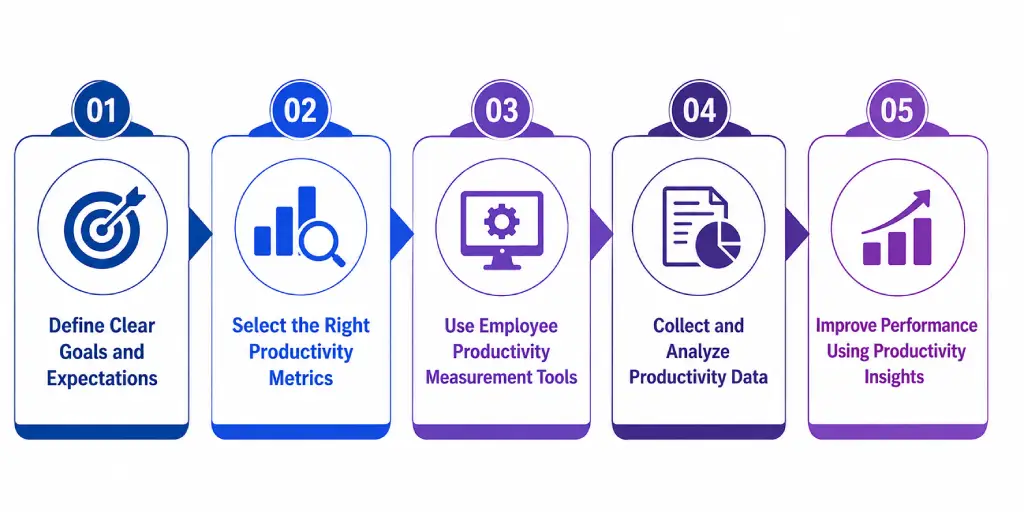
Measuring employee productivity becomes much easier when you follow a clear process. Follow these five steps to measure employee productivity accurately and make better performance decisions.
Step 1: Define Clear Goals and Expectations
Start by defining what drives productivity for each role. A salesperson's goals will differ from those of a software developer or customer support representative. Set clear, measurable expectations so employees know what they're working toward and how their success will be evaluated. Well-defined goals also make productivity measurement more consistent and objective.
Step 2: Select the Right Productivity Metrics
Choose metrics that align with each employee's responsibilities instead of using the same measurements across every role. For example, sales teams can be measured by revenue generated, while support teams may focus on ticket resolution time and customer satisfaction. Using a combination of quality, output, and efficiency metrics provides a more balanced view of productivity.
Step 3: Use Employee Productivity Measurement Tools
Manual tracking is time-consuming and often inaccurate. Employee productivity measurement tools automatically capture work hours, task progress, application usage, project updates, and other productivity data. This gives you reliable insights while reducing the administrative effort of manual data collection.
Step 4: Collect and Analyze Productivity Data
Gather productivity data regularly and look for patterns instead of judging performance based on a single day or week. Compare current results with past performance, team benchmarks, and business goals to identify trends, bottlenecks, or areas that need attention. Reviewing data over time leads to more accurate and meaningful insights.
Step 5: Improve Performance Using Productivity Insights
The purpose of measuring productivity is to help employees succeed. Use the insights you gather to remove obstacles, balance workloads, provide coaching, and improve workflows. Review your productivity metrics periodically to make sure they continue to reflect business goals and the changing needs of your team.
Which Employee Productivity Measurement Approach Is Right for Your Team?
There's no single approach that works for every team. The right method depends on the nature of the work, your business goals, and the metrics that best reflect success. The table below compares the four common approaches to help you choose the one that fits your team's needs.
Quantitative (Output-Based) Measurement
Quantitative measurement focuses on the amount of work employees complete over a specific period. It compares output, such as units produced, sales closed, or support tickets resolved, against the time or resources used to achieve those results.
Best for:
Manufacturing, sales, customer support, and other output-driven roles.
Limitation:
This approach measures quantity but doesn't always reflect the quality of work.
Objective-Based (Goal-Oriented) Measurement
This approach measures productivity based on how well employees achieve predefined goals or key performance indicators (KPIs). It focuses on results rather than the amount of work completed.
Common frameworks include SMART goals, OKRs (Objectives and Key Results), and MBO (Management by Objectives
Best for:
Project teams, knowledge workers, managers, and leadership roles.
Limitation:
Productivity depends on how realistic and well-defined the goals are.
Task-Based Measurement
Task-based measurement evaluates productivity by tracking the number of tasks, assignments, or deliverables employees complete within a given timeframe. It also considers factors like on-time completion and work quality.
Best for:
Developers, designers, project managers, operations teams, and other task-driven roles.
Limitation:
All tasks don't require the same level of effort, so task count alone may not accurately reflect productivity.
Outcome-Based Measurement
Outcome-based measurement focuses on the impact employees create rather than the amount of work they perform. It evaluates whether their work contributes to business objectives, customer satisfaction, revenue growth, or other meaningful outcomes.
Best for:
Leadership, strategic roles, customer-facing teams, and senior professionals.
Limitation:
Business outcomes are often influenced by multiple factors, making it difficult to measure an individual's contribution alone.
steps to measure employee productivity
Measure employee performance and productivity more accurately with Time Champ!
Common Challenges in Measuring Employee Productivity
Measuring employee productivity isn't as simple as counting hours or completing tasks. Here are some of the most common challenges and how they impact productivity measurement.
Measuring Productivity in Remote and Hybrid Teams
When employees work remotely or follow hybrid schedules, it's harder to judge productivity based on visibility or office presence. Instead, focus on measurable outcomes such as completed tasks, project progress, and goal achievement to evaluate performance fairly.
Balancing Productivity and Quality
Finishing more tasks doesn't always mean employees are more productive. If work is rushed or contains mistakes, overall productivity can suffer. That's why it's important to measure both the amount of work completed and the quality of the results.
Managing Too Much Productivity Data
Productivity tools can generate more data than you actually need. When you try to track everything, it's easy to lose focus on the metrics that truly matter. Instead, prioritize a few key productivity metrics that align with your business goals and use them to guide your decisions.
Avoiding Employee Surveillance Concerns
Employees are more likely to accept productivity measurement when they understand its purpose. Be clear about what you're measuring and explain how the data will be used. The goal should be to improve workflows and support employees, not to watch their every move.
Choosing the Right Metrics for Different Roles
One of the biggest challenges is deciding which metrics truly reflect productivity. Productivity metrics should evolve as your business and teams change. Metrics that were useful a year ago may no longer reflect how work gets done today. Reviewing and updating them regularly helps you measure productivity more accurately.
How Time Champ Simplifies Employee Productivity Measurement
Measuring employee productivity becomes much easier when you have the right data in one place. Instead of relying on manual tracking, you need a solution that gives you a complete view of how work is being done. Time Champ is built exactly to do that.
Time Champ is an employee monitoring and productivity tracking software that automates time tracking, analyzes work patterns, and provides real-time productivity insights. It combines work hours, task progress, application usage, and performance analytics in one platform, giving you the insights you need to measure productivity accurately.
- Automatic Time Tracking: Records work hours automatically, eliminating manual timesheets and giving you an accurate view of how time is spent.
- Project & Task Tracking: Tracks task progress, project time, and completion status, making it easier to measure productivity against assigned work.
- Productivity Analytics: Classifies work activities into productive, neutral, and unproductive categories, helping you understand how employees spend their workday.
- Application and Website Usage: Shows which applications and websites employees use during work hours, helping you identify productive work patterns and potential distractions.
- Real-Time Dashboards & Reports: Provides live productivity reports, trends, and performance summaries for individuals and teams, making it easy to monitor progress over time.
- Idle Time Detection: Identifies periods of inactivity so you can distinguish active work time from idle time and improve productivity analysis.
- Attendance & Work Hours Tracking: Tracks attendance, working hours, overtime, and break time, giving you a complete picture of employee availability and work patterns.
Ready to measure employee productivity effectively?
Start your free trial today and see how Time Champ helps you measure employee productivity accurately!
Measuring employee productivity isn't about tracking every minute of the workday. It's about understanding how work contributes to your business goals and using that insight to help employees perform at their best. When you set clear expectations, choose the right metrics, and use the right measurement approach, you gain a more accurate picture of individual and team performance.
The right employee productivity tracking software, like Time Champ, makes measuring productivity simple and accurate. Try now!

Guna Lakshmi

Table of Content
 What Is Employee Productivity Measurement?
- Why Is Measuring Employee Productivity Important?
- Which Employee Productivity Measurement Approach Is Right for Your Team?
- Common Challenges in Measuring Employee Productivity
- How Time Champ Simplifies Employee Productivity Measurement
Related Blogs

Quick answers to the questions people ask most
Guna Lakshmi | Frequently Asked Questions
Explore the productivity effects of hybrid work and discover how it can improve focus, employee engagement, retention, and overall team performance.
Guna Lakshmi | Jul 01, 2026

Struggling to stay productive? Discover 25 daily routines and habits that can improve focus, reduce distractions, and boost your productivity.
Guna Lakshmi | Jun 27, 2026
Discover 7 hidden workday productivity insights that reveal how your team spends time and improve performance using real productivity data.
Guna Lakshmi | May 12, 2026


 4.7/5 avg.
Ready to Manage Your Workforce Smarter?
Join our family of 1500+ companies using smart insights to redefine workforces!

Free Trial
No Credit Card Required