Time Champ > Blog > How to Manage AI in the Workforce Effectively in 2026 > Content
How to Manage AI in the Workforce Effectively in 2026
Learn what AI in the workforce is, why it matters, and how to manage it effectively. Also, explore its pros and cons to strengthen productivity and performance.
Managing AI in the workplace is a prominent approach that helps you establish trust, transparency, and quantifiable influence within groups and technologies. In fact, 78% of businesses are currently applying AI in at least one of their business operations, which highlights the importance of AI in modern business operations. It offers you real-time performance insights, predictive analytics, and intelligent task management for measuring productivity in real-time.
The next generation of workforce relies on intelligent systems, automation tools and analytics to improve planning and efficiency. Knowing how to integrate AI into your workforce correctly will help you to prevent ethical concerns, employee burnout, and misunderstandings. With accurate AI insights, you can get greater engagement, increased productivity, and sustainable competitive advantage. In this blog, you will find out the necessary elements, issues, strategies, and technologies that will enable you to handle AI in your workforce in 2026.
What is AI in the Workforce?
AI in the workforce means the utilization of artificial intelligence to facilitate, assist, or fully automate tasks, decision-making, performance management, and workforce management. It facilitates more intelligent, rapid and scalable human-AI cooperation by ensuring human oversight across the process.
AI was first introduced in workforce management to automate routine tasks and general scheduling processes. Later, analytics-driven AI has emerged to generate reports and forecasts out of historical information. Operational intelligence proposes AI in the workforce to give teams a real-time understanding of the workflows, performance trends, and bottlenecks. This evolution made AI a reliable business partner that offers practical information regarding performance, utilization, and productivity.
Automation and real-time insights enable teams to work more efficiently and make data-driven decisions that enhance productivity with the help of AI. AI is required for remote and hybrid working trends to effectively evaluate productivity without losing employee autonomy. It focuses more on visibility than continuous monitoring to promote accuracy and operational clarity in dealing with workforces.
Curious how AI can augment your team?
Explore how Time Champ leverages AI insights to enhance productivity.
Why is AI in the Workforce Important?
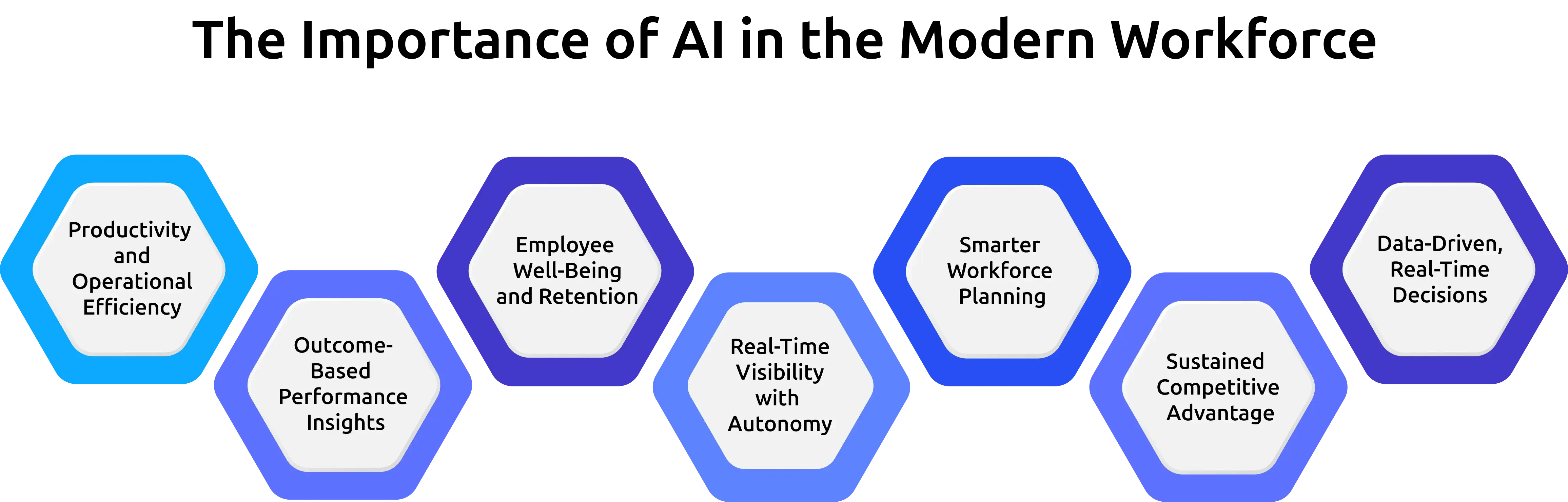
With work going digital and distributed, managing your workforce without AI gives you blind spots and missed opportunities. In fact, 91% of employees report their organizations use at least one type of AI in the workplace, demonstrating the significance of AI in workforce management. You need the appropriate strategy, governance and purpose to actually create operational value from AI.
Productivity, Speed, and Operational Efficiency
AI helps you transform raw work signals into insights that help you increase productivity. Using AI insights, you can observe the time spent, bottlenecks created, and processes that require optimization. This clarity helps you to manage workloads, remove workflow friction and enhance operational efficiency.
Outcome-Based AI Performance Measurement
Efficient AI workforce management enables you to replace tracking activities with performance-based results. Knowing focus time, patterns of utilization and performance trends gives you a clearer picture of employee performance. This will lead to fair and confident decisions to improve your team's performance.
Employee Experience and Retention
The responsible use of AI can help you strengthen workforce management by ensuring the well-being of employees and maintaining sustainable performance. Early detection of burnout or disengagement results helps you in preventing the attrition risk and building a more engaged and resilient workforce.
Real-Time Visibility Without Micromanagement
AI keeps you updated without overseeing your workforce. You can view work progress, collaboration patterns and real-time performance, which can be used to control the outcomes. It enhances trust, facilitates autonomy and better management of the workforce, particularly in remote and hybrid locations.
Smarter Planning and Resource Allocation
You can plan your workforce more accurately and confidentially with the help of AI-driven insights. You can know accurate capacity, demand and performance trends in advance, which helps assign work more efficiently. The result is an improved workforce management decision, reduced inefficiency and an easier execution across projects and teams.
Long-Term Competitive Advantage
Strategic management of AI provides a clear advantage in influencing business performance. You can take quicker and smarter decisions to react to changes quickly and guide your teams confidently in challenging times. A well-structured AI-based workforce management helps you maximize performance, remove inefficiency, and gain a competitive advantage that increases with your organizational changes.
Better Decision-Making with Real-Time AI Insights
AI allows you to make timely and superior decisions. By having real-time insights into utilization, performance trends and emerging risks, you can take action before the problems transform into bigger ones. This will allow more assured leadership, continuous improvement, and better alignment of workforce performance to business objectives.
How to Manage AI in the Workforce
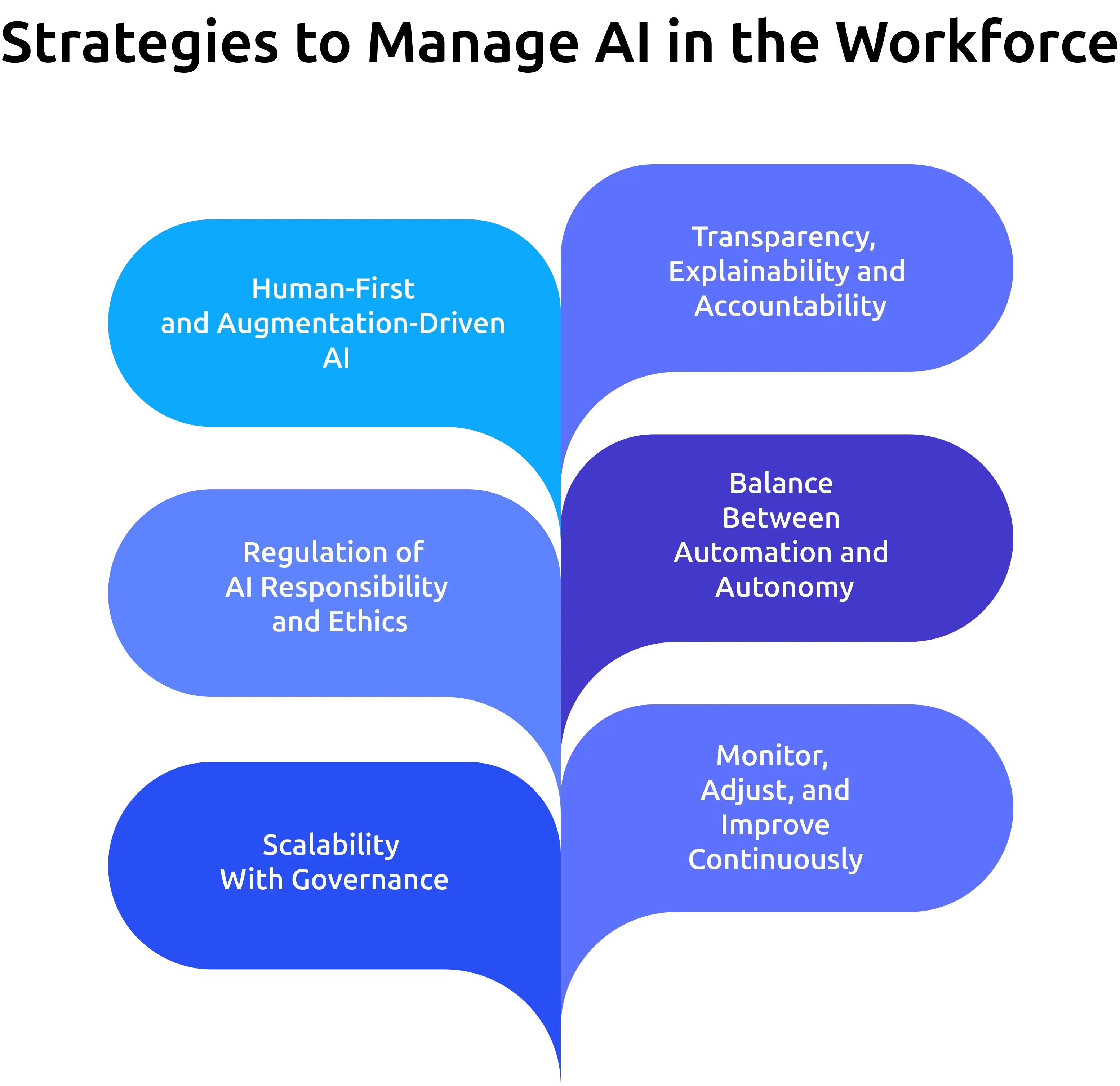
An effective AI workforce management follows clear policies that focus on ethics, outcomes, and employee privacy. Here are some of the fundamental principles that can guide you to manage AI in the workforce.
Human-First and Augmentation-Driven AI
Use AI to augment your teams and not replace them. Automate processes, minimize workload, and boost productivity, but make sure that humans are still involved in decision-making. Develop mechanisms in which AI insights can assist human judgment, which will enable you to enhance the operational performance and empower employees.
Transparency, Explainability and Accountability
Be honest with your teams on the type of data collected, why and how it will be used. Create transparent dashboards and reports with AI insights in a simple and easy-to-understand format for your teams. By this, you can develop a sense of trust and confidence in AI systems and make your workforce feel involved, safe, and willing to take action based on AI-driven insights.
Regulation of AI Responsibility and Ethics
Establish transparent guidelines that entail the use of AI, data gathering, and access to it. Check adherence to these policies on a regular basis to prevent abuse and ethical pitfalls. Ensure your AI management plan emphasizes visibility, which will help you to protect your business and employees without losing responsibility.
Balance Between Automation and Autonomy
Make decisions on what to automate and what to stay under human control. Reduce work redundancy and reveal features of action by maintaining autonomy. Ensure that your teams understand the value of AI, which will help them to generate productivity and business development.
Scalability With Governance
Build AI systems that are scalable along with your business. Adopt role-based access, standardized measures and flexible governance systems that work across teams, locations, and work models. Scalable systems ensure that as you scale or embrace new working models, AI will still present actionable, similar and reliable insights.
Monitor, Adjust, and Improve Continuously
Regularly monitor the performance and the results of AI. Monitor the utilization of insights, evaluate employee feedback and modify governance rules where necessary. Real-time monitoring ensures that AI is aligned with your business goals, enhances the efficiency of your staff and expands alongside your teams.
Want to implement human-first AI responsibly?
See how Time Champ balances automation and autonomy
What are the Pros & Cons of AI in the Workforce?
| Pros | Cons |
|---|---|
| Ensured workforce productivity. | Employees' fear of job displacement. |
| Quick and fact-based decision making. | Employees' fear of job displacement. |
| Expandable operations without new staff. | Ethical issues and data privacy. |
| Better workload and employee health | Absence of a clear decision-making process by AI. |
| More effective remote and hybrid team management. | Skill gaps and training needs of AI. |
| Lowered operational expenses in the long term. | Over-reliance on automation. |
Ready to future-proof your workforce with AI?
Get started with Time Champ for AI-powered workforce intelligence.
Conclusion
Managing AI in your workforce is concerned with having a clear understanding of how work happens and how teams scale. Make sure you use the insights from this blog, as they are going to help you understand why AI workforce management is important, the value it brings, and the issues you need to overcome for developing trust and consistency. With a human-centered model and proper governance, AI helps you increase productivity without interfering with autonomy and employee experience. Clear AI governance in the workforce enables you to increase productivity, reduce friction, enhance decision-making and encourage trust among the teams. With proper management, AI can be a stable force for operational clarity and a robust platform to create resilient and future-oriented teams.

Shabana Shaik

Table of Content
-
 What is AI in the Workforce?
-
Why is AI in the Workforce Important?
-
How to Manage AI in the Workforce
-
What are the Pros & Cons of AI in the Workforce?
-
Conclusion
Related Blogs
Discover the secrets of a remote workforce management with maximum efficiency. Our expert guide offers proven strategies to boost productivity and success.
Mounika Sai | June 6 2023
Discover workforce productivity analytics in 2025: what it is, why it matters, key metrics, benefits, and how AI enhances workforce performance
Thasleem Shaik | September 25 2025
Get insights for workforce tracking: Meaning, importance, methods, how to implement it, benefits, challenges, and FAQs to support better team productivity.
Thasleem Shaik | September 25 2025
Explore the future of remote work, including emerging trends, technological advancements, and key challenges shaping the workforce.
Thasleem Shaik | May 30 2023
Workforce management software is a set of tools and processes designed to improve employee productivity in a business.
Mounika Sai | January 8 2024
Learn what workforce efficiency means in 2025, why it matters, key factors, how to measure, tips to improve, and what a good workforce efficiency rate is.
Guna Lakshmi | September 15 2025


 4.7/5 avg.
Ready to Manage Your Workforce Smarter?
Join our family of 1500+ companies using smart insights to redefine workforces!

Free Trial
No Credit Card Required