40+ Hybrid Work Statistics and Trends in 2026
Hybrid work statistics highlighting employee preferences, productivity, workplace flexibility, and business performance across modern organizations.

Hybrid work is no longer an experiment. For many organizations, it has become the default way of working.
But as workplace expectations continue to shift, it can be difficult to separate assumptions from reality. Is hybrid work actually improving productivity? Are employees still asking for flexibility? How are return-to-office policies changing workplace decisions?
The answers are constantly evolving, and so is the data behind them.
That is why keeping up with the latest hybrid work statistics matters. The right insights can help you understand workplace trends, evaluate the impact of hybrid work and productivity, and see how organizations are adapting to new ways of working.
In this guide, we have gathered the latest hybrid work statistics from trusted research and industry reports covering adoption, productivity, engagement, retention, workplace flexibility, return-to-office trends, and the key shifts shaping today's workplace.
Let's dive into the numbers and see what they reveal about the future of flexible work.
Key Hybrid Work Statistics at a Glance
- 53% of remote-capable U.S. workers follow a hybrid schedule in 2026, making it the dominant work model.
- 90% of hybrid workers say they are just as productive or more productive than when fully in-office.
- 55% of job seekers rank a hybrid schedule as their top preference when evaluating new roles.
- 29% of hybrid and remote workers say they would consider leaving if required to return to the office full-time.
- Stanford research found that hybrid work reduces employee resignations by 33%.
- 76% of employees cite better work-life balance as a primary benefit of hybrid work. (Gallup)
- Office attendance remains roughly 50% of pre-pandemic levels despite widespread RTO pressure.
- Organizations save an average of $10,000 per employee annually on real estate costs through hybrid models.
- The global hybrid workplace market is projected to grow from $6.47 billion in 2025 to $22.83 billion by 2034.
Want better visibility into your hybrid team's productivity and work patterns?
Use Time Champ to track performance, attendance, and team activity.
Hybrid Work Adoption Statistics
Hybrid work has become the standard for many remote-capable employees. The latest data shows how widely employees and organizations have adopted it and why it remains the preferred work model for both employees and organizations.
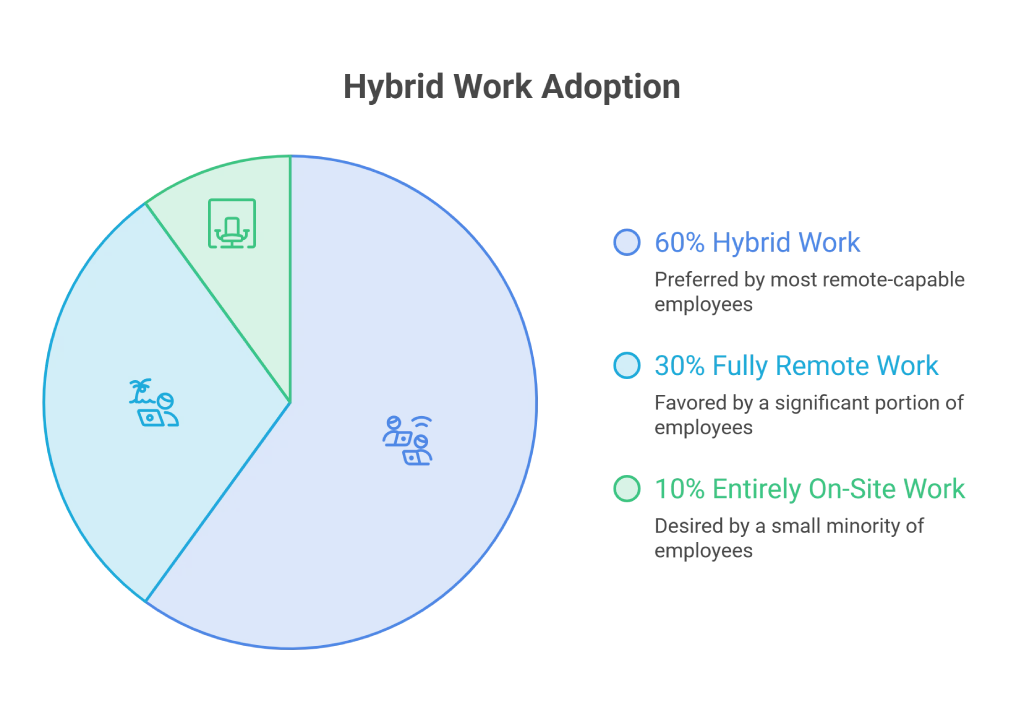
- Six in 10 employees with remote-capable jobs prefer a hybrid work arrangement. About one-third favor fully remote work, while fewer than 10% want to work entirely on-site.
- 64% of business leaders say their companies currently use a hybrid work model, with larger organizations being more likely to adopt flexible work arrangements.
- Over half of U.S. workplaces continue to operate with a hybrid model. The workplace has largely settled into a long-term balance between office and remote work.
- Robert Half surveyed more than 500 HR managers in the United States and found that 88% of employers offer some form of hybrid work.
- A recent survey found that 74% of U.S. companies either already use a permanent hybrid work model or plan to adopt one in the future.
- 63% of high-growth companies have adopted hybrid work models. This suggests that many fast-growing organizations see hybrid work as a way to support flexibility while driving productivity and growth.
Hybrid vs Remote vs In-Office Split
As workplace flexibility continues to evolve, hybrid work remains the dominant arrangement across modern workplaces. To better understand how employees are splitting their time between different work models, let's look at the latest data comparing hybrid vs remote and in-office work arrangements.
- According to Flex Index, the following workplace flexibility trends are observed among U.S. companies:
- 66% of U.S. companies offer some form of location flexibility.
- 34% of U.S. companies require employees to work full-time from the office.
- 71% of Fortune 100 companies continue to offer flexible work arrangements.
- The most common workplace policy among companies is a 3-day hybrid schedule, adopted by 35% of firms.
- 29% of Fortune 100 companies require employees to work from the office full-time.
- 45% of Fortune 100 companies require employees to be in the office 4 or 5 days per week.
- 29% of Fortune 100 companies still support either fully remote or hybrid work models.
- Nearly 80% of employees who can work remotely now choose either hybrid work (52%) or fully remote work (26%).
Hybrid Work Productivity Statistics
One of the biggest questions surrounding flexible work is whether it actually improves productivity. The following hybrid work productivity statistics highlight how workplace flexibility is influencing performance, focus, and overall output.
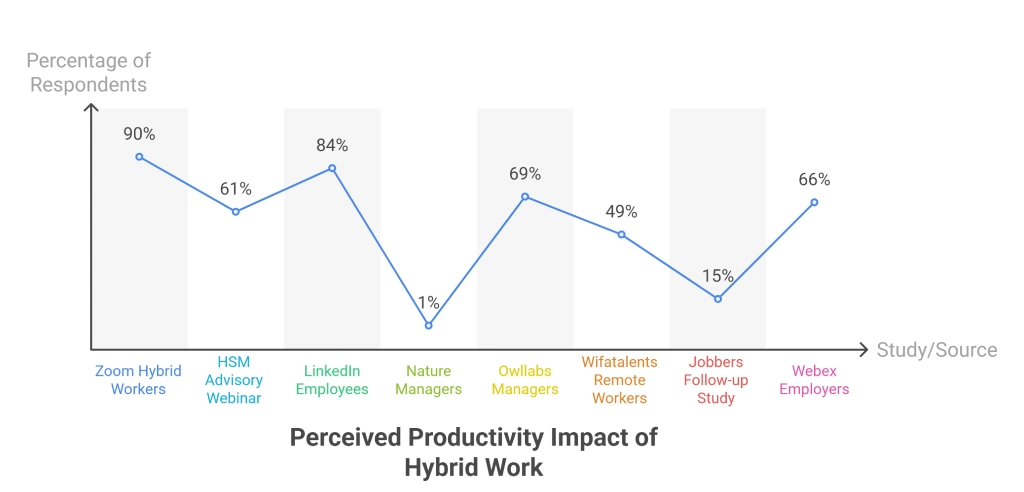
- 90% of hybrid workers say they are just as productive or more productive compared to being fully in-office.
- A poll conducted among attendees of HSM Advisory’s Redefining Productivity webinar found that 61% agreed that hybrid work has positively impacted productivity.
- 84% of employees say they are more productive when working remotely or in a hybrid setup than when working entirely from the office.
- A study published in the journal Nature found that the 395 managers who took part in a hybrid work experiment changed their perception of hybrid work’s impact on productivity, from a negative view (-2.6%) to a positive one (+1%).
- 69% of managers believe that hybrid or remote work has increased their team's productivity.
- 49% of remote workers say they are more productive when working from home than when working in a traditional office.
- A follow-up study found that fully remote workers were about 10 to 20% less productive in certain collaborative tasks than hybrid workers, indicating that a hybrid approach may offer a better balance between remote and in-office work.
- According to Webex research, 66% of employers worldwide say that hybrid work has improved employee productivity.
Finding it difficult to measure productivity in a hybrid workplace?
Try Time Champ to track productivity and improve team performance.
Employee Preference Statistics for Hybrid Work
Employee expectations have changed significantly in recent years. The following statistics show what employees value most and why flexibility continues to influence workplace decisions.
- According to Owl Labs, approximately 83% consider flexible hours important, 82% value flexible workdays, and 79% prioritize the ability to work from different locations.
- Research indicates that 55% of job seekers rank a hybrid schedule as their top preference.
- SWAA survey led by Bloom, Barrero, and Davis found that the average employee values the ability to work from home two to three days per week at approximately 8% of their salary.
- Over half of full-time, in-person employees (55%) say they would accept a pay cut for permanent remote or hybrid work. On average, they would take an 11% salary reduction to make that switch.
- 42% of professionals say that having a hybrid work arrangement, whether flexible or fixed, would be a top consideration when choosing a new job.
Return-to-Office Pushback and Retention Risk
Many organizations are asking employees to spend more time in the office. These statistics reveal how return-to-office policies can affect retention, trust, and workplace satisfaction.
- SurveyMonkey’s 2026 workforce research found that 29% of remote and hybrid workers would consider leaving their jobs if they were required to return to the office full-time.
- In fact, 77% of workers believe that return-to-office (RTO) policies come from a lack of trust rather than genuine business needs. Additionally, 81% of employers acknowledge that trust concerns play a role in these decisions.
- 65% of organizations require employees to work from the office for a minimum number of days each week or month. Additionally, 14% of employers that offer a hybrid work plan to introduce or increase the number of mandatory in-office days over the next 12 months.
- BambooHR Study on
Return-to-Office (RTO) sentiment:
- 32% of managers said the main goal of RTO policies was to track employees.
- 25% of VP and C-suite executives admitted they hoped for some voluntary turnover during an RTO.
- 18% of HR professionals admitted they expected return-to-office mandates could lead to increased employee attrition.
- 88% of remote employees feel the need to prove they are online and working.
- 79% of in-office employees reported feeling pressure to demonstrate their productivity and contribution throughout the workday.
- Kastle Systems Back to Work Barometer shows that average office occupancy across U.S. markets is approximately 50% of pre-pandemic levels. Despite return-to-office mandates from major companies, office attendance remains around 50%, indicating many employees continue to work in flexible arrangements.
- About 25% of paid workdays in the US were work-from-home days in January 2026, compared to less than 5% before COVID. Although remote work peaked during lockdowns, it remained much higher than pre-pandemic levels after offices reopened.
- 76% of employees reported that they would consider searching for a new job if remote work options were removed due to return-to-office requirements.
- Recent workforce research shows that 61% of U.S. companies have implemented formal return-to-office (RTO) policies.
- A recent study found that 73% of employees say they need a compelling reason to come into the office, rather than returning simply because their employer requires it.
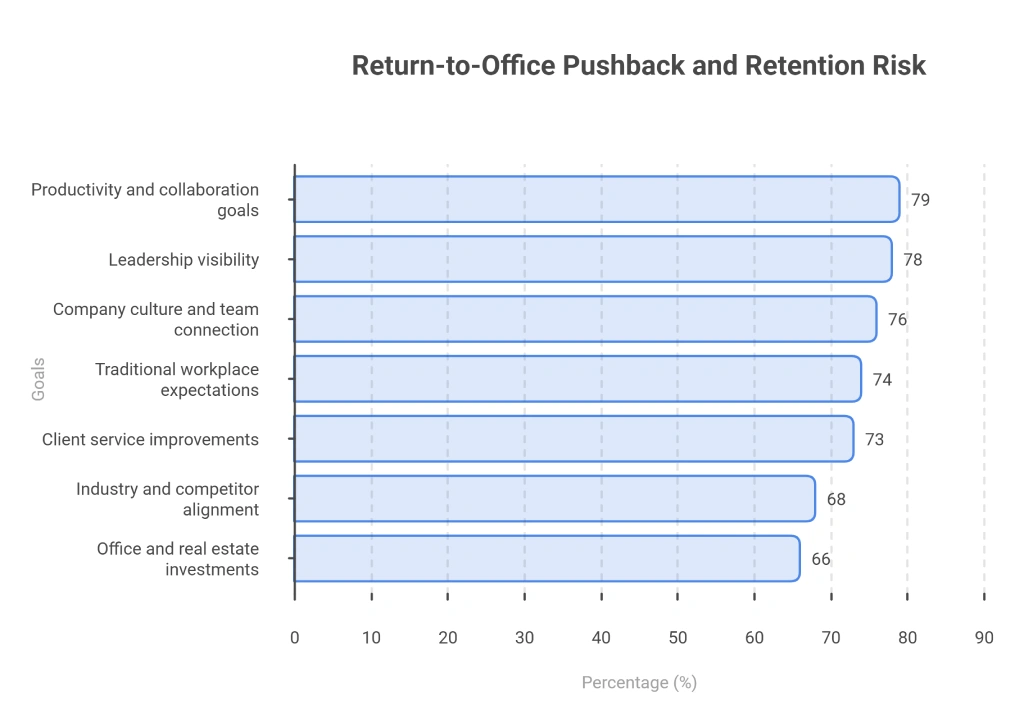
- The top reasons workers think organizations are enforcing return-to-office policies, according to Owl Labs:
- Productivity and collaboration goals (79%)
- Leadership visibility (78%)
- Company culture and team connection (76%)
- Traditional workplace expectations (74%)
- Client service improvements (73%)
- Industry and competitor alignment (68%)
- Office and real estate investments (66%)
Real Estate and Cost Savings
Hybrid work can influence more than employee flexibility. Here are key statistics on office space, operating costs, and workplace expenses.
- Approximately half of the organizations have reduced their office space over the past five years.
- Organizations can save an average of $10,000 per employee annually on real estate costs when employees work in hybrid environments.
- Cost savings make telecommuting a major benefit for nearly six out of ten employers.
- Hybrid employees typically save between $4,500 and $6,000 per year by reducing expenses related to commuting, work attire, and daily meals.
- IBM reduced its real estate footprint by 78 million square feet as a result of implementing hybrid work strategies.
- Sun Microsystems reduces its annual real estate expenses by approximately $68 million.
Hiring, Retention, and the Competitive Advantage
Workplace flexibility has become an important factor in attracting and retaining talent. These statistics show how hybrid work can influence hiring outcomes and long-term retention.
- A Stanford University study found that hybrid work reduced employee resignations by 33%.
- According to FlexJobs, 81% of professionals say flexible work options would make them more loyal to their employer.
- Only 11% of postings are remote, but 55% of candidates prefer hybrid or remote options. The companies offering flexibility have a massive candidate pool advantage.
- Companies that provide flexible work options experience 76% higher employee retention and 78% greater engagement.
- Remote recruitment expands candidate pools by 340%, shortens hiring timelines by 16%, and increases offer acceptance rates by 13%.
| Metric | Remote Hiring | On-site Hiring | Difference |
|---|---|---|---|
| Time-to-hire | 32 days | 38 days | -16% |
| Cost per hire | $3,800 | $4,200 | -10% |
| Candidate pool size | 340% larger | Baseline | +340% |
| Offer acceptance rate | 78% | 69% | +13% |
| Quality of hire score | 4.1/5 | 3.8/5 | +8% |
| Preference Factor | Priority Ranking | Willing to Change Jobs | Salary Trade-off |
|---|---|---|---|
| Full Remote Option | 1st | 87% | Up to 11% |
| Flexible Hours | 2nd | 79% | Up to 12% |
| Hybrid Schedule | 3rd | 72% | Up to 8% |
| Work-Life Balance | 4th | 68% | Up to 10% |
Source: Second Talent
- Findings indicate that 71% of businesses believe flexible work arrangements help them access a broader and more diverse talent pool. 77% of organizations are implementing flexible work policies as a strategy to improve employee retention and keep top talent engaged.
- 69% of employers reported improved retention after adopting a hybrid policy.
- According to an Owl Labs survey, eliminating hybrid or remote work would have a significant impact on employee retention. About 40% of workers said they would begin looking for a new job, 22% would expect a salary increase as compensation, and 5% reported they would resign immediately.
- 42% of organizations that enforced return-to-office mandates reported elevated employee turnover, while 29% said they are facing increased hiring challenges.
- According to business leaders, the most effective ways to improve employee retention are offering flexible working hours (67%) and providing remote work opportunities (58%).
Burnout and Well-Being in Hybrid Work
Flexible work arrangements can affect both employee well-being and workplace experiences. The insights below highlight how hybrid work is shaping stress levels, engagement, and work-life balance.
- Gallup found that 76% of respondents identified a better work-life balance as one of the primary benefits of hybrid work.
- Fully remote workers have the highest engagement rate at 31%, compared to 23% for both hybrid employees and on-site workers in remote-capable roles. On-site employees in non-remote-capable positions have the lowest engagement rate at 19%.
- 79% of remote workers report reduced stress levels, while 82% say flexible work has improved their mental health.
- The Eagle Hill Consulting workforce burnout survey reveals several issues linked to burnout:
- 72% of surveyed employees say burnout lowers their productivity.
- 71% say it negatively affects their overall job performance.
- 65% say it limits their ability to support customers.
- 64% say it decreases their ability to innovate.
- 56% say it affects their attendance.
- Work-from-home research shared by Nicholas Bloom, Professor of Economics at Stanford University, highlighted how hybrid employees often spread their work across the week rather than following a traditional Monday-to-Friday schedule. As Bloom tweeted, “Hybrid WFH has blurred the weekday/weekend boundary.” The findings showed that:
- 10% of hybrid workers aren’t working on a given weekday.
- 56% of hybrid workers are working a full day on any given Saturday.
- 24% are working from the office on Saturday.
- 32% are working remotely on Saturday.
- 18% are working from the office on Sunday.
- 29% are working remotely on Sunday.
- Owl Labs introduced the term "quiet cracking" to describe in-office workers who silently burn out while continuing to perform their jobs. The findings indicate higher concerns around disengagement and quiet burnout among in-office workers:
- 33% of managers cite in-office workers' satisfaction as a key workplace challenge.
- 27% of managers report overwork and burnout among in-office employees as a major concern.
- 26% of managers identify remote workers' satisfaction as an area requiring attention.
- 21% of managers say remote worker burnout is one of the issues they monitor most closely.
Want to understand how hybrid work is affecting employee well-being and burnout levels?
Use Time Champ to track employee workload, work patterns, and burnout indicators with ease.
Hybrid Work Challenges and Collaboration Statistics
Hybrid work brings new opportunities, but it also introduces challenges. The following data highlights the most common obstacles organizations face when supporting communication, collaboration, and team connections.
- Microsoft found that 85% of leaders say it is challenging to have confidence that employees are being productive in a hybrid work environment.
- 68% of business decision-makers report that maintaining team cohesion and social connections has become a moderate or major challenge after moving to hybrid work.
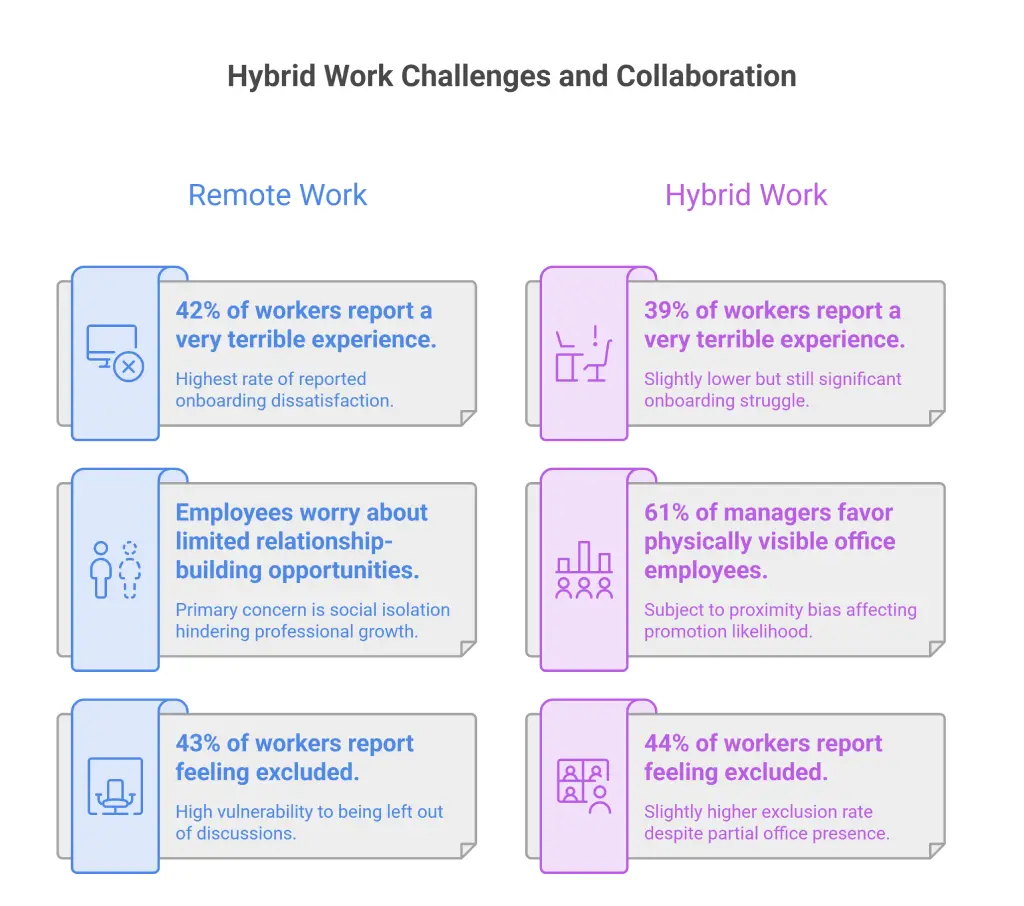
- 43% of remote workers and 44% of hybrid employees report feeling excluded during meetings, while only 27% of organizations have implemented new hybrid work meeting etiquette.
- 61% of managers say they are more likely to promote employees who work in the office and are physically visible to leadership, highlighting concerns about proximity bias in hybrid work environments
- Remote employees are the most likely to report a very terrible onboarding experience (42%), followed closely by hybrid workers (39%).
- 46% of employees worry that remote or hybrid work may limit their opportunities to build strong relationships with coworkers.
- 29% of hybrid and remote workers say communication gaps are a regular challenge.
- According to CBRE, organizations continue to face several challenges when managing hybrid work programs:
- 67% rely on manager discretion to determine hybrid work arrangements, creating inconsistencies across teams.
- 64% have written hybrid work guidelines in place, making it the most common program component.
- 61% use technology tools to support hybrid work and collaboration.
- 55% do not provide predictable in-office schedules, reducing transparency for employees.
- Only 16% offer employee training to help teams adapt to hybrid work.
- Just 15% provide manager training, despite its importance for effective hybrid workforce management.
- From Gallup:
- 76% cited burnout or workplace fatigue as their primary challenge.
- 57% pointed to reduced work-life balance as a key challenge.
- 52% identified meeting customer needs as a major challenge.
Hybrid Work Statistics by Industry
Sectors with more digital and knowledge-based roles tend to have higher levels of remote and hybrid work, while industries that rely on physical presence continue to have lower adoption rates.
| Industry | Key Insight (%) |
|---|---|
| Technology | 85% of software developers are in remote or hybrid roles. Just 9% of tech companies require employees in the office full-time. |
| Finance | 60% of banks require employees in the office at least three days a week, the highest rate among major industries. 40% of financial analysts say they would leave if required to return to the office five days a week. |
| Healthcare | 35% of non-clinical healthcare staff now work remotely on a permanent basis. Telehealth has allowed 25% of doctors to work on hybrid schedules. |
| Government | 45% of federal employees are in a hybrid arrangement. Federal agencies have cut office space by 20% due to telework policies. |
| Marketing | 70% of marketing agencies follow a remote-first work model. |
| Education | 30% of higher education administrative roles are fully remote now. |
| Legal | 50% of law firms offer a two-day remote policy to attract and keep younger associates. |
Source: Dropdesk
Demographics and Diversity Statistics
Demographic factors can play a significant role in how employees view hybrid work. Preferences and experiences often vary across age groups, genders, and family situations, shaping how different groups respond to workplace flexibility.
| Demographic | Statistic |
|---|---|
| Women who work remotely, at least part of the time | 24.9% |
| Men who work remotely, at least part of the time | 20.5% |
| Gen Z respondents who say a hybrid setup influences job acceptance | 66% |
| Boomers who say a hybrid setup influences job acceptance | 40% |
| Working parents are concerned that caregiving impacts job performance | 65% |
| Working parents are concerned that caregiving affects performance | 68% |
Source: Makerstations
The following data highlights how office-based, remote, and hybrid work arrangements are distributed across different European markets, showing that workplace flexibility is not uniform across regions:
| Country | Office / On-site | Remote | Hybrid |
|---|---|---|---|
| Italy | 65% | 9% | 26% |
| France | 64% | 8% | 28% |
| Sweden | 62% | 8% | 30% |
| Spain | 61% | 7% | 32% |
| Germany | 60% | 14% | 26% |
| Poland | 58% | 13% | 29% |
| Czech Republic | 57% | 11% | 32% |
| United Kingdom | 54% | 14% | 32% |
| Netherlands | 53% | 12% | 35% |
| Switzerland | 52% | 18% | 30% |
Source: Ronspot
According to findings reported by Archie, work arrangements vary across different regions worldwide.
- North American organizations tend to favor in-office work arrangements.
- Western European employees generally prefer a hybrid work model.
- The Asia-Pacific region shows a stronger preference for remote work.
- Remote work is highly valued in Indonesia (93%), India (88%), and Switzerland (86%).
- In contrast, employees consider remote work less important in Japan (68%) and Singapore (70%).
Hybrid Work Trends and Technology
Technology continues to play a key role in the evolution of hybrid work. These insights reveal emerging workplace trends, technology investments, and the future direction of flexible work.
- The global hybrid workplace market reached $6.47 billion in 2025, and analysts project it to reach $22.83 billion by 2034. The market will grow at a compound annual growth rate (CAGR) of 15.02% between 2026 and 2034.
- 54% of employees across various industries have used AI, while 14% use GenAI tools at work on a daily basis.
- The "Navigating the Future of Work" survey found that 75% of professionals believe the technology their companies currently use needs improvement or upgrades. In addition, 72% say their organizations need to invest in new technologies to better support flexible work arrangements.
- Zoom, in partnership with Reworked Insights, conducted a global survey of more than 600 IT and C-suite leaders and nearly 1,900 knowledge workers to understand how organizations are adapting to the modern workplace and hybrid work models. 72% say their company needs to invest in new technologies to better support remote and hybrid work.
- Workplace trends reflect lasting shifts in how organizations and employees work, driven by technology, global events, and changing expectations. 17% of employees experience “hushed hybrid” arrangements, where hybrid work setups are not openly communicated.
- Organizations are investing to improve hybrid work, with 44% investing in AI technologies, 32% investing in collaboration technologies, and 15% investing in both AI and collaboration technologies.
- Most companies now see flexibility as the future of the workplace. A large majority offer employees access to office space along with flexible work options. About 61% of companies provide both flexible work policies and office access.
How Time Champ Helps Your Hybrid Teams Stay Aligned
Hybrid work offers flexibility, but it can also make it harder to understand how work is progressing across different locations. Having the right solution, like Time Champ, in place helps you stay informed, improve collaboration, and maintain better oversight across your hybrid work environment.
Time Champ is an advanced employee monitoring and productivity tracking tool built to give you a clear picture of what's happening across a distributed team. Here are some ways Time Champ helps you keep your hybrid teams connected, organized, and working smoothly:
- Track Time Automatically: Capture work hours without manual entries, helping maintain accurate records across hybrid teams.
- Track Attendance Across Locations: Easily view who is working remotely, who is in the office, and who is on leave, helping you maintain accurate attendance records.
- Monitor Employee Activity: Get a clear understanding of how employees spend their work hours through activity tracking and application usage monitoring.
- Manage Work Schedules Efficiently: Plan and organize shifts, work hours, and schedules for both remote and in-office employees from a single platform.
- Improve Team Availability Visibility: Know when employees are available, active, or away, making collaboration and communication easier.
- Balance Workloads Better: Understand team capacity and work distribution to assign tasks more effectively and avoid uneven workloads.
- Identify Potential Burnout and Attrition Risks: Gain visibility into work patterns such as extended work hours, frequent overtime, and irregular schedules.
Running a hybrid workplace well means having clear visibility into daily work and team activities. Time Champ helps you stay informed and make better decisions while keeping remote and in-office teams connected, coordinated, and aligned with their work goals.
Struggling to manage productivity across hybrid teams?
Use Time Champ to gain visibility into daily work and progress.
Conclusion
The hybrid work statistics in this article highlight a clear shift in how people work today. As you review the data, it becomes evident that hybrid work is no longer just an option for many organizations. Employee expectations, productivity, flexibility, and workplace experience are all influencing how businesses approach work and manage their teams.
The real challenge for you is not deciding whether hybrid work should be part of your workplace, but finding the right way to make it successful. Creating the right balance between flexibility, visibility, collaboration, and employee well-being helps build a stronger, more adaptable workplace that supports both business goals and workforce needs. Hybrid work management tools like Time Champ help you understand work patterns, monitor productivity, and make better decisions across remote, in-office, and hybrid teams.

Thasleem Shaik

Table of Content
 Key Hybrid Work Statistics at a Glance
- Hybrid Work Adoption Statistics
- Hybrid vs Remote vs In-Office Split
- Hybrid Work Productivity Statistics
- Employee Preference Statistics for Hybrid Work
- Return-to-Office Pushback and Retention Risk
- Real Estate and Cost Savings
- Hiring, Retention, and the Competitive Advantage
- Burnout and Well-Being in Hybrid Work
- Hybrid Work Challenges and Collaboration Statistics
- Hybrid Work Statistics by Industry
- Demographics and Diversity Statistics
- Hybrid Work Trends and Technology
- How Time Champ Helps Your Hybrid Teams Stay Aligned
- Conclusion
Related Blogs

Hybrid work offers savings, but hidden costs can erode ROI. Explore 9 expenses and practical ways to identify them before they grow.
Guna Lakshmi | Jun 06, 2026
See what the data says about hybrid work productivity gains, including productivity, retention, engagement, cost savings, and long-term business impact.
Thasleem Shaik | Jun 08, 2026
Learn about employee rights in hybrid work, including pay, benefits, overtime, privacy, workplace safety, promotions, accommodations, and compliance laws.
Anjali | Jun 05, 2026
Learn 10 essential hybrid workforce best practices to boost productivity, improve communication, and foster team morale for success in a flexible work setup.
Tarun Kumar Reddy | Nov 12, 2024
Learn what a hybrid work policy is, see the 9 essential components to include, and download, edit, and use your free hybrid work policy template.
Guna Lakshmi | Jun 13, 2026
Learn to design an effective hybrid work schedule that balances flexibility and productivity, with best practices to fit your team’s needs.
Jahnavi Pulluri | Oct 26, 2024


 4.7/5 avg.
Ready to Manage Your Workforce Smarter?
Join our family of 1500+ companies using smart insights to redefine workforces!

Free Trial
No Credit Card Required