Hybrid Work vs Remote Work: Which Fits Your Business?
Compare hybrid and remote work models to determine which improves your team's productivity, collaboration, flexibility, and long-term business performance.

Are you still trying to find the right balance between flexibility and performance? Some teams perform better when they work remotely, while others need regular face-to-face interaction to stay aligned. Choosing the wrong work model can lead to communication gaps, lower engagement, operational challenges, and difficulty maintaining productivity. As work expectations continue to evolve, you need a clear understanding of which approach best supports your goals, workforce, and company culture.
As you rethink how work gets done in your organization, understanding the differences between hybrid vs remote work becomes essential. Each model offers distinct benefits and challenges, and the best choice depends on your team’s needs and business goals. This blog compares both approaches, highlights their pros and cons, and explains which industries are best suited for each model to help you make an informed decision.
What Is Hybrid Work?
Hybrid work is a flexible work model that allows employees to split their time between the office and a remote location. Employees can work from both locations based on company policies, team schedules, or job requirements. This approach helps organizations balance flexibility, collaboration, productivity, and employee engagement while supporting different work preferences.
What Is Remote Work?
Remote work is a work arrangement in which employees carry out their job responsibilities from locations outside a traditional office, such as their homes, coworking spaces, or any place with internet access. Communication, collaboration, and daily operations are managed through digital tools, enabling your teams to work effectively without being tied to a physical workplace.
Hybrid Work vs Remote Work at a Glance
Choosing between hybrid and remote work involves deciding where employees work. Each model influences collaboration, productivity, hiring opportunities, employee experience, and operational costs in different ways. The comparison below highlights the key differences to help evaluate which approach aligns best with your business goals.
| Aspect | Hybrid Work | Remote Work |
|---|---|---|
| Workplace Flexibility | Offers a balance between office collaboration and remote convenience. | Gives employees complete freedom to work from any location. |
| Team Collaboration | Supports in-person discussions, brainstorming, and relationship building. | Relies on digital communication tools for collaboration and teamwork. |
| Employee Work-Life Balance | Provides flexibility while maintaining a structured work routine. | Allows greater control over schedules and personal commitments. |
| Talent Acquisition | Expands hiring beyond a single office location while retaining local connections. | Enables access to talent from different cities, regions, and countries. |
| Productivity Potential | Combines focused remote work with collaborative office sessions. | Reduces commuting time and supports uninterrupted individual work. |
| Company Culture | Easier to strengthen workplace relationships through regular face-to-face interactions. | Requires deliberate efforts to build engagement and team connections virtually. |
| Operational Costs | Reduces office space requirements compared to fully office-based work. | Significantly lowers facility and workplace-related expenses. |
| Business Scalability | Supports growth while maintaining some physical workplace presence. | Allows you to scale teams quickly without location constraints. |
Struggling to maintain visibility and accountability across hybrid or remote teams?
Time Champ provides real-time workforce insights to improve productivity and team performance.
Pros and Cons of Hybrid Work vs Remote Work
Every work model comes with its own strengths and challenges. Understanding the advantages and limitations of hybrid and remote work can help you choose the option that best supports your team's productivity, collaboration, and long-term business goals.
Hybrid Work
You may choose a hybrid setup to balance flexibility with in-person collaboration. Hybrid work allows your teams to stay connected while giving employees more control over where they work.
Pros
1. Better Team Collaboration
Hybrid work makes it easier for your teams to connect in person when needed, leading to faster decision-making, smoother communication, and more productive discussions.
2. Greater Employee Flexibility
Employees can balance remote work convenience with the benefits of office access, helping them stay productive while maintaining a healthier work-life balance.
3. Stronger Workplace Culture
Regular face-to-face interactions help you build stronger relationships, improve employee engagement, and create a greater sense of belonging across the organization.
Cons
1. Scheduling and Coordination Challenges
Managing office days, meeting schedules, and team availability can become complicated, especially across multiple departments.
2. Uneven Employee Experience
Remote employees may sometimes miss important discussions or opportunities that happen during in-office interactions.
3. Ongoing Office Costs
Organizations still need to maintain office space, utilities, and workplace resources, which can increase operational expenses.
Remote Work
Advances in technology have made it possible for teams to stay connected and productive without sharing the same physical workspace. You can use this approach to give your employees more flexibility, hire talent from a wider range of locations, and reduce workplace-related costs.
Pros
1. Access to a Wider Talent Pool
You can hire skilled professionals from different cities, regions, or countries without location restrictions.
2. Lower Operating Costs
Reduced spending on office space, utilities, and workplace facilities can help you save money.
3. Improved Work-Life Flexibility
Employees can manage their schedules more effectively and avoid daily commuting, which often improves job satisfaction.
Cons
1. Reduced Face-to-Face Interaction
Building relationships, mentoring employees, and maintaining team connections can be more challenging in a fully remote environment.
2. Communication Gaps
Without clear communication processes, teams may experience delays, misunderstandings, or information silos.
3. Greater Dependence on Technology
Remote teams rely heavily on internet connectivity, collaboration platforms, and digital tools to keep work moving smoothly.
Hybrid vs Remote Work by Industry
Different industries have different operational needs, employee responsibilities, and collaboration requirements. While some sectors can function effectively with fully distributed teams, others benefit from a mix of remote flexibility and in-person interaction. The table below highlights which model is generally the better fit for various industries and why.
| Industry | Best Fit | Why |
|---|---|---|
| Software & IT | Remote Work | Most tasks are digital, allowing teams to collaborate and deliver projects from any location. |
| Digital Marketing | Remote Work | Campaign management, content creation, and client communication can be handled online. |
| Customer Support | Remote Work | Cloud-based tools and communication platforms enable teams to assist customers from anywhere. |
| Consulting | Hybrid Work | Consultants often need flexibility for remote work while still meeting clients and teams in person. |
| Financial Services | Hybrid Work | Balances compliance, security requirements, and collaboration with employee flexibility. |
| Healthcare Administration | Hybrid Work | Administrative tasks can be completed remotely, while some responsibilities require on-site presence. |
| Education & Training | Hybrid Work | Supports both online learning and in-person teaching, workshops, or student interactions. |
| Manufacturing | Hybrid Work | Production roles require on-site work, while administrative and support functions can work remotely. |
| Human Resources | Hybrid Work | Allows flexibility for routine tasks while supporting in-person onboarding, training, and employee engagement. |
| Sales Teams | Hybrid Work | Combines remote work flexibility with face-to-face client meetings and team collaboration. |
How Time Champ Supports Both Hybrid and Remote Work Models
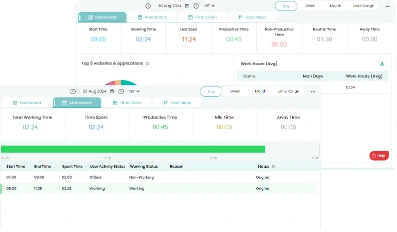
Managing a hybrid or remote workforce often comes with limited visibility into attendance, productivity, workload distribution, and employee engagement. Without reliable workforce data, it can be difficult to identify performance trends, ensure accountability, maintain compliance, and support employees effectively. Time Champ is an employee monitoring software with complete workforce intelligence features that help organizations gain clear visibility into workforce performance, improve accountability, streamline operations, and make informed decisions across hybrid and remote teams.
Whether your employees work from the office, remotely, or in a hybrid setup, Time Champ provides the visibility needed to manage teams with confidence. For hybrid teams, it offers location-based attendance tracking, anchor-day attendance reports, productivity comparisons between office and remote workdays, and workload distribution insights that help reduce proximity bias. For remote teams, it provides activity and productivity tracking without micromanagement, time zone visibility, async work pattern analysis, idle time detection, and built-in data loss prevention across distributed devices. In both environments, Time Champ supports Windows, Mac, and Linux devices, integrates with payroll and HRMS systems, strengthens compliance through built-in DLP capabilities, and delivers real-time workforce insights that help you identify issues early and make better decisions.
Struggling to keep hybrid and remote teams on track?
Time Champ gives you complete visibility into productivity, attendance, and performance.
Conclusion
Choosing the right work model depends on your business goals, team structure, operational requirements, and employee expectations. While hybrid work offers a balance between flexibility and in-person collaboration, remote work provides greater location freedom and access to a wider talent pool. Understanding the differences between hybrid vs remote work can help you create a work environment that supports productivity, employee engagement, and sustainable business growth. Selecting the model that best aligns with your organization will position your team for long-term success.

Anjali

Table of Content
 What Is Hybrid Work?
- What Is Remote Work?
- Hybrid Work vs Remote Work at a Glance
- Pros and Cons of Hybrid Work vs Remote Work
- Hybrid vs Remote Work by Industry
- How Time Champ Supports Both Hybrid and Remote Work Models
- Conclusion
Related Blogs

Discover the hybrid work model, which blends office and remote environments for greater flexibility and productivity.
Thasleem Shaik | Oct 25, 2024
Discover how hybrid remote work blends flexibility with productivity. And explore key benefits, challenges, and tips for managing a successful hybrid workplace.
Sai Keerthi Uppala | Oct 25, 2024
Learn how to monitor remote employees the right way, what to track, how to roll it out, and how to keep your team's trust through the whole process.
Thasleem Shaik | May 06, 2026
Learn how to track time for remote workers using simple methods and remote tracking tools and learn best practices that improve trust and productivity.
Guna Lakshmi | May 19, 2026
Learn 10 essential hybrid workforce best practices to boost productivity, improve communication, and foster team morale for success in a flexible work setup.
Tarun Kumar Reddy | Nov 12, 2024
Ensure remote work compliance with our guide on key areas, common challenges, and best practices for your team.
Shabana Shaik | Jan 10, 2025


 4.7/5 avg.
Ready to Manage Your Workforce Smarter?
Join our family of 1500+ companies using smart insights to redefine workforces!

Free Trial
No Credit Card Required