How to Improve Employee Productivity: 12 Proven Methods
12 proven methods to improve employee productivity. Diagnose your biggest time leak first, then fix it with clarity, trust, focus, and the right tools.

If you have also noticed a productivity decline in your organization, then you are not alone.
With the rise of remote and hybrid work models, questions about employee productivity have also been raised. Now, companies are searching for the best ways to improve employee productivity.
So, here I have a compilation of 12 methods you can use to level up your employee’s productivity, no matter where they work from.
What is Employee Productivity?
Employee productivity is how much meaningful output a person or team produces in a set amount of time. It is not about hours logged or how busy someone looks on the surface. A productive employee turns time and effort into real results, like finished work, met goals, and value for the business, without burning out to get there.
That last part matters. Productivity is output you can sustain, not a one-week sprint that leaves everyone fried. There are also different types of employee productivity (individual, team, and organizational), and the method that fixes one will not always fix the others. Keep that in mind as we go deep into the topic.
Why Does Employee Productivity Matter?
Employee productivity matters because it links directly to your company’s profit, work quality, and how long your best people stay. When work happens well, you deliver more without adding headcount or hours. When it does not, the costs climb quietly through rework, missed deadlines, overtime, and the slow drift of disengaged employees toward the exit.
The numbers back this up: Gallup’s long-running research shows that highly engaged teams are about 17% more productive and 23% more profitable than disengaged ones. The flip side is sobering: in 2025, only around one in five employees worldwide felt engaged, which Gallup ties to roughly $10 trillion in lost productivity globally.
So, productivity is not just a nice-to-have thing. It is the gap between a team that quietly compounds results and one that quietly bleeds them. A good thing is that a big chunk of it is within your control as a manager.
Gallup also found that managers account for almost 70% of the variance in team engagement, so the change should start with you.
What Affects Employee Productivity?
Employee productivity is shaped by four big things:
- The work environment
- How workload is managed
- The tools people have
- And their well-being
Get these 4 things right, and most of your team performs well by default.
Before you start fixing things, without knowing the problem, it helps to know what you are actually working with. Here are the four factors that move the needle most.
| Factor | What it Looks Like When it is Off | Quick Read |
|---|---|---|
| Work Environment | Noise, constant pings, no quiet space for focus | Hard to start, harder to stay in flow |
| Workload Management | Some people are drowning, others are idle, unclear priorities | Effort goes to the wrong things |
| Tools and Resources | Slow software, too many apps, manual busywork | Time leaks into friction, not work |
| Well-being | Skipped breaks, long uneven hours, and early burnout signs | Output looks fine, then falls off a cliff |
You can notice that three of these four are about removing friction, not adding pressure. That is the theme of pretty much everything below.
Find Your Productivity Leaks Before You Fix Anything
Also, before applying any method, find where your team’s time actually goes. Most productivity is not lost to lazy people. There are deeper things that drain an employee’s energy before it turns into productivity, and the irony is that people easily overlook them.
Here’s a list of where productivity drains:
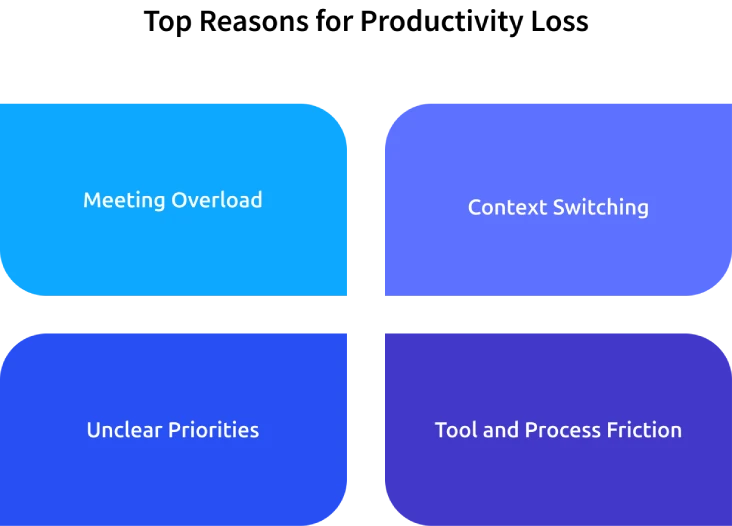
Leak 1: Meeting Overload
Calls feel productive, so your teams add more of them.
- A call for escalations
- A call for productivity drop
- A call for good work
- A call for issue discussion
- A call for productivity improvement
All of these might look very normal to you, but instead of putting an hour-long call for issue discussion and investigation, you can just strategize and use it for the better.
Leak 2: Context Switching
Every ping pulls attention away, and getting it back to the work with the same focus is not easy. Research from the University of California, Irvine, found it takes around 23 minutes to fully refocus after a single interruption.
So, a day full of small distractions is not a small thing, it’s a hidden tax on everything else.
Leak 3: Unclear Priorities
When people are not sure what matters most, they default to whatever is either loudest or easiest.
Efforts are always 100%
But the output stays flat.
This leak hides as “busyness,” which is exactly why it is so easy to miss.
Leak 4: Tool and Process Friction
Slow systems, too many overlapping apps, and manual data entry quietly drain work hours. If you want the deeper list of what drags teams down, we have covered the common causes of low productivity separately.
Here is the practical move you can apply: Spend one week finding your biggest leak instead of guessing. This is where productivity tracking earns its place. Instead of opinions, you get a clear picture of where hours actually go, which apps eat the day, and when focus peaks and breaks. Diagnose first, then pick your method. That single habit is what separates a fix that works from a fix that just feels good on the surface.
Quick Gut Check
Before you roll out any new tool or ritual, ask yourself one question: “Which leak does this actually plug?” If you cannot answer it in one sentence, you are about to fix the wrong thing.
How to Improve Employee Productivity: 12 Proven Methods
To improve your employee productivity, here are the top proven methods you can use to see real results.
You don’t need to use all 12 at once. Pick any two or three that match the leak you just found, do them well, then add more.
The 12 methods at a glance:
| Number | Method | Best When Your Leak is… |
|---|---|---|
| 1 | Set clear SMART goals | Unclear priorities |
| 2 | Match tasks to the right people | Uneven workload |
| 3 | Give regular feedback | Drift and slow course-correction |
| 4 | Recognize good work | Low engagement |
| 5 | Trade micromanagement for trust | Slow, stifled teams |
| 6 | Protect deep work | Context switching |
| 7 | Fix meeting overload | Meeting overload |
| 8 | Train and grow people | Skill gaps |
| 9 | Support well-being | Burnout and uneven hours |
| 10 | Give the right tools | Tool and process friction |
| 11 | Use productivity tracking | You honestly do not know |
| 12 | Coach your managers | Inconsistent team performance |
A detailed explanation of where and how to use each method:
1. Set Clear, SMART Goals
People generally work better when they know exactly what “done” looks like. So, make goals specific, measurable, achievable, relevant, and time-bound. So, your employees don’t struggle while working.
It’s called SMART for a reason.
A vague “improve the onboarding flow” drifts for weeks. “Cut onboarding steps from 9 to 5 by month-end” won’t give proper clarity on the work that needs to be done.
2. Match Tasks to the Right People
Find people who are absolutely capable of doing the task.
A right person for the right job is equal to 10 wrong people working on the same task
Map work to skills and current load, not just to whoever replies first. Balanced workloads beat the heroic ones every time.
3. Give Regular, Specific Feedback
Waiting for the annual review to course-correct is like steering a car once a year, just to see if it still works.
Short, specific, frequent feedback helps people fix small things before they become big ones, and it signals that someone is paying attention to the good work too.
4. Recognize and Reward Good Work
Personally, I work twice as effectively when my work gets recognized and appreciated. People love to repeat what gets noticed.
Even a report from achievers states that 92% of employees say they are likely to repeat a behavior they were recognized for.
A genuine, specific “this saved the client relationship” lands far harder than a generic “great job team,” and it is a direct lever on the engagement that drives output.
5. Trade Micromanagement for Trust
How well do you focus when someone constantly lingers around and asks about the progress, yes that’s what we call micromanagement
So, naturally, hovering kills employee initiatives and slows everything down. All you need to do is set the outcomes and guardrails, then let the people choose how to get there. Encourage them to take ownership of their tasks, because only ownership turns task-doers into problem-solvers, and that is where real productivity lives.
6. Protect Deep Work and Cut Distractions
Distraction kills 99.99% of productivity, because what do you mean I am working focused, and a message, a person, and a sudden priority comes up every time.
Each time an employee gets back to work, he/she takes atleast 23 minutes to refocus on whatever they are doing
So, defend focus like it is a resource, encourage no-meeting blocks, quiet hours, and notifications off during deep work.
7. Fix Meeting Overload
Back-to-back meetings don’t get the work done, a quiet and productive space does!
So, audit the recurring meetings on your team’s calendar and kill or shorten the ones that could have been just a message.
If you really want to conduct meetings, then give every surviving meeting an agenda and an owner. Most teams do exceptionally well when they don’t need to join a meeting every 1 hour.
8. Invest in Training and Growth
Work is changing, and how we work is also changing, so traditional methods of working cannot keep up with the fast pace of today’s technology
And a skill gap obviously slows task progress.
Find those skill gaps and provide targeted training to your employees, because when people feel they are working well and getting better, they tend to work happily.
9. Support Well-being and Prevent Burnout
Productivity starts from employee well-being, period!
Burnt-out people are not productive, they just look busy until they completely break.
Encourage real breaks, and sane working hours, and also watch for early burnout signs. If you want to know how burnout shows up, we have covered it as well.
10. Give People the Right Tools
A wrong train won’t take you to the right destination, same with the tools your employees use too, a good tool creates less confusion and helps get work done faster and better.
The wrong one, or five overlapping ones, adds it. Standardize on tools that fit how your team works and cut the rest.
11. Use Productivity Tracking to See What is Really Happening
Visibility is all you need to do all of the points discussed above. When you can see what’s happening right, what is wrong, or what could have been done better, you change it
An employee productivity tracking software like Time Champ turns activity into a clear picture: where time goes, which apps help, and where focus breaks.
When used transparently, it replaces guesswork with facts, so your other 11 methods are aimed at the right problem.
Want accurate productivity tracking for your team?
Time Champ gives you activity data, productivity insights, and early burnout signs.
12. Coach Your Managers
Since managers drive most of the variance in engagement, the highest-leverage productivity move is often developing the managers themselves.
Encourage your managers to set clear goals, give good and proper feedback, and protect employee focus, it really changes a lot more than you imagine.
How Time Champ Helps You Improve Productivity
Time Champ is an efficient employee monitoring and productivity tracking software. It captures how work actually happens, then turns that into reports that explain why a number looks the way it does, so you can find leaks, choose the right method, and check whether it worked, all without managing on inaccurate guesswork.
Most of the methods discussed above get easier when the data is automatically collected. Time Champ does that quietly in the background once installed, so you spend your energy reading the picture, not building it. Here is what it brings to this specific job:
- Automatic Activity Capture: Productive hours, idle time, and app and website usage are logged as people work, so the “find the leak” step happens on its own.
- Reports and Dashboards: Individual, team, and manager views that show output next to activity, not just raw busyness.
- Heatmaps and Trends: See when focus peaks and where it breaks, which is exactly how you spot meeting overload and context switching.
- Workload and Burnout Signals: Flags who are overloaded before a deadline slips, so well-being stops being an afterthought.
Most monitoring tools only provide activity logs. Time Champ adds the workforce intelligence layer that explains the why, which is the part that keeps you from misreading a quiet week as a lazy one.
How to Know If It Is Actually Working
If you want to know if any method you used worked or not, then measure a baseline before you start, change one thing at a time, and then compare the same metric a few weeks later. If output rises while hours stay steady or fall, congratulations, your method worked. If activity rises but output does not, you added busywork, not productivity.
A method is a hypothesis, not a guarantee. Pick one leak, apply one fix, and watch the same number you started with. Resist the urge to change five things at once, or you will never know which one really helped and which one didn’t.
Get accurate productivity patterns with Time Champ!
See if the productivity is rising or declining, don’t wait for signs, move with insights.
Mistakes to Avoid
Here are some of the most common mistakes you should absolutely avoid:
- Mistaking Busy for Productive: People can be busy all the time but show zero output, so always compare activity with the output
- Fixing Before Diagnosing: Buying a new tool for undiagnosed issues solves zero issues and creates a few more, actually. Understand the issue first and then apply solutions.
- Adding Instead of Removing: Do not keep adding on more tools, meetings, and rituals onto your team, you can see productivity gains only when you cut friction.
- Monitoring in Secret: Do not play with employee trust by monitoring discreetly, it destroys trust more than anything could, let everyone know why you are tracking and what the data is used for.
- Changing Everything at Once: Do not change processes all of a sudden before you even get to see the difference. Give it time and try understanding patterns first.
A Few Final Words
Improving employee productivity is less about willpower and more about attention. Find where the time really leaks, fill the biggest gap with the method that fits, give people clarity and trust, and then check whether it worked. Do that, and productivity stops being something you chase and starts being something you can actually see and thrive.

Shabana Shaik

Table of Content
 What is Employee Productivity?
- Why Does Employee Productivity Matter?
- What Affects Employee Productivity?
- Find Your Productivity Leaks Before You Fix Anything
- How to Improve Employee Productivity: 12 Proven Methods
- How Time Champ Helps You Improve Productivity
- How to Know If It Is Actually Working
- Mistakes to Avoid
- A Few Final Words
Related Blogs

Explore how employee engagement impacts productivity with real data insights, trends, and what teams should focus on to improve performance.
Thasleem Shaik | May 06, 2026
Learn what productivity intelligence is, why it's important, how it works, ways it transforms team performance, pros & cons, and how to measure it.
Shabana Shaik | Feb 11, 2026
Learn about productivity tracking policy with a downloadable template and 30-day rollout plan to implement tracking clearly and build team acceptance.
Jahnavi Pulluri | May 11, 2026
Employee screen monitoring captures work activity in real time. Learn all monitoring types, how they boost productivity, and how to implement them ethically.
Jahnavi Pulluri | Apr 17, 2026
Boost your team's productivity with these 10 effective strategies for success. Learn how to enhance team productivity, improve morale, and drive growth.
Tarun Kumar Reddy | Jan 20, 2025
Discover 20 essential employee performance metrics to track. Learn how to measure and implement these metrics to boost productivity and drive success.
Shabana Shaik | August 08, 2025


 4.7/5 avg.
Ready to Manage Your Workforce Smarter?
Join our family of 1500+ companies using smart insights to redefine workforces!

Free Trial
No Credit Card Required