Top Causes of Low Productivity and How to Fix Them
Find out the causes of low productivity, the warning signs to watch for, how to identify the root cause, and proven ways to fix it to improve performance.

When productivity drops, the first instinct is often to blame employees, but low employee productivity isn't always a people problem. In many cases, the real cause is hidden in the way work is organized, managed, or prioritized.
The challenge is that low employee productivity can stem from multiple sources, from burnout and disengagement to inefficient workflows, meeting overload, and constant interruptions. Without identifying the root cause, even the best productivity initiatives can fail.
In this blog, we'll look at the common causes of low productivity, the signs to watch for, and what you can do to fix the problem.
What Does Low Employee Productivity Actually Mean?
Low employee productivity occurs when an employee or team consistently delivers less output than expected based on their role, skills, available time, and resources. It can be caused by factors such as disengagement, burnout, unclear expectations, inefficient processes, or workplace distractions.
It's important to remember that low productivity is not the same as being busy. An employee can spend the entire day in meetings, replying to messages, and switching between tasks, yet make little progress on meaningful work.
What Are the Early Signs of Low Employee Productivity?
Early signs of low productivity often show up in everyday work. These signals are easy to overlook on their own, but together they point to deeper issues with priorities, processes, or focus.
| Sign | What It Looks Like Day to Day | What It Often Points To |
|---|---|---|
| Missed or slipping deadlines | Tasks that used to be delivered on time now consistently run late | Unclear priorities or overload, not always effort |
| Constant rework | Work comes back multiple times before it’s accepted | Unclear expectations or a skills gap |
| Always on, rarely done | People are active all day, but produce little finished output | Too much context switching and fragmented focus |
| Status replaces progress | More meetings about work than actual work being completed | A process problem, not a people problem |
| A few people carry the rest | The same individuals consistently deliver most of the output | Uneven workload or disengagement |
| Quiet withdrawal | A once-engaged employee becomes silent and does only the minimum | Disengagement or early burnout |
If you start seeing three or more of these patterns in the same team, it usually means something deeper is going on. The next step is not to push harder, but to understand what’s actually causing it.
What Causes Low Productivity?
Low employee productivity usually comes from three areas: the individual, the process, or the environment. In reality, most situations involve a mix of all three, which is why quick fixes often don’t work.
Instead of looking at a long list of random causes, it helps to group them into these buckets. It makes it much easier to understand where the real issue is coming from.
People-Related Causes
These factors relate to individual employees, but they are often influenced by the work environment, management, and systems around them.
1. Disengagement and Low Motivation
When work feels meaningless or unrecognized, effort usually drops. According to Gallup, only about 21% of employees globally are engaged at work, meaning most people are operating below their full energy and focus. While not everyone starts disengaged, workplace conditions often play a big role in how engaged people become.
2. Unclear Expectations
When employees are not clear about what “good work” looks like, they end up guessing. This leads to delays, repeated revisions, and confusion about priorities, all of which slow down overall productivity.
3. Skills or Training Gaps
If someone is not fully trained or lacks the right skills for a task, progress becomes slower and more error-prone. What may appear as low effort is often a sign that the employee needs better guidance, tools, or support.
4. Burnout and Overload
After a point, extra hours don’t lead to extra output. It usually leads to fatigue, which slows thinking, increases errors, and reduces overall productivity. Which makes this a capacity planning problem rather than a motivation one. If the work in the pipeline exceeds the hours genuinely available, no amount of individual effort closes the gap.
Process-Related Causes
These issues come from how work is structured, assigned, and managed inside the system.
1. Broken or Outdated Workflows
When simple tasks require multiple steps, approvals, or handoffs, work slows down. Employees spend more time navigating the process than actually doing the work. Over time, this creates delays, frustration, and unnecessary work.
2. Tool Overload and Context Switching
Using too many tools at the same time forces employees to constantly switch between apps, tabs, and notifications. Each switch breaks focus and makes it harder for employees to stay deep in work.
3. Too Many Meetings
When calendars are filled with back-to-back meetings, there’s little uninterrupted time left for work. Even short meetings fragment the day, making it difficult to focus, plan properly, or make steady progress on tasks.
4. Unclear Priorities
When everything is marked urgent, nothing truly stands out. Employees are left guessing what matters most, often working on whichever task feels most immediate rather than on what actually drives results.
Environment-Related Causes
These are the day-to-day conditions employees work in, and they directly impact how focused, motivated, and productive they can be.
1. Constant Distractions
Work environments filled with noise, notifications, and frequent interruptions make it difficult to stay focused. Even short breaks in attention can pull employees out of deep work, leading to slower progress and more errors.
2. Ineffective Management
You play a major role in shaping productivity. When expectations are unclear, feedback is inconsistent, or priorities keep changing, employees spend more time figuring out what to do than actually doing the work.
3. Lack of Recognition
When effort and excellent work go unnoticed, motivation naturally drops. Over time, employees may stop going beyond the basics if they feel their contribution doesn’t matter or isn’t valued.
4. Remote and Hybrid Friction
Remote and hybrid setups are not inherently unproductive, but they can make communication less direct. Small misunderstandings, delayed feedback, and missed signals can slowly build up and affect overall team efficiency.
How To Fix Low Employee Productivity?
Fixing low employee productivity starts with understanding what’s actually causing it. Once the root cause is clear, the fix becomes much easier.
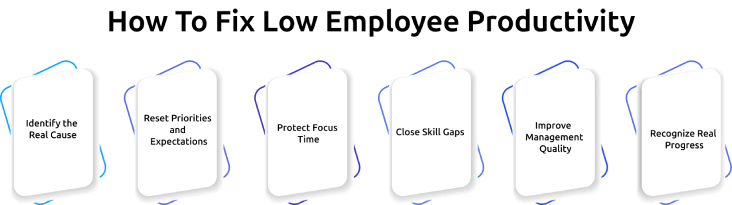
1. Identify the Real Cause
Start by checking whether the issue is people-related, process-related, or environment-related. This step matters more than anything else. If you get this wrong, everything that follows will miss the mark.
2. Reset Priorities and Expectations
Make it clear what actually matters this week and what “done” looks like. A lot of productivity issues are really clarity issues in disguise.
3. Protect Focus Time
Reduce unnecessary meetings, limit constant interruptions, and give employees blocks of uninterrupted time to work. This alone can significantly improve output.
4. Close Skill Gaps
If the issue is capability, putting extra pressure won’t help. Targeted training, support, or better onboarding usually works better than pushing harder.
5. Improve Management Quality
Regular one-on-ones, clear feedback, and consistent direction make a big difference. A large part of team productivity depends on how you support your teams.
6. Recognize Real Progress
Don’t focus only on hours or activity, recognize the actual output. Employees naturally continue the kind of work that gets noticed and valued.
How a Low-Productivity Conversation Should Actually Go
These conversations work best when they feel curious, not critical.
Rather than focusing on fault, the goal is to understand the challenges and address them collaboratively.
A Few Simple Rules That Help
- Start with a specific observation, not a general judgment.
- Ask what’s getting in the way before sharing your assumptions, you’ll often hear something unexpected.
- End with one or two clear actions and a date to review progress.
- Avoid comparing employees, it usually creates resistance, not improvement.
- Don’t leave it vague. “Try harder” isn’t a plan.
If done right, this conversation feels less like a performance review and more like solving a problem together.
How Time Champ Helps Improve Productivity and Reduce Low Performance
Time Champ is an employee monitoring software that provides clear visibility into how work actually happens across a team. Instead of relying on assumptions, it helps identify what drives productivity, what slows it down, and where time is being lost.
It goes beyond basic activity tracking by revealing meaningful work patterns that impact performance.
Here are the key insights it provides:
Time Tracking (Active vs Idle Time)
Time Champ automatically tracks active work and idle time, helping measure real effort. This makes it easier to identify whether low productivity is caused by distractions, interruptions, or inefficient time usage.
App and Website Usage Insights
It tracks which apps and websites consume the most time during work hours. This helps identify distractions, unnecessary tools, and context-switching that reduce overall efficiency.
Productivity and Work Behavior Insights
The platform highlights productivity trends and work behavior patterns across individuals and teams. This helps determine whether performance issues are isolated or part of a larger workflow problem.
Focus and Collaboration Insights
It breaks down time spent on focused work, collaboration, and multitasking. This helps understand whether productivity is affected by interruptions or a lack of deep work time.
Work Reports and Time Patterns
Time reports provide a structured view of attendance, working hours, and daily time distribution. They help connect productivity gaps to workload imbalance, inconsistent schedules, and long-term work patterns.
Find the real cause of low productivity with Time Champ!
Identify bottlenecks, improve focus, and drive better performance across your team.
Conclusion
Low employee productivity is rarely caused by a single factor, it usually comes from a mix of unclear expectations, broken processes, distractions, and burnout. The key to fixing it is not working harder but understanding the real root cause behind the drop in performance. Once you identify whether the issue is people, process, or environment-related, the solution becomes much clearer. With the right insights and visibility, teams can remove friction and create a more focused and productive work culture.

Jahnavi Pulluri

Table of Content
 What Does Low Employee Productivity Actually Mean?
- What Are the Early Signs of Low Employee Productivity?
- What Causes Low Productivity?
- How To Fix Low Employee Productivity?
- How a Low-Productivity Conversation Should Actually Go
- How Time Champ Helps Improve Productivity and Reduce Low Performance
- Conclusion
Instant Signup
Thank you for your request!
We have received your signup request and our team will get back to you soon. In the meantime, you can book a demo to see Time Champ in action.
Book a DemoFree trial. No credit card required. Prefer a walkthrough? Book a demo.
Related Blogs
Toxic productivity at the workplace harms employee well-being and leads to burnout. Discover what it is, signs to watch for, and strategies to overcome it.
Sai Keerthi Uppala | Jan 10, 2025
Learn how time and productivity tracking can boost SEO reporting. Discover how tracking work helps improve accuracy, insights, and results in SEO efforts.
Jahnavi Pulluri | Sep 17, 2024
Boost team productivity and performance with effective tracking methods. Enhance productivity through data-driven insights and actionable strategies.
Shabana Shaik | Mar 17, 2025
Productivity vs. Efficiency, Are you focusing on the wrong one? Discover the key difference and how to master both and strike the perfect balance!
Tarun Kumar Reddy | Jun 13, 2024
Organize your workplace with these best productive tips. Boost efficiency, reduce clutter, and optimize your work environment today!
Sai Keerthi Uppala | Feb 22, 2025
Explore the most important productivity metrics and KPIs to measure employee performance, improve efficiency, and boost workplace productivity.
Anjali | May 12, 2026


 4.7/5 avg.
Ready to Manage Your Workforce Smarter?
Join our family of 1500+ companies using smart insights to redefine workforces!

Free Trial
No Credit Card Required