Productivity vs Efficiency: Key Differences Explained
Compare productivity vs efficiency with real examples, practical benefits, key differences, and actionable tips to improve business results and performance.
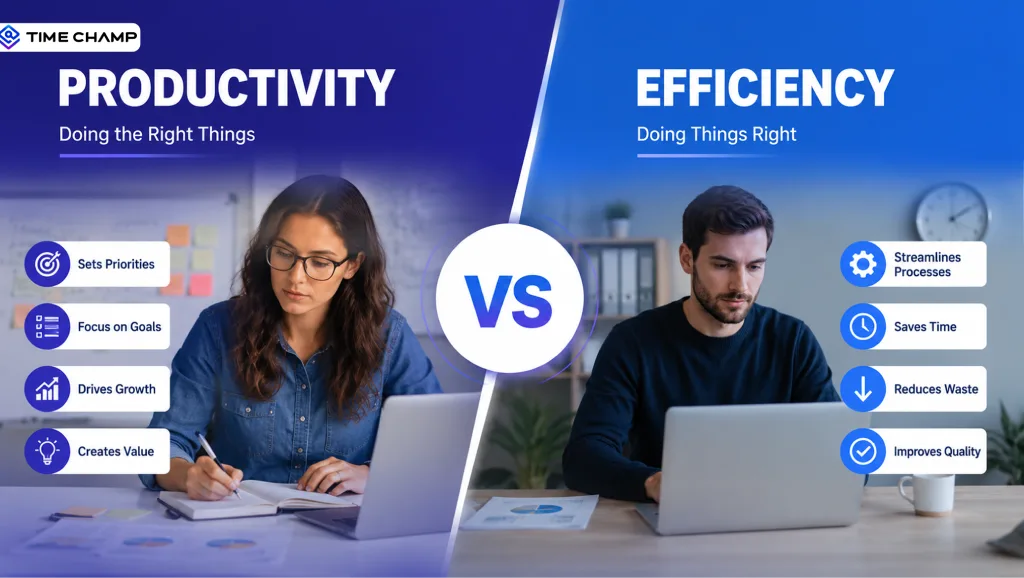
Productivity and efficiency often seem similar because both measure work performance. Productivity looks at how much you accomplish, while efficiency focuses on how well you use your time, energy, and resources to accomplish it.
Knowing the difference can change the way you approach your goals. You can complete more tasks and still waste time, or you can work with very little waste but make little progress. The best results come when you balance both. This guide breaks down productivity vs efficiency with clear examples, key differences, and practical ways to improve each one.
What is Productivity?
Productivity measures how much work, output, or value you create with the time, effort, and resources available to you. In simple terms, it answers one question. How much are you getting done? The more meaningful results you achieve with the same available resources, the more productive you become.
- Scope: Measures the quantity of work, tasks, projects, or output completed.
- Focus: Increasing results and accomplishing more within a specific timeframe.
- Key Functions: Productivity helps you track progress toward your goals, measure output and performance, identify ways to accomplish more work, and improve planning and prioritization so you can achieve better results.
Example: Your sales team makes 80 calls per day and closes 12 deals per week. That is a productivity number. It tells you how much output the team is generating. It does not tell you whether those 80 calls were the right calls or whether the team used extra time and effort to close those 12 deals.

Did You Know
The average employee remains productive for only about 60% of the workday. Across different professions, interruptions, task switching, and low-value activities consume nearly half of the workday.
What is Efficiency?
Efficiency measures how well you use time, effort, money, and other resources to achieve a result. In simple terms, it focuses on how effectively you complete a task. Instead of asking how much you get done, efficiency asks how well you get it done. The less waste you create while reaching the same outcome, the more efficient you become.
- Scope: Measures how effectively you use available resources while completing a task or achieving a goal.
- Focus: Reducing wasted time, effort, energy, and costs without sacrificing results.
- Key Functions: Efficiency helps you streamline workflows, eliminate unnecessary steps, reduce resource consumption, improve consistency, and achieve the same outcome with less effort.
Example: Take two customer support teams that each close 40 tickets per day. Team A requires 8 agents to achieve that result, while Team B requires only 5 agents because it uses better workflows, standardized templates, and a more efficient escalation process.
Both teams deliver the same output of 40 tickets. However, Team B achieves that result with 37.5% fewer resources.
Since Team B uses fewer agents, it lowers the cost per ticket and reduces the workload on each shift. It also has greater flexibility to handle sudden increases in ticket volume because three agents remain available for other tasks or additional support.
What Are the Key Differences Between Productivity and Efficiency?
Productivity and efficiency both help you improve performance, but they measure success in different ways. Productivity focuses on the amount of work you complete, while efficiency focuses on how well you use your available resources to complete that work. Looking at only one metric can give you an incomplete picture of performance. To see where the real difference lies, take a look at how productivity and efficiency compare across key areas.
| Aspect | Productivity | Efficiency |
|---|---|---|
| Definition | Measures how much output you produce within a specific period. | Measures how effectively you use time, effort, money, and resources to achieve an outcome. |
| Primary Goal | Focuses on increasing the amount of work completed. | Focuses on reducing waste while maintaining or improving results. |
| Key Question | Answers the question "How much did you accomplish?" | Answers the question "How well did you accomplish it?" |
| Common Metrics | Common metrics include tasks completed, sales made, or projects delivered. | Common metrics include cost per task, time per task, resource usage, and waste reduction. |
| Measurement | Tracks output, volume, and completed work. | Tracks resource utilization, cost, time, and effort. |
| Formula | Productivity = Total Output ÷ Total Input | Efficiency = Useful Output ÷ Total Input × 100 |
| Calculation Example | If you produce 100 units in 10 hours, productivity equals 10 units per hour. | If 90 out of 100 units meet the desired standard, efficiency equals 90%. |
| Limitation | High productivity does not always mean resources were used wisely. | High efficiency does not always mean a large amount of work was completed. |
| Benefit | Helps you measure growth and output capacity. | Helps you improve processes and optimize performance. |
The most effective approach combines both. When you increase output while reducing wasted time, effort, and resources, you create sustainable performance instead of short-term gains.
What Are the Key Similarities Between Productivity and Efficiency?
Although productivity and efficiency measure different aspects of performance, they share a common purpose. Both help you improve results, make better use of available resources, and achieve goals more effectively. When you focus on both, you gain a clearer picture of overall performance and identify opportunities for continuous improvement. Take a look at the key similarities between productivity and efficiency.
| Aspect | Productivity | Efficiency |
|---|---|---|
| Goal Achievement | Helps you accomplish desired outcomes. | Supports reaching goals with optimal use of resources. |
| Performance Measurement | Evaluates how well work progresses toward goals. | Evaluates how well resources support goals. |
| Resource Management | Relies on effective use of available resources. | Focuses on minimizing waste and maximizing resource value. |
| Decision Making | Provides insights to prioritize high-impact tasks, set realistic workloads, and plan output targets. | Provides insights to allocate time, budget, and resources more effectively while reducing waste. |
| Long-Term Success | Supports sustainable growth and performance over time. | Supports sustainable operations and resource management over time. |
When Should You Use Productivity and Efficiency?
Productivity and efficiency serve different purposes. The right metric depends on what you want to improve. If your goal is to increase output, focus on productivity. If your goal is to reduce wasted time, effort, or costs, focus on efficiency. In the productivity vs efficiency debate, the best choice depends on your objective, so take a look at when each one makes the most sense.
When to Use Productivity
- Growing Workload Challenges: You have more tasks, projects, or requests than you can handle. In this situation, increasing output matters more than refining the process.
- Business Expansion Phase: Launching a new product, entering a new market, or growing a business often requires higher output. A productivity focus helps keep pace with increasing demands.
- Output Falls Short: Customers, clients, or stakeholders expect more than the current level of delivery. Productivity helps close that gap by increasing the amount of work completed.
- Unused Capacity Exists: Available time, skills, and resources exist, but output remains unchanged. Improving productivity helps turn that unused capacity into results.
- Need For Speed: When timing plays a critical role, such as meeting a deadline, launching a feature, or capturing an opportunity, productivity helps drive faster execution and greater output.
When to Use Efficiency
- Rising Costs: You're delivering enough output, but the cost of producing it keeps increasing. This points to an efficiency issue rather than a productivity problem.
- Cost Control Phase: During budget constraints, business stabilization, or economic slowdowns, the goal is to achieve the same results with fewer resources.
- More Rework: Completing a lot of work does not help if you need to fix mistakes or redo tasks later. Improving the process reduces waste and helps maintain quality.
- Signs of Burnout: Strong productivity numbers can hide problems when overtime, time off, and employee turnover increase at the same time. Better efficiency helps reduce unnecessary strain.
- Ready to Scale: Before expanding operations or adding more staff, build efficient processes first. This helps you grow without carrying existing inefficiencies into the next stage.
Improve Productivity and Efficiency with Time Champ
Improving productivity and efficiency becomes much easier when you can see exactly how work happens throughout the day. Time Champ gives you real-time visibility into work patterns, resource utilization, and performance trends, helping you identify what drives results and what slows progress. It combines productivity tracking, efficiency monitoring, time tracking, and activity monitoring in a single platform.
Here is what Time Champ actually tracks and how each feature ties directly to productivity or efficiency.
- Productivity Tracking: See how time flows across productive, neutral, and unproductive activities so you can identify opportunities to improve output.
- Focus Time Analysis: Track focused work sessions, context switching patterns, and distraction trends to understand when productivity peaks and drops.
- Application and Website Usage: Monitor which websites, and applications support productive work and which ones consume valuable time.
- Productivity Reports: Access daily, weekly, and monthly productivity reports that highlight performance trends and workload patterns.
- Automatic Time Tracking: Capture work hours automatically without manual entries, giving you accurate data on where time goes.
- Idle Time Detection: Identify periods of inactivity and uncover workflow bottlenecks that reduce efficiency.
- Task and Project Tracking: Track time spent on tasks and projects to evaluate whether resources align with priorities and business goals.
- Workload Visibility: View capacity, utilization, and activity trends to balance workloads and improve resource management.
These features help you measure output, identify inefficiencies, improve resource utilization, and make data-driven decisions that support long-term productivity and efficiency improvements.
Tired of switching between multiple tools to track employee performance?
Try Time Champ to track productivity and efficiency automatically with accurate reports
Conclusion
When comparing productivity vs efficiency, it is important to remember that they measure different aspects of performance and work together to improve results. Productivity focuses on increasing output, while efficiency focuses on achieving results with the best use of time, effort, and resources. A balanced approach helps you accomplish more without creating unnecessary waste.
With Time Champ, you can track productivity, monitor efficiency, identify bottlenecks, and improve work processes. This allows you to improve performance, optimize workflows, and achieve sustainable growth over time.

Thasleem Shaik

Table of Content
 What is Productivity?
- What is Efficiency?
- What Are the Key Differences Between Productivity and Efficiency?
- What Are the Key Similarities Between Productivity and Efficiency?
- When Should You Use Productivity and Efficiency?
- Improve Productivity and Efficiency with Time Champ
- Conclusion

Related Blogs
![Performance Management vs Performance Appraisal [Key Differences]](https://www.timechamp.io/images/blog-images/difference-between-performance-management-and-performance-appraisal--1-a77b14b4.webp)
Confused about performance management vs performance appraisal? Discover the key differences and when to use each to achieve stronger results.
Thasleem Shaik | Apr 02, 2026
Strategic planning vs operational planning: definitions, differences, benefits, and use cases to align long-term goals with daily execution effectively.
Anjali | Apr 08, 2026
Learn the difference between productivity tracking and time tracking, how they work, and which approach helps improve team performance and visibility.
Guna Lakshmi | May 09, 2026
Understand how billable and non-billable hours impact profitability, efficiency, and time management in businesses and freelancing.
Sai Keerthi Uppala | Sep 13, 2024![Workforce Management vs Workforce Optimisation-[2025]](https://www.timechamp.io/images/workforcemanagement-vs-workforce-optimization.webp)
Workforce Management (WFM) vs Workforce Optimisation (WFO). Learn the definitions, key functions, similarities, and best-fit use cases for businesses
Chethana Choudary | September 01, 2025
Understand monitoring reports vs performance reviews, key differences, and how to use both for better performance decisions and team clarity.
Thasleem Shaik | Apr 23, 2026


 4.7/5 avg.
Ready to Manage Your Workforce Smarter?
Join our family of 1500+ companies using smart insights to redefine workforces!

Free Trial
No Credit Card Required