10 Meeting Agenda Templates & Examples (Free Download)
Download 10 free meeting agenda templates and examples for every meeting type. Learn how to write, customize, and run more productive meetings with ease.
We've all been in that meeting that starts on time but goes nowhere. Conversations drift, decisions stay unresolved, and everyone leaves wondering what actually got done.
The problem is often simple, there's no clear agenda.
A good meeting agenda keeps discussions focused, helps everyone come prepared, and turns conversations into action. Whether you're leading a team check-in, client call, project kickoff, or board meeting, the right agenda can make every minute count.
In this blog, you'll find 10 free meeting agenda templates for every team and meeting type. We'll also cover what to include in an agenda, how to create one, and tips to run more productive meetings.
What is a Meeting Agenda?
A meeting agenda is a document that outlines the purpose, topics, timeline, and participants for a meeting. It lists what will be discussed, who is responsible for each agenda item, and how much time is allocated to every topic.
A clear meeting agenda helps participants prepare in advance, keeps discussions focused, and ensures meetings end with decisions, action items, and clear next steps.
What Should a Meeting Agenda Include?
A well-structured meeting agenda includes all the information participants need to prepare, stay focused, and leave with clear next steps. While every meeting is different, the best meeting agenda template needs to cover a few essential elements.
| Element | What It Does | Quick Example |
|---|---|---|
| Objective | Defines the meeting's goal and desired outcome. | Decide the product launch date and assign owners. |
| Meeting details | Lists the date, time, location, or video meeting link. | May 12, 3:00–3:45 PM, Zoom |
| Attendees & roles | Identifies participants and key roles like facilitator or note-taker. | Facilitator: Priya • Notes: Sam |
| Time-boxed agenda items | Break the meeting into topics with time limits. | Q3 Results Review (10 min) |
| Topic owners | Assigns a person to lead each discussion item. | Budget Review, Owner: Ravi |
| Pre-read materials | Share documents or reports to review before the meeting. | Review the attached sales report. |
| Action items | Record decisions, next steps, owners, and deadlines. | Send presentation deck by Friday, Owner: Mia |
How to Write a Meeting Agenda in 6 Steps
Creating a meeting agenda doesn't have to be complicated. With a simple framework, you can build an agenda in just a few minutes.
1. Define the Meeting Objective
Start with one clear outcome. Instead of writing "Discuss marketing," write "Decide the Q3 marketing campaign budget." A specific objective keeps the meeting focused and makes success easy to measure.
2. Invite the Right Participants
Only invite people who need to contribute, make decisions, or stay informed. Keeping the attendee list small leads to more focused discussions and faster decisions.
3. List Agenda Items in Order
Break the meeting into action-oriented topics using verbs like review, discuss, decide, or brainstorm. Put the highest-priority agenda items first to make the most of everyone's focus.
4. Set a Time Limit for Each Topic
Assign a realistic amount of time to every agenda item to keep the meeting on schedule. Leave a few extra minutes at the end for questions or wrap-up.
5. Assign an Owner to Each Agenda Item
Every discussion topic should have someone responsible for leading it, presenting updates, or preparing supporting materials. This improves accountability and keeps conversations moving.
6. Share the Agenda Before the Meeting
Send the meeting agenda and any supporting documents at least 24 hours in advance. Giving attendees time to review materials leads to better discussions and more productive meetings.
10 Meeting Agenda Examples and Templates
1. Team Meeting Agenda Template
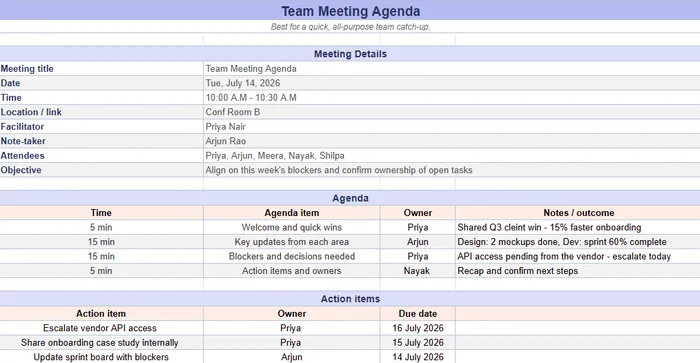
The team meeting agenda template helps you organize every team meeting in one place. Use it to plan the discussion, assign owners, capture important notes, and track action items so nothing gets missed.
Best For: Weekly team meetings, department check-ins, project updates, and cross-functional team discussions.
2. Weekly Team Sync Agenda Template
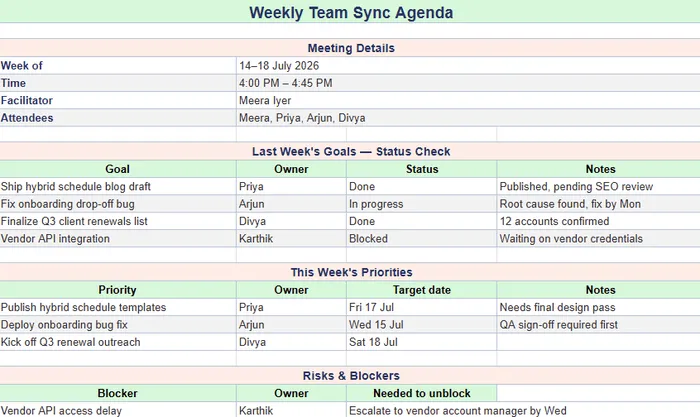
The weekly team sync agenda template helps to review last week's progress, align priorities for the week ahead, and identify any risks or blockers early. It keeps everyone on the same page with clear ownership and next steps.
Best for: Weekly team syncs, project status meetings, sprint check-ins, and recurring team planning sessions.
3. Daily Standup Agenda Template
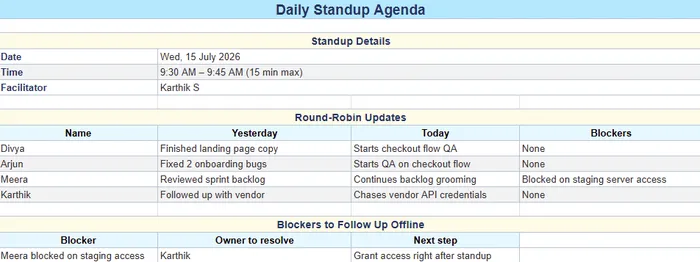
The daily standup agenda template helps teams stay aligned with quick updates on yesterday's progress, today's priorities, and any blockers. Its simple format keeps standups short, focused, and easy to follow.
Best for: Daily standups, Agile teams, Scrum meetings, and project progress check-ins.
4. Project Kickoff Meeting Agenda Template
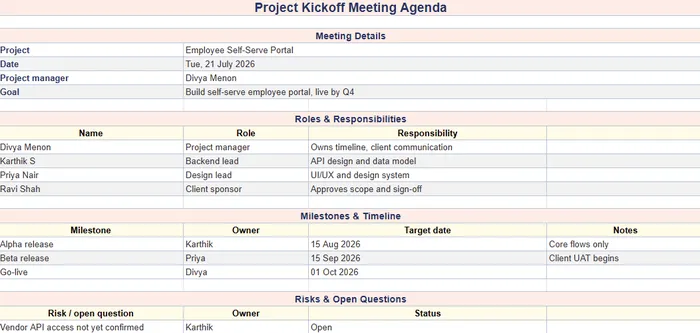
The project kickoff meeting agenda template helps teams start new projects with clear goals, defined roles, and a shared timeline. It also includes space to track milestones, discuss risks, and align everyone before work begins.
Best for: Project kickoffs, client onboarding, cross-functional projects, and new initiative planning.
5. One-on-One Meeting Agenda Template
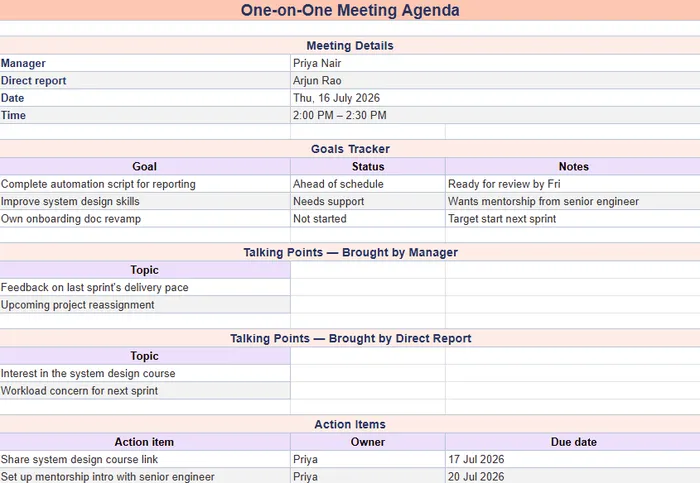
The one-on-one meeting agenda template helps you have focused conversations about employees’ goals, progress, feedback, and career growth. It also includes space to capture discussion points and action items, so every check-in ends with clear next steps.
Best for: Manager-employee check-ins, performance discussions, coaching sessions, career development, and regular one-on-one meetings.
6. Sprint Planning Agenda Template
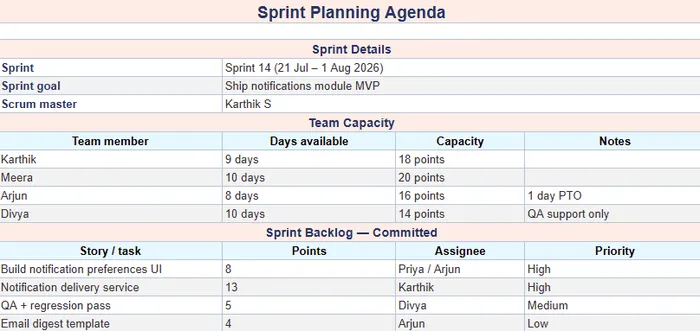
The sprint planning agenda template helps Agile teams plan each sprint with clear goals, team capacity, and prioritized backlog items. It keeps everyone aligned with what will be delivered and who is responsible for each task.
Best for: Sprint planning meetings, Scrum teams, Agile projects, and product development planning.
7. Sprint Retrospective Agenda Template
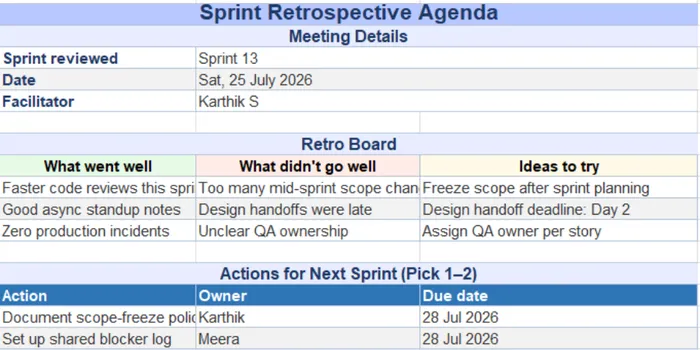
The sprint retrospective agenda template helps teams reflect on what worked well, identify challenges, and agree on improvements for the next sprint. It also includes an action plan to turn feedback into meaningful changes.
Best for: Sprint retrospectives, Agile teams, Scrum ceremonies, and continuous improvement meetings.
8. All-Hands Agenda Template
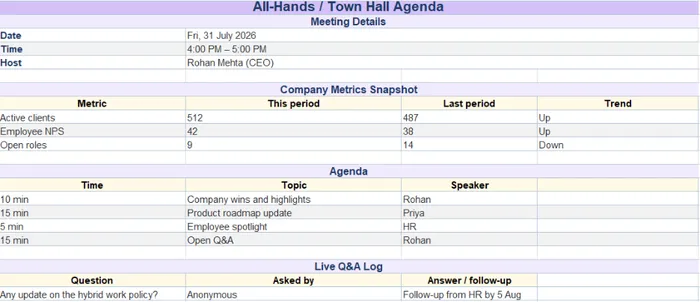
The board meeting agenda template helps keep board meetings organized by covering attendance, key resolutions, voting outcomes, and follow-up actions. It provides a clear record of decisions while ensuring important governance discussions stay on track.
Best for: All-hands meetings, town halls, company updates, quarterly reviews, and leadership announcements.
9. Board Meeting Agenda Template
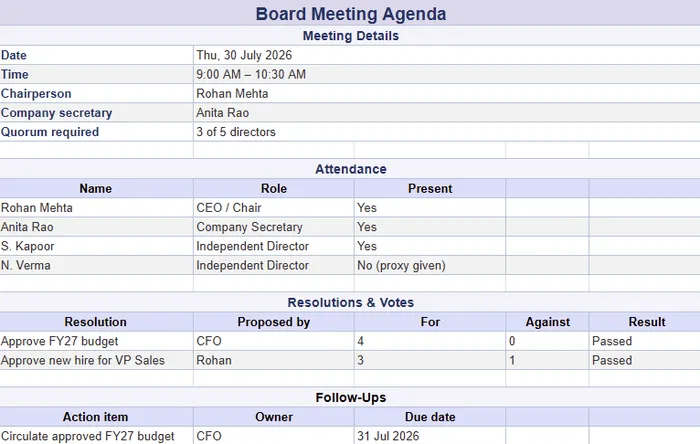
The board meeting agenda template helps keep board meetings organized by covering attendance, key resolutions, voting outcomes, and follow-up actions. It provides a clear record of decisions while ensuring important governance discussions stay on track.
Best for: Board meetings, executive meetings, governance reviews, and shareholder discussions.
10. Client Check-In Agenda Template
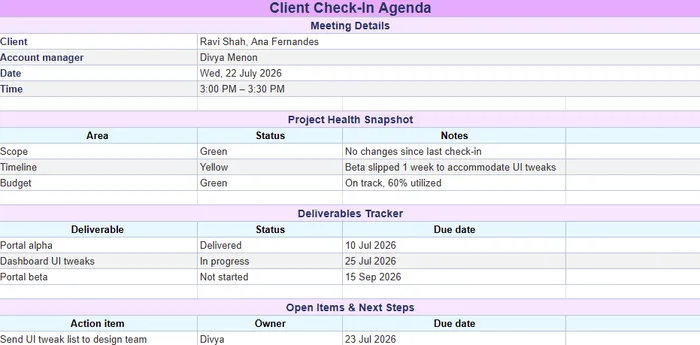
The client check-in agenda template helps you run structured meetings with clients by reviewing project progress, timelines, deliverables, and next steps. It keeps both teams aligned and ensures every meeting ends with clear action items.
Best for: Client status meetings, project update calls, account management, and recurring client check-ins.
How Much Does a Meeting Really Cost?
Here's something most meeting agenda templates don't tell you: every meeting has a cost. Before scheduling one, take a minute to estimate what it will actually cost your team.
A simple way to calculate meeting cost is:
Meeting Cost = Number of Attendees × Average Hourly Rate × Meeting Duration (Hours)
For example, if eight employees earning an average of $50 per hour attend a one-hour meeting, that single meeting costs $400 in employee time.
| Meeting | Attendees | Average Hourly Rate | Duration | Estimated Cost |
|---|---|---|---|---|
| Weekly status meeting | 8 | $50 | 1 hour | $400 |
| Same meeting (52 times/year) | 8 | $50 | 52 hours/year | ~$20,800 |
| Reduced to 30 minutes | 8 | $50 | 26 hours/year | ~$10,400 |
Looking at meetings in dollars changes the way you think about them. It becomes easier to ask, "Does everyone really need to be here?" or "Could this be a 30-minute meeting, or even an email?" or "Something as simple as office digital signage can deliver the same update at a fraction of the cost, with zero time pulled from anyone's calendar". A clear meeting agenda helps make sure the time and money spent on a meeting lead to real decisions and next steps.
But to improve your meetings, you first need to know where your team's time is going. Tools like Time Champ make that easy. Time Champ is an employee monitoring software that helps you get visibility into how much time employees spend in Zoom, Microsoft Teams, and Google Meet. With that insight, you can find meetings that can be shortened, improved, or replaced with quick updates.
Common Meeting Agenda Mistakes to Avoid
Even with a solid meeting agenda template, small habits can quietly ruin the effectiveness of a meeting. Here are the most common mistakes to watch out for:
- Treating the Agenda as Optional: A meeting agenda should guide the discussion, not just sit in the invite. Without it, meetings easily lose direction.
- Turning the Agenda into a Checklist: An agenda isn't just a list of topics. Focus on decisions and outcomes, not random discussion points.
- Ignoring Follow-Ups: A meeting isn’t complete until action items, owners, and deadlines are clearly noted and shared.
- Going Off-Topic: New ideas are useful, but unrelated discussions should be saved for another meeting to respect everyone’s time.
- Never Improving Your Agenda: For recurring meetings, review what worked and refine your agenda over time to make each session more effective.
Conclusion
A clear meeting agenda template is one of the easiest ways to make your meetings more focused, efficient, and outcome-driven. It keeps everyone aligned, reduces wasted time, and ensures discussions lead to clear action points. Start using the templates and steps shared in this guide to structure your next meeting better. Before every meeting, take a few minutes to set an objective, add time-boxed topics, and assign owners, it will instantly improve the quality of your meetings.

Jahnavi Pulluri

Table of Content
 What is a Meeting Agenda?
- What Should a Meeting Agenda Include?
- How to Write a Meeting Agenda in 6 Steps
- 10 Meeting Agenda Examples and Templates
- How Much Does a Meeting Really Cost?
- Common Meeting Agenda Mistakes to Avoid
- Conclusion
Instant Signup
Thank you for your request!
We have received your signup request and our team will get back to you soon. In the meantime, you can book a demo to see Time Champ in action.
Book a DemoFree trial. No credit card required. Prefer a walkthrough? Book a demo.
Related Blogs
Download free employee transfer letter templates for quick and professional use. Explore types, benefits, and templates to simplify every employee transition.
Guna Lakshmi | July 24, 2025
Create a compliant and effective GPS tracking policy. Download a free, customizable template and explore best practices for ethical operation and compliance.
Chetana Choudary | July 24, 2025
Discover free Employee Development Plan (EDP) templates and a practical use case guide to help build effective growth plans for every employee role
Thasleem Shaik | August 08, 2025
Discover the meaning, benefits, and types of work plan templates. Learn how to create one step-by-step and what to include for effective project planning.
Shabana Shaik | August 08, 2025
Download 5 free workforce planning templates for 2025 in Excel. Simplify headcount planning, skills gap analysis, succession & project capacity planning.
Thasleem Shaik | October 01, 2025
Explore Kanban board templates for projects, teams, HR, and IT. Free Excel, Word, and PDF downloads to visualise tasks and streamline workflows.
Thasleem Shaik | November 3, 2025


 4.7/5 avg.
Ready to Manage Your Workforce Smarter?
Join our family of 1500+ companies using smart insights to redefine workforces!

Free Trial
No Credit Card Required