Employee Accountability: How to Measure and Improve It
Learn what employee accountability means, how to measure it the right way (not just activity), and 7 practical ways to improve it without micromanaging.

Have you ever run a project where everyone was responsible for it, and somehow nobody was accountable? The deadline slips, you ask what happened, and you get a circle of perfectly reasonable explanations, each one ending with someone else's name.
Nobody lied, nobody slacked exactly, and yet the thing just did not get done, because nobody was ready to take accountability for the task.
Accountability is not about being lazy, it’s most prominently caused by unclear expectations, fuzzy ownership, and the absence of the ability to see who actually moved the work forward
The harder you squeeze, the more people perform accountability instead of really practicing it.
So, in this blog, I’ll sort it out properly and cover: what employee accountability really means, how it is different from responsibility, how to actually measure it (the part most articles skip), and seven ways to improve it, all without turning into the manager who hovers. Let's get into it.
What is Employee Accountability?
Employee accountability is when people take ownership of their work, their commitments, and the results of both, the wins and the misses. Accountability is not about playing the blame game or punishing people for the work they accounted for. It simply means everyone knows what they are responsible for, follows through on it, and is willing to answer for the end outcome. The healthiest version of accountability is built on clarity and trust, not fear.
Think of it as the difference between I did my part and I own the result. A team with strong accountability does not need chasing because people have internalized what good looks like and they hold themselves to it. Your job as a manager is mostly to make that easy by being clear about expectations and fair about how you measure them.
Accountability vs Responsibility: What is the Difference?
There’s a thin line between accountability and responsibility, let me break it down for you:
Responsibility is the task you are assigned to do.
Accountability is owning the outcome of that task, including answering for it.
You can give someone responsibility, but accountability is something a person him/herself accepts.
In a team, several people can be responsible for different steps, while one person stays accountable for the whole result.
Here’s a clean laydown:
| Query | Responsibility | Accountability |
|---|---|---|
| What it is | The task you are given to do | Owning the outcome of that task |
| Can it be shared? | Yes, across several people | Best held by one clear owner |
| Given or accepted? | Assigned to you | Accepted by you |
| The question it answers | Who is doing the work? | Who answers for the result? |
Why Employee Accountability Matters (with the data)
Employee accountability does matter because it is the quiet driving engine behind reliable teams. When people own their outcomes, work gets finished, trust grows, and you stop spending your week chasing updates from everyone.
When accountability is neglected, deadlines slip, work quality drops, and the whole team learns that follow-through is optional.
A few stats I want you to look at:
- Clarity is Shockingly Rare: Gallup found that only about 45% of employees clearly know what is expected of them at work, down from 56% in 2020. You obviously cannot hold someone accountable for a target they never knew about.
- Managers Set the Tone: Gallup also reports that managers account for about 70% of the variance in team engagement, which means accountability culture rises and falls largely on how you lead it.
- Disengagement is Expensive: Low engagement and weak follow-through cost the global economy an estimated $438 billion in lost productivity, a big chunk of which is simply work that was owned by no one.
What Causes a Lack of Accountability at Work?
A lack of accountability might shoot up because of more than a few reasons, here I have listed some of them:
| Cause | What it looks like | The fix in one line |
|---|---|---|
| Unclear expectations | People guess at what good means | Define outcomes, not just tasks |
| No feedback loop | Misses go unnoticed for weeks | Give regular, specific feedback |
| No consequences either way | Great work and poor work look the same | Recognize follow-through, address misses |
| Leaders do not model it | Do as I say, not as I do | Own your own commitments first |
| Blame culture | Owning a mistake feels dangerous | Make it safe to say I missed this |
Get real-time visibility into your team’s work!
Time Champ gives you the visibility needed to evaluate accountability! Sign Up For Free Book Demo
How to Measure Employee Accountability
Now you know how important accountability is for growth, you also need to know how to actually measure it the right way, so that you don’t end up confusing it with activity again.
The simplest test is whether commitments made turn into commitments met, consistently, over time. Activity tells you someone was busy. Accountability data tells you whether the work they owned actually happened.
Instead of vibes, track signals like these:
| What to Measure | What it Tells You | How to Read it |
|---|---|---|
| Commitments met vs made | Reliability of follow-through | The single clearest accountability signal |
| On-time completion rate | Whether owners hit deadlines | Falling rate means clarity or capacity issues |
| Work quality and rework | Ownership of the result, not just the task | High rework hints at low ownership |
| Ownership of misses | Whether people answer for outcomes | Owning a miss early is a good sign, not a bad one |
| Consistency over time | Accountability as a habit, not a mood | Look at trends, not one-off weeks |
Now you know what to track, let me also tell you where to look:
Pull these from the tools you already use, your project board, your goals, and a workforce intelligence tool that shows how work actually flows.
Accountability vs Surveillance: The Line You Should Not Cross
This is the section I wish more guides included, because it is where good intentions go wrong. Accountability and surveillance can look similar from the outside, but they come from completely opposite places.
Accountabilityis about shared clarity, people owning outcomes they helped define.
Ex: Did we get the outcome we agreed on?
Surveillance is about control, watching activity to catch people out.
Ex: Surveillance asks, are they working right now?
One builds immense trust while the other quietly destroys it.
When you measure activity and police people, they learn to perform busyness.
When you measure outcomes transparently and use the data together, people own their results.
So yes, definitely measure, but measure outcomes, share the data openly, and never let monitoring become a hidden camera.
That is the line between intelligence that helps and surveillance that hurts.
How to Improve Employee Accountability: 7 Ways That Work
If you want to encourage your employees to take accountability for their work, here’s how you can do that efficiently:
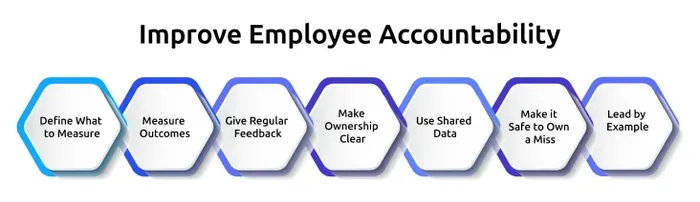
- Define What Good Looks Like: Give every role and project clear, outcome-based goals. Most accountability gaps start here.
- Measure Outcomes, Not Optics: Judge finished work and quality, not hours online or reply speed.
- Give Feedback Regularly: Short, specific check-ins catch small misses before they become big ones.
- Make Ownership Clear: Every important outcome needs one accountable owner, you don’t need a whole committee for it.
- Use Shared Data: Let people see the same numbers you do, so conversations are about facts, not opinions.
- Make it Safe to Own a Miss: Reward people who flag problems early instead of punishing honesty.
- Lead by Example: Own your own commitments visibly, teams copy what managers do, not what they say.
Holding Remote and Hybrid Teams Accountable
Remote and hybrid work is where accountability gets tested to its brim, because you cannot just rely on seeing people at their desks. The trick here is to lean even harder into outcomes, when you cannot watch the work happen, what someone delivers becomes the only fair measure, which is honestly how it should have been all along.
A few things that help with distributed teams:
- Write all your expectations down, verbal clarity fades fast when your team is working across time zones.
- Agree on deliverables and deadlines, then judge results, not green status dots.
- Use shared dashboards so everyone sees the same progress, wherever they sit.
- Replace constant check-ins with a steady rhythm of outcome-based reviews.
A Quick Employee Accountability Self-audit
Before you self-confirm your team has an accountability problem, run this quick check yourself first. To be honest, most of these point back to the manager, not the team.
- Does every important outcome have one clear, named owner?
- Could each person tell you exactly how their work is measured?
- Do you give feedback on follow-through at least every couple of weeks?
- Is it safe on your team to say I missed this without fear?
- Do you measure outcomes, or just activity and availability?
If you answered no a few times, then that’s good news: that is not a people problem, it is a fixable system problem, and you just found your starting point.
How Time Champ Helps You Measure and Build Accountability
Time Champ is a smart employee monitoring software with a workforce intelligence layer. That layer is a very important part here, because it is built to show how work actually flows and where outcomes happen, not just whether someone is active. That is exactly the shared, honest data that real accountability needs.
For accountability specifically, here is where it helps:
- See Ownership Clearly: Understand who is moving which work forward, so accountability is based on facts, not memory.
- Measure Outcomes, Not Optics: Pair activity with real results and completion, so follow-through is what shows up.
- Spot Issues Early: Catch slipping deadlines, overload, or stuck work before they become missed commitments.
- Transparent by Default: Employees get their own self-service dashboard, so accountability feels fair and shared, not like surveillance, with an optional stealth mode for specific security needs.
- Built for Trust and Compliance: Supports GDPR, ISO 27001, HIPAA, and SOC 2, so accountability never comes at the cost of privacy.
When you use monitoring in the right way, it stops being about only watching people and becomes about giving everyone proper visibility.
That is the whole difference between surveillance that breeds theater and intelligence that builds ownership.
Ready to build accountability on real data and not guesswork?
A Few Final Words
Employee accountability is not about catching people doing less or doing wrong. It is about making it easy for them to do right, by being clear about what they own, fair about how you measure it, and honest about the data you both can see. Get that foundation right, and the never-ending chasing stops, because people only own the outcomes they understand and trust. So, define what good looks like, measure outcomes instead of optics, make it a safe place to own a miss, and lead it yourself. Do these things, and accountability stops being something you enforce and becomes something your team adapts.
Table of Content
 What is Employee Accountability?
- Accountability vs Responsibility: What is the Difference?
- Why Employee Accountability Matters (with the data)
- What Causes a Lack of Accountability at Work?
- How to Measure Employee Accountability
- Accountability vs Surveillance: The Line You Should Not Cross
- How to Improve Employee Accountability: 7 Ways That Work
- Holding Remote and Hybrid Teams Accountable
- A Quick Employee Accountability Self-audit
- How Time Champ Helps You Measure and Build Accountability
- A Few Final Words
Related Blogs
In the ever-changing landscape of modern business, the tools we use to assess, monitor, and manage our work can mean the difference between success stagnation.
Mounika Sai | Dec 02, 2023
See how employee monitoring strengthens accountability, improves transparency, and helps teams perform better without crossing into workplace surveillance.
Anjali | Jul 01, 2026
Unlock the secrets to evaluating and boosting employee satisfaction. Explore actionable tips and techniques for measuring and enhancing workplace morale.
Tarun Kumar Reddy | Jul 10, 2024
Explore ethical employee monitoring techniques to track work transparently, protect privacy, and improve productivity while building trust across your team.
Anjali | Apr 27, 2026
Boost team productivity and performance with effective tracking methods. Enhance productivity through data-driven insights and actionable strategies.
Shabana Shaik | Mar 17, 2025


 4.7/5 avg.
Ready to Manage Your Workforce Smarter?
Join our family of 1500+ companies using smart insights to redefine workforces!

Free Trial
No Credit Card Required