Employee Satisfaction: What It Is, How to Measure and Improve It
Learn what employee satisfaction is, its benefits, the 7 key factors that drive it, and proven ways to measure and improve it at your workplace effectively.

If you want to know how to measure and improve employee satisfaction in your organization, you're in the right place.
Employee satisfaction is more than keeping employees happy. It reflects how employees feel about their work, leadership, career growth, compensation, work-life balance, and overall workplace experience. These factors directly influence productivity, retention, engagement, and business performance.
This guide covers everything you need to know about employee satisfaction, including its definition, benefits, key drivers, measurement methods, and practical strategies to improve it.
Key Takeaways
- Employee satisfaction reflects how employees feel about their job, workplace, and overall experience.
- Higher employee satisfaction improves productivity, retention, and business performance.
- You can measure employee satisfaction through surveys, eNPS, one-on-one meetings, and workplace data.
- Fair pay, recognition, career growth, supportive leadership, and work-life balance are the biggest drivers of employee satisfaction.
- Improving employee satisfaction requires continuous feedback and consistent action.
What Is Employee Satisfaction?
Employee satisfaction is how content and fulfilled employees feel about their job, workplace, and overall employment experience. It reflects whether employees find their work meaningful, feel fairly treated, and enjoy the environment they work in. High employee satisfaction leads to higher productivity, lower turnover, and stronger business performance.
Employee Satisfaction vs Employee Engagement
People use these two terms interchangeably, but they measure different things. Both matter, and both improve when addressed together.
| Employee Satisfaction: The Attitude | Employee Engagement: The Behavior |
|---|---|
| Employee satisfaction measures how employees feel about their job, workplace, and conditions. It focuses on contentment, comfort, and whether expectations are being met. You measure it with survey questions like "How happy are you with X?" A satisfied employee likes their job but may not push to go above and beyond. | Employee engagement measures how invested employees are in their work and the company. It focuses on effort, passion, and initiative. You measure it with questions like "How willing are you to go above and beyond?" An engaged employee does not just show up; they push for outcomes. |
For deeper coverage of engagement, see our Employee Engagement Statistics and Impact on Productivity guide.
Why Is Employee Satisfaction Important?
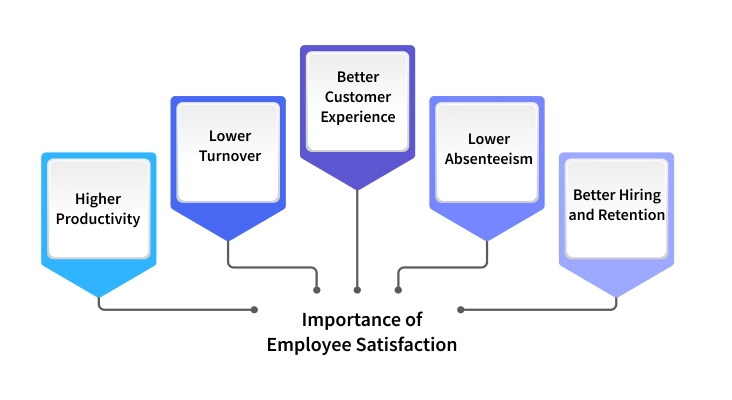
Employee satisfaction is not a soft metric. It directly shapes productivity, retention, customer results, and profit. Below are the 5 key benefits of employee satisfaction.
1. Higher Productivity
Unhappy employees are expensive. McKinsey research shows that a mid-size S&P 500 company loses $228 million to $355 million each year in productivity due to disengaged workers. Over five years, that adds up to more than $1 billion per company. Satisfied employees do better work, make fewer mistakes, and treat customers better.

Did You Know?
Only 20% of employees worldwide felt engaged at work in 2025, according to the Gallup State of the Global Workplace 2026 report. This drop cost the global economy about $10 trillion in lost productivity.
2. Lower Turnover
Pay is not what drives most people to quit. MIT Sloan Management Review found that a bad workplace culture is 10 times more likely to cause employees to leave than low pay. Fixing culture, respect, and recognition keeps people longer than a raise does. When people leave, teams also lose knowledge, morale, and momentum.
For deeper coverage of the retention side, see our guide on Employee Retention: Benefits and Strategies.
3. Better Customer Experience
Satisfied employees deliver better customer service. The link is direct and easy to measure, especially in customer-facing roles. When employees feel valued, customers feel it in every interaction. Business results like revenue growth, customer retention, and referrals follow strong customer experiences.
4. Lower Absenteeism
Unhappy employees skip work more often. And that adds up fast. The CDC reports that absenteeism costs U.S. employers $225.8 billion each year in lost productivity. Satisfied employees take fewer unplanned sick days, and stay focused when they are at work. Consistent attendance is one of the clearest signs of a healthy, engaged workplace.
5. Better Hiring and Retention
Satisfied employees become your best recruiters. They refer good candidates, speak well about you on Glassdoor and LinkedIn, and shape how future hires see your workplace. Companies with high employee ratings attract better talent for every open role. And the loyalty runs both ways. Happy employees stay longer, cutting your hiring costs and protecting the knowledge, relationships, and momentum your business runs on.
What Are the Key Factors That Drive Employee Satisfaction?
Seven factors shape employee satisfaction across nearly every industry. When each factor is healthy, satisfaction rises. When one or more fails, dissatisfaction spreads faster than you expect.
| Factor | What Works Well | Common Failure |
|---|---|---|
| Pay and Benefits | Fair salary, health coverage, retirement plans | Below-market pay or slow raises |
| Growth Opportunities | Clear career paths, training, promotions | No visible next step |
| Recognition | Regular appreciation, awards, praise | Contributions go unnoticed |
| Work-Life Balance | Reasonable hours, flexibility, paid time off | Constant overwork, no boundaries |
| Management Quality | Supportive, skilled, communicative leaders | Micromanagement or absent leaders |
| Company Culture | Psychological safety, inclusion, trust | Toxic behavior, gossip, blame |
| Meaningful Work | Clear purpose, visible impact | Feeling like a cog in the machine |
How to Measure Employee Satisfaction?
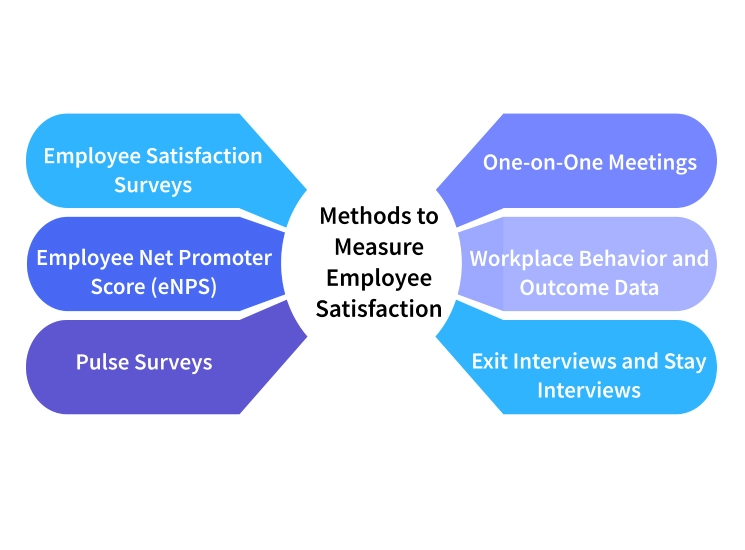
Use the following 6 methods to measure employee satisfaction accurately.
1. Employee Satisfaction Surveys
Structured surveys are the most common way to measure employee satisfaction. Here's how to run them right:
- Frequency: Send surveys every 3 months, twice a year, or once a year
- Topics to Cover: Pay, growth, management, culture, work-life balance, and workload
- Question Types: Mix rating questions (1 to 5 or 1 to 10) with open-ended questions
- Anonymity: Keep answers anonymous so people can be honest
When workers think their answers can be traced, they hold back. Research from the American Psychological Association found that around 87% of employees feel more comfortable giving honest feedback when surveys are anonymous. Without it, you get polite answers instead of the truth.
2. Employee Net Promoter Score (eNPS)
Ask a single question: "On a scale of 0 to 10, how likely are you to recommend this company as a place to work?" Group the responses:
- Promoters: Score 9 to 10
- Passives: Score 7 to 8
- Detractors: Score 0 to 6
Formula
Employee Net Promoter Score (eNPS) = % Promoters - % Detractors.
Scores range from -100 to +100. A positive score is good. Anything above +30 is strong.
For a deeper look, see our Employee Net Promoter Score guide.
3. Pulse Surveys
Pulse surveys are quick check-ins that catch real-time feelings, so problems surface in days instead of months. Here's how to run them right:
- Length: Short surveys with just 3 to 5 questions
- Frequency: Send weekly or every other week
- Focus Areas: Specific topics like workload, recognition, or management
- Pairing: Work best when combined with a full annual survey
The speed is what makes pulse surveys valuable. You spot burnout, unhappiness, or team friction while there is still time to fix it, not after your best people have already checked out.
4. One-on-One Meetings
Weekly or biweekly meetings between managers and team members are not satisfaction surveys, but they give one of the strongest qualitative signals you can get. Here's what to cover:
- Career Goals: Where the employee wants to grow next
- Blockers: What is slowing them down or frustrating them
- Workload: Whether they feel stretched, balanced, or under-used
- Feelings: How they are doing personally and at work
Managers who hold one-on-ones regularly spot dissatisfaction early, before it turns into a resignation letter. The best signals come from what employees say between the lines, not from any survey score.
5. Workplace Behavior and Outcome Data
Some satisfaction signals show up in day-to-day data, not surveys:
- Turnover Rate: High turnover often signals low satisfaction, especially among people who leave within two years
- Absenteeism Rate: Unplanned absences link closely to dissatisfaction and burnout
- Referral Rate: Happy employees refer friends. Unhappy ones do not
- Grievance Rate: Formal complaints point to culture or management problems that need action
For deeper coverage of specific metrics, see our guide on 20 Employee Performance Metrics to Track.
Improve Employee Satisfaction with Real-Time Work Insights.
Use Time Champ to track attendance, productivity, and work patterns in one place.
6. Exit Interviews and Stay Interviews
Exit and stay interviews are direct conversations that surface honest signals faster than any survey can. Here's how each one works:
- Exit Interviews: Find out why employees quit and spot patterns your company needs to fix
- Stay Interviews: Talk to current employees about why they stay and what might make them leave
- Speed: Both give you answers faster than a yearly survey
- Together: Show you what makes people happy and what quietly drives them away
The results speak for themselves. HR.com's State of Employee Retention 2025-26 report found that companies with the best retention use stay interviews 4 times more than companies losing lots of employees (40% vs 10%). Asking your best people why they stay is one of thestrongest signs of a healthy workplace.
What Is the Employee Satisfaction Rate Formula?
The employee satisfaction rate is the percentage of employees who report being satisfied with their job and workplace. It gives you a single number to track over time. Easy to calculate, easy to follow.
Formula
Employee Satisfaction Rate = (Number of Satisfied Employees ÷ Total Employees Surveyed) × 100
Example
If 82 out of 100 surveyed employees say they are satisfied, your satisfaction rate is 82%.
Track it every quarter or year to see trends. A rising number means your actions are working. A falling number means something has changed and needs attention.
The Employee Satisfaction Index (ESI)
For a more detailed view, use the Employee Satisfaction Index (ESI). It combines three questions on a 1 to 10 scale:
- How satisfied are you with your current workplace?
- How well does your current workplace meet your expectations?
- How close is your current workplace to your ideal job?
Formula
Employee Satisfaction Index (ESI) = ((mean question score ÷ 3) - 1) ÷ 9 × 100
The result falls between 0 and 100. ESI captures more than a single-question rate because it factors in expectations and how workers compare their current job to their ideal one. Both are strong predictors of whether employees will stay.
How to Read Satisfaction Scores
- 80% or Higher: Strong workplace with low attrition risk.
- 60% to 79%: Healthy, but clear improvement areas exist. Identify specific low-scoring topics.
- 40% to 59%: Warning zone. Take targeted action within 30 to 60 days.
- Below 40%: Urgent intervention needed across pay, culture, or leadership.
How to Improve Employee Satisfaction? 7 Proven Strategies
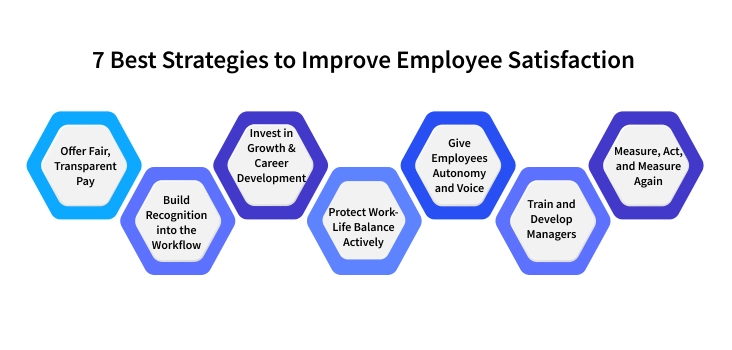
Follow these 7 proven strategies to improve employee satisfaction and performance in their jobs.
1. Offer Fair, Transparent Pay
Fair pay does not make employees love their jobs. But unfair pay makes them hate everything about their jobs, including the things you do right. Payscale research found that pay transparency reduces intent to quit by 30%.
Here is how to build fair, transparent pay:
- Compare your salaries to the market every 6 months. Use tools like Payscale, LinkedIn Salary, or Glassdoor to check if your pay matches what other companies offer for similar roles.
- Share your pay bands with your employees. Tell them the salary range for each role and what it takes to move up.
- Give raises before employees ask for them. Adjust pay when the market shifts, when someone takes on more work, or when performance clearly stands out.
Hidden pay bands breed resentment. Reactive raises always feel less genuine than proactive ones. When pay feels fair, satisfaction rises across every other area you measure.
2. Build Recognition into the Workflow
Recognition costs you almost nothing. But it delivers more value than most perks you can offer.
According to Workhuman and Gallup research, well-recognized employees are 45% less likely to leave within two years, and employees who feel recognized are nearly 4 times as likely to be engaged.
- Praise good work often and in public. Weekly recognition works better than yearly awards.
- Let coworkers recognize each other, not just you as their manager.
- Praise specific results, not just general effort or long hours.
"Great job on the launch" carries less weight than "You turned around the customer objection that saved the deal." Specific recognition sticks. Vague praise fades.
3. Invest in Growth and Career Development
Your people stay where they can grow. They leave when they see no future with you.
LinkedIn's research found that 94% of employees would stay at a company longer if the company invested in their career growth.
How to invest in your team's growth:
- Set aside a training budget every year for courses, certifications, and conferences your employees want.
- Map out career paths so every employee knows what role comes next and how to reach it.
- Promote from within your team whenever you have an open senior role.
When you always hire outside people for senior roles, your current employees get the wrong message. They feel there is no growth for them at your company. Show your people you value them before they start job hunting.
Learn more in our guide on Employee Retention: Benefits and Strategies.
4. Protect Work-Life Balance Actively
Your actions set the rules for your team, not your written policies. You shape your culture whether you mean to or not.
- Make it clear that off-hours messages can wait until the next morning.
- Show healthy boundaries in your own behavior first.
- Push your employees to actually use their paid time off.
If you send emails at 11 PM, your employees will think 11 PM emails are expected. Your policy does not matter if your behavior does not match it. Unused PTO usually means your employees feel pressure to skip time off.
Want to Help Your Employees Maintain a Healthy Work-Life Balance?
Time Champ gives you clear visibility into workloads, work hours, and overtime, so you can prevent burnout and support a healthier workplace.
5. Give Employees Autonomy and Voice
Autonomy is one of the strongest ways to boost your team's satisfaction. It costs you nothing but shows your employees that you trust them.
- Include your team in decisions that affect their work.
- Cut down on approvals your employees need to get their work done.
- Act on survey feedback in the open, so your team sees results.
When your employees see their feedback lead to real change, they keep speaking up. When they see nothing happen, they stop filling out your surveys. Your trust builds satisfaction better than any perk ever will.
6. Train and Develop Managers
Managers account for 70% of the variance in team engagement, according to Gallup's State of the Global Workplace 2026 report. This is the single highest-ROI investment you can make in satisfaction.
- Train managers on coaching, feedback, and one-on-ones, not just annual reviews.
- Coach them on how to have hard conversations without damaging relationships.
- Measure manager effectiveness through team engagement scores, not self-reporting.
Great managers create satisfaction. Poor ones destroy it, no matter how good the pay package is. Learn more in our guide on How to Keep Your Remote Teams Motivated.
7. Measure, Act, and Measure Again
Measurement without action is worse than no measurement at all. It teaches employees their voice does not matter.
- Combine annual satisfaction surveys with quarterly pulse checks.
- Share results openly, including the uncomfortable ones.
- Attach specific action items to low-scoring areas within 30 days of survey close.
- Measure again quarterly to check whether your actions actually worked.
Employees respect honesty about problems more than they respect polished summaries. Follow-through builds trust. Broken promises destroy it.
What Are the Warning Signs of Low Employee Satisfaction?
Some signs of employee dissatisfaction appear before survey scores drop. Managers who spot these early prevent turnover and disengagement before they take hold. Watch for patterns across four categories.
Behavior Signs
- Rising unplanned absences (sick days, personal days, no-shows)
- Falling participation in optional activities like team events, training, and celebrations
- Reduced initiative (waiting to be told what to do instead of taking ownership)
- More frequent conflict, with small disputes escalating faster than they used to
Communication Signs
- Quieter one-on-ones, with employees no longer raising concerns or fresh ideas
- More complaints about specific policies, tools, or managers
- Feedback tone shifts from constructive to bitter or resigned
Output Signs
- Missed deadlines become more common among usually reliable performers
- Quality drops across capable employees who used to deliver excellent work
- Rising rework rates, defect rates, or customer complaints tied to specific team members
Attrition Signals
- Top performers start updating their LinkedIn profiles
- Referral rate drops (happy employees refer friends; unhappy ones do not)
- Exit interview themes cluster around the same two or three issues
Build a Happier, More Productive Workplace with Time Champ
Employee satisfaction starts with understanding how work gets done. Use workforce management and employee monitoring tools like Time Champ, which gives you clear insights into team workloads, productivity, attendance, and work patterns. So, you can identify problems before they affect your employees. Here’s how Time Champ helps you in improving employee satisfaction and productivity:
- Workload Management: Balance workloads across your team to prevent employee burnout and improve productivity
- Attendance & Time Tracking: Track employee attendance, work hours, and punctuality accurately to ensure fair evaluations
- Performance Analytics: Recognize top performers and identify employees who may need additional support
- Productivity Insights: Understand work patterns and identify challenges without relying on guesswork
- Flexible Work Support: Manage remote, hybrid, and in-office teams with complete visibility
- Reports & Dashboards: Access real-time reports to make informed decisions that improve employee experience
Ready to Improve Employee Satisfaction?
Start your free trial today and see how Time Champ helps you build a more engaged, productive, and satisfied workforce!

Sai Keerthi Uppala

Table of Content
 What Is Employee Satisfaction?
- Employee Satisfaction vs Employee Engagement
- Why Is Employee Satisfaction Important?
- What Are the Key Factors That Drive Employee Satisfaction?
- How to Measure Employee Satisfaction?
- What Is the Employee Satisfaction Rate Formula?
- How to Improve Employee Satisfaction? 7 Proven Strategies
- What Are the Warning Signs of Low Employee Satisfaction?
- Build a Happier, More Productive
Workplace with Time Champ
Instant Signup
Thank you for your request!
We have received your signup request and our team will get back to you soon. In the meantime, you can book a demo to see Time Champ in action.
Book a DemoFree trial. No credit card required. Prefer a walkthrough? Book a demo.
Related Blogs

Employee Net Promoter Score (eNPS) is a metric used by organizations to measure the overall satisfaction and loyalty of their employees.
Vijaya Lakshmi | Apr 04, 2024
Learn what employee retention is, why it matters, and discover proven strategies to retain top talent, reduce turnover, and build a more engaged workforce.
Guna Lakshmi | Jul 22, 2026
Discover effective strategies to keep your remote employees motivated and engaged, ensuring peak productivity and performance.
Jahnavi Pulluri | Nov 12, 2024
Think about going to a workplace where people are full of energy. People look at their peers with warm smiles, people do not hesitate to share their ideas
Thasleem Shaik | Jun 27, 2024
Boost work-life balance in your workforce with simple, effective strategies. Reduce stress, prevent burnout, and create a healthier work culture.
Shabana Shaik | Feb 25, 2025
Discover 20 essential employee performance metrics to track. Learn how to measure and implement these metrics to boost productivity and drive success.
Shabana Shaik | August 08, 2025


 4.7/5 avg.
Ready to Manage Your Workforce Smarter?
Join our family of 1500+ companies using smart insights to redefine workforces!

Free Trial
No Credit Card Required