Hybrid Work Productivity Gains in 2026: What the Data Shows
See what the data says about hybrid work productivity gains, including productivity, retention, engagement, cost savings, and long-term business impact.

Trying to improve output in a hybrid setup can feel messy when some work moves fast, some work slows down, and it is hard to see what is actually helping. That is the real problem behind hybrid work productivity gains. You want flexibility without losing focus, collaboration, or accountability.
This guide breaks down what actually improves productivity in a hybrid work model, where the gains show up, and how you can measure them clearly on your team.
What the Research Actually Says About Hybrid Work Productivity
The debate around hybrid work productivity has produced plenty of opinions, but the most reliable research points to a fairly consistent conclusion. Hybrid work does not automatically increase output, but it also does not reduce productivity
when implemented well. Instead, many of the benefits show up through stronger retention, higher job satisfaction, better focus, and lower operating costs.
1. Stanford University Study: Productivity Remains Stable While Retention Improves
One of the strongest studies on hybrid work comes from Stanford University. Researchers conducted a six-month randomized controlled trial involving 1,612 employees and found that hybrid workers maintained the same performance levels as employees working fully in the office.
Key Findings from the Study Include
- No significant decline in employee performance or productivity.
- A 33% reduction in employee turnover among hybrid workers.
- Higher employee satisfaction and improved retention outcomes.
- Evidence based on actual workplace performance rather than self-reported opinions.
2. Industry Research: Businesses Report Broader Productivity Benefits
Academic studies often focus on direct output, but business leaders tend to evaluate productivity through a wider lens that includes efficiency, retention, and operational performance. According to research from International Workplace Group (IWG):
- 72% of organizations reported improved productivity after adopting hybrid work
- 79% reported cost savings
- 71% said hybrid work helped attract and retain talent
These findings suggest that the benefits of hybrid work extend beyond individual output and can positively influence overall business performance.
Not all studies measure productivity in the same way. This is one of the main reasons research findings can vary. When viewed together, the research points to the same result. Hybrid work does not typically reduce productivity. Instead, the research shows that organizations can maintain performance levels while gaining advantages in areas such as employee retention, job satisfaction, and workforce flexibility.
Six Real Productivity Gains from Hybrid Work
Most conversations about hybrid work jump straight to "is it more productive?" but that's the wrong question. The real question is where the gains show up. They don't always appear in raw output. They show up in retention, focus, costs, and talent. These are the factors that quietly compound over months and have a bigger impact on your business results than a few extra hours spent working.
Here are the six productivity gains backed by data.
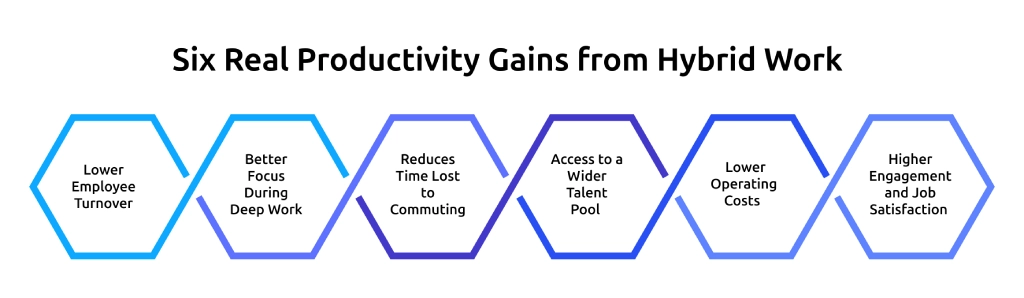
1. Lower Employee Turnover
One of the biggest hybrid work productivity gains comes from improved retention. When skilled employees stay longer, teams spend less time hiring, onboarding, and filling knowledge gaps. A Gallup study found that three in 10 hybrid employees say they are extremely likely to switch companies if remote flexibility is no longer available. This highlights how offering a balance between remote and in-office work can encourage employees to stay with their company and contribute to greater workforce stability.
2. Better Focus During Deep Work
A Harvard Business School study found that face-to-face interactions in open offices dropped by 70% after companies moved to open-plan layouts, with employees relying more on digital communication instead. This shows that the office environment can sometimes create distractions rather than improve collaboration.
A hybrid work policy helps solve this by giving employees the flexibility to choose the best setting for different types of work. Employees can complete focus-intensive tasks at home, while collaboration and team discussions can happen in the office, helping teams produce higher-quality work and stay productive.
3. Reduces Time Lost to Commuting
Long commutes can consume hours each week without adding value to business outcomes. Full-time in-office and hybrid employees spend an average of 31 minutes commuting, and 84% travel up to 45 minutes each way.
Hybrid work reduces the time spent traveling, giving employees more time and energy to dedicate to their workday. As a result, employees can start work with better focus, experience less commuting-related stress, and maintain productivity more consistently throughout the day.
4. Lower Operating Costs
Productivity is not only about output. It is also about how efficiently organizations use resources. Hybrid work can reduce spending on office space, utilities, and workplace operations. CBRE research indicates that 80% of current office occupiers have adopted and plan to maintain hybrid work policies, highlighting how organizations continue to see long-term value in this flexible approach.
5. Access to a Wider Talent Pool
Hybrid work removes many geographic limitations from hiring. This allows companies to hire skilled people from different locations, not just those who live near the office. A broader talent pool often leads to stronger hiring decisions, improved expertise, and better long-term performance across teams.
6. Higher Engagement and Job Satisfaction
Employees with greater flexibility often report stronger job satisfaction and a better work-life balance. These improvements can lead to higher engagement, stronger commitment to goals, and more consistent performance. While engagement is harder to measure than output, it often influences productivity, retention, and overall business results.
Struggling to see which of these gains are actually showing up in your team?
Time Champ's productivity tracking helps you track focus time, compare performance, and measure productivity gains over time.
Where Hybrid Work Does NOT Improve Productivity
Hybrid work can deliver meaningful benefits, but it is not a guaranteed solution for every team or every type of work. Let's take a closer look at the situations where hybrid work can be more challenging and may require additional support to work effectively.
1. Roles That Depend on Constant Collaboration
Some roles rely on frequent discussions, quick decisions, and continuous teamwork throughout the day. When schedules are not aligned, communication can slow down, and team members may miss important conversations. In these situations, hybrid work is often most effective when teams coordinate shared office days for planning, problem-solving, and collaboration.
2. New Hires and Early-Career Employees
Building skills is often easier when learning happens through direct observation, informal conversations, and regular guidance. Research and industry experts have raised concerns that hybrid and remote environments can reduce access to mentorship opportunities. These can be especially challenging for new hires who are still learning the responsibilities of their role and building workplace relationships.
3. Unstructured Hybrid Policies
Hybrid work performs best when expectations are clear. When there is no agreement on office days, communication practices, or team availability, coordination becomes more difficult. Successful hybrid teams give employees flexibility while also setting clear schedules and guidelines so everyone knows when and how to work together.
How to Measure Hybrid Work Productivity Gains on Your Team
Industry research can provide useful benchmarks, but it cannot tell you whether hybrid work is improving results within your organization. The only reliable way to measure hybrid work productivity gains is to compare performance before and after adopting a hybrid model using consistent metrics.
To get started, here are the key steps you can use to measure productivity gains in a simple and effective way.

1. Establish a Baseline First
Before measuring improvement, you need a starting point. Record your current performance levels for four to six weeks before making any workplace changes. This gives you a clear benchmark for future comparisons.
2. Focus on a Few Key Metrics
Avoid tracking dozens of metrics at once. Choose three to five outcome-based measures that directly reflect team performance.
Examples Include
- Deliverables completed per week
- Project completion time
- Customer satisfaction scores
- Response times
- Employee retention rates
Organizations that focus on outcomes rather than attendance tend to get a more accurate picture of hybrid work success.
3. Track How Your Team Spends Time
One of the clearest hybrid work productivity signals is how time allocation shifts between home days and office days. Are your team's focus hours longer at home? Are meetings heavier on office days?
A productivity tracking tool gives you this breakdown automatically, with no manual logging and no guesswork. You get a clear view of whether employees use remote days for focused work and use office days for collaboration and team activities. This makes it easier to identify what is working and make informed improvements to your hybrid work strategy.
4. Measure Results Over a Longer Period
Making decisions based on only a few weeks of data can lead to inaccurate conclusions about how well your hybrid work model is performing. Teams need time to adjust to new schedules, workflows, and communication habits. Comparing 90-day performance periods usually provides a more accurate view than measuring results after only 30 days.
5. Include Engagement Alongside Performance Data
Productivity is only part of the picture. Engagement, satisfaction, and retention often influence long-term results. Regular pulse surveys and retention tracking can help you understand whether the hybrid work model is supporting sustainable performance over time.
The goal is not to prove that hybrid work is good or bad. The goal is to understand what is working, what needs adjustment, and where measurable improvements are actually happening across your team.
How Time Champ Helps You Track Hybrid Productivity Gains
Measuring hybrid work productivity gains is often harder than determining whether your hybrid work strategy is delivering the expected results. You may notice improvements in performance, collaboration, or efficiency, but without reliable data, it is difficult to know what is actually driving those results.
That's the exact problem Time Champ solves. Instead of relying on assumptions or occasional check-ins, Time Champ gives you a clear view of how work happens across both remote and office days. It helps you understand whether your hybrid strategy is creating the outcomes you expected and where adjustments may be needed.
- Compare Productivity Across Different Work Environments: See how work patterns change between remote and office days. This helps you identify where focused work happens, where collaboration is strongest, and how different work environments influence performance.
- Understand How Time Is Actually Spent: Time Champ automatically tracks active hours, focus time, app usage patterns, and work activity trends. Instead of guessing where time goes, you get a clearer picture of how work flows throughout the day.
- Spot Productivity Trends Early: Track productivity patterns over time to identify improvements, slowdowns, or workload imbalances before they become larger issues. This makes it easier to support teams with data rather than assumptions.
- Measure Progress with Clear Reports: Use detailed productivity reports to compare results across weeks, months, or different hybrid schedules. This helps you evaluate whether changes to your workplace strategy are delivering measurable improvements.
If you're looking for a simple way to understand what drives productivity in a hybrid workplace, Time Champ can help. It provides clear visibility into how work happens across remote and office environments, helping you identify productivity patterns, improve team performance, and make informed decisions based on real data.
Tracking your hybrid work productivity gains without data is guesswork.
Start your free trial and see exactly where your team's productivity stands.
Conclusion
Hybrid work can lead to better productivity, flexibility, and employee satisfaction when managed effectively. The key is understanding what works best for your team and making improvements along the way. Tools like Time Champ help you track productivity, understand work patterns, and make smarter decisions to get the most out of your hybrid work model.

Thasleem Shaik

Table of Content
 What the Research Actually Says About Hybrid Work Productivity
- Six Real Productivity Gains from Hybrid Work
- Where Hybrid Work Does NOT Improve Productivity
- How to Measure Hybrid Work Productivity Gains on Your Team
- How Time Champ Helps You Track Hybrid Productivity Gains
- Conclusion
Instant Signup
Thank you for your request!
We have received your signup request and our team will get back to you soon. In the meantime, you can book a demo to see Time Champ in action.
Book a DemoFree trial. No credit card required. Prefer a walkthrough? Book a demo.
Related Blogs

Discover 40 essential hybrid work statistics to help you boost productivity, enhance employee satisfaction, and stay ahead in today’s flexible work environment.
Tarun Kumar Reddy | Nov 09, 2024
Learn 10 essential hybrid workforce best practices to boost productivity, improve communication, and foster team morale for success in a flexible work setup.
Tarun Kumar Reddy | Nov 12, 2024
Explore the pros and cons of remote vs. hybrid work models, and learn how to choose the best setup for your team
Tarun Kumar Reddy | Oct 25, 2024
Learn to design an effective hybrid work schedule that balances flexibility and productivity, with best practices to fit your team’s needs.
Jahnavi Pulluri | Oct 26, 2024
Learn how to calculate productivity using simple formulas, practical methods, and real examples to measure employee performance accurately.
Thasleem Shaik | May 20, 2026
Discover the hidden cost of low productivity in business. Learn how to calculate productivity loss, reduce inefficiencies, and improve profitability in 2026.
Guna Lakshmi | May 13, 2026


 4.7/5 avg.
Ready to Manage Your Workforce Smarter?
Join our family of 1500+ companies using smart insights to redefine workforces!

Free Trial
No Credit Card Required