How Much Does Low Productivity Cost Your Business in 2026?
Discover the hidden cost of low productivity in business. Learn how to calculate productivity loss, reduce inefficiencies, and improve profitability in 2026.

Low productivity directly affects your business's profitability.
When your employees lose focus, workflows slow down, projects get delayed, and operational efficiency drops, your business starts losing revenue, time, and growth opportunities.
According to Gallup’s State of the Global Workplace Report, low employee engagement costs the global economy nearly $10 trillion annually, equal to around 20% of global GDP. If your business has productivity gaps, hidden costs are already affecting your performance through lower output, burnout, turnover, absenteeism, missed opportunities, and customer dissatisfaction.
In this guide, you will learn how to calculate the real cost of low productivity, understand where your business is losing money, and identify practical ways to reduce productivity losses.
What Is the True Cost of Low Productivity?
The true cost of low productivity includes the financial losses your business experiences when workflows slow down, teams operate inefficiently, and employees struggle to maintain consistent performance. Productivity gaps affect your team's efficiency, increase operational costs, delay projects, and impact customer experience and business growth.
According to Asana’s Anatomy of Work Report, employees spend nearly 79% of their time on work coordination, such as meetings, status updates, and switching between apps, leaving less time for skilled, high-value work.
Low productivity also increases hidden costs like overtime pressure, communication delays, management workload, employee burnout, absenteeism, and employee turnover. Over time, these issues reduce operational efficiency and profitability across your business. That is why you need to measure low productivity as a financial business cost.
Want to see where productivity loss is affecting your business?
Track work hours, identify inefficiencies, and improve workforce performance with Time Champ.
5 Hidden Costs of Low Productivity in Business
Low productivity slowly impacts profitability, team performance, customer relationships, and overall business growth. At first, the impact can seem small, like delayed tasks or slower project completion. But when productivity problems continue for long periods, they quietly create financial pressure across different parts of your business.
Here are five hidden costs you experience when workplace productivity starts declining.
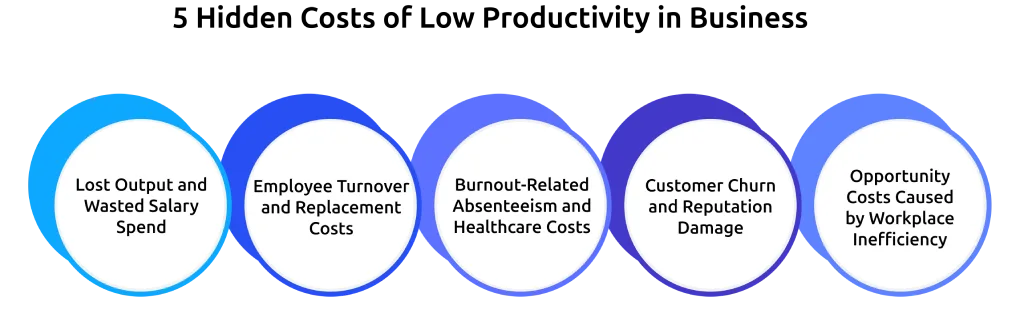
1. Lost Output and Wasted Salary Spend
One of the biggest financial impacts of low productivity is spending on work hours that fail to support business growth and operational goals. When your employees spend significant work hours managing distractions, navigating inefficient processes, or working without clear direction, your business continues to invest in labor costs without receiving results.
Even small productivity gaps across your teams can gradually create substantial financial losses for your business.
2. Employee Turnover and Replacement Costs
Low productivity often increases workplace stress, frustration, and disengagement among employees. Over time, this can contribute to burnout and higher employee turnover.
When employees leave, replacing them becomes expensive and time-consuming. Your business must invest additional resources into recruitment, onboarding, training, and workflow transitions. During this period, productivity usually declines further as existing employees manage extra responsibilities.
Beyond hiring expenses, turnover also affects your business through delayed projects, reduced collaboration, knowledge loss, and operational disruption. If productivity issues remain unresolved, these costs can continue increasing quietly in the background.
3. Burnout-Related Absenteeism and Healthcare Costs
When your employees consistently work under pressure without proper workload management or operational support, burnout gradually begins affecting both performance and well-being.
This often leads to higher employee absenteeism, lower concentration, reduced engagement, and declining work quality. Even when employees remain present at work, many struggle with presenteeism, where they are physically available but mentally disengaged.
As burnout increases across your teams, your business also experiences higher healthcare-related costs, more workplace mistakes, lower morale, and increased employee turnover. Ignoring burnout can create long-term operational instability that becomes increasingly expensive to manage over time.
4. Customer Churn and Reputation Damage
Low productivity does not stay limited to internal operations. It directly affects the experience you deliver to your customers. When your teams operate inefficiently, customers are more likely to experience delayed project delivery, slower support responses, inconsistent communication, and quality-related issues.
Over time, these problems reduce customer trust and increase the chances of customers moving to competitors. That means productivity issues can quietly increase your customer acquisition costs while simultaneously reducing retention rates.

Did You Know?
Research by Frederick Reichheld of Bain & Companyshows that increasing customer retention rates by 5% increases profits by 25% to 95%.
5. Opportunity Costs Caused by Workplace Inefficiency
One of the highest hidden costs of low productivity is opportunity cost. When your employees spend too much time dealing with inefficient workflows, repetitive manual tasks, or disconnected systems, your business loses valuable time that could otherwise support growth and innovation.
According to Deloitte Insights, the average worker spends nearly 9% of their work year switching between workplace applications and searching for information. That lost time can delay product launches, slow innovation, reduce strategic planning, and limit your ability to scale operations effectively.
Productivity Loss Calculator: Calculate Your Financial Loss
Most businesses underestimate how much low productivity actually costs because the losses are spread across salaries, delayed projects, turnover, burnout, and missed opportunities. Even a small productivity gap across your workforce can quietly reduce profitability by thousands or even millions every year.
This simple productivity loss calculator helps you estimate the financial impact of low productivity in your organization.
The Basic Productivity Loss Formula
It works because:
- Number of Employees → Total workforce affected
- Average Annual Salary → Cost paid per employee annually
- Estimated Productivity Loss % → Percentage of paid work time lost due to inefficiency, disengagement, burnout, idle time, delays, or workflow issues
How to Calculate Estimated Productivity Loss %
Estimated productivity loss % represents the percentage of paid work time lost due to inefficiency, distractions, disengagement, burnout, delays, or unproductive activities.
You can estimate it using this formula:
| Estimated Productivity Loss % = (Unproductive Work Hours ÷ Total Paid Work Hours) × 100 |
Example Calculation:
Let’s assume:
- Employees are paid for 8 hours per day
- Only 6.5 hours are spent productively
1.5 hours are lost to distractions, idle time, delays, unnecessary meetings, or inefficient workflows
Calculation:
- Example Productivity Loss % = (1.5 ÷ 8) × 100 = 18.75%
- Estimated Productivity Loss = 18.75%
That means nearly 19% of paid work time is not contributing to productive business output.
Example Calculation for a 100-Employee Company
Here’s a simple step-by-step example showing how low productivity can financially impact a business.
Assumptions:
Let’s assume your company has:
- 100 employees
- Average annual salary = $60,000
- Estimated productivity loss = 18%
- 10% annual employee turnover
- Average replacement cost = $5,000 per employee
Step 1: Calculate Total Annual Salary Spend
First, calculate how much your business spends on employee salaries annually.
This means your business spends $6 million annually on employee salaries.
Step 2: Calculate Productivity Loss Amount
Now, calculate how much of that salary is lost due to low productivity.
This means your business could lose over $1.08 million annually from reduced productivity alone. These losses can come from distractions, inefficient workflows, disengagement, burnout, excessive meetings, idle time, or delayed communication.
Step 3: Calculate Number of Employees Replaced
Next, calculate how much employee turnover costs your business.
This means your company needs to replace around 10 employees every year. Frequent turnover often signals deeper productivity, engagement, or burnout issues within the organization.
Step 4: Calculate Employee Turnover Cost
Now calculate replacement costs.
This shows that your business could spend at least $50,000 annually on hiring and replacing employees. This estimate usually covers only direct replacement costs and does not include onboarding delays, training time, lost productivity, or knowledge gaps.
Step 5: Calculate Total Estimated Productivity Cost
Finally, combine productivity loss and turnover costs.
This means your business could lose approximately $1.13 million every year from productivity-related challenges alone. And this is often only the measurable portion of the financial impact.
Many hidden costs remain uncalculated, including:
- Customer churn
- Burnout-related absenteeism
- Reputation damage
- Delayed innovation
- Missed sales opportunities
- Lower employee morale
- Operational inefficiencies
This clearly shows that low productivity is not just an employee performance issue. It directly affects business profitability, operational efficiency, scalability, and long-term growth.
Struggling with delays, burnout, or declining productivity?
Measure workforce performance, identify operational bottlenecks, and improve efficiency more effectively with Time Champ.
How to Reduce the Financial Impact of Low Productivity
Reducing productivity loss starts with understanding where your business is losing time, efficiency, and operational value.
If you do not identify the real source of productivity loss first, you may end up spending more money without improving performance. The most effective approach is to first measure your productivity gaps, identify the areas creating the highest financial impact, and then focus on improvements that deliver measurable business results.
Identify the Biggest Productivity Cost Drivers
Every business experiences productivity loss differently. Depending on how your operations function, you may lose more money through employee turnover, workflow inefficiencies, burnout, communication delays, or disengagement.
The first step is identifying which productivity problems create the biggest financial impact in your business. Productivity loss often comes from excessive idle time, delayed project delivery, poor workload distribution, repetitive manual work, and inefficient communication processes. Once you understand your biggest productivity challenges, you can focus your efforts on the operational areas that improve efficiency and profitability the fastest.
Measure Employee Productivity Before Investing in Solutions
Before investing in new tools or operational changes, you need clear visibility into where productivity loss is actually happening. You have to measure productive work hours, idle time, workflow bottlenecks, project delays, and team efficiency patterns to understand how work happens across your organization. Without accurate productivity data, you may end up making decisions based on assumptions instead of measurable workforce insights.
Focus on the Highest-Impact Productivity Improvements
Not every productivity issue requires immediate attention. You need to prioritize the improvements that create the biggest operational and financial return for your business. In many cases, improving communication processes, reducing workflow inefficiencies, balancing workloads more effectively, and reducing burnout risks can significantly improve team performance. Even small productivity improvements across your workforce can create long-term gains in operational efficiency, employee engagement, customer experience, and profitability.
How Time Champ Helps You Measure and Reduce Productivity Loss
To reduce productivity loss effectively, you need an employee monitoring, productivity tracking, and time tracking tool that gives you clear visibility into how work happens across your teams. With features like productivity tracking, workforce analytics, and time tracking, etc. Time Champ helps you identify productivity gaps, improve operational visibility, and reduce hidden productivity costs more effectively.
- Time Tracking:Time tracking helps you understand how employees' work hours are being utilized throughout the day, making it easier to identify productivity gaps and reduce wasted work hours.
- Productivity Tracking:Productivity tracking helps you measure productive and unproductive activities across teams so you can identify inefficiencies and improve workforce performance.
- Idle Time Tracking:Idle time tracking helps you detect inactivity patterns and workflow interruptions that may be affecting operational efficiency and team productivity.
- Burnout Monitoring:Burnout monitoring helps you identify excessive overtime and workload imbalance before they lead to disengagement, absenteeism, or employee turnover.
- Project and Task Tracking:Project and task tracking help you monitor project progress, reduce workflow bottlenecks, and improve team coordination to avoid delays and missed deadlines.
- Productivity Dashboards and Analytics:Productivity dashboards help you analyze workforce performance, productivity trends, and operational inefficiencies so you can make better operational and financial decisions.
Still relying on assumptions to measure productivity?
Time Champ helps you use workforce analytics and productivity tracking to make more informed operational decisions.
Conclusion
Low productivity does not just affect daily performance. It quietly increases operational costs, reduces efficiency, impacts employee engagement, and slows business growth over time. Even small productivity gaps across your workforce can lead to significant financial losses through delayed projects, burnout, turnover, and missed opportunities.
That is why measuring productivity is essential. Once you identify where your business is losing productive time, you can focus on the operational improvements that create the biggest financial impact and support long-term business growth.

Guna Lakshmi

Table of Content
 What Is the True Cost of Low Productivity?
- 5 Hidden Costs of Low Productivity in Business
- Productivity Loss Calculator: Calculate Your Financial Loss
- How to Calculate Estimated Productivity Loss %
- How to Reduce the Financial Impact of Low Productivity
- How Time Champ Helps You Measure and Reduce Productivity Loss
- Conclusion
Related Blogs

Learn how to track productivity in the workplace using proven methods, role-based metrics, and tools. A practical 2026 guide for modern managers and teams.
Jahnavi Pulluri | May 06, 2026
Discover the real pros and cons of employee productivity tracking, how it impacts your team, and the right way to use it to support trust and performance.
Anjali | May 02, 2026
Learn the difference between productivity tracking and time tracking, how they work, and which approach helps improve team performance and visibility.
Guna Lakshmi | May 09, 2026
Discover how employee productivity tracking builds accountability, drives ownership, and turns daily activity into measurable team performance.
Guna Lakshmi | May 01, 2026
Want productivity tracking without the micromanagement? Learn the four signals that separate healthy oversight from surveillance, and practical rules.
Anjali | May 07, 2026
A practical guide to choosing productivity tracking software for your team, with comparisons of features, pricing, privacy, security, and rollout risks.
Jahnavi Pulluri | May 01, 2026


 4.7/5 avg.
Ready to Manage Your Workforce Smarter?
Join our family of 1500+ companies using smart insights to redefine workforces!

Free Trial
No Credit Card Required