Pros and Cons of Employee Productivity Tracking
Discover the real pros and cons of employee productivity tracking, how it impacts your team, and the right way to use it to support trust and performance.

Managing a team doesn’t always give you a clear view of how work is actually progressing. Across many organizations, it’s common to see projects slow down without clear reasons, workloads becoming uneven, and small delays quietly turning into larger issues. Without a clear view of how time is spent, these gaps are hard to identify early. This is where many businesses start exploring employee productivity tracking, along with the concerns that come with it.
In this blog, you’ll explore the pros and cons of productivity tracking, what it involves, and how to approach it in a balanced and transparent way.
What Employee Productivity Tracking Actually Means
Employee productivity tracking helps you understand how work happens during work hours. It shows how employees spend their time on tasks, which tools they use, how long they stay active, and where time might be slipping away. Without guessing, you can get a clear insight into work patterns so that you can support your team more effectively.
This approach focuses only on work-related activity and excludes things like video surveillance, GPS tracking, or reading emails. This distinction is important because productivity tracking is designed to improve workflows and outcomes, not to monitor employees.
Once you understand this difference, it becomes easier to evaluate the pros and cons of productivity tracking with a clear perspective.
Pros of Employee Productivity Tracking
When you use productivity tracking thoughtfully, it goes beyond just showing data. It helps you understand how work actually flows, where support is needed, and how to improve both performance and employee experience.
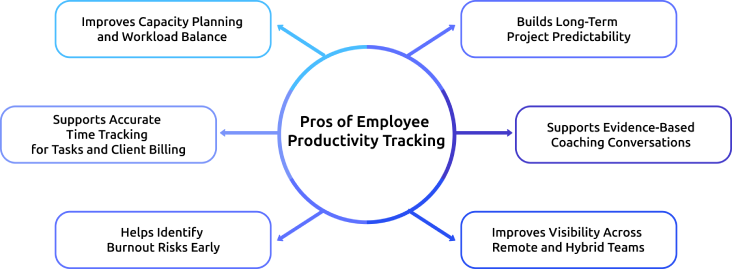
Improves Capacity Planning and Workload Balance
Productivity tracking gives you a clear view of how work is distributed across your team. You can see who is overloaded, who has bandwidth, and where projects need more support. With this clarity, you can manage workloads early and prevent the burnout that comes from uneven distribution.
Over time, this leads to fairer task distribution and a healthier pace of work. You can stay ahead and plan better without reacting late to problems.
Supports Accurate Time Tracking for Tasks and Client Billing
If your business depends on time-based work, accurate tracking becomes essential. Productivity tracking shows exactly how long tasks and projects take, helping you bill clients correctly and avoid underestimating effort. This kind of visibility is especially helpful for agencies, consultancies, and service-based businesses where work is closely tied to time spent.
With reliable data, you can reduce billing disputes and improve project profitability. It also helps you create more realistic timelines for future work.

Did You Know?
According to Owl Labs research , 90% of remote employees say their productivity has either improved or stayed the same while working remotely, showing how the right visibility and structure support consistent performance.
Helps Identify Burnout Risks Early
One of the most useful things productivity tracking can do is reveal the early signs of burnout. When you see patterns like extended working hours combined with falling output, you can have a chance to step in before the problem becomes serious.
These signals give you the chance to step in early. A quick check-in or workload adjustment can prevent bigger problems later. This becomes especially important in remote teams where burnout signs are harder to notice.
Builds Long-Term Project Predictability
As you collect more productivity data, it becomes easier to understand how long different types of work actually take. These patterns help you plan projects better, set realistic deadlines, and avoid overpromising. When you know how long similar projects usually take, you can set clear expectations and avoid last-minute pressure.
Over time, this makes a real difference. Your estimates become more accurate, projects run more smoothly, and your team works with less stress. Consistent tracking gradually builds this level of predictability.
Supports Evidence-Based Coaching Conversations
Good feedback depends on clarity. Productivity tracking gives you real data to guide conversations without relying on assumptions. It helps you highlight specific patterns and discuss them with context without making general observations. This makes feedback more focused and actionable.
When you use real data for training, it feels fair and clear for everyone. The data doesn’t replace conversations, it simply makes them easier to start and more useful.
Improves Visibility Across Remote and Hybrid Teams
Managing distributed teams is one of the biggest challenges in modern work. When your team is spread across time zones and locations, you lose the natural visibility that comes from working in the same office. Productivity tracking gives you a single source of truth across remote, hybrid, and in-office work, so you can support your team well without relying on constant check-ins or status meetings.
This visibility helps you spot issues early, coordinate work across time zones, and keep everyone aligned on what matters. When you combine it with employee-visible dashboards and clear communication, it supports your team without creating pressure.
Want to track productivity without affecting your team's trust?
Time Champ helps you understand work clearly and improve performance without pressure.
Cons of Employee Productivity Tracking
While productivity tracking offers clear benefits, it also comes with challenges. Most of these issues depend on how you introduce and use the system, not just the tool itself.
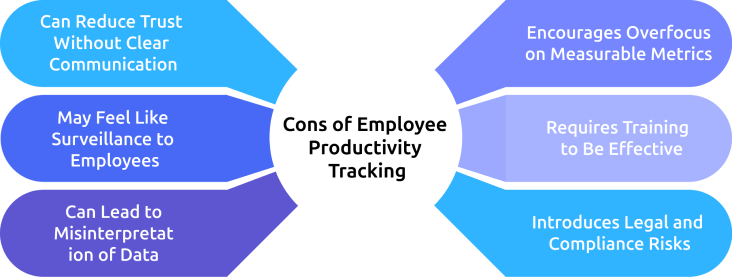
Can Reduce Trust Without Clear Communication
The biggest risk with productivity tracking is the trust impact when it is rolled out without clear communication. When employees don’t clearly understand the purpose of tracking, it can lead to confusion and negative assumptions. Trust takes a long time to build and a short time to break.
You can avoid this by being transparent from the start. Explain the purpose, what will be tracked, and how the data will be used. Clear communication builds trust and prevents misunderstandings.
May Feel Like Surveillance to Employees
Even though productivity tracking is reasonable and well-configured, some employees may still feel surveilled. This is a perception issue that affects engagement and retention, and it does not always match the technical reality of what the tool actually does.
You can reduce this feeling by being open and giving employees visibility into their own data. When people understand the purpose, discomfort usually fades over time.
Did You Know?
Recent Worklytics research shows that, 86% of employees believe employers should be legally required to disclose when monitoring tools are used, highlighting the importance of transparent communication in productivity tracking.
Can Lead to Misinterpretation of Data
Productivity data can vary from day to day, and quick conclusions can lead to mistakes. A short drop-in activity doesn’t always mean poor performance. It could be due to onboarding, training sessions, or wrapping up a demanding project. Without proper context, normal fluctuations can easily be misunderstood.
To avoid this, focus on patterns not just the single-day data. Give it a few days before drawing conclusions and always check in with the employee to understand the situation. Use the data as a starting point for discussion, not as the final judgment.
Encourages Overfocus on Measurable Metrics
When teams focus too much on tracked metrics, they can lose sight of the actual work. Employees may start trying to look productive in the system without focusing on meaningful outcomes. For example, time spent on certain apps might increase, but that doesn’t always reflect real progress or deep work.
To avoid this, don’t rely only on productivity data. Look at results like completed tasks, project outcomes, and overall quality of work. When employees understand that you evaluate performance based on both effort and outcomes, they focus on what truly matters.
Requires Training to Be Effective
Productivity tracking depends on how well you understand and use the data as a manager. Without proper training, even useful insights can lead you in the wrong direction. If you react too quickly to a drop in productivity, you may create unnecessary pressure instead of solving the actual issue.
You need to learn how to read patterns, ask the right questions, and have supportive conversations. A short training session before rollout helps you understand what the data shows and how to use it constructively. This makes a noticeable difference in how your team responds to the system.
Introduces Legal and Compliance Risks
Productivity tracking involves employee data, which means you need to follow certain legal and privacy requirements. These rules can vary depending on the region, but they often include informing employees, maintaining proper documentation, and handling data responsibly.
With the right planning, these requirements are manageable. Setting clear policies, reviewing them regularly, and using tools that support compliance can help you handle this smoothly.
Track Productivity Without Compromising Trust with Time Champ
Productivity tracking works best when it supports both performance and trust, not just visibility. A balanced approach focuses on outcomes, not just activity. When you combine productivity data with clear goals, deadlines, and quality expectations, your team stays aligned on what really matters. Transparency also plays a major role. When employees understand what is being tracked and why, it removes confusion and builds confidence in the system.
This is where Time Champ, an employee monitoring and productivity tracking solution, helps you understand how work happens while keeping trust intact. With features like employee-visible dashboards, flexible tracking settings, and role-based access, you stay transparent and in control. Automated reports and configurable data retention give you clear insights without adding pressure or complexity.
Ready to introduce productivity tracking the right way?
Time Champ helps you track productivity accurately while giving you a clear view of how work gets done.
Conclusion
Productivity tracking can bring real clarity to how work gets done, but its impact depends on how you use it. When implemented with transparency and the right intent, it helps you plan better, support your team, and improve overall performance. At the same time, ignoring concerns around trust, communication, and data use can create challenges that affect team morale. Understanding the pros and cons of productivity tracking allows you to take a balanced approach. Focus on outcomes, communicate openly, and use data to support, not to control your team. When done right, productivity tracking becomes a tool that strengthens both performance and trust across your organization.

Anjali

Table of Content
-
 What Employee Productivity Tracking Actually Means
-
Pros of Employee Productivity Tracking
-
Cons of Employee Productivity Tracking
-
Track Productivity Without Compromising Trust with Time Champ
-
Conclusion
Related Blogs
Boost team productivity and performance with effective tracking methods. Enhance productivity through data-driven insights and actionable strategies.
Shabana Shaik | March 17, 2025
Productivity Tracking Software helps remote teams stay on top, track progress, streamline workflows & boost efficiency effortlessly. Learn more!
Shabana Shaik | March 15, 2025
Discover the best ways to introduce productivity monitoring in your organization smoothly and effectively.
Thasleem Shaik | March 18, 2025
Productivity Tracking Software helps remote teams stay on top, track progress, streamline workflows & boost efficiency effortlessly. Learn more!
Shabana Shaik | March 15, 2025
Understand employee monitoring legal compliance, key laws, and best practices to track work activity while protecting privacy and avoiding legal risks.
Thasleem Shaik | April 14, 2026
Learn how to overcome employee monitoring challenges like low trust, privacy concerns, and data misuse. Discover 8 common challenges and solutions that work.
Anjali | April 22, 2026


 4.7/5 avg.
Ready to Manage Your Workforce Smarter?
Join our family of 1500+ companies using smart insights to redefine workforces!

Free Trial
No Credit Card Required