Employee Monitoring Legal Compliance: The Full Guide
Understand employee monitoring legal compliance, key laws, and best practices to track work activity while protecting privacy and avoiding legal risks.

Employee monitoring gives you visibility into how work happens across your team. But without the right legal foundation, that visibility can turn into a liability. Many businesses set up monitoring tools, track activity, and collect data without realizing they are operating outside the boundaries of the law. This is where employee monitoring legal compliance becomes critical. The result of ignoring it is fines, lawsuits, and a breakdown of trust that is hard to rebuild. Skipping over US employee privacy laws can turn a useful tool into a legal liability overnight.
The rules around employee monitoring are not simple. They vary by country, by state, and by the type of data you collect. What is perfectly legal in one region may require explicit consent in another, or some regions prohibit it altogether. If you run a team across multiple locations, the complexity doubles.
This guide breaks it all down clearly. You will learn which laws apply to your business, what data you can legally collect, how to get consent the right way, and how to build a monitoring setup that protects both your business and your team.
What Is Legal Compliance in Employee Monitoring?
Legal employee monitoring means tracking your employees' activity, time, communications, or location in a way that follows the applicable laws in your region. It is not just about having the right software. It is about having the right employee monitoring policies, the right disclosures, and the right boundaries in place before you start collecting any data.
Employee monitoring in the workplace covers a wide range of activities, from tracking computer usage and keystrokes to recording calls, monitoring emails, and logging location data. Employee monitoring laws by state vary significantly across the US, and internationally, regulations like GDPR add further obligations. So the answer to "is employee monitoring legal" is not a simple yes or no. It depends on where your business operates, what you monitor, and how you handle that data.
Employee monitoring legal issues usually surface when you skip the foundational steps, such as having no written employee surveillance policy, no communication to your team, and no defined limits on what data you collect. These gaps are what turn a routine monitoring setup into a compliance violation. Monitoring of employees in the workplace only stays on the right side of the law when it is transparent, proportionate, and backed by a clear policy that your team actually knows about.
Why Does Legal Compliance in Employee Monitoring Matter?
Legal compliance in employee monitoring directly impacts how safely and effectively you run your operations. When you follow the right approach, monitoring improves productivity without creating risk. When you ignore it, it leads to legal problems and internal confusion. Here are the key reasons it matters:
- Reduces Legal and Financial Risk: Compliance helps you follow applicable laws, so you avoid penalties, disputes, and regulatory checks linked to employee monitoring legal issues.
- Creates Clarity for Employees: Clear policies tell employees what the company tracks and why. This removes confusion and builds acceptance across the team.
- Protects Employee Privacy: A compliant approach keeps monitoring focused only on work-related activity and prevents teams from accessing or misusing personal data.
- Supports Consistent Decision-Making: Defined policies help managers apply monitoring rules in the same way across teams, avoiding bias or uneven practices.
- Strengthens Long-Term Trust and Culture: Transparent and lawful monitoring shows respect for employees and helps maintain trust while still giving managers the visibility they need.
Finding it hard to monitor work without risking privacy violations?
Use Time Champ to track only what matters and keep your monitoring practices compliant.
What Are the Key Laws Governing Legal Employee Monitoring?
There is no single global law that covers employee monitoring legal compliance. The rules you follow depend on where your business operates, where your employees are based, and what type of data you collect. To stay compliant, you need to understand the laws that apply at the federal level, the state or regional level, and internationally. Here is a clear breakdown of the key frameworks you need to know.
1. Federal Laws in the United States
At the federal level, three core laws set the baseline for what is and is not allowed when monitoring employees.
A. Electronic Communications Privacy Act (ECPA)
The ECPA is the primary federal law governing employee monitoring in the US. Passed in 1986, it prohibits the unauthorized interception of electronic communications, including emails, phone calls, and instant messages. But two exceptions allow employers to monitor legally.
The first is the business purpose exception. You can monitor employee communications on company-owned systems if you have a legitimate work-related reason, such as quality control, security, or productivity oversight. The second is the consent exception. If employees give prior consent through a signed policy or employment agreement, you have broader legal cover to monitor their activity.
One important boundary here: the ECPA does not give you permission to intercept personal emails or messages sent from private accounts, even if the employee sends them during work hours or on a company device. That crosses a legal line.
The ECPA also includes the Stored Communications Act (SCA) as its second title. The SCA specifically protects stored electronic data, meaning emails sitting on a server or messages in a cloud system. You can access company emails under a disclosed monitoring policy, but accessing personal accounts or private messages requires separate consent.
B. National Labor Relations Act (NLRA)
The NLRA limits how you use monitoring data, even when the monitoring itself is legal. Under this law, employees have the right to discuss wages, working conditions, and union activity among themselves. You cannot use monitoring tools to surveil, interfere with, or discourage these protected conversations. Recording employees who are organizing, or setting up surveillance specifically in areas where employees tend to have protected discussions, can result in unfair labor practice charges, regardless of whether you own the devices involved.
C. Computer Fraud and Abuse Act (CFAA)
The CFAA becomes relevant when monitoring goes beyond what employees have authorized. It prohibits accessing a computer system without permission or exceeding the access level granted. In a monitoring context, this means your IT team cannot access personal accounts, personal devices, or areas of a system that fall outside the scope of what the employee agreed to in their onboarding policy. Violations can carry fines up to $500,000 for organizations and potential prison time for individuals.
D. Other Federal Laws
Beyond these three, a few other federal laws touch on monitoring.
The Americans with Disabilities Act (ADA) and the Genetic Information Nondiscrimination Act (GINA) restrict you from collecting health-related information through monitoring tools. If your monitoring system picks up data that reveals a disability or health condition, you must handle it carefully and separately from general employment records.
Anti-discrimination laws also apply. You cannot monitor specific groups of employees more closely than others based on protected characteristics like race, religion, gender, or national origin.
2. US State-Level Requirements
Federal law sets the floor, but many states have built higher standards on top of it. If you operate across multiple states, you need to meet the strictest requirements that apply to each employee's location. Here is a summary of the key state-level laws you are likely to encounter:
| State | Key Requirement |
|---|---|
| New York | Employers must give written notice of electronic monitoring before it begins. Employees must acknowledge receipt in writing or electronically. |
| Connecticut | Employers must provide prior written notice before any electronic monitoring and post it visibly in the workplace, covering all types of monitoring in use. |
| Delaware | Employers must notify employees each day they access the employer-provided email or internet, unless employees acknowledge a one-time written notice. |
| California | California Consumer Privacy Act and California Privacy Rights Act require employers to inform employees what data they collect, why, and for how long. Employees have the right to access, correct, and request deletion of their data. Additional rules on automated decision-making take effect from 2027. |
| Illinois | The Biometric Information Privacy Act (BIPA) requires written informed consent before collecting any biometric data, such as fingerprints or facial scans. Penalties run from $1,000 to $5,000 per violation. |
The clear pattern across states is that notice and consent requirements are becoming stricter, not looser. If you have employees in any of these states, written disclosure is not optional.
For a more detailed look at how these rules apply at the federal and state levels, read our full guide on employee monitoring privacy laws in the USA.
3. Employee Monitoring Data Protection Laws: GDPR and the EU Framework
If your employees work in the EU or EEA, the General Data Protection Regulation applies to your monitoring practices, even if your company operates elsewhere. It sets strict rules on how you collect, use, and manage employee data.
Here’s what you need to follow:
A. Lawful Basis for Monitoring
You must have a valid legal reason before you monitor employees. Most companies rely on legitimate interest, but you need to prove that your business need does not override employee privacy. Consent alone is usually not enough in workplace settings.
B. Data Minimization Requirements
You can only collect data that is necessary for a specific purpose. If basic tracking solves the problem, excessive monitoring becomes non-compliant.
C. Clear Employee Communication
You must inform employees about what you track, why you track it, how long you store it, and who can access it. Hidden or covert monitoring is generally not allowed except in rare, justified cases.
D. Employee Data Rights
Employees have the right to access their data, correct inaccuracies, and, in some cases, request deletion. Your monitoring system must support these rights.
E. High-Risk Monitoring Requires DPIA
If your monitoring involves continuous or large-scale tracking, you must conduct a Data Protection Impact Assessment (DPIA) before implementation.
F. Penalties for Non-Compliance
GDPR violations can result in fines up to €20 million or 4% of your global annual revenue, whichever is higher.
G. UK GDPR Still Applies
The UK follows a similar framework after Brexit. If you have employees in the UK, these rules still apply to your monitoring setup.
For a deeper breakdown of how GDPR applies specifically to your monitoring practices, see our guide on GDPR and Employee Monitoring.
4. Data Privacy Laws Beyond the EU
Employee monitoring compliance requirements extend beyond the US and EU. If your teams operate across different regions, you need to follow the specific data protection laws that apply in each location.
A. Canada: PIPEDA
- Personal Information Protection and Electronic Documents Act (PIPEDA) governs how federally regulated employers collect, use, and share employee data.
- Monitoring must be reasonable, necessary, and aligned with a clear business purpose.
- You must inform employees about what you monitor and why.
- Implied consent may apply for less sensitive data, but only after proper notice.
- Provinces like Alberta, British Columbia, and Quebec have their own privacy laws, so requirements may vary by location.
B. Australia: Privacy Act 1988
- Australia's Privacy Act 1988 regulates how employers collect and handle employee personal information.
- You must store data securely and use it only for its intended purpose.
- Employees have the right to access their personal data when requested.
- Additional workplace surveillance laws may apply at the state or territory level.
- Rules often include specific requirements for video monitoring and computer tracking notices.
C. Other Notable Frameworks
- Japan's Act on Protection of Personal Information (APPI) requires transparent data handling and limits how employers use employee data.
- Brazil's Lei Geral de Proteção de Dados (LGPD) focuses on consent, purpose limitation, and data protection safeguards.
- India's Digital Personal Data Protection Act (DPDPA) emphasizes responsible data use and clear communication with employees.
- Many countries across Asia-Pacific, Latin America, and the Middle East follow similar principles.
The practical takeaway for global businesses is that applying GDPR-level standards across your entire operation is often the simplest way to stay compliant everywhere. Since GDPR represents the highest benchmark, most jurisdictions measure against it.
What Employee Data Can You Legally Monitor?
The line between permitted monitoring and privacy violation depends on what you track, how you disclose it, and which laws govern your business. Here are the main data categories typically monitored and what the law generally allows.

1. Computer and Internet Activity
On company-owned devices and networks, you can monitor websites visited, applications used, time spent on specific tasks, and overall activity levels. This is one of the most broadly permitted forms of monitoring, as long as you inform employees through a clear written policy before monitoring begins.
2. Emails and Workplace Communications
You can monitor emails sent through company email accounts and messages on workplace platforms like Slack, Teams, or any other business communication tool you provide. Personal email accounts, even if accessed on a company device, fall into a more sensitive category under laws like the ECPA and generally require stronger justification or explicit consent.
3. Location and GPS Data
For employees working in the field or using company vehicles, GPS and location tracking during work hours is generally permitted. Some states and countries require you to notify employees before you track their location. Tracking employees outside of working hours without consent crosses into legally risky territory in most jurisdictions.
4. Time and Attendance
Tracking clock-in and clock-out times, shift hours, break durations, and attendance patterns is standard and widely accepted. This becomes more sensitive when you tie it to biometric data like fingerprints or facial recognition, which carry stricter consent and storage requirements in states like Illinois, Texas, and Washington.
5. Phone Calls
On company-provided phone systems, call monitoring for quality assurance or compliance purposes is generally legal with prior notice. Recording calls involving third parties triggers additional rules, as many states require consent from all parties on the call before recording.
6. Keystrokes and Screen Activity
Keystroke logging and screenshot capture are generally allowed on company devices in most US states, as long as employees receive proper notice. Under GDPR and similar frameworks in the EU, this type of monitoring is more strictly regulated. You need a lawful basis, and the level of monitoring must stay proportionate to the business purpose.
What You Generally Cannot Monitor
Regardless of jurisdiction, certain monitoring is off-limits or heavily restricted. Personal devices, personal accounts, and any activity in spaces where employees have a reasonable expectation of privacy, such as restrooms or personal break areas, fall outside the boundaries of lawful monitoring. Union-related conversations and protected activity under the NLRA are also protected from surveillance.
Worried about tracking more data than you should?
Use Time Champ to monitor the right data with full control and clarity.
What Are the Penalties for Non-Compliance with Employee Monitoring Laws?
Getting monitoring wrong does not just create awkward HR conversations. It opens your business up to criminal charges, civil lawsuits, and regulatory fines that can run into millions. Here is exactly what non-compliance looks like across federal law, state law, and real enforcement actions.
I. Federal Penalties
A. Electronic Communications Privacy Act (ECPA) and Stored Communications Act (SCA)
If you access or intercept employee communications without proper legal grounds, these laws allow employees to take legal action. Civil damages start at $10,000 or $100 per day of violation. In serious cases, violations can also lead to criminal penalties, including fines and jail time.
B. Computer Fraud and Abuse Act (CFAA)
The CFAA applies when monitoring crosses into unauthorized access. If you go beyond what employees were informed about or approved, penalties can reach up to $250,000 for individuals and $500,000 for organizations. Accessing personal accounts without clear permission is a major risk area.
C. National Labor Relations Act (NLRA)
The NLRA protects employees' rights to discuss work conditions and organize. If monitoring interferes with these rights, it is treated as an unfair labor practice. Consequences include stopping the monitoring, reinstating employees, and paying back wages.
II. State-Level Penalties
State laws vary significantly, and some of the strictest exist in the most business-heavy states. If you operate across multiple states, you need to comply with the toughest law that applies to your team.
| State | Violation Type | Fine Range |
|---|---|---|
| New York | Failure to provide written notice of electronic monitoring | $500 first offense, $1,000 repeat offense |
| Connecticut | Electronic monitoring without prior written notice | $500 to $3,000 per violation |
| Delaware | Monitoring without notice to employees | $100 per violation |
| California (CCPA/CPRA) | Unintentional data privacy violation | $2,500 per violation |
| California (CCPA/CPRA) | Intentional data privacy violation | $7,500 per violation |
| Illinois (BIPA) | Biometric data misuse without consent | $1,000 to $5,000 per violation |
Illinois deserves a special mention. BIPA applies per person, per violation. If you use fingerprint scanners or facial recognition with 500 employees and you did not collect proper consent, you are looking at potential exposure of up to $2.5 million from a single compliance gap.
III. Real Enforcement Cases
A. Amazon France – €32 Million GDPR Fine
France's data protection authority fined Amazon France €32 million after finding that its warehouse productivity scoring system crossed the line. The system tracked workers in excessive detail, including very short pauses in activity, and gave them almost no time to recover between tasks. The authority ruled that the level of monitoring was disproportionate to the business purpose and that employees had not been properly informed about how the company used the data.
B. Serco UK – ICO Enforcement Notice
The UK's Information Commissioner's Office issued an enforcement notice against Serco Leisure after it found the company was using facial recognition and fingerprint scanning to track attendance across leisure staff. The ICO found that less intrusive methods were available, that the company had not demonstrated a lawful basis for using biometric data, and that consent obtained from staff was not genuinely free, given the power imbalance between an employer and an employee.
Best Practices for Staying Legally Compliant with Employee Monitoring
Legal employee monitoring does not stop at knowing the laws. How you apply those laws in your day-to-day operations is what keeps your business protected. These practices help you stay compliant, build trust with your team, and avoid the legal issues that come from poorly structured monitoring setups.
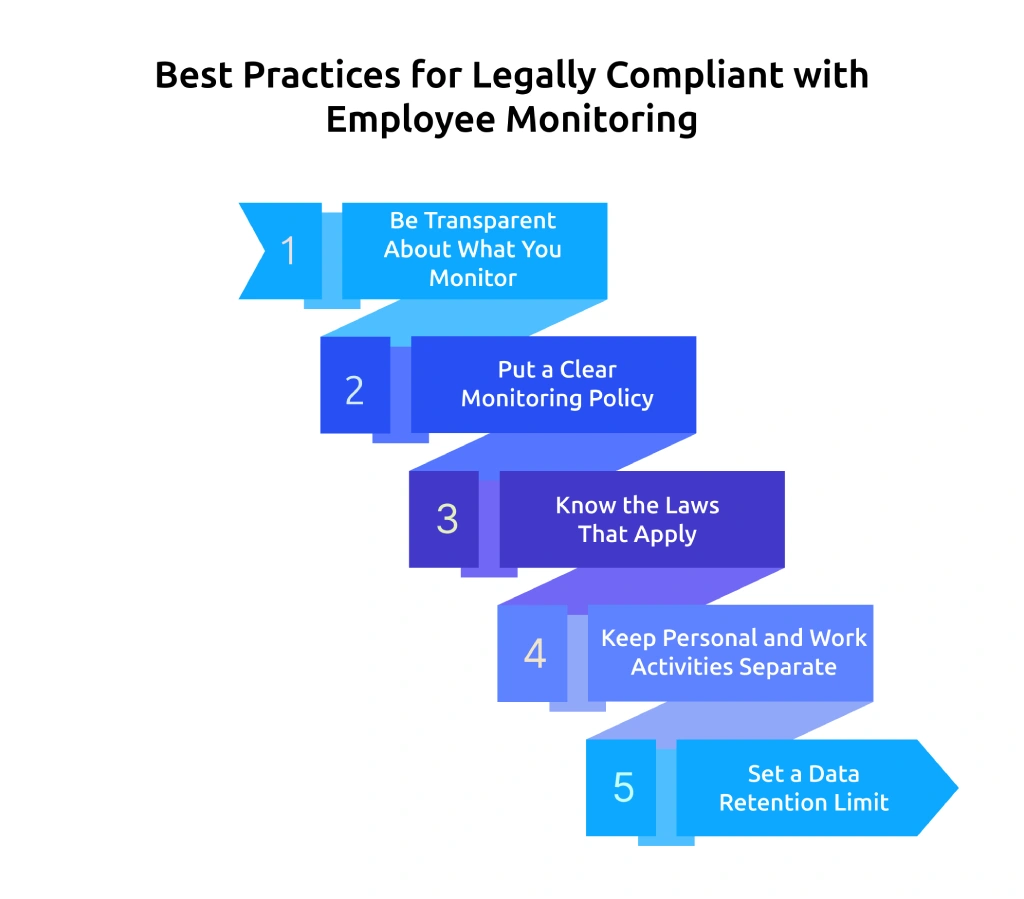
1. Be Transparent About What You Monitor
Secretive monitoring is where most legal trouble starts. Your team should know upfront that monitoring happens, what you track, and why. This is not just a good practice, it is a requirement under most employee monitoring laws. Whether you track screen activity, location, or communications, make sure every team member knows before monitoring begins, not after.
2. Put a Clear Monitoring Policy in Writing
A verbal agreement is not enough. You need a written employee monitoring policy that spells out exactly what you monitor, how you store that data, who can access it, and how long you keep it. A well-written employee surveillance policy removes ambiguity for both your team and your legal counsel. Review it regularly and update it whenever your tools or processes change.
3. Know the Laws That Apply to Your Locations
Employee monitoring laws by state and country vary significantly. What is acceptable in one jurisdiction may be illegal in another. If you have team members in multiple states or countries, you cannot apply a single blanket policy and assume it covers everyone. Map out where your team operates and verify compliance requirements for each location separately.
4. Keep Personal and Work Activities Separate
Monitoring personal activity, whether on a personal device or during non-work hours, puts you in risky legal territory. This becomes especially important when you allow BYOD (Bring Your Own Device), where employees use personal devices for work. Even on company devices, tracking outside working hours can violate employee monitoring and workplace privacy laws in many regions. Stick to work hours and work-related activity only, and ensure your tools and BYOD policy clearly define these boundaries.
5. Set a Data Retention Limit
Holding onto monitored data indefinitely creates unnecessary legal risk. Define how long you keep monitoring records and stick to it. Most compliance frameworks expect you to have a clear retention policy, and deleting data once it is no longer needed is one of the simplest ways to reduce your exposure under data protection laws.
How Does Time Champ Support Legal Monitoring Compliance?
Staying compliant with employee monitoring laws is not just about knowing the rules. It is about having a system that helps you follow them consistently. Time Champ is an employee monitoring software built with that in mind. It gives you the visibility you need across your team while keeping your monitoring practices transparent, documented, and legally defensible. Whether you are navigating employee monitoring laws by state or aligning with GDPR requirements for your international teams, Time Champ gives you the controls to monitor employees in the workplace without overstepping legal boundaries.
From activity tracking and attendance logs to screen monitoring and location data, every feature in Time Champ works within a framework that supports a clear employee monitoring policy. You get detailed audit trails, role-based access controls, and configurable tracking settings so you only collect what you actually need. That means no excessive data collection, no compliance gaps, and full clarity when it comes to employee monitoring and workplace privacy law. If you want to build a monitoring setup that is both effective and legally sound, Time Champ gives you a practical starting point.
Conclusion
Employee monitoring legal compliance is about balancing visibility with responsibility. When you follow the right laws, define clear policies, and track only what is necessary, you reduce risk while maintaining trust across your team. Your approach needs to stay aligned as laws and work environments evolve. In the end, effective monitoring is not about tracking more, but about tracking the right things in a transparent and controlled way.
Struggling to balance monitoring with employee privacy?
Use Time Champ to track work responsibly while staying within legal limits.

Thasleem Shaik

Table of Content
-
 What Is Legal Compliance in Employee Monitoring?
-
Why Does Legal Compliance in Employee Monitoring Matter?
-
What Are the Key Laws Governing Legal Employee Monitoring?
-
What Employee Data Can You Legally Monitor?
-
What Are the Penalties for Non-Compliance with Employee Monitoring Laws?
-
Best Practices for Staying Legally Compliant with Employee Monitoring
-
How Does Time Champ Support Legal Monitoring Compliance?
-
Conclusion
Related Blogs
Get answers to the most asked questions about employee monitoring laws, including legal considerations and privacy rights for compliant workplace monitoring.
Thasleem Shaik | Aug 17, 2024
Stay informed on employee GPS tracking laws and policies, including state regulations, device compliance rules, and how to create a legal tracking policy.
Thasleem Shaik | October 09, 2025
Learn how employee monitoring enhances safety through compliance, risk management, and awareness. Explore key practices and future trends.
Tarun Kumar Reddy | Aug 22, 2024
Explore the possible ethical considerations of monitoring employee's activities to increase their productivity while respecting their privacy.
Jahnavi Pulluri | Jul 31, 2024
Master the art of remoteemployee monitoring with our effective strategies and tools to enhance productivity while ensuring a positive remote work experience
Mounika Sai | Aug 03, 2023
Find the best employee monitoring tools for 2026. Compare features, pricing, pros & cons to manage workforce performance and improve productivity.
Thasleem Shaik | Apr 02, 2026


 4.7/5 avg.
Ready to Manage Your Workforce Smarter?
Join our family of 1500+ companies using smart insights to redefine workforces!

Free Trial
No Credit Card Required