Home / B / Business Communication
Business communication is the main foundation of how modern organizations operate and make decisions. All emails, meetings, reports, or decisions announced are based on the working of communication. And when communication fails, even the most brilliant strategies cannot work properly.
This guide will help you to know what business communication is, why it is important in your workplace, how it is different to organizational communication, the various types of business communication, its advantages and limitations and the future trends that are defining how you will communicate in your working environment.
What Is Business Communication?
Business communication is the structured process you use to create, share, and interpret information within and outside your organization to achieve business goals, coordinate work, support decision-making, and maintain professional relationships.
In simple terms, business communication is the way that you and other people in your organization share ideas, instructions, feedback, and updates to keep the work flowing. It involves internal communication (among you, your groups, and management) and external communication (among you, clients, vendors, partners and stakeholders).
According to McKinsey, effective communication plays a critical role in driving productivity improvements of up to 25%.
The purpose of business communication goes beyond just speaking or writing. It helps you ensure that the right message is conveyed to the right people at the right time. When you communicate clearly, you reduce confusion, improve efficiency, strengthen teamwork, and respond faster to change.
Why is Business Communication Important in the Workplace?
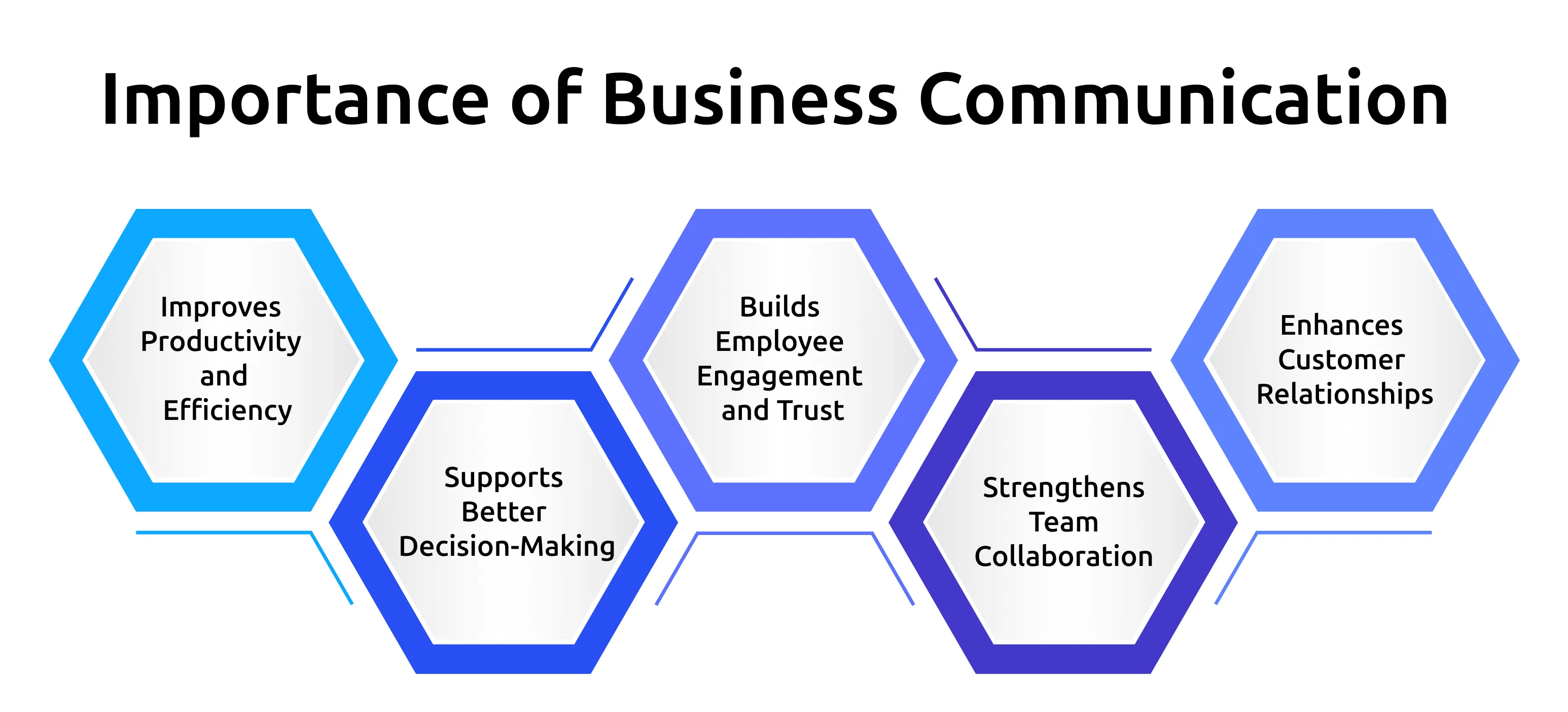
Business communication has a direct impact on how productive your teams are, how engaged your employees feel, how decisions are made, and how customers experience your brand. When communication breaks down, you face more errors, missed deadlines, and loss of trust.
Here’s why business communication is important in your workplace:
1. Improves Productivity and Efficiency
When you give clear instructions and set clear expectations, your teams spend less time fixing mistakes. (stats) Over time, strong communication systems help you streamline workflows, reduce delays, and improve overall workforce efficiency.
2. Supports Better Decision-Making
Better decisions start with better information. When communication flows smoothly across teams, you gain access to accurate updates, clear insights, and timely feedback. This allows you to spot issues early, evaluate options more effectively, and act with confidence.
3. Builds Employee Engagement and Trust
Open and transparent communication helps employees feel informed, valued, and included. When you clearly explain goals, expectations, and changes, employees are more likely to trust leadership and stay committed to their work. Frequent contact also helps the employees to exchange ideas and express their concerns, and engage in the workplace culture to make it healthier and more active.
You know what? Deloitte Human Capital Trends research shows that 86% of employees and 74% of leaders consider trust and transparent communication critical to organizational success.
4. Strengthens Team Collaboration
Effective communication helps you align priorities and coordinate efforts across individuals and departments. Teams can collaborate more smoothly when everyone understands their roles and responsibilities. Clear communication also helps resolve misunderstandings quickly and reduces conflicts before they escalate.
5. Enhances Customer Relationships
The way you communicate with customers directly influences how they perceive your brand. Clear, professional, and timely communication builds confidence and reliability. Whether it’s handling inquiries, resolving issues, or sharing updates, strong business communication helps you set the right expectations and deliver consistent experiences.
Is Business Communication the Same as Organizational Communication?
No, business communication is not the same as organizational communication, even though they are closely connected.
Business communication mainly focuses on how information is exchanged across an organization to get work done. It is a practical, task-driven flow that supports the distribution of work, daily updates, team coordination, client interactions, and daily operations. Its primary goal is clarity, speed, and action, ensuring tasks move forward and outcomes are delivered efficiently.
Organizational communication looks at how communication flows across your organization, including culture, leadership messaging, power structures, and employee behavior. It helps you understand why people communicate the way they do and how communication shapes trust, alignment, and long-term organizational health.
In short, business communication helps you do the work, while organizational communication helps you understand the communication environment in which that work happens.
What Are the Different Types of Business Communication?
Business communication can be categorized in various ways, depending on the direction, method, and audience. Below are the main types, explained clearly.
1. Internal Communication
The internal communication occurs within the organization. It includes emails, meetings, internal reports, announcements, and collaboration between employees and teams. Its goal is to align people, share information, and coordinate work. Effective internal communication can help you in reducing confusion, duplication of work and ensuring that all are working in a similar direction.
2. External Communication
External communication refers to the interaction with individuals who are not part of the organization, i.e. customers, suppliers, investors and the community. Others are marketing messages, customer support, sales calls, press releases and official statements. How you communicate externally directly shapes your brand reputation and public trust.
3. Upward Communication
Upward communication flows from employees to managers or leadership. This includes feedback, reports, suggestions, and performance updates. It helps you understand challenges on the ground and make better decisions. Effective upward communication promotes transparency and allows employees to share ideas for improvement.
4. Downward Communication
Downward communication flows from management to employees. Examples include company policies, instructions, performance expectations, and strategic updates. Clear downward communication reduces confusion and aligns teams with goals. When this communication is consistent, employees clearly understand priorities and expectations.
5. Horizontal (Lateral) Communication
Horizontal communication occurs between employees or teams at the same organizational level. It supports collaboration, problem-solving, and knowledge sharing across departments. This type of communication helps break silos and improve cross-team efficiency.
6. Formal Communication
Formal communication occurs through official channels and structures, and this includes policy documents, contracts, board meetings and official emails. It is documented and often legally important for internal processes. This form of communication provides uniformity, transparency and good documentation throughout the organization.
7. Informal Communication
Informal communication includes casual conversations, chats, and spontaneous interactions. While less structured, it plays a key role in relationship-building and team culture. Healthy informal communication often improves morale and strengthens workplace relationships.
What Are the Pros and Cons of Effective Business Communication?
Here are the key advantages and disadvantages of business communication that reflect how it enhances clarity and effectiveness, as well as the challenges that organizations face.
| Pros of Effective Business Communication | Cons of Effective Business Communication |
|---|
What Are the Future Trends in Business Communication?
Business communication continues to evolve as technology, work models, and employee expectations change. The following are the major trends that are influencing your future communication:
-
AI-Assisted Communication
Artificial intelligence (AI) is turning into a fundamental support system for your communication at work. AI tools can be used to write professional emails, summarize lengthy meeting discussions, translate messages into other languages, and identify important action points. Beyond speed, AI also helps you improve clarity by reducing vague language and identifying communication gaps. Many teams also make a habit of humanizing AI drafts before sending them, so emails and updates keep a natural, personal tone instead of sounding automated. -
Remote and Hybrid Communication Models
As remote and hybrid work becomes permanent, you can no longer rely on in-person communication. This shift requires better documentation, clear communication channels, and better asynchronous communication practices. This shift allows your teams to work across time zones without delays, but it also requires more intentional messaging to avoid confusion. -
Data-Driven Communication Decisions
The new workplaces are not just sending messages, but they are getting to know how communication really works. Engagement levels, response time, message reach, and information flow are all tracked using analytics. With these insights, it becomes easier to identify the most effective communication methods and areas where the communication breaks down. -
Video-First Communication
Workplace communication is steadily shifting away from long emails and text-heavy updates toward video-based formats. Tone, intent, and context can be transmitted more efficiently with the help of short video messages, recorded announcements and virtual meetings. Video can also add a human touch, particularly to remote teams, and it makes communication more personal, engaging, and understandable. -
Greater Focus on Clarity and Simplicity
As information overload increases, you need to communicate more clearly and simply. You need to move away from complex language and lengthy explanations to short messages and clear structures to direct intent. When you communicate with clarity, you reduce misunderstandings, improve response times, and help employees stay focused without feeling overwhelmed. -
Unified Communication Platforms
The communication at the workplace is becoming more integrated into one platform that incorporates messaging, meetings, task updates, and shared documentation. This approach reduces tool switching, minimizes information loss, and keeps conversations connected to the work context. Unified platforms also enhance uniformity, increase visibility among teams and ensure everyone accesses accurate information from one centralized source.

Run HR in One Place
Time, attendance, leaves, and payroll-ready reports unified.
Explore HR Management →Productivity Starts With Visibility - Time Champ Gives You Both!
Book Your Free Demo