Employee Monitoring Ethics: Balance Productivity & Privacy
Explore 5 core principles of employee monitoring, emerging AI ethics in 2026, and a practical playbook to balance employee productivity, privacy, and trust.
Is your monitoring approach helping your team, or quietly crossing an ethical line? Many leaders struggle to balance visibility with respect for privacy, especially as tracking tools become more advanced and widespread. While organizations rely on data to improve performance, unclear boundaries can quickly erode trust and create resistance. That is why employee monitoring ethics has become a critical focus in 2026, because how you monitor matters just as much as what you monitor.
This blog explains the core principles of Employee Monitoring Ethics and how they apply in today’s workplace. It also explores the 2026 AI ethics layer and shares a practical playbook to help you balance productivity, privacy, and trust.
What Is Employee Monitoring Ethics and Why It Matters
Employee monitoring ethics refers to the principles that guide how you collect, use, and protect data about your employees’ work activity. At its core, it is about finding the right balance, gaining the visibility you need to run your business effectively while fully respecting employee privacy, autonomy, and dignity.
Ethics goes beyond legality, because laws only set the minimum standard while ethical choices define what is appropriate for your workplace. Even if a tool allows certain types of tracking, such as a keystroke logger where it is legally permitted, it may still feel excessive or unnecessary for your team.
This matters because monitoring directly influences trust, which in turn shapes how employees perform, engage with their work, and stay with your organization. When you approach monitoring ethically, it supports productivity and builds confidence. When you ignore ethics, even the best tools can damage morale and weaken the culture you are trying to build.
The 5 Core Principles of Ethical Employee Monitoring
Many monitoring programs fail because they lack a clear structure. Employee monitoring ethics gives you that structure through five practical principles you can apply in real situations, not just as abstract ideas.
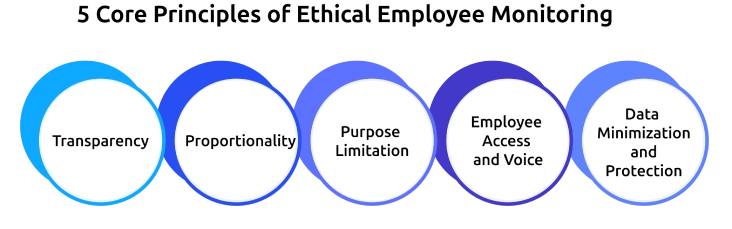
Pillar 1: Transparency
Principle: Employees understand what you track, how you track it, and why it matters.
What This Looks Like in Practice: Clearly explain monitoring through a simple, easy-to-read document that outlines what is tracked and what is not. You communicate this before rollout and give employees access to their own dashboards, so nothing feels hidden.
The Impact of Trust: When employees know exactly what is happening, they stop second-guessing the system and focus more on their work.
Pillar 2: Proportionality
Principle: Match the level of monitoring to the actual business need without going beyond what is necessary.
What This Looks Like in Practice: Rely on basic activity tracking for most roles and reserve more intrusive methods, like screen recording, only for high-risk situations with a clear reason. Always start with the least intrusive option.
The Impact of Trust: When monitoring stays reasonable, employees feel respected, which helps them work better and feel less stressed.
Pillar 3: Purpose Limitation
Principle: Use data only for its original purpose and do not apply it to unrelated decisions.
What This Looks Like in Practice: If you collect data to understand productivity, you can use it to improve workflows or planning, not to search for unrelated issues or justify decisions later. You can keep the purpose clear and consistent.
The Impact of Trust: Employees feel more secure when they know their data will not be reused in unexpected or unfair ways.
Pillar 4: Employee Access and Voice
Principle: Employees can view their own data and raise concerns if something looks incorrect.
What This Looks Like in Practice: You provide dashboards that employees can access and create a simple way for them to question or correct data before it affects evaluations.
The Impact of Trust: When employees see the same data as managers, monitoring becomes a shared system not a one-sided process.
Pillar 5: Data Minimization and Protection
Principle: You collect only the data you truly need and protect it properly.
What This Looks Like in Practice: You avoid capturing personal or sensitive information, secure data with proper safeguards, limit access to authorized roles, and set clear timelines for how long data is stored.
The Impact of Trust: Collecting less data reduces risk and shows employees that their privacy is taken seriously, which strengthens confidence in your approach.

Did You Know?
According to Remotely, employee monitoring adoption reached 76% in 2025 and is expected to rise to 82% by 2026, showing how quickly tracking is expanding, making ethical monitoring more important than ever.
How AI Is Reshaping Employee Monitoring Ethics in 2026
AI has changed how organizations approach employee monitoring ethics. Earlier systems simply recorded what employees did, but modern tools can now predict patterns and flag potential risks before they happen. This shift brings more power, but it also raises new ethical questions that many organizations are still figuring out.
Algorithmic Decision-Making
AI can flag employee’s burnout risks or potential attrition risks, but it should not decide what happens next. Remain responsible for decisions and use AI insights as guidance, not as the final judgment. A flag must start a conversation, not replace human thinking or trigger automatic actions.
Predictive Profiling
AI can estimate future behavior based on current data, such as predicting whether someone might leave soon. This feels very different from basic activity tracking and requires careful handling. Predictions are not facts, so you should treat them as signals to check in with employees, not as reasons to take early action.
Clear Explanations and the Right to Understand Decisions
When AI flags an employee, both managers and employees should understand why it happened. If no one can explain the reasoning behind a decision, trust breaks quickly. Clear and visible explanations help employees feel confident that the system is fair and not working in the background without accountability.
Biometric Data and Sensors
Some tools now track detailed signals like typing patterns, mouse movement, or even attention through webcams. While these technologies are advanced, they are not always necessary. Organizations should only use such data when there is a strong and clear need, as it directly affects employee privacy.
Bias Auditing
AI systems can unintentionally favor certain work styles or patterns, which can lead to unfair outcomes. Regular checks are important to ensure that the system treats all employees fairly across different roles and working styles. People analytics practices that include regular audits can help surface and address hidden bias before it influences decisions.
Finding it hard to keep monitoring effective without affecting employee trust?
Time Champ helps you balance visibility and privacy with clear tracking and built-in reviews.
A Practical Playbook to Implement Ethical Monitoring
Building an ethical monitoring approach does not require starting from scratch. This practical playbook helps organizations apply employee monitoring ethics across rollouts, updates, and audits in a clear and structured way.
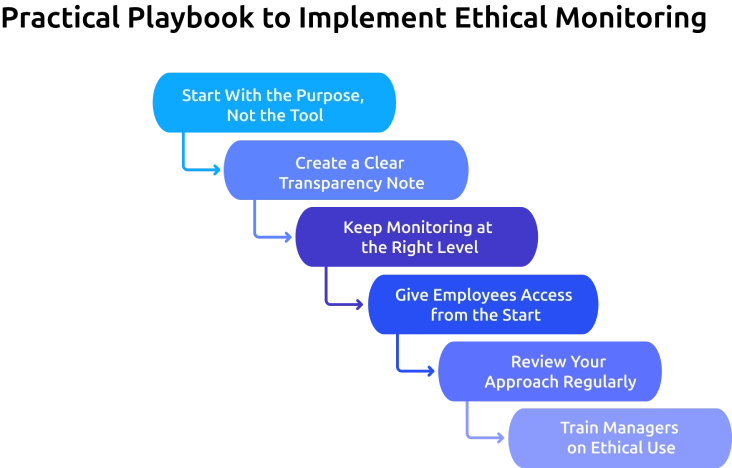
1. Start With the Purpose, Not the Tool
Define the real business need before choosing any software. Whether your goal is capacity planning, compliance, security, or productivity improvement, each need requires a different level of monitoring.
2. Create a Clear Transparency Note
Write a short, simple document in plain language that explains what is tracked, what is not tracked, who can access the data, and how it will be used. This clarity builds trust faster than any feature.
3. Keep Monitoring at the Right Level
Match the level of tracking to the actual need. If basic activity tracking solves the problem, there is no need to use more intrusive methods. Use stronger tools only when there is a clear and valid reason.
4. Give Employees Access from the Start
Allow employees to see their own data from day one. When both managers and employees look at the same information, monitoring feels more open and collaborative.
5. Review Your Approach Regularly
Monitoring practices can slowly change over time. Run a quick review every quarter to check if your tools and policies still match your original purpose. Keep a record of any changes and the reasons behind them.
6. Train Managers on Ethical Use
Most issues come from how tools are used, not the tools themselves. Train managers to interpret data carefully, avoid quick judgments, and focus on coaching, not constant oversight.
How Time Champ Approaches Monitoring Ethics
Time Champ is an employee monitoring software with built-in workforce intelligence, designed to support ethical and transparent monitoring practices. The platform focuses on giving organizations clear visibility while maintaining transparency and respect for employees. The platform ensures that monitoring remains open and understandable, so both managers and employees stay aligned on how data is collected and used.
Two-way dashboards allow employees to access their own data from day one, creating a shared view between managers and teams. Configurable tracking gives organizations control over what gets captured, while sensitive activities like personal browsing and financial data stay excluded. AI insights remain clear and explainable, and regular review templates help teams keep monitoring aligned with their original purpose without drifting into unnecessary tracking.
Ready to build a monitoring program your team trusts?
Time Champ offers two-way dashboards, transparent tracking, and built-in quarterly ethics reviews.
Conclusion
Monitoring itself is not the problem, the real issue begins when it lacks a clear ethical framework. The five core principles give you a structured way to approach employee monitoring ethics, while the 2026 AI ethics layer helps you handle newer, more advanced tools responsibly. A practical playbook turns these ideas into actions you can apply immediately. When organizations build monitoring systems on trust, they create a more stable and productive work environment. This approach supports better performance, improves employee confidence, and reduces legal or reputational risks. Ignoring ethics, on the other hand, can weaken trust and create long-term challenges that are harder to fix.

Anjali

Table of Content
 What Is Employee Monitoring Ethics and Why It Matters
- The 5 Core Principles of Ethical Employee Monitoring
- How AI Is Reshaping Employee Monitoring Ethics in 2026
- A Practical Playbook to Implement Ethical Monitoring
- How Time Champ Approaches Monitoring Ethics
- Conclusion
Related Blogs

Address employee concerns about productivity tracking with clear communication, rollout steps, and practical scripts that build trust and transparency.
Thasleem Shaik | May 01, 2026
Learn the pros and cons of employee monitoring and discover when monitoring improves productivity and when it creates workplace risks.
Guna Lakshmi | May 06, 2026
Learn how to detect employee monitoring software, identify the key signs on your computer, and understand what to do if your activity is being monitored.
Anjali | Apr 13, 2026
Learn about employee monitoring laws, what they mean for businesses, and how they protect employee privacy and rights.
Shabana Shaik | Jul 10, 2024
Discover the real pros and cons of employee productivity tracking, how it impacts your team, and the right way to use it to support trust and performance.
Anjali | May 02, 2026
Explore ethical employee monitoring techniques to track work transparently, protect privacy, and improve productivity while building trust across your team.
Anjali | Apr 27, 2026


 4.7/5 avg.
Ready to Manage Your Workforce Smarter?
Join our family of 1500+ companies using smart insights to redefine workforces!

Free Trial
No Credit Card Required