Time Tracking ROI: How to Boost Project Profitability
Improve project profitability with Time Tracking ROI by reducing wasted hours, controlling labor costs, increasing productivity, and boosting returns.

Have you ever completed a project on time, kept your team busy, and still wondered why the profit was lower than expected? Small delays, untracked work, inaccurate estimates, unnecessary overtime, and poor visibility into how time is spent can quietly eat into your project margins. Without accurate records of work hours, you may struggle to control costs, avoid billing errors, and identify which projects are truly profitable. Time Tracking ROI has become a valuable metric for businesses looking to improve financial performance and make more informed project decisions.
This blog explains how to measure the value of time tracking and evaluate its impact on business performance. You'll also learn about common profit leaks and the steps that can help improve project profitability.
What is Time Tracking ROI
Time Tracking ROI is a metric that evaluates the return a business receives from its time-tracking efforts by comparing the benefits achieved, such as improved productivity, accurate billing, reduced time waste, and better project control, against the costs of the tracking solution. It helps you understand the financial impact of time tracking and whether it contributes to higher project profitability and operational efficiency.
How To Calculate the Time Tracking ROI?
Calculating Time Tracking ROI helps you determine whether the value gained from tracking employee time outweighs the cost of implementing and maintaining the system. Comparing the investment with the measurable benefits helps you understand the actual financial impact of time tracking on project profitability.
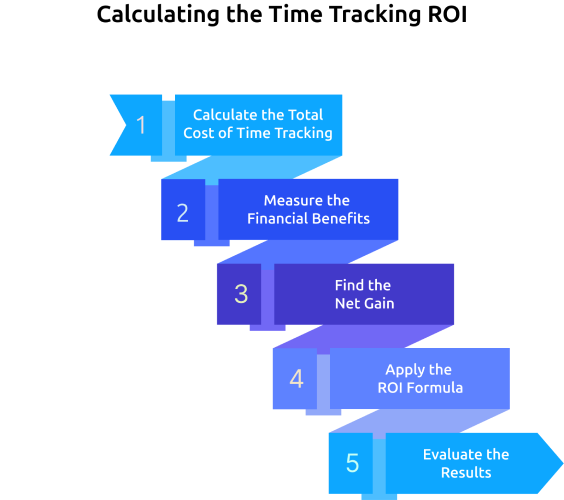
Step 1: Calculate the Total Cost of Time Tracking
Start by identifying all expenses related to your time tracking process. This may include software subscriptions, implementation costs, employee training, and the time spent managing the system.
Step 2: Measure the Financial Benefits
Next, calculate the gains generated from time tracking. Look for measurable improvements such as increased billable hours, reduced payroll errors, lower overtime expenses, improved productivity, and better resource utilization.
Example:
- Additional billable revenue: $12,000
- Reduced payroll errors: $3,000
- Lower overtime costs: $5,000
Total Benefits = $20,000
Step 3: Find the Net Gain
Subtract the total investment from the total benefits achieved. This gives you the financial value generated after implementing time tracking.
Example:
If your total benefits are $20,000 and your total investment is $5,000.
Net Gain = $20,000 − $5,000 = $15,000
Step 4: Apply the ROI Formula
Use the standard ROI formula:
ROI (%) = (Net Gain ÷ Total Investment) × 100
Example: ROI = ($15,000 ÷ $5,000) × 100 = 300%
Since the ROI is well above 0%, it indicates a positive ROI, which means the benefits gained from time tracking are significantly higher than the investment.
Step 5: Evaluate the Results
Review the final ROI percentage to determine whether your investment is delivering value. A positive ROI means the benefits exceed the costs, while a higher percentage indicates a stronger return and a greater contribution to project profitability.
Struggling to understand whether your projects are actually profitable?
Time Champ helps you track work hours, project effort, and productivity in one place.
Common Causes of Project Profitability Loss
You may focus on increasing revenue when profits start shrinking, but the real problem often lies elsewhere. Small inefficiencies in project planning, resource management, and time tracking can quietly reduce margins, making even busy projects less profitable than expected. Understanding these common profit leaks is the first step toward fixing them.
1. Inaccurate Time Tracking
When employees fail to accurately record their work hours, you lose visibility into the actual effort required to complete projects. This leads to missed billable hours, incorrect project cost management, and reduced profitability.
Solution: Implement a reliable time-tracking system that captures work hours consistently and provides accurate records for billing, budgeting, and performance analysis.
2. Poor Project Estimation
Projects frequently become unprofitable when the time, budget, or resources required are underestimated during planning. As work progresses, unexpected costs begin to accumulate and reduce profit margins.
Solution: Use historical project data and track work hours to create more realistic estimates and allocate resources more effectively.
3. Scope Creep
Additional client requests, revisions, and unplanned tasks can gradually expand a project's scope beyond what was originally agreed upon. When more work is added without increasing the budget or deadline, project costs can quickly rise and reduce profits.
Solution: Define project requirements clearly, document change requests, and track additional work separately to ensure it is properly recorded and billed when appropriate.
4. Low Resource Utilization
When employees spend excessive time on non-billable activities or are not assigned to work efficiently, labor costs increase without generating equivalent value for your business.
Solution: Monitor workloads regularly and allocate tasks based on employee capacity, skills, and project priorities to maximize productive work hours.
5. Excessive Overtime and Labor Costs
Consistent overtime may help your teams meet deadlines, but it can significantly increase project expenses and reduce profit margins. Frequent overtime often indicates inefficient resource allocation, unrealistic project timelines, or uneven workload distribution across the team.
Solution: Track workload trends, identify capacity issues early, and redistribute work before overtime becomes a recurring expense.
6. Lack of Real-Time Project Visibility
Without clear insight into project progress, budgets, and resource usage, problems often remain unnoticed until they become expensive to fix. Delayed decisions can lead to budget overruns and missed profitability targets.
Solution: Use real-time reporting and project tracking tools to monitor performance continuously and address issues before they impact project outcomes.
How Time Tracking Improves Project Profitability Step by Step
Time tracking provides clear visibility into how work hours are spent across projects and tasks. With accurate time data, you can identify inefficiencies, manage costs more effectively, and take steps to improve project profitability.

1. Track Actual Time Spent on Work
Start by recording the actual time spent on tasks, projects, and client work. Accurate time data helps you understand where effort is being invested and whether projects are consuming more hours than originally planned. Without this visibility, it becomes difficult to understand true project costs.
2. Identify Unprofitable Activities
Review tracked time regularly to identify activities that consume significant effort without delivering meaningful value. Repetitive administrative work, excessive meetings, and unnecessary revisions can reduce productivity and increase project costs. Identifying these activities helps you to eliminate or streamline them.
3. Improve Resource Allocation
Use time data to understand how workloads are distributed across the team. This helps you prevent some employees from becoming overloaded while others remain underutilized. Assign work based on capacity and skill sets to improve efficiency and allow projects to progress more smoothly.
4. Control Labor Costs and Overtime
Monitor working hours and overtime trends before they become a recurring problem. When projects consistently require extra hours to stay on schedule, labor costs can rise quickly and reduce profit margins. Early visibility allows you to adjust workloads and timelines before expenses increase.
5. Make Better Project Decisions
Use historical time-tracking data to support future planning and decision-making. Accurate records help you estimate project timelines, allocate resources more effectively, and set up realistic budgets. Over time, these improvements lead to better project outcomes and stronger profitability.
How Time Champ Helps Maximize Time Tracking ROI
You may struggle to understand where project time is spent and whether resources are being used efficiently. Without accurate visibility, controlling costs and improving profitability becomes difficult. Time Champ is a time tracking and monitoring software that helps you gain accurate insights into productivity, project performance, and resource utilization.
Here's how Time Champ helps maximize profitability:
- Automatic Time Tracking: Captures work hours automatically, reducing reliance on manual timesheets and improving the accuracy of recorded time.
- Project and Task-Level Insights: Compares estimated effort against actual time spent, helping you identify issues before they become costly overruns.
- Billable and Non-Billable Hour Tracking: Separates billable and non-billable work, making it easier to account for valuable time and invoice clients accurately.
- Productivity Reports and Workforce Analytics: Provides visibility into team performance, helping identify inefficiencies, balance workloads, and improve operational decisions.
- Integrated Project Management View: Brings project, productivity, and time data together in one place, making it easier to monitor progress and improve future planning.
With accurate time data, actionable insights, and better project visibility, Time Champ helps you make informed decisions that improve efficiency and maximize project profitability.
Losing revenue through missed billable hours and inaccurate project estimates?
Time Champ provides accurate time data and insights to improve project profitability.
Conclusion
Improving project profitability requires clear visibility into how time, resources, and budgets are being used. Accurate time data helps you identify inefficiencies, control costs, and support better project decisions before small issues affect margins. Measuring time tracking ROI allows you to determine whether your time-tracking efforts are delivering real value. With the right processes and tools in place, you can improve productivity, strengthen operational efficiency, and build a more profitable foundation for future projects.

Anjali

Table of Content
 What is Time Tracking ROI
- How To Calculate the Time Tracking ROI?
- Common Causes of Project Profitability Loss
- How Time Tracking Improves Project Profitability Step by Step
- How Time Champ Helps Maximize Time Tracking ROI
- Conclusion
Instant Signup
Thank you for your request!
We have received your signup request and our team will get back to you soon. In the meantime, you can book a demo to see Time Champ in action.
Book a DemoFree trial. No credit card required. Prefer a walkthrough? Book a demo.
Related Blogs

Improve ROI with productivity tracking software by reducing wasted time, recovering billable hours, and improving workforce efficiency.
Guna Lakshmi | May 11, 2026
Understand what idle time is, its main causes, how to calculate it using a simple formula, and practical ways to reduce it without micromanaging your team.
Anjali | May 26, 2026
Discover essential time-tracking features that improve productivity, payroll accuracy, and workforce visibility, and learn how to use them effectively.
Guna Lakshmi | May 16, 2026
Learn how real-time productivity tracking helps teams monitor performance, improve efficiency, and make smart decisions for better workplace productivity.
Jahnavi Pulluri | May 12, 2026
Learn what time tracking is, why it matters in 2026, the best methods, and how to implement it without team pushback. A practical guide for modern teams.
Jahnavi Pulluri | May 19, 2026
Learn how resource efficiency time tracking improves workload balance, productivity, resource utilization, and project outcomes without burnout for teams.
Anjali | May 21, 2026


 4.7/5 avg.
Ready to Manage Your Workforce Smarter?
Join our family of 1500+ companies using smart insights to redefine workforces!

Free Trial
No Credit Card Required