Project Cost Management: Steps, Methods & Best Practices
Learn how project cost management helps you estimate, control, and optimize project budgets with proven methods, best practices, and accurate time tracking.

Project cost management is more than creating a budget, it's about keeping your project financially on track from planning to completion. With the right process, you can estimate costs accurately, control spending, and avoid budget overruns.
In this blog, I'll explain the key steps, cost estimation methods, best practices, and why tracking employee time is critical for managing project costs effectively.
What is Project Cost Management?
Project cost management is the process of estimating, budgeting, and controlling project costs to ensure a project is completed within its approved budget. It covers every stage of the project lifecycle, from creating initial cost estimates and setting the budget to tracking expenses and controlling costs as the project progresses.
The goal is to allocate resources wisely, monitor actual costs against the budget, and identify potential overruns before they become costly problems.
The 4 Steps of Project Cost Management
Project cost management follows four key steps. While these steps happen in sequence, they continue throughout the project as costs, resources, and scope evolve. Together, they provide a framework for keeping projects financially on track.
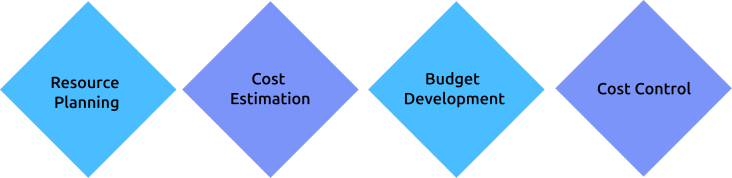
1. Resource Planning
Before you can estimate project costs, you need to identify the resources required to complete the work. This includes people, materials, equipment, software, and any other resources the project depends on. Determine how much of each resource you'll need and when it will be required. A clear work breakdown structure (WBS) helps you map resources to individual tasks, creating a solid foundation for accurate cost estimates.
2. Cost Estimation
Cost estimation is the process of calculating how much your planned resources will cost. Depending on the project, estimates may be based on historical data, expert judgment, or established estimation techniques. As the project scope becomes clearer, your estimates should become more accurate. The more accurate your estimates, the lower the risk of budget overruns.
3. Budget Development
Once your costs have been estimated, the next step is to combine them into an approved project budget. This budget should include contingency reserves for known risks and establish a cost baseline, a time-phased budget used to compare planned spending with actual project costs. A well-defined budget provides a clear financial roadmap and serves as the benchmark for measuring project performance.
4. Cost Control
Cost control is the ongoing process of tracking actual project costs against the approved budget. It involves monitoring spending, identifying budget variances, forecasting future costs, and taking corrective action whenever expenses begin to exceed the plan. Reviewing project costs regularly allows teams to find issues early, maintain financial control, and keep the project on budget.
Cost Estimation Methods in Project Management
The best cost estimation method depends on the project stage, the information available, and the level of accuracy required. Early estimates are often broad, while later estimates become more detailed as the project scope is finalized. Here's a quick comparison of the most common methods.
| Method | How It Works | Best Used When | Typical Accuracy |
|---|---|---|---|
| Analogous (Top-Down) | Uses the cost of similar past projects to estimate the current project. | Early planning with limited project details. | ±25–50% |
| Parametric | Calculates costs using measurable units, such as cost per hour, task, or unit of work. | Work can be measured using reliable historical data. | ±10–25% |
| Bottom-Up | Estimates the cost of every task or activity, then combines them into the total project cost. | The project scope and work breakdown structure (WBS) are well defined. | ±5–10% |
| Three-Point (PERT) | Uses optimistic, pessimistic, and most likely estimates to account for uncertainty. | Projects with higher risk or uncertain requirements. | Varies based on assumptions. |
| Vendor Bid Analysis | Uses quotes or proposals from suppliers and subcontractors to estimate external costs. | Procuring products, services, or outsourced work. | High for the quoted scope. |
There's no one-size-fits-all estimation method. Choose the technique that best matches your project's scope, available data, and required accuracy.
Get Real-Time Visibility into Your Project Costs
Best Practices for Effective Project Cost Management
Following a structured cost management process is important, but long-term success comes from consistent habits. These best practices can help you with that.

1. Define the Project Scope Before Estimating
A clear project scope is the foundation of an accurate budget. Document what's included and what's not before estimating costs. Well-defined requirements reduce scope creep and help prevent unexpected expenses later.
2. Use Bottom-Up Estimation
Estimate costs for individual tasks before rolling them into the overall project budget. This approach is generally more accurate than top-down estimating and makes it easier to justify costs to stakeholders.
3. Include a Contingency Reserve
Unexpected costs are part of every project. Setting aside a contingency reserve for identified risks helps absorb unforeseen expenses without disrupting the overall budget.
4. Monitor Costs Regularly
Don't wait until project milestones to review spending. Compare actual costs with your budget on a regular schedule to identify variances early and take corrective action before they become major issues.
5. Track Resource Time Accurately
Labor is often the largest project expense, making accurate time tracking essential. Monitoring how much time people spend on tasks gives you a clearer picture of actual project costs and helps prevent hidden budget overruns.
6. Manage Scope Changes Through a Formal Process
Every scope change affects the project budget. Evaluate, estimate, and approve changes before adding them to the project to keep your budget and cost baseline accurate.
Project Cost Management Software: What to Look For
Not all project cost management tools offer the same capabilities. If you're evaluating software, these are the features that make the biggest difference in keeping projects on budget.
| Feature | Why It Matters |
|---|---|
| Real-time budget tracking | Compare planned and actual costs to identify budget overruns early. |
| Time tracking | Convert employee hours into accurate labor costs automatically. |
| Project cost reports | View costs by project, task, team member, or department. |
| Earned Value Management (EVM) | Measure project performance by comparing planned value, earned value, and actual costs. |
| Cost forecasting | Predict the final project cost based on current spending trends. |
| Approval workflows | Control scope changes and prevent unauthorized spending. |
| Payroll and HR integrations | Keep labor costs accurate by syncing employee and payroll data. |
No single estimation method works for every project. As your project scope becomes clearer, you can move from high-level estimates to more detailed and accurate techniques.
How Time Champ Supports Project Cost Management
Time Champ is a project management software that helps project managers gain complete visibility into project costs by combining project tracking, time tracking, and workforce analytics in one platform. This makes it easier to monitor budgets, optimize resources, and prevent cost overruns before they impact project profitability.
With Time Champ, you can:
- Track actual vs. budgeted hours across projects and tasks in real time.
- Plan and manage projects with task-level tracking for better resource allocation.
- Set budget alerts to get notified when a project is approaching or exceeding its budget.
- Mark projects as billable or non-billable for accurate billing and internal cost tracking.
- Generate detailed project and timesheet reports to monitor labor costs and project performance.
- Monitor time spent on productive work, meetings, and administrative tasks.
- Use workforce analytics to identify resource imbalances and prevent budget overruns.
Stop Losing Budget to Hidden Labor Costs
Track project hours, monitor labor costs, and prevent budget overruns with Time Champ
Conclusion
Project cost management is an ongoing process that helps keep projects on budget from planning to completion. Accurate cost estimation, regular expense tracking, and careful scope management help keep projects on budget and prevent unexpected costs. Most importantly, don't overlook labor costs, tracking your team's time gives you the visibility needed to manage budgets, optimize resources, and improve project profitability.
Table of Content
 What is Project Cost Management?
- The 4 Steps of Project Cost Management
- Cost Estimation Methods in Project Management
- Best Practices for Effective Project Cost Management
- Project Cost Management Software: What to Look For
- How Time Champ Supports Project Cost Management
- Conclusion
Related Blogs
Explore 6 free project charter templates in Excel, Word, and PDF, including simple, agile, and six sigma formats for clear project starts.
Shaik Thasleem | Nov 07, 2025
Download free agile project management templates in Excel, Word, and PDF formats to plan, track, and manage agile projects with clarity and control.
Thasleem Shaik | Feb 19, 2026
Kanban vs Scrum board explained. Understand their key differences, features, benefits, and when to use each method to manage projects effectively.
Thasleem Shaik | Apr 02, 2026![10 Best Project Portfolio Management Software For [2026]](https://www.timechamp.io/images/blog-images/port-folio-feature-image-c3ae91d9.webp)
Find the 10 best project portfolio management software for 2026. Compare the features, pricing, pros & cons to prioritize projects and control budgets.
Anjali | Apr 02, 2026
Learn how to track time on multiple projects without losing billable hours or missing deadlines. Discover common challenges, workflows, and tool features.
Guna Lakshmi | May 21, 2026
Improve project profitability with Time Tracking ROI by reducing wasted hours, controlling labor costs, increasing productivity, and boosting returns.
Anjali | Jun 03, 2026


 4.7/5 avg.
Ready to Manage Your Workforce Smarter?
Join our family of 1500+ companies using smart insights to redefine workforces!

Free Trial
No Credit Card Required