How to Choose the Right Productivity Tracking Software for Your Team
A practical guide to choosing productivity tracking software for your team, with comparisons of features, pricing, privacy, security, and rollout risks.

You rolled out a productivity tracking tool, and within a few weeks, Slack conversations started to slow down and become noticeably quieter.
Nobody opens the dashboard, and the reports nobody asked for keep landing in your inbox. And one of your employees sent a polite message: “What exactly is being tracked?”
Does all of this sound familiar?
That’s what choosing the wrong productivity tracking software looks like. And the real cost isn’t the subscription, it’s the trust you spent getting buy-in in the first place.
This isn’t another list of “top 10 tools.” This is the buyer’s framework you should have had before you started comparing products, how to define what you actually need, how to match tools to your team, what to ask vendors, and how to roll it out without damaging morale.
By the end, you’ll know what to choose and what to avoid.
What is Productivity Tracking Software?
Productivity tracking software records how work happens on company devices and turns those signals into reports, trends, and summaries that managers can act on. Those signals usually include time spent on apps and websites, keyboard activity, idle time, and work tied to tasks or projects. The output typically shows focus time, application usage, and team-level patterns over days or weeks.
In simple words:
- It captures activity from the tools your team uses
- It groups that activity into work-related patterns
- It presents those patterns in dashboards or reports
- Some tools connect it to timesheets, payroll, or project tools
Some tools stop at “what happened”, better ones try to explain “what it means.” That difference is what decides whether the data gets ignored or actually changes how a team works.
Why Do Most Teams Pick the Wrong Productivity Tracking Software?
Most teams pick the wrong productivity tracking software because they evaluate features instead of fitting. They build a comparison sheet, tick every box, and end up with a “7.4/10 winner” that nobody actually uses six months later.
The failure usually shows up in a few predictable ways:
- The CFO wants timesheets, the COO wants screenshots, the CTO wants privacy, and the final choice is rarely the best tool, it’s just the most politically acceptable one.
- The system is often already in front of employees before it gets addressed, and at that point, it is no longer a configuration issue but a trust issue.
- Raw activity data is easy, but useful interpretation is not. If the dashboard doesn’t give you detailed insights and trends, it won’t be used.
- Standalone productivity data tells half a story. Without a project and HR context, it rarely tells a useful one.
- Two weeks of data won’t show real work patterns, which means you are not really testing the tool, you are testing onboarding speed.
If none of these risks came up in your evaluation process, you’re not really comparing tools, you’re just comparing brochures.
What Should Productivity Tracking Software Actually Do for Your Team?
The right productivity tracking software is not defined by features alone, but by how reliably it performs across five core areas in a real team environment. It needs to capture activity accurately, turn it into productivity signals, present it in detailed reports, integrate with your existing tools, and give you privacy controls your team can live with. Miss any one of these, and you will start feeling the gaps within weeks of rollout.
1. Time and Activity Tracking
This is the foundation. If this layer is wrong, everything built on top of it becomes unreliable. The system records login, logout, idle time, app usage, and website activity automatically without requiring punch-ins, manual timers, or spreadsheets. It operates through cross-platform agents rather than being limited to a single operating system.
Tracking continues even in offline scenarios. When a device reconnects, the system syncs activity data without gaps or duplication.
A reliable check is simple, if work happens in low-connectivity situations, such as travel or weak network environments, that activity still appears accurately in the final record. If it does not, the system is not capturing work consistently.
2. Good Productivity Score
Productivity scoring only works when the logic behind it is transparent and adaptable to real work contexts. The productivity time tracking software makes categorization rules visible and editable at the manager level, so you can ensure scoring reflects how your teams actually operate rather than a fixed global model.
It applies role-based context so that the same activity can be changed differently depending on function. For example, design work in Figma is treated differently from finance work in the same tool.
Employees also have visibility into how their activity is classified and can challenge incorrect categorization. If scoring cannot be explained or audited, it loses reliability regardless of its precision.
3. Reporting That You Will Actually Open
Productivity reporting is only effective when it supports the decisions you need to make, not when it simply shows more data. The default reports focus on the questions you will repeatedly come back to: who is on track, who is overloaded, where time is being lost, and what has changed compared to the earlier time.
The employee productivity tracking software prioritizes clarity over volume. Instead of forcing you to explore multiple dashboards, it delivers direct summaries you can understand quickly, often in a single view.
If a report does not help you decide within minutes of reading it, it is not being used effectively.
4. Integrations with Your Current Stack
The productivity tracking system is only useful when it connects directly with the tools you already use to manage work. Native integrations with project management platforms such as Asana, Trello, and Jira ensure you have task-level visibility. Communication tools like Slack or Microsoft Teams provide contextual signals. HR and payroll systems connect work activity to organizational structure and compensation logic.
Two-way synchronization is essential. Task data flows into the productivity system while activity data feeds back into your operational tools, enabling accurate analysis of delivery timelines, workload distribution, and execution bottlenecks.
Without integration depth, your productivity data remains isolated, and you end up depending on manual reconciliation across systems.
5. Privacy and Admin Controls
Privacy controls define whether the system is trusted or resisted. The productivity tracking system supports role-based tracking rules so different teams can operate under appropriate visibility levels. It avoids applying uniform monitoring across unrelated functions.
Employees have access to their own activity data, maintaining transparency in how their work is recorded. Sensitive information such as passwords, payment fields, and private browsing activity is automatically excluded from tracking.
Audit logs record system access so you can see who viewed data and when, ensuring accountability at every level. Retention policies remain configurable, so you can define how long data is stored instead of depending on indefinite retention by default.
If privacy controls are weak or unclear, adoption typically declines regardless of feature completeness.
Turn All Productivity Tracking Capabilities into Real Workforce Visibility!
How Do You Match Productivity Tracking Software with Your Team Setup?
Productivity tracking software is not a one-size-fits-all. A tool that fits a 12-person remote startup will often fail in a 200-person hybrid services organization. You match the tool to your team structure first, then evaluate features.
Fully Remote Teams
You need a system that works without physical monitoring. That means reliable activity capture, strong defaults, and self-view dashboards that allow employees to understand their own data.
Reporting needs to support asynchronous work, not assume shared working hours. Anything dependent on physical presence signals, such as badge swipes or office-based tracking, does not apply here.
Hybrid Teams
Hybrid setups are the most complex because work happens across multiple contexts. You need per-role and per-location tracking rules, so the system reflects different working patterns. Calendar sync becomes important because it helps distinguish scheduled work from actual execution.
Focus-time analytics matter more than raw activity because the key question is not whether work is happening, but whether uninterrupted work is happening on remote days.
In-Office Teams
You already have visibility into presence, so the system’s value is showing what cannot be seen directly. You focus on how time is distributed across applications, which projects consume the most effort, and where work is being fragmented or interrupted.
Idle detection and app-level categorization have become the most useful signals for understanding real productivity patterns.
Field And Outside Sales Teams
You prioritize mobility and reliability over everything else. The system must support mobile agents on iOS and Android with offline tracking that syncs later without data loss. GPS tracking and route logging become relevant only if they directly support your sales or field operations model.
The key requirement is continuity, data must follow the work, not the device.
| Team Setup | What to Prioritize | What to Skip |
|---|---|---|
| Fully remote | Strong activity capture, self-view dashboards, async-friendly reporting, time-zone aware workflows | On-prem agents, badge integrations |
| Hybrid | Per-role tracking rules, calendar sync, focus-time analytics, attendance reporting | Field GPS, heavy location tracking |
| In-office | Idle detection, app categorization, project time allocation, timesheet sync | Remote-first scheduling features |
| Field and outside sales | Mobile agents, GPS tracking, offline sync, expense and route logging | Deep desktop-only monitoring |
Which Features Separate Good Productivity Tracking Software from Average Tools?
The tools that last beyond a year in production environments are more likely to share seven core traits. You can score any shortlist candidate out of 7. Anything below 5 will typically start creating friction within a single quarter of use.
A score of 6 or 7 indicates a system that will remain usable beyond the first year of adoption. A score of 4 or below typically signals friction, low adoption, and eventual replacement at renewal.
| Feature | What “Good” Looks Like | What “Average” Looks Like |
|---|---|---|
| Setup time | Basic setup in under 3 days, full rollout within 2-3 weeks | Undefined onboarding timeline, dependent on “customer success” |
| Cross-platform parity | Consistent support across Windows, macOS, Linux, Android, iOS, and Chrome OS | Windows-first with limited or inconsistent support elsewhere |
| Categorization control | Rules are editable by managers and visible to employees | Fixed black-box rules controlled entirely by the vendor |
| Self-view dashboards | Enabled by default with full access to personal data | Hidden in admin settings or not available |
| Native integrations | Deep integrations with 20–30+ tools (Asana, Jira, Slack, payroll, etc.) | API-only or reliance on generic connectors like Zapier |
| Privacy controls | Role-based rules, retention controls, and full audit logs | Generic compliance claims with little operational detail |
| Reports executives open | Short, narrative-style weekly summaries tailored by role | Static dashboards that require manual interpretation |
Questions to Ask a Vendor Before Buying?
Most demo calls are designed to show the product in its best possible way. Your job is to take control of the conversation and check how the system really works in real situations. These twelve questions help you ask things vendors usually don’t explain upfront:
- Show how a manager edits a productivity rule. Who can change it, and who can view those changes?
- Show what an employee sees in their own dashboard. What level of transparency do they actually get?
- What happens when a device is offline for several hours? Where is the data stored, and how is it synced later?
- What differences exist between Windows, macOS, and Linux? Provide a clear feature of parity breakdown.
- Which integrations are truly native, and which rely on third-party connectors or middleware?
- What is the exact data retention period, and how can it be configured or restricted?
- Walk through the full process of removing a user after they leave the organization. What data remains?
- What is the smallest and largest customer currently using this product in production?
- What is your average time-to-value, defined as the point when a manager first uses the dashboard without assistance?
- What does support response look like during working hours on a normal weekday?
- What is the renewal pricing after the first contract term, and can it be confirmed in writing?
- Can you provide two long-term customers in a similar industry who have used the product for at least 12 months?
If a vendor cannot clearly answer multiple questions in the first call, it is usually a signal to deprioritize them in your shortlist. Strong vendors typically answer most of these without hesitation.
How to Implement Productivity Tracking Software the Right Way
A successful productivity tracking rollout begins with clear communication about why the system is being introduced and what will and will not be tracked. A simple, one-page policy helps set up transparent rules around data access, usage, and storage. Running a small pilot first allows you to identify real-world issues before a full rollout. Giving employees self-view access builds trust and improves transparency from day one. Finally, reviewing the system at 30, 60, and 90 days ensures continuous refinement and smoother adoption over time.
To learn more about the complete rollout framework in detail, please read our blog on: How to Implement a Productivity Tracking Tool at Work
How Time Champ Can Be the Right Productivity Tracking Software for Your Team
Time Champ is employee monitoring software with a workforce intelligence layer. It combines activity tracking, productivity tracking, and reporting into a single system that works across different team setups. Time Champ is also designed to be cost-effective for teams of all sizes. With pricing starting at $3.9 per user/month, it offers an affordable entry point compared to most enterprise productivity tracking tools, making it suitable for SMBs as well as growing teams. Each feature is built to support visibility, accountability, and decision-making without relying on manual input.
Offline Tracking
Time Champ continues recording activity even when devices lose internet connectivity. Work data, such as app usage, website activity, and system interactions, is captured locally and synced once the connection is restored. This ensures that work done in low-connectivity environments, travel scenarios, or unstable networks is not lost or partially recorded.
Time and Attendance
The system automatically captures login and logout times, working hours, idle time, and attendance patterns without requiring manual check-ins or timesheets. It provides a continuous record of working hours that can be used for operational tracking, workforce planning, or compliance reporting.
GPS Tracking
For field and mobile teams, Time Champ includes GPS-based tracking that helps map employee movement and location-based activity. This is typically used in roles like sales, delivery, or on-site operations where physical presence and movement patterns are relevant to work execution. It also provides geo-fencing, which allows you to set geofences for accurate attendance.
Integrations
Time Champ integrates with widely used work systems, including project management tools, communication platforms, and HR or payroll software. These integrations allow activity data and task data to flow between systems, so work can be analyzed in context rather than in isolation.
Reports and Summaries
The platform generates structured reports that show productivity patterns, time distribution, and team-level trends. Instead of only raw logs, it provides summarized views that help you quickly understand workload distribution, focus time, and changes in work behavior over time.
Configurable Productivity Rules and Roles
The system allows productivity definitions to be customized based on roles, teams, or departments. You can define what counts as productive activity depending on job function, ensuring that the same tool reflects different types of work accurately rather than using a single universal scoring model.
Employee Self-View Dashboard
Employees can access their own activity data through a personal dashboard. This provides transparency into how their work is recorded and categorized, allowing them to review patterns, understand productivity classification, and identify discrepancies if needed.
Taken together, Time Champ turns work activity into clear, understandable insights. If your requirement is a single platform that covers tracking, intelligence, reporting, and control across different team types, Time Champ fits into that category of end-to-end productivity tracking systems.
See Time Champ in Action in a 30-minute Demo
See real dashboards and privacy controls in action
Conclusion
Choosing productivity tracking software is ultimately about the fit, not features. The right tool is the one that captures work accurately, translates it into useful insights, and fits how your team actually operates. If it creates friction, confusion, or distrust, it will fail regardless of its feature list. A structured evaluation across tracking, reporting, integrations, privacy, and rollout reduces that risk. When these factors align, productivity data becomes something teams actually use, not something they ignore.

Jahnavi Pulluri

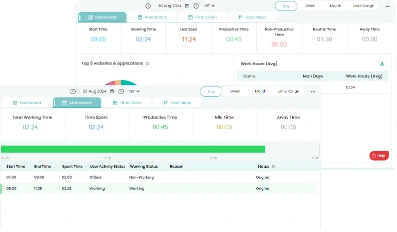
Table of Content
-
 What is Productivity Tracking Software?
-
Why Do Most Teams Pick the Wrong Productivity Tracking Software?
-
What Should Productivity Tracking Software Actually Do for Your Team?
-
How Do You Match Productivity Tracking Software with Your Team Setup?
-
Which Features Separate Good Productivity Tracking Software from Average Tools?
-
Questions to Ask a Vendor Before Buying?
-
How to Implement Productivity Tracking Software the Right Way
-
How Time Champ Can Be the Right Productivity Tracking Software for Your Team
-
Conclusion
Related Blogs
Productivity Tracking Software helps remote teams stay on top, track progress, streamline workflows & boost efficiency effortlessly. Learn more!
Shabana Shaik | March 15, 2025
Learn how to boost productivity by finding the right balance in employee monitoring, focusing on key indicators, and maintaining transparency for a driven team.
Tarun Kumar | March 14, 2025
Productivity vs. Efficiency—Are you focusing on the wrong one? Discover the key difference and how to master both and strike the perfect balance!
Tarun Kumar | June 13, 2024
Productivity metrics are becoming a norm for businesses and organizations of all sizes, but only because it gives managers, executives, some insight
Sai Keerthi Uppala | May 30, 2023
Organize your workplace with these best productive tips. Boost efficiency, reduce clutter, and optimize your work environment today!
Sai Keerthi Uppala | February 22, 2025


 4.7/5 avg.
Ready to Manage Your Workforce Smarter?
Join our family of 1500+ companies using smart insights to redefine workforces!

Free Trial
No Credit Card Required