How to Enhance Productivity Without Over-Monitoring
Productivity enhancement starts with measuring output, not activity. Learn four key metrics, a six-step framework, and how to avoid over-monitoring easily.

Is keeping a closer eye on your employees really the key to better productivity? Not always. In fact, too much monitoring can create stress, reduce trust, and push employees to look busy instead of delivering actual results.
The most productive teams aren't built on constant oversight; they're built on clear goals, accountability, and trust. In this blog, you'll learn how to enhance productivity without over-monitoring, the metrics that truly matter, and practical strategies to help your team perform at its best.
What is Productivity Enhancement?
Productivity enhancement is the process of improving employee or business output by optimizing how work is performed. It focuses on eliminating inefficiencies, streamlining workflows, balancing workloads, and using data-driven insights to help teams achieve more with the same resources.
Rather than tracking every activity, productivity enhancement identifies where time is being lost and what changes will have the biggest impact. It relies on three key levers: reclaiming time from low-value work, distributing workloads more effectively, and removing process inefficiencies that delay progress.
What Counts as Over-Monitoring?
Over-monitoring happens when an organization collects more employee data than it actually uses to make meaningful business decisions. Instead of improving productivity, excessive monitoring creates distrust, increases stress, and encourages employees to appear busy rather than focus on meaningful work.
A simple rule to remember: every metric you collect should lead to a decision or an action. If it doesn't, it's probably unnecessary.
5 Signs You've Crossed into Over-Monitoring
If three or more of these sound familiar, it's time to rethink your approach.
1. You're Collecting Data That Never Gets Used
Every metric should answer a business question or support a decision. If no one uses the data to improve workflows, allocate resources, or solve problems, there's little reason to collect it.
2. Employees Can't Access Their Own Data
Transparency builds trust. If you can see performance metrics but employees can't, monitoring starts to feel like constant oversight instead of a tool for improvement.
3. Metrics Replace Conversations
Metrics start conversations, not end them. If performance reviews depend only on activity scores instead of considering context, feedback, and outcomes, you're measuring the wrong things.
4. Managers Watch Dashboards More Than They Support People
Monitoring dashboards supports good management, not replace it. Frequent dashboard checks can't substitute for regular one-on-one conversations and coaching.
5. Employees Start Gaming the System
When employees use mouse movers, leave apps open, or stay online just to appear active, monitoring has become a compliance exercise instead of a productivity strategy. That's a clear sign your metrics are driving the wrong behaviors.
How to Enhance Productivity Without Over-Monitoring: A Six-Step Framework
Improving productivity without creating a culture of constant oversight requires a deliberate approach. The following six-step framework helps you increase productivity while maintaining employee trust and transparency.

Step 1: Start with the Decision
Begin by identifying the key decisions your organization needs to make this quarter. Do you need to hire? Which projects are falling behind? Which teams are at risk of burnout?
Once those questions are clear, work backward to determine the minimum data required to answer them. Every metric you track should support a specific decision. If it doesn't, don't collect it.
Step 2: Publish Your Monitoring Policy First
Transparency builds trust. Before enabling any monitoring features, explain what data will be collected, why it's being collected, who can access it, how long it will be stored, and how it won't be used.
A clear monitoring policy eliminates uncertainty and prevents monitoring from feeling like constant oversight.
Step 3: Let Employees See Their Own Data First
Give employees access to their productivity insights before you review team reports. When employees can see their own focus time, workload, and work patterns, they're more likely to self-correct and improve without constant intervention.
This simple change shifts monitoring from an oversight tool to a self-improvement resource.
Step 4: Measure Teams, Support Individuals
Use team-level metrics to identify organizational trends, such as workload imbalances or inefficient processes. Then use individual insights to provide training and support.
Comparing employees based on activity metrics often creates unhealthy competition while hiding the systemic issues that actually need attention.
Step 5: Fix the System Before Coaching the Person
When productivity drops, investigate the process before assuming it's a people problem.
Ask these questions:
- Has the workload increased?
- Has the workflow changed?
- Has something changed for the employee?
In many cases, inefficient processes, unclear priorities, or unnecessary approvals are the real cause. Fixing those issues often improves productivity more than training alone.
Step 6: Review Your Metrics Every Quarter
Not every metric stays useful forever. Review your productivity metrics every quarter and remove any that haven't influenced a business decision in the past 90 days.
Help Your Team Achieve More Every Day!
Identify productivity trends, reduce inefficiencies, and make better decisions
How Time Champ Helps Improve Productivity Without Constant Oversight
Collecting employee data is only half the equation. The real value comes from turning that data into actionable insights that help managers make better decisions.
Time Champ is a workforce intelligence platform. The monitoring layer captures work-related data, while the intelligence layer analyzes it to identify productivity trends, workload imbalances, and burnout risks.
1. Real-Time Activity Monitoring
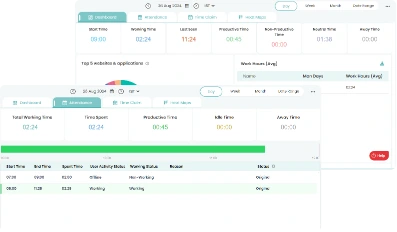
Time Champ tracks activity across applications and websites with customizable productivity classifications. Instead of simply showing how active employees are, it helps identify which tools support productive work and which create unnecessary distractions and context switching.
2. Timeline View & Productivity Heatmaps
The timeline view and color-coded heatmaps reveal how the workday is actually spent. You can quickly find uninterrupted focus periods, excessive meeting time, and recurring interruptions that reduce productivity.
3. Automatic Time Tracking
Automatic task-level time tracking lets you categorize work into billable and non-billable hours without requiring manual timesheets. This helps you understand where time goes, identify profitable work, and find projects that are consuming more effort than planned.
4. Project Budget & Capacity Tracking
Time Champ monitors project budgets by hours or cost and alerts you before limits are reached. These insights make it easier to plan future work, allocate resources effectively, and avoid overcommitting teams.
5. Workload & Burnout Insights
Work-life balance dashboards and overutilization alerts highlight employees who have been working beyond their normal capacity. Instead of reacting after burnout occurs, you can redistribute workloads before productivity and morale decline.
6. Attrition Risk Detection
Time Champ helps you identify early signs of disengagement and burnout by analyzing work patterns. These insights encourage timely conversations and proactive support, reducing the risk of losing valuable employees.
7. Privacy-First Monitoring Controls
Features like screenshot blur, role-based access controls, and configurable monitoring settings help organizations maintain transparency while respecting employee privacy. This helps businesses to gain visibility without collecting more data than their monitoring policy requires.
Improve Productivity Without Over-Monitoring!
Track work, optimize workloads, and build a more productive team
Conclusion
Productivity improves when organizations focus on removing obstacles. Measuring the right metrics, maintaining transparency, and using data to make smart decisions help teams stay productive without feeling constantly watched. A balanced approach creates trust, improves engagement, and supports long-term business growth. With clear processes and the right workforce intelligence tools, you can increase productivity while respecting employee privacy.

Jahnavi Pulluri

Table of Content
 What is Productivity Enhancement?
- What Counts as Over-Monitoring?
- How to Enhance Productivity Without Over-Monitoring: A Six-Step Framework
- How Time Champ Helps Improve Productivity Without Constant Oversight
- Conclusion
Related Blogs

Explore common employee monitoring myths and learn what's actually true. Find out how proper monitoring boosts productivity, trust, and team performance.
Anjali | Apr 14, 2026
Discover the ultimate guide to remote employee monitoring software, including its features, benefits, and how to choose the best one for your business.
Mounika Sai | Aug 29, 2023
Find answers to the top 20 most asked questions about employee monitoring, including how it works, its benefits, legal concerns, and practices for businesses.
Jahnavi Pulluri | May 07, 2026
Learn how GDPR and employee monitoring impact your business, including key principles, risks, employee rights, compliance steps, and best practices.
Thasleem Shaik | Apr 15, 2026
Managing an async team? Learn how asynchronous work employee monitoring works and what to track to keep your team productive.
Guna Lakshmi | Apr 16, 2026
Use a RACI matrix to plan employee monitoring to define roles, accountability, and governance. Get a free template, sample chart, and step-by-step guide.
Anjali | Apr 16, 2026


 4.7/5 avg.
Ready to Manage Your Workforce Smarter?
Join our family of 1500+ companies using smart insights to redefine workforces!

Free Trial
No Credit Card Required