RACI Matrix for Efficient Employee Monitoring Implementation
Use a RACI matrix to plan employee monitoring to define roles, accountability, and governance. Get a free template, sample chart, and step-by-step guide.

Who actually owns your employee monitoring program - HR, IT, or Legal? And when something goes wrong, who is truly accountable? Do you have answers for these? Most companies deal with unclear roles, which causes delays, compliance problems, and a loss of trust among employees. According to Gartner, only 48% of digital initiatives meet or exceed their business outcome targets, meaning more than half fail to deliver expected results. That means even the best monitoring tools can fail if responsibilities are not clearly defined. Most teams underestimate the planning phase, which is exactly where employee monitoring training pays off. Anyone weighing this decision usually starts with our enterprise employee monitoring guide for the full landscape.
A RACI matrix for employee monitoring fixes this by assigning every task clearly, who is responsible, accountable, consulted, and who stays informed. In this blog, you will learn how to build a RACI matrix, set clear roles for HR, IT, and compliance teams, avoid common mistakes, and run a monitoring program that is open, fair, and ready for any audit.
What Is a RACI Matrix in Employee Monitoring Implementation?
A RACI matrix for employee monitoring is a simple chart that puts four roles, Responsible, Accountable, Consulted, and Informed, against each task. It links tasks like policy writing, compliance checks, and data access to stakeholders, so there is no guessing about who owns what.
Employee monitoring is not just about tools, it is part of how you manage your workforce. It is part of how you run your team day to day. A RACI matrix lines up your monitoring setup with the roles your people already have. It keeps managers, HR, and IT on the same page so no one overlaps on each other's tasks. This improves coordination and helps you use monitoring data more effectively.
Before you choose any employee monitoring software, you need to settle who owns what. Without that, even a solid tool can be misused or ignored. A RACI matrix answers the basic questions, such as who controls the data, who reads the reports, and who makes the final call. This makes your monitoring process more reliable, fair, and easier to manage from the start.
Why Do Employee Monitoring Programs Need a RACI Matrix?
Most employee monitoring programs fail not because the tool is bad, but because nobody agreed on who is in charge of what. When the roles are unclear, teams make decisions without alignment, data gets misused, and employees lose trust. A RACI matrix brings clear structure by putting a clear owner on every task so that your software actually works as intended.
Common Rollout Failures without Governance
When you roll out employee monitoring with no defined roles, small gaps grow fast. One team handles the same task work, another skips it entirely. This results in confusion, an inconsistent setup that nobody completely trusts.
Common failures include:
- No clear owner for the monitoring setup and policies.
- HR, IT, and managers each assume someone else is handling it.
- The tool gets used differently across departments.
- Nobody has clarity on who reviews the data or what triggers an action.

Did You Know?
86% of leaders say greater transparency leads to higher workforce trust. Clear communication and defined roles are key to making employee monitoring work effectively.
Privacy, Legal, and Trust Impact
Without clear ownership, handling employee data privacy becomes risky. Teams may collect or use data without proper clarity, which can make monitoring feel intrusive. This can reduce trust, create legal concerns, and make employees uncomfortable with how their data is managed.
Cost of Poor Role Clarity
When roles are not clear, teams waste time fixing the same problems. Teams spend more time fixing issues without improving performance. This reduces the effectiveness of employee monitoring software and impacts productivity, making it harder to manage work smoothly and efficiently.
Struggling with unclear roles in employee monitoring?
Time Champ brings clarity with role-based access and accountability.
What Are the Four RACI Roles Applied to Employee Monitoring?
A RACI matrix helps you assign clear roles when you start monitoring employees. It removes confusion and keeps every team member aligned. When you define who does what, your monitoring process becomes more structured, transparent, and easy to manage.
Responsible (R): Who Executes the Monitoring Work
The responsible person handles the day-to-day tasks of monitoring employees. They set up the monitoring software, tracking time, pull reports, and keep the system running effectively. They ensure the system runs properly and collect the data needed for analysis.
Accountable (A): Who Owns Monitoring Outcomes
The accountable person takes full ownership of the results. They approve decisions, review outcomes, and ensure monitoring aligns with company goals. This role is responsible for how the monitoring process performs. Clear accountability helps you avoid confusion and keeps decisions consistent.
Consulted (C): Who Provides Input before Decisions
The consulted group includes people who share insights before decisions are made. This often involves HR, legal, or IT teams who guide policies and employee data privacy practices. Their input helps you make informed decisions and avoid risks. This role supports better planning and smoother implementation.
Informed (I): Who Receives Status Updates
The informed group includes employees and stakeholders who need updates about monitoring. They stay aware of what is being tracked and how it affects their work. Clear communication keeps everyone aligned and builds trust. This role ensures transparency across the organization.
How Do You Build a RACI Matrix for Employee Monitoring?
Building a RACI matrix for employee monitoring requires a clear structure and cross-functional alignment. You need to define every activity, involve the right stakeholders, and assign ownership without overlap. A well-built matrix helps you implement employee monitoring with clarity, compliance, and accountability from the first day.
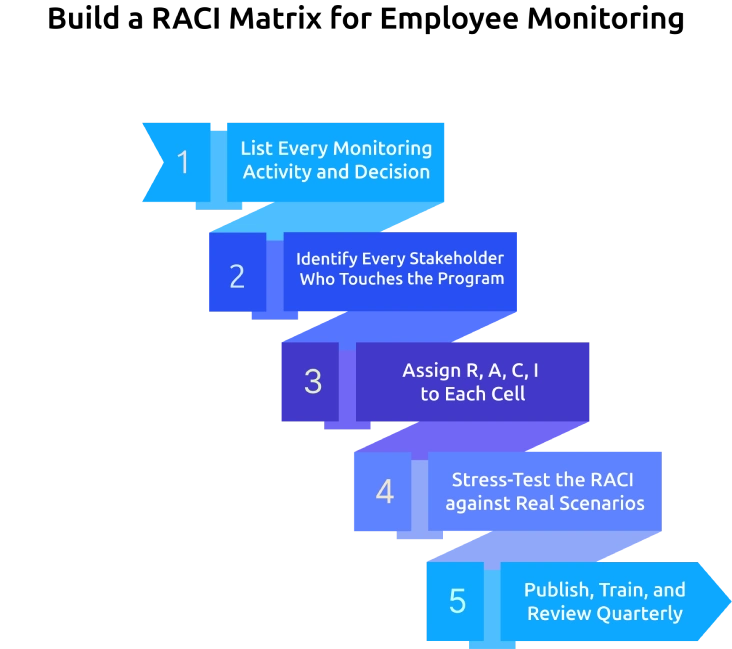
Step 1: List Every Monitoring Activity and Decision
Start by identifying all tasks involved in your employee monitoring program. Include activities like policy creation, tool selection, data access control, employee communication, and incident response. A complete list ensures you don’t miss critical responsibilities that could lead to compliance gaps or confusion later.
Step 2: Identify Every Stakeholder Who Touches the Program
List every person or team that is involved in the monitoring process, including HR, IT, Legal, managers, and senior leadership. If your region requires data privacy or labor laws, add a Data Protection Officer or works council. Identifying the right stakeholders ensures your RACI will reflect how things actually work.
Step 3: Assign R, A, C, I to Each Cell
Assign one role, Responsible, Accountable, Consulted, or Informed, to each stakeholder for every activity. Ensure each task has only one Accountable owner to avoid confusion. This step creates clarity in decision-making and helps teams implement employee monitoring without delays or conflicts.
Step 4: Stress-Test the RACI against Real Scenarios
Test your matrix using real-world scenarios such as employee complaints, compliance audits, or security incidents. Walk through who takes action, who approves decisions, and who gets informed. This step helps you identify gaps and refine your RACI matrix implementation before rollout.
Step 5: Publish, Train, and Review Quarterly
Finally, share the matrix with all stakeholders and train them on their roles. Make it easily accessible and review it regularly, especially when policies or tools change. Continuous updates ensure your RACI matrix for employee monitoring implementation stays aligned, effective, and audit-ready.
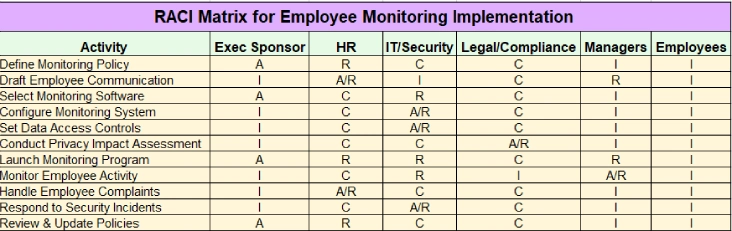
What Are the Best Practices to Implement Employee Monitoring with a RACI Matrix?
Implementing a RACI matrix for employee monitoring is about building a monitoring program that is transparent, compliant, and trusted by employees. The right approach helps you balance productivity insights with employee data privacy while avoiding the risks of over-surveillance.
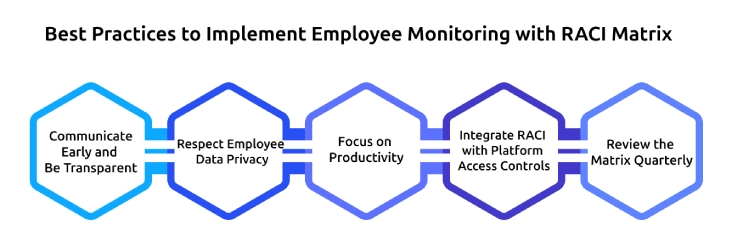
Communicate Early and Be Transparent
Start communicating before you begin monitoring employees. Clearly explain what data you collect, why it matters, and how you use it. Share policies and examples to build trust and reduce confusion from the beginning.
Respect Employee Data Privacy
Make employee data privacy a core part of your monitoring approach. Define clear data boundaries, limit access, and follow compliance requirements. Strong privacy practices protect your organization and help employees feel secure and respected.
Focus on Productivity
Use employee monitoring to improve productivity, not only to control behavior. Avoid excessive screen monitoring and focus on meaningful insights like workload balance and efficiency. This approach keeps monitoring supportive and prevents a negative impact on morale.
Integrate RACI with Platform Access Controls
Align your RACI matrix with platform access controls to ensure proper data visibility. Give decision-makers the right authority and limit access based on roles. This setup strengthens governance and prevents misuse of sensitive monitoring data.
Review the Matrix Quarterly
Review your RACI matrix regularly to keep it accurate and effective. Update roles when policies, tools, or regulations change. A quarterly review helps you fix gaps early and maintain a strong, well-aligned employee monitoring process.
Struggling to balance monitoring with employee trust?
Use Time Champ to monitor employees with clear roles, privacy, and actionable insights.
What Are the Common Mistakes When Using a RACI Matrix for Monitoring?
Even with a solid RACI matrix for employee monitoring implementation, small mistakes can break your entire monitoring process. If you overlook key roles or skip governance steps, you create confusion, compliance risks, and poor decision-making. Avoid these common mistakes to keep your implementation effective.
1. Assigning Two Accountable Owners
Assigning more than one accountable owner creates confusion and slows decision-making. Each activity needs a single owner who takes full responsibility. Clear accountability keeps decisions fast, consistent, and easy to track.
2. Skipping Legal on Data-Related Activities
Leaving Legal out of data-related decisions increases compliance risks. Employee monitoring involves sensitive data, so legal input is essential. Involving them early helps you align with regulations and avoid costly issues later.
3. Excluding Employees from the Matrix
Excluding employees reduces transparency and trust. Even if they are not decision-makers, they must stay informed about monitoring practices. Including them strengthens communication and improves acceptance of the program.
4. Using “A/R” as a Default
Using “A/R” across tasks blurs the line between ownership and execution. When roles overlap, teams struggle to understand responsibilities. Keeping roles clearly defined ensures better accountability and smoother execution.
5. Publishing Without a Review Schedule
Treating the RACI matrix as a one-time document leads to outdated roles and gaps. Monitoring programs evolve with tools and policies. Regular reviews keep your RACI matrix implementation accurate and aligned with current needs.
How Does a Workforce Intelligence Platform Help Enforce Your RACI?
A RACI matrix only works when your team actually follows it in daily operations. Without the right system, roles become unclear, access gets misused, and decisions lose accountability over time. A workforce intelligence platform solves this by aligning roles with real actions, ensuring the right people see only the sensitive data they need, make the right decisions, and stay accountable at every step.
This is where Time Champ helps you implement and enforce your RACI effectively. It maps roles to platform access, gives HR, IT, and Legal clear visibility based on responsibility, and maintains audit trails for every action. Without just relying on a static document, you can turn your RACI matrix into a working system, keeping your employee monitoring structured, compliant, and easy to manage.
Finding it hard to implement employee monitoring smoothly?
Time Champ simplifies it with structured workflows and insights.
Conclusion
A well-structured RACI matrix for employee monitoring implementation transforms monitoring from a confusing, risk-prone process into a clear and accountable system. When you define roles properly, you can eliminate delays, reduce compliance risks, and improve decision-making across HR, IT, and Legal teams. As you implement employee monitoring, focus on clarity, transparency, and regular reviews to keep your framework effective. More importantly, support your RACI matrix with the right tools and communication practices so it works in real operations, not just on paper. When you combine structured governance with practical execution, you can build a monitoring program that stays compliant, adapts as your team grows, and earns trust from both leadership and employees.

Anjali

Table of Content
-
 What Is a RACI Matrix in Employee Monitoring Implementation?
-
Why Do Employee Monitoring Programs Need a RACI Matrix?
-
What Are the Four RACI Roles Applied to Employee Monitoring?
-
How Do You Build a RACI Matrix for Employee Monitoring?
-
What Are the Best Practices to Implement Employee Monitoring with a RACI Matrix?
-
What Are the Common Mistakes When Using a RACI Matrix for Monitoring?
-
How Does a Workforce Intelligence Platform Help Enforce Your RACI?
-
Conclusion
Related Blogs
Employee attendance tracker helps businesses maintain accurate work hour records, ensure labor law compliance, manage overtime, and prevent legal issues.
Thasleem Shaik | Mar 15, 2025
Struggling to monitor your field teams? Here's how to track employee location with smart, proven methods that boost visibility, accuracy, and control.
Thasleem Shaik | July 24, 2025
Learn how a task timer boosts productivity, simplifies billing, and helps you manage time effectively. Learn its benefits and tips to tackle challenges!
Boost team productivity and reduce stress with effective time management. Discover key tips and how Time Champ can streamline your workflow.

Learn how to create an effective time management plan in 6 simple steps. Boost productivity with easy tips to organize your day and achieve your goals.
Jahnavi Pulluri | July 24, 2025
Workforce management software is a set of tools and processes designed to improve employee productivity in a business.


 4.7/5 avg.
Ready to Manage Your Workforce Smarter?
Join our family of 1500+ companies using smart insights to redefine workforces!

Free Trial
No Credit Card Required