How to Increase Accountability with Employee Productivity Tracking
Discover how employee productivity tracking builds accountability, drives ownership, and turns daily activity into measurable team performance.

You can’t build accountability by sending reminders or asking for updates again and again. If you’re constantly following up with questions like “Is this done?”, “What’s the status?” or “Who’s handling this?” Then accountability is already missing in your workflow.
When work is not clearly visible, accountability breaks down. Responsibility becomes unclear, tasks slip, and ownership gets shared or avoided. Over time, this affects performance, trust, and team confidence. About 93% of people say they struggle to align their work or take responsibility for expected results. Around one-third also say their priorities change often, which leads to confusion. That is where employee productivity tracking helps you virtually rebuild accountability.
In this blog, you will learn how employee productivity tracking helps you build strong accountability, improve ownership, and create a team that takes responsibility without constant follow-ups.
What Does Accountability Really Mean in a Modern Workplace?
Accountability is the ability of employees to clearly understand their responsibilities, take ownership of their work, and deliver expected outcomes with transparency. Accountability focuses more on clarity and ownership rather than constant supervision. Employees are expected to manage their work independently while staying aligned with team goals and expectations.
In simple terms, accountability means:
- Knowing what needs to be done
- Being clear about who is responsible
- Having visibility into progress
- Taking ownership of results
In modern workplaces, especially in remote and hybrid teams, accountability comes from clear visibility into work. Employees need to know what tasks they are responsible for, how their work is progressing, and what results are expected. When this information is clear and easy to track, employees understand their role better and take responsibility for completing their work on time.
5 Ways Employee Productivity Tracking Increases Accountability
Building accountability requires clear visibility into work, consistent expectations, and a system that helps you and your employees stay aligned. Employee productivity tracking plays a key role in making this possible. It connects daily activities with outcomes, making responsibilities easier to understand and measure.
Here are five practical ways productivity tracking helps you build stronger accountability across your team:
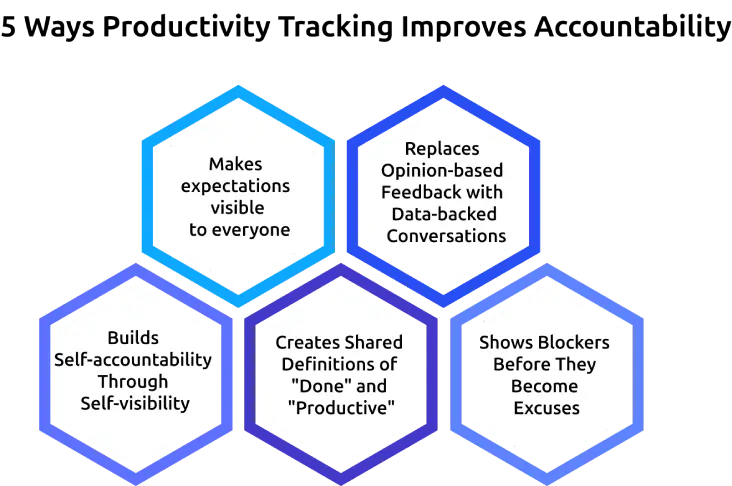
1. Makes expectations visible to everyone
Accountability starts when there is no confusion about what needs to be done.
Productivity tracking makes expectations clear by showing tasks, timelines, and priorities in one place. Everyone knows what they are responsible for and what success looks like. Instead of relying on reminders or assumptions, your team works with clarity. This reduces back-and-forth communication and ensures that work moves forward without delays.
2. Replaces Opinion-based Feedback with Data-backed Conversations
When feedback is based on opinions, it often feels unclear and sometimes unfair. Employees may not understand what exactly went wrong or what they need to improve. Productivity tracking makes things clearer by showing how work is actually being done. You can see how much time a task takes, how progress is moving, and what results are being delivered. This makes conversations simple and more useful.
3. Builds Self-accountability Through Self-visibility
People take more responsibility when they can see their own performance. With productivity tracking, employees get a clear view of how they are spending their time and how their work is progressing. This awareness helps them identify gaps and improve on their own.
Over time, they stop waiting for instructions or follow-ups. They start managing their work proactively, which is a strong sign of real accountability.
4. Creates Shared Definitions of "Done" and "Productive"
Accountability becomes weak when everyone is working with their own understanding of what “done” means. One person may think a task is complete, while another expects more detail or better quality. Productivity tracking brings clarity by setting clear expectations for completion, timelines, and output. Everyone knows what needs to be delivered and what standard it should meet.
5. Shows Blockers Before They Become Excuses
Most delays happen because something is getting in the way of the work. It could be unclear instructions, too much workload, or tools not working properly.
With productivity tracking, you can see where work is slowing down. If a task is taking longer than usual or is not moving forward, it becomes easy to notice. This helps you step in early, understand the issue, and fix it before it turns into a bigger problem. Instead of finding out late, you stay ahead and keep the work on track.
Struggling to bring accountability into your team’s daily work?
See how Time Champ gives you clear, real-time visibility to turn confusion into ownership.
How do You Set up Employee Productivity Tracking that Builds Accountability?
Setting up productivity tracking is about creating a system your team understands, accepts, and actually uses to improve their work. When done right, it builds clarity, trust, and ownership across the team.
Here’s how you can set it up in a way that strengthens accountability:
Step 1: Communicate the why before the what
Before introducing any tracking, explain the purpose clearly. Your team needs to understand how this helps them, along with how it helps management.
- Reduce confusion around expectations
- Make work more visible and organized
- Help identify delays early
- Support fair performance reviews
When people see the benefit, they are more open to using it and less likely to resist.
Step 2: Make data visibility two-way
Accountability grows when everyone has access to the same information.
Do not keep data limited to managers. Let employees see their own reports, track their progress, and understand how they are performing. This creates transparency and encourages employees to take ownership of their work instead of waiting for feedback.
Step 3: Track outcomes, not just activity
Tracking only activity does not give a clear picture of performance. Someone may spend a lot of time working, but that does not always mean meaningful results are being delivered. Focus on what actually matters. Look at whether tasks are completed on time, whether the quality meets expectations, and whether goals are being achieved. When your team knows that results are what count, they pay more attention to finishing work properly instead of just staying busy.
Step 4: Set clear consequences and rewards
Accountability becomes stronger when expectations are clearly connected to results.
Your team should know what happens when work is completed well and what happens when it is not. Recognizing good work encourages consistency, while addressing gaps helps employees understand where they need to improve. Keep it simple and consistent. When people see that effort and results are noticed and treated fairly, they are more likely to take their responsibilities seriously.
Step 5: Review, coach, repeat
Tracking is useful only when it is reviewed regularly.
Set time to go through progress with your team. Look at what is going well and where things are slowing down. Use these moments to guide, support, and help employees improve. When this becomes a regular habit, your team starts learning from their work and improving over time. Accountability grows naturally when people know their work will be reviewed and supported, not ignored.
Common Mistakes that Turn Productivity Tracking into Anti-Accountability
Productivity tracking can improve accountability, but only when it is used in the right way. If implemented poorly, it can create pressure, confusion, and even reduce ownership.
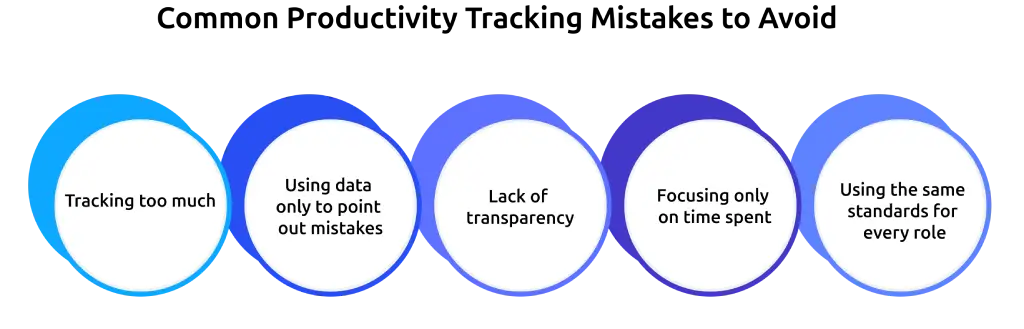
Tracking too much
When every small action is monitored, employees start to feel watched instead of supported. This creates stress and makes them less willing to take initiative or think independently.
Over time, this kind of tracking shifts focus away from meaningful work. Instead of thinking about results, employees become more concerned about how their activity looks, which weakens true accountability.

Did You Know?
Employees in high-surveillance workplaces report 45% stress levels compared to 28% in low-surveillance environments.
Using data only to point out mistakes
When tracking is mainly used to highlight errors, employees begin to avoid it. Instead of helping them improve, it creates fear and resistance. When feedback is balanced and focused on improvement, employees are more open to it. This builds trust and encourages them to take responsibility for doing better.
Lack of transparency
If employees do not know what is being tracked or why, trust quickly breaks down. This leads to confusion and defensiveness, which weakens accountability instead of strengthening it. Being open about what is tracked and how it is used helps employees feel included. When they understand the purpose, they are more likely to accept it and take ownership of their work.
Focusing only on time spent
More time spent does not always mean better results. When teams are judged only by hours, they focus on looking busy instead of doing meaningful work. This can lead to unnecessary work and reduced efficiency. When you shift focus to outcomes and quality, employees start prioritizing what truly matters.
Using the same standards for every role
Not all roles work in the same way, but applying one standard to everyone can create confusion. What works for a developer may not work for a designer or a sales team. When expectations do not match the nature of the work, employees may feel the system is unfair. This reduces employee motivation to take ownership and follow it seriously.
How do You Measure if Employee Productivity Tracking is actually Building Accountability?
Accountability becomes visible through everyday work patterns. When productivity tracking is set up well, you start noticing clear changes in how work gets done, how people respond to responsibilities, and how smoothly tasks move across the team.
Employees take ownership without reminders
A noticeable shift happens when tasks are completed without constant follow-ups. You can see that responsibilities are clearly understood and handled on time.
Instead of waiting for instructions, you will find that employees move work forward on their own. This shows that accountability is becoming part of how they work every day.
Less time spent on follow-ups
Repeated status checks and reminders begin to reduce. Since progress is already visible, you do not need to spend time asking for updates again and again.
This allows you to focus more on improving work and supporting your team rather than tracking what is happening.
Work moves forward without delays
Tasks start flowing more smoothly, and fewer things get stuck in between. You will notice that deadlines are met more consistently because everyone knows what they are responsible for.
When work moves without unnecessary delays, it reflects clear ownership and better coordination across the team.
Conversations become clear and purposeful
Workplace communication improves as discussions focus on real work, progress, and results. Instead of vague updates, you will see conversations based on progress, results, and what needs attention.
This makes it easier for you and your team to understand what is working and where improvements are needed.
Employees improve their work on their own
A strong sign of accountability is when employees start reviewing their own performance. You will notice them identifying gaps and making changes without waiting for feedback.
This creates a habit of continuous improvement, where people take responsibility for doing better.
More consistent performance across the team
Work quality and output become steadier over time. You will see fewer unexpected drops in performance and more reliable results.
This consistency shows that accountability becomes a regular part of how your team works every day.
How does Time Champ help you build accountability through productivity tracking?
Building accountability becomes easier when work is clear, visible, and easy to track. That is exactly where Time Champ supports your team. It gives you a clear view of how time is spent, what tasks are being worked on, and how progress is moving. This removes confusion and helps you understand ownership across your team.
As an employee monitoring software, Time Champ tracks activity in real time and categorizes productivity into productive, non-productive, and neutral. This helps you quickly understand how effectively time is being used. You also get reports on time usage, task progress, and performance. With application and website tracking, you can see where focus is going and guide your team better. Your employees can view their own data, track their performance, and improve their work without constant follow-ups. This builds awareness and encourages ownership.
Beyond productivity tracking, Time Champ also includes features like live screen monitoring, screenshots, attendance tracking, and idle time detection. These features help you stay informed, support your team at the right time, and keep work aligned with expectations.
Looking for a simple way to bring clarity to your workflow?
See how Time Champ makes work visible and responsibility easier to manage.
Conclusion
Accountability improves when work is clear, visible, and easy to track. When your team understands their responsibilities and can see their progress, ownership starts to build naturally. Employee productivity tracking helps you create this clarity. It connects daily work with outcomes, reduces confusion, and keeps everyone aligned without constant follow-ups.
Over time, this creates a system where responsibility is clear, work moves smoothly, and accountability becomes part of everyday work.

Guna Lakshmi

Table of Content
-
 What Does Accountability Really Mean in a Modern Workplace?
-
5 Ways Employee Productivity Tracking Increases Accountability
-
How do You Set up Employee Productivity Tracking that Builds Accountability?
-
Common Mistakes that Turn Productivity Tracking into Anti-Accountability
-
How do You Measure if Employee Productivity Tracking is actually Building Accountability?
-
How does Time Champ help you build accountability through productivity tracking?
-
Conclusion
Related Blogs
Explore the top benefits of productivity tracking software for better visibility, balanced workloads, smarter planning, and improved business decisions.
Guna Lakshmi | Apr 30, 2026
Implement a productivity tracking tool with clear steps, setup tips, and best practices to track employee productivity and improve team performance.
Thasleem Shaik | Apr 30, 2026
Employee screen monitoring captures work activity in real time. Learn all monitoring types, how they boost productivity, and how to implement them ethically.
Jahnavi Pulluri | Apr 17, 2026
Struggling with remote work productivity challenges? Learn what’s slowing your team down and how to improve focus, communication, and performance.
Guna Lakshmi | Apr 15, 2026
Learn what workforce productivity is, key factors, metrics, and ways to measure and optimize it. Discover AI’s role in improving workforce efficiency.
Chetana Choudary | October 1, 2025
Learn how employee productivity monitoring software can boost your company with key features, usage tips, and advantages of using tools like Time Champ.
Tarun Kumar | June 24, 2024


 4.7/5 avg.
Ready to Manage Your Workforce Smarter?
Join our family of 1500+ companies using smart insights to redefine workforces!

Free Trial
No Credit Card Required