How to Calculate Productivity: Formulas and Methods
Learn how to calculate productivity using simple formulas, practical methods, and real examples to measure employee performance accurately.

Have you ever looked at timesheets, reports, and completed tasks and still felt unsure whether your team actually worked productively or just stayed busy throughout the day? That lack of clarity pushes you to make decisions based on assumptions instead of real performance data.
Learning how to calculate productivity helps you measure output properly, identify performance gaps, and understand where time and effort actually deliver results. This guide helps you understand different productivity formulas, when to use them, and how to measure productivity more accurately with practical examples.
What Is a Productivity Calculation?
A productivity calculation is how you turn work activity into a measurable number. At its core, the math is straightforward:
Productivity = Output ÷ Input
Output includes completed tasks, generated revenue, delivered projects, or produced units. Input includes work hours, team size, operating costs, or the resources you use to complete that work. Run that ratio, and you get a number that tells you exactly how much your team produces for every unit of effort or resource you put in.
That number makes conversations about performance clearer and measurable instead of relying on assumptions. It is also important to understand that productivity, efficiency, and effectiveness do not mean the same thing. Efficiency measures how well you use resources. Effectiveness measures whether you achieve your goals. Productivity brings both together by measuring the output your team generates from the time, effort, and resources invested. If you want a more complete view of what to track, explore the guide on how to measure employee productivity
Why Should You Need to Calculate Productivity?
Tracking hours tells you when your team works. Calculating employee productivity tells you how much output that time actually generates. Here are five reasons to make productivity tracking a regular part of your workflow.
1. Catch Efficiency Problems Before They Cost You
When you calculate workplace productivity regularly, you stop reacting to performance slowdowns too late. You can identify the issue early and fix the root cause, whether that comes from workflow bottlenecks, tool issues, or uneven workload distribution, before the problem affects overall performance.
2. Allocate Resources Based on Tracking Data
Many workforce decisions, such as hiring, workload distribution, budgeting, and project planning, still depend on assumptions instead of measurable performance data.
3. Create Clear Performance Standards
Vague feedback like "work smarter" does not help your team understand what needs improvement. A clear productivity formula gives measurable targets based on output and completed work. When your team can clearly see their performance numbers, it becomes easier to improve workflows, identify gaps, and work toward realistic productivity goals.
4. Spot Hidden Workflow Gaps
Workflow problems do not always appear clearly. They often show up as slowdowns, missed deadlines, or too much time spent on low-value tasks. A report from Deloitte found that the average employee loses 32 days each year switching between workplace applications. Calculating productivity helps you identify where time and effort start slipping away.
Want clearer visibility into how your team actually works?
Try Time Champ for complete visibility into work hours and employee productivity
How to Calculate Productivity with Simple Formulas?
Not every team measures the same thing. A sales team counts deals closed. A factory counts units built. A support team counts resolved tickets. The formula that fits one role will not fit another, and using the wrong one gives you numbers that look accurate but offer little useful insight.
These five productivity formulas cover the most common scenarios. Each one follows the same logic, output divided by input, but they differ in what you measure and how you apply the result. Choose the formula that best matches what your team actually produces.

1. Standard Productivity Formula
The standard productivity formula measures total output against total input.
Productivity = Output ÷ Input
This is the basic employee productivity formula every other calculation builds on. Output is the work your team completes. Input is the resource you spend to complete that work, usually time.
When to Use it: Any role where output is easy to count, such as units, calls, tasks, or deliverables.
Example: A sales rep closes 12 deals in a month and works 160 hours.
12 ÷ 160 = 0.075 deals per hour, or roughly one deal every 13 hours.
2. Labor Productivity Formula
This formula measures how much output each employee generates.
Labor Productivity = Total Output ÷ Number of Employees
This one shifts the input from hours to headcount. Instead of asking how much one employee produces per hour, you're asking how much each employee on the team contributes over a set period. It works well when you want to compare output across teams or measure how productivity changes as your team grows.
When to Use it: Team or company-level reporting, capacity planning, and headcount decisions.
Example: Your team of 200 produces 1,000,000 units in a year.
1,000,000 ÷ 200 = 5,000 units per employee per year
Run the same number next quarter. If that figure rises without adding headcount, your labor productivity has improved.
3. Partial Factor Productivity (PFP)
PFP = Output ÷ Single Input Factor
Partial factor productivity isolates one specific input instead of combining all resources. You choose the input that directly drives output in your context, such as labor hours, machine hours, or material cost.
When to Use it: When one input dominates your cost structure, and you want to track it without the complexity of a multi-input formula.
Customer Service Example: Your support team resolves 250 tickets across 200 hours of logged work.
250 ÷ 200 = 1.25 tickets per hour
4. Multi-Factor Productivity (MFP)
This formula measures output against multiple inputs together, including labor, costs, and materials.
MFP = Output ÷ (Labor Input + Capital Input)
Multi-factor productivity measures output using multiple inputs together instead of just one input. It is the right formula when labor does not fully explain the output because machines, software, or capital investment also play a major role in producing results.
When to Use it: Manufacturing, operations, or any team where equipment costs or software investment directly affect output and overall results.
Example: A company produces $500,000 in output.
Labor cost for the period = $100,000
Capital cost (equipment, software) = $50,000
MFP = $500,000 ÷ ($100,000 + $50,000) = 3.33
That means the company generates $3.33 in output for every $1 spent on labor and capital costs.
5. Revenue Per Employee
Businesses often use this formula to measure financial productivity.
Revenue Per Employee = Total Revenue ÷ Number of Employees
This formula ties productivity calculation directly to business output. It answers a simple question: how much revenue does each employee on the team generate?
When to Use it: Business performance reviews, investor reporting, benchmarking against industry peers, and tracking team productivity over time.
Example: Your company brings in $2,000,000 in annual revenue with 50 employees.
$2,000,000 ÷ 50 = $40,000 revenue per employee
Run this quarterly and compare it against your own historical baseline. If revenue grows faster than headcount, that ratio climbs, which is exactly what healthy scaling looks like.
Common Productivity Calculation Mistakes to Avoid
Even with the right formula in hand, the numbers can still mislead you. Most productivity calculation errors don't come from wrong math. They come from measuring the wrong thing, using the wrong input, or reading the output without any context to compare it against. Here's what to watch out for.
1. Tracking Hours Worked Instead of Output
Work hours only show how long your team stayed active, not how much work they actually completed. When you treat desk time as productivity, you focus more on presence than real output. A productivity formula is to divide output by input, so if you never define what output looks like for a specific role, the final number becomes difficult to use in any meaningful way.
A sales rep who closes 15 deals in 30 hours is more productive than one who logs 60 hours and closes 10 because the output-to-input ratio clearly shows the difference in performance.
2. Using One Formula Across Every Role
The standard productivity formula works well for manufacturing or customer service. It becomes less reliable for creative roles or cross-functional teams where output varies from task to task. Applying the same employee productivity formula across roles that require different measurement methods gives you numbers that look accurate but lack meaningful context.
A developer finishing 3 complex features and a support agent closing 80 tickets in the same week cannot be measured on the same scale. Pick the formula that fits the work type, not the one that's easiest to run.
3. Ignoring Quality in the Output Count
If you count output volume without checking quality, you reward speed over accuracy. A content team publishing 30 blog articles a month with constant revisions, factual errors, and poor engagement is not more productive than a team publishing 20 well-researched articles that consistently perform better. Calculate workplace productivity alongside quality metrics; the formula only shows how much work your team completed, not whether the work actually delivered value.
4. Counting Input Inconsistently
This one quietly breaks cross-team comparisons. If one team's input includes meetings, admin, and onboarding time, and another team only counts focused work hours, the productivity ratios aren't comparable even if the formula is identical. Before you run any productivity formula by industry or across departments, define exactly what goes into the input number and apply that definition consistently
5. Running the Calculation Once and Moving On
Calculating employee productivity isn't a one-time task. A single data point only shows you a snapshot. Productivity shifts with team size, workload distribution, tool changes, and role transitions. If you run the numbers once at the start of a quarter and don't revisit them, you're making decisions based on data that's already stale. Set a regular cadence, whether weekly, bi-weekly, or monthly, so the numbers reflect how work is actually moving right now, not how it looked three months ago.
Automate Productivity Tracking and Measurement with Time Champ
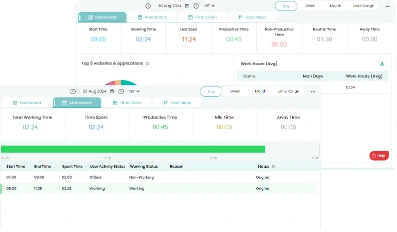
Time Champ is an employee monitoring and productivity tracking software with complete workforce intelligence features. When you want to understand where your team's time actually goes, Time Champ breaks it down through app and website usage tracking so you can see how your team spends work hours across the day. You can compare productivity between teams, identify productive and non-productive applications, and understand which activities contribute to actual work output.
Visual productivity heatmaps help you identify trends across different hours and workdays, making it easier to notice productivity drops before they start affecting overall performance. Smart idle time detection also helps you track inactive periods more accurately, so your productivity data reflects real work activity instead of just logged hours.
On top of that, Time Champ gives you proactive alerts for productivity dips, late logins, non-productive app usage, and unusual activity so you can identify issues early and respond faster. Attrition risk insights help you notice engagement changes before they grow into larger workforce problems. Whether you want to review individual performance or compare output across departments, Time Champ gives you clearer visibility into how work actually happens across your organization. Start a 7-day free trial and see what your team's productivity tracking actually looks like.
Stop relying on scattered spreadsheets or manual tracking to track team productivity.
Try Time Champ to track work hours, productivity, and activity with better visibility.
Conclusion
Calculating productivity becomes much more effective when you measure the right output against the right input instead of relying on assumptions or activity. The formulas, methods, and examples in this guide help you understand how your team performs, where workflows slow down, and which areas need attention. Once you start tracking employee productivity consistently with the right approach for each role, it becomes easier to identify performance gaps and improve workflows. You can also allocate resources more effectively and make decisions using real operational data instead of guesswork.

Thasleem Shaik

Table of Content
 What Is a Productivity Calculation?
- Why Should You Need to Calculate Productivity?
- How to Calculate Productivity with Simple Formulas?
- Common Productivity Calculation Mistakes to Avoid
- Automate Productivity Tracking and Measurement with Time Champ
- Conclusion
Related Blogs

Learn how time tracking improves remote team productivity through better visibility, accountability, performance tracking, and smarter team management.
Anjali | May 16, 2026
Discover essential time-tracking features that improve productivity, payroll accuracy, and workforce visibility, and learn how to use them effectively.
Guna Lakshmi | May 16, 2026
Learn how automated time tracking improves team productivity, reduces manual work, builds trust, and delivers smarter workforce insights for managers today.
Anjali | May 15, 2026
Get 6 free employee productivity report templates for 2026, designed for daily, weekly, monthly, and team reporting. Simple, customizable, and easy to use.
Jahnavi Pulluri | May 14, 2026
Explore 20 proven productivity hacks to improve employee focus, reduce workplace distractions, and help your teams work more efficiently in 2026.
Guna Lakshmi | May 14, 2026
Discover the hidden cost of low productivity in business. Learn how to calculate productivity loss, reduce inefficiencies, and improve profitability in 2026.
Guna Lakshmi | May 13, 2026


 4.7/5 avg.
Ready to Manage Your Workforce Smarter?
Join our family of 1500+ companies using smart insights to redefine workforces!

Free Trial
No Credit Card Required