Remote Work Statistics 2026: Key Remote Work Trends and Data
See what the latest remote work statistics reveal about hybrid work, productivity, employee preferences, pay, hiring trends, and workplace changes.

Remote work has settled into a more complex pattern in 2026. Fully remote work remains common in some roles, while hybrid work now accounts for the largest share of remote-capable jobs. Many companies also continue to tighten office requirements. Current remote work statistics also show major differences across industries, worker demographics, productivity, and employee preferences.
This article brings together the latest remote work statistics from government data, workplace research, and current workforce surveys. You will see how remote work is changing, where it is most common, how it affects productivity, and what the latest numbers say about the future of flexible work.
Remote Work Statistics by Industry
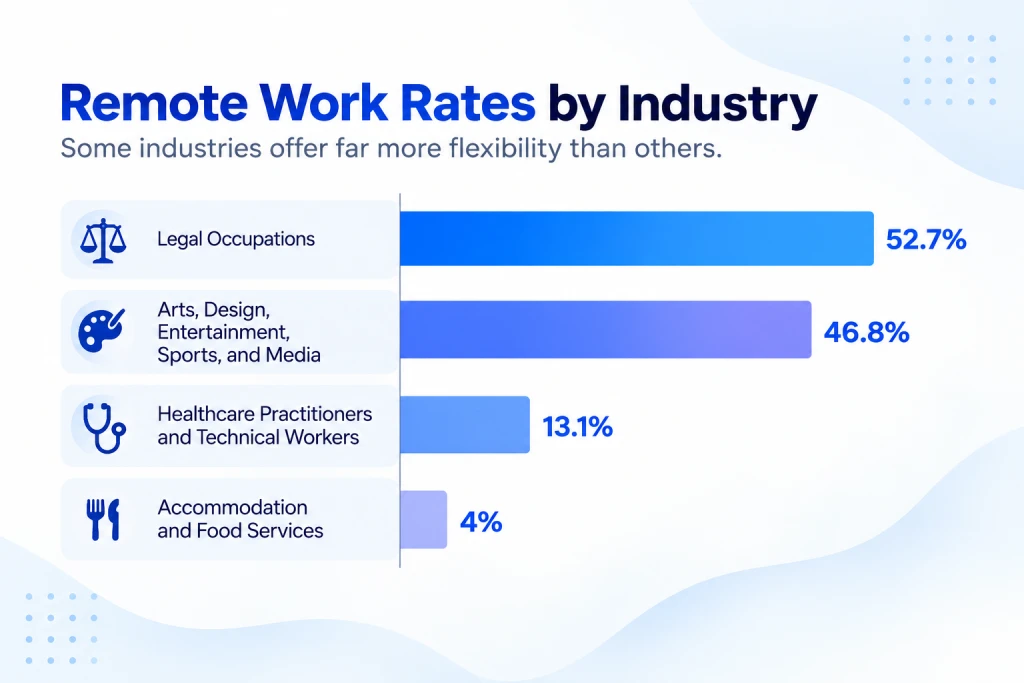
Remote work availability varies sharply by industry. Jobs that rely heavily on digital tools tend to offer more flexibility, while roles that require physical locations remain largely on-site. The latest remote work statistics by industry show just how wide this gap remains.
1. Legal Occupations Had One of the Highest Remote Work Rates
Legal occupations recorded a 52.7% telework rate, according to BLS data. About 960,000 legal workers teleworked or worked from home for pay, with 33.2% working remotely for some hours and 19.5% working remotely for all hours.
2. Arts, Design, Entertainment, Sports, and Media Had a 46.8% Telework Rate
Nearly half of workers in arts, design, entertainment, sports, and media occupations teleworked in 2025. The same BLS report found a 46.8% telework rate, with about 1.57 million workers in the category working from home for at least some hours.
3. Healthcare Practitioners Had a 13.1% Telework Rate
Healthcare remains much more location-dependent than many knowledge-based fields. BLS reported that 13.1% of healthcare practitioners and technical workers teleworked, reflecting the large share of healthcare work that requires physical interaction or on-site facilities.
4. Accommodation and Food Services Had Only a 4% Telework Rate
Accommodation and food services recorded one of the lowest rates of remote work. Only 4% of workers in the industry teleworked or worked from home for pay in 2025, while 96% did not telework.
Are scattered work patterns making remote teams harder to manage?
Use Time Champ to bring time, attendance, and productivity data together.
Who Works Remotely? Demographic Statistics
Remote workforce statistics vary widely by age, education, and family situation. These numbers show who is most likely to work remotely and how remote work differs across groups.
According to the BLS study:
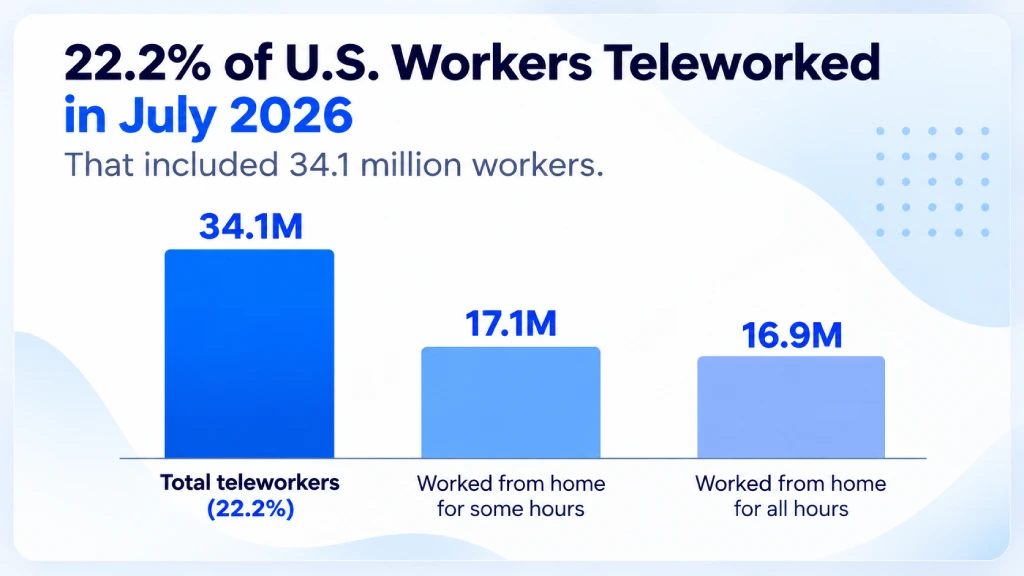
5. 22.2% of U.S. Workers Teleworked in July 2026
That included 34.1 million workers, with 17.1 million working from home for some hours and 16.9 million working from home for all their work hours.
6. 25.3% of Employed Women Teleworked, Compared With 19.6% of Men
Among workers aged 25 to 54, the gap was also clear, with 28.7% of women teleworking compared with 21.5% of men.
7. Workers Aged 35 to 44 Had a 27.5% Telework Rate
This was higher than the 21.7% rate for workers aged 25 to 34 and the 25.3% rate for workers aged 45 to 54.
8. Workers With Higher Education Were More Likely to Telework
39.6% of workers aged 25 and older with a bachelor's degree or higher teleworked, compared with 18% of those with some college or an associate degree and 9.5% of high school graduates without college.
9. 26.6% of Workers with Children Under 18 Teleworked
Workers with children under 18 were more likely to telework than those without children. 26.6% of workers with children under 18 teleworked, compared with 20.5% of workers without children under 18.
10. Asian Workers Had the Highest Telework Rate Among Major Racial Groups
31.9% of Asian workers teleworked, compared with 22.7% of White workers, 14.9% of Black workers, and 12.9% of Hispanic or Latino workers.
Want a clearer picture of how hybrid teams are working today?
Read our hybrid work statistics blog for the latest trends, data, and insights.
Remote Work Productivity Statistics
The debate around remote work productivity statistics often produces conflicting claims because studies measure different workers, industries, and work arrangements. The strongest research does not show that remote work is automatically more or less productive. Instead, results vary by job, schedule, and how teams organize work.
11. Hybrid Workers Were Just as Productive as Office Workers in a Stanford Study
A randomized study of more than 1,600 Trip.com employees found that employees working from home two days a week were just as productive as their fully office-based peers. The study also found no negative effect on promotion rates or performance reviews.
12. Remote Workers Showed A 13% Increase in Performance
Remote workers showed a 13% increase in performance compared with office workers. The improvement came from working more minutes during each shift and completing more calls per minute. Remote workers also reported higher job satisfaction and had 50% lower attrition, showing positive results for both performance and retention.
13. Skipping the Commute Saves 55 Minutes Each Day
Working from home saves an average of 55 minutes each day by eliminating the daily commute. That adds up to about 239 hours a year, giving you more time for work, personal activities, or rest. Across 27 countries, the average time saved reaches 72 minutes per day.
14. A 1 Percentage-point Increase in Remote Work is Linked to a 0.05 Percentage-point Rise in Productivity Growth
A 1 percentage-point increase in remote work was associated with a 0.05 percentage-point increase in total factor productivity growth after accounting for pre-pandemic productivity trends. However, this shows an association rather than proof that remote work directly caused the productivity increase.
15. Remote Work Provides More Focus Time
Remote work gives employees an average of 22.75 hours of focus time each week, compared with 18.6 hours for office-based employees. They also experience 18% fewer interruptions during periods of deep concentration, giving them more uninterrupted time to focus on important tasks.
16. Remote Work Keeps Productivity Stable or Higher
According to Great Place to Work, productivity among 800,000 employees was found to be stable or higher when working remotely from home. The findings show that working from home did not lead to a drop in productivity.
Remote Work Benefits and Challenges by the Numbers
The latest remote work data shows that flexible work can improve work-life balance and retention, but it also creates challenges around coordination, boundaries, trust, and security. The numbers tell a more balanced story than simply calling remote work good or bad.
17. Remote Work Can Reduce Annual Workplace Costs
According to Global Workplace Analytics, employers can save roughly $11,000 per year for each employee who works at least half the time remotely. The savings come from lower office space, utilities, and other workplace-related costs.
18. Remote Work Can Save Employees Thousands Each Year
Working from home can reduce everyday expenses by cutting costs such as fuel or transit, meals bought at work, and work clothing. Estimates suggest these savings can range from $2,000 to $7,000 per year, depending on commuting distance and personal spending habits.
19. Fully Remote Workers Report Higher Engagement
Globally, 31% of fully remote workers are engaged at work, compared with 23% of hybrid workers and 19% of on-site workers in roles that cannot be done remotely. The data shows higher engagement among fully remote workers than across other work arrangements.
20. Remote Work Can Increase Feelings of Loneliness
About 25% of remote workers experience loneliness every day, compared with 16% of fully on-site workers. Working from home can reduce casual social interactions, such as conversations over coffee or shared meals, which can make it harder to maintain regular workplace connections.
21. Fully Remote Work Can Bring Higher Stress Levels
Fully remote employees report higher levels of anger, sadness, and daily stress than some hybrid and on-site workers. About 45% say they experienced significant stress the previous day, compared with 39% of remote-capable on-site workers and 38% of non-remote-capable on-site workers.
22. 70% of Remote Workers Did Not Receive Regular Training
70% of remote workers say they have not received regular training from their company, leaving 30% with consistent training support. Regular training can help remote teams stay updated on skills, tools, and changing work requirements.
23. 54% of IT Professionals See Remote Work as a Higher Security Risk
According to OpenVPN, 54% of IT professionals consider remote workers a greater security risk than traditional office-based workers. The finding highlights the need for strong security practices, employee training, and tools such as VPNs to protect remote work environments.
24. 69% of Remote Workers Report Higher Burnout from Digital Communication
According to Forbes Advisor data, 69% of remote workers report increased burnout from digital communication tools. Frequent messages, meetings, and notifications can add to mental fatigue, making clear work boundaries important for maintaining a healthy remote work routine. A healthy remote work routine.
25. 71% of Remote Workers Say Remote Work Supports Work-Life Balance
71% of remote workers say working remotely helps them balance their work and personal life. The flexibility of working from home can make it easier to manage professional responsibilities alongside personal commitments.
How much does employee engagement influence productivity?
Check out our blog for the numbers and insights behind the connection.
Remote Work and Return-to-Office Trends
The biggest shift in the latest remote working trends is the move from the rapid expansion of remote work toward a more controlled mix of remote, hybrid, and office-based work. Companies are tightening some policies, but the data does not show remote work disappearing.
26. Older CEOs Are More Likely to Favor a Return to the Office
The preference for returning to the office increases with CEO age. Among CEOs who support a full return, 75% of those aged 40 to 49, 83% aged 50 to 59, and 87% aged 60 to 69 favor going back to the office. The data also show a gender difference, with 84% of male CEOs and 78% of female CEOs expecting a full return within three years, according to KPMG.
27. Fully In-Office Job Postings Rose Sharply in 2026
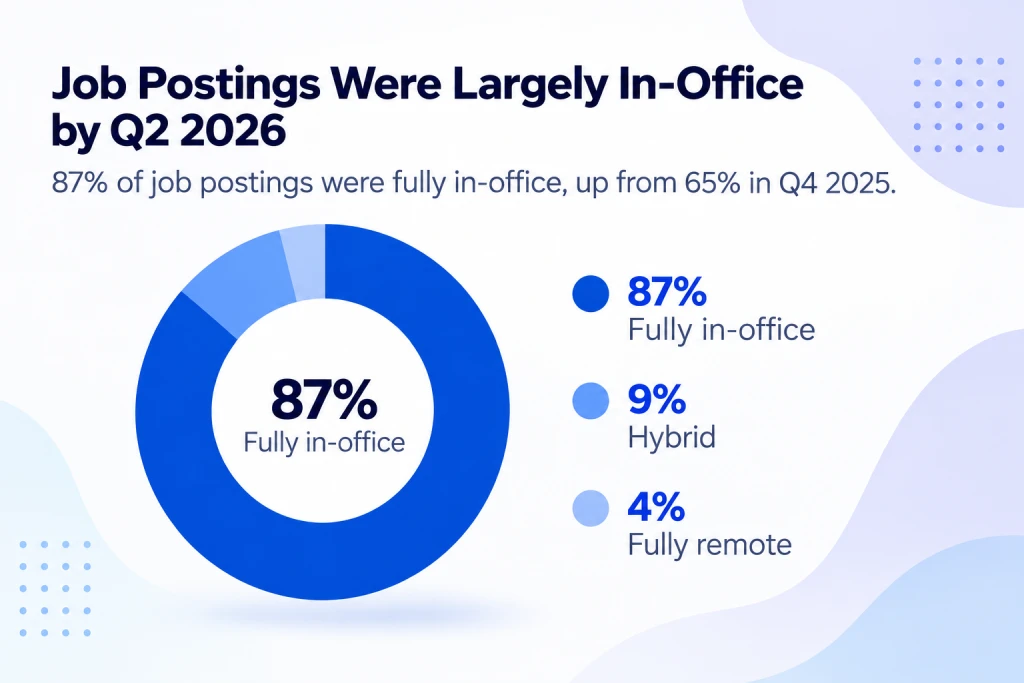
According to Robert Half, fully in-office roles increased from 65% of job postings in Q4 2025 to 87% in Q2 2026. This sharp rise shows that employers are advertising more office-based roles, even though many current employees continue to work remotely or in hybrid arrangements.
28. RTO Mandates Can Lead to Higher Employee Turnover
A University of Pittsburgh study found that companies introducing RTO mandates experienced higher employee turnover, particularly among women, senior employees, and highly skilled workers. The study also found no significant improvement in company profitability or market value after the mandates.
29. Half of Companies Require Employees to Work In-Office Four or More Days a Week
About half of companies require employees to work in the office at least four days a week. The most common requirement is three days in the office, followed by four and five days. Only a small share of companies have reduced in-office requirements to one or two days, while very few have removed RTO requirements completely.
30. RTO Mandates Can Create Workplace Tension
According to Gartner, nearly three-quarters of HR leaders say return-to-office mandates have created tension within their organizations. The finding shows that stricter office requirements can affect workplace relationships and employee experience.
31. 46% of Remote-Capable Workers May Leave if Remote Work Ends
According to Pew Research Center, 46% of remote-capable workers say they would be unlikely to stay with their current employer if they could no longer work from home. This includes 26% who say they would be very unlikely to stay.
32. 48% of Workers Would Take a Pay Cut to Keep Working from Home
WTW found that 48% of hybrid and remote workers said they would accept an 8% pay cut to continue working from home. The finding highlights how highly many workers value the flexibility of remote work.
Finding it difficult to keep remote work visible and accountable?
Try Time Champ to understand work patterns and support better team performance.
What the Remote Work Statistics Mean for the Future of Work
The latest remote work trends point toward a more stable model rather than a simple return to either fully remote or fully office-based work. Hybrid work remains strong, remote work continues in roles where it fits, and companies are paying more attention to how teams work and perform.
33. Remote Workplace Services Market Could Reach $187.31 Billion by 2032
The global remote workplace services market is estimated to reach $59.02 billion in 2026 and is projected to grow to $187.31 billion by 2032, according to a 2026 market forecast. The growth reflects continued demand for tools that support secure access, collaboration, communication, and productivity across distributed work environments.
34. Global Digital Jobs Could Reach 90 million by 2030
The number of digital jobs that can be performed remotely from anywhere is expected to grow by about 25% and reach 90 million by 2030. This growth points to a larger global workforce that can work across locations without being tied to a traditional office.
35. 86% of Companies Expect AI to Transform Work by 2030
86% of companies expect advances in AI and information processing technologies to transform their businesses by 2030. This highlights the growing role of AI in shaping how work is organized and carried out.
36. Flexible Work Can Improve Retention and Engagement
Companies that offer flexible work arrangements report 76% greater retention and 78% higher employee engagement. These results suggest that giving employees more flexibility can help companies retain talent and maintain stronger engagement.
37. Hybrid Work Raises Concerns About Connection and Career Growth
According to SurveyMonkey, 46% of workers worry about missing opportunities to build relationships with coworkers in a hybrid work setup. Others are concerned about career growth, work-life boundaries, learning opportunities for junior staff, onboarding, and trust between employees and management.
38. 34.9% of Full-Time Workers Work from Home on an Average Day
According to the SHRM, 34.9% of full-time workers performed at least part of their job from home on an average day. That represents approximately 32.5 million workers, showing how common working from home has become among full-time employees.
39. 91% of Employees Prefer Fully or Mostly Remote Work
The demand for remote work remains strong, with 91% of employees worldwide preferring to work fully or mostly remotely. At the same time, 83% say a hybrid schedule is ideal, showing a clear preference for flexibility in where they work.
40. Remote Work Could Account for 30% of Global Work Hours by 2030
The World Economic Forum projects that around 30% of global work hours could be performed remotely by 2030, up from roughly 18% to 20% in 2025. This points to continued growth in flexible and location-independent work.
Keep Remote Teams on Track with Clear Data from Time Champ
Remote work statistics can show you where work patterns are changing, but you still need clear data to see what those changes mean for your day-to-day operations. Time Champ helps you track work hours, activity, attendance, and productivity patterns across remote and hybrid teams from one place.
With clear reports and real-time insights, you can see where time goes, identify work patterns, and support better decisions without relying on assumptions.
Remote work gives you flexibility, but do you have enough visibility?
Use Time Champ to see work patterns, time usage, and productivity in one place.
Conclusion
The latest remote work statistics show that remote and hybrid work have become established parts of the modern workplace. While companies continue to adjust their policies, employees still value flexibility, and businesses need clear data to see how different work models perform.
If managing a distributed team feels difficult without enough visibility, Time Champ gives you the tools to track time, attendance, and productivity in one place. You can use these insights to understand work patterns and keep your teams on track.
Table of Content
 Remote Work Statistics by Industry
- Who Works Remotely? Demographic Statistics
- Remote Work Productivity Statistics
- Remote Work Benefits and Challenges by the Numbers
- Remote Work and Return-to-Office Trends
- What the Remote Work Statistics Mean for the Future of Work
- Keep Remote Teams on Track with Clear Data from Time Champ
- Conclusion
Related Blogs

Explore the latest time tracking statistics for 2026, including productivity trends, AI insights, remote work data, and workforce analytics.
Thasleem Shaik | May 22, 2026
Create an effective and simple remote work policy with practical steps, proven best practices, helpful examples, and a free downloadable template.
Thasleem Shaik | Jul 27, 2026
Boost productivity with remote work best practices that improve communication, overcome challenges, and help you manage remote teams more effectively.
Anjali | Jul 23, 2026
Compare hybrid and remote work models to determine which improves your team's productivity, collaboration, flexibility, and long-term business performance.
Anjali | Jun 16, 2026
Understand the role of productivity tracking in remote work and how it improves team clarity, workload balance, and performance with real insights.
Thasleem Shaik | May 01, 2026
Struggling with remote work productivity challenges? Learn what’s slowing your team down and how to improve focus, communication, and performance.
Guna Lakshmi | Apr 15, 2026


 4.7/5 avg.
Ready to Manage Your Workforce Smarter?
Join our family of 1500+ companies using smart insights to redefine workforces!

Free Trial
No Credit Card Required