10 Time Tracking Use Cases That Drive Real ROI
Still relying on manual time tracking? Discover 10 proven time tracking use cases that boost productivity, reduce inefficiencies, and drive real ROI.

Are you losing revenue to unbilled hours, payroll errors, or hidden productivity gaps without realizing it?
Even small inefficiencies can add up quickly, impacting your profitability, team performance, and ability to grow. Time tracking gives you visibility into how work is performed, where time is being spent, and which factors may be affecting productivity.
Explore these time tracking use cases to uncover opportunities for improving productivity, reducing costs, and increasing profitability.
What Is Time Tracking?
Time tracking is the practice of recording how employees spend their work hours on tasks, projects, and activities. Capturing work hours data helps you improve productivity, manage costs, track project progress, and ensure accurate payroll, billing, and resource planning.
In the past, businesses relied on paper timesheets and manual entries, which often led to errors and missed hours. Today, modern time tracking tools automatically capture work activity, giving you accurate insights into how time is spent and helping you make better decisions based on real data.

Did You Know?
Gallup found that highly engaged business units experience 78% less absenteeism and 14% higher productivity than less engaged teams. This highlights the importance of understanding how employees spend their time to improve engagement and performance.
The Biggest Time Tracking Mistake Businesses Make
You often make the mistake of choosing a time tracking tool before identifying the problem they need to solve. As a result, you end up with data you don't use and features you don't need.
Common mistakes include:
- Tracking hours without linking them to business goals.
- Using the same approach for every team, regardless of how they work.
- Focusing only on attendance instead of productivity and profitability.
- Collecting work hours data but failing to act on the insights.
- Choosing software based on features rather than business needs.
- Relying on manual timesheets leads to errors and missed hours.
- Treating time tracking as a monitoring tool instead of a decision-making tool.
The most successful businesses start by identifying the biggest challenge, whether it's billable hours, payroll accuracy, project profitability, or productivity. Once you understand the problem, you can focus on the time tracking use cases that deliver the greatest impact and choose a solution that helps you solve it.
Looking for a smarter way to track time and improve performance?
Time Champ helps you turn every working hour into measurable business value.
10 Real-World Time Tracking Use Cases Every Business Should Know
Time tracking does more than record hours. It helps you improve profitability, simplify payroll, optimize resources, and prevent employee burnout.
These time tracking use cases show how you can use workforce insights to work more efficiently, make better decisions, and get more value from every hour worked.
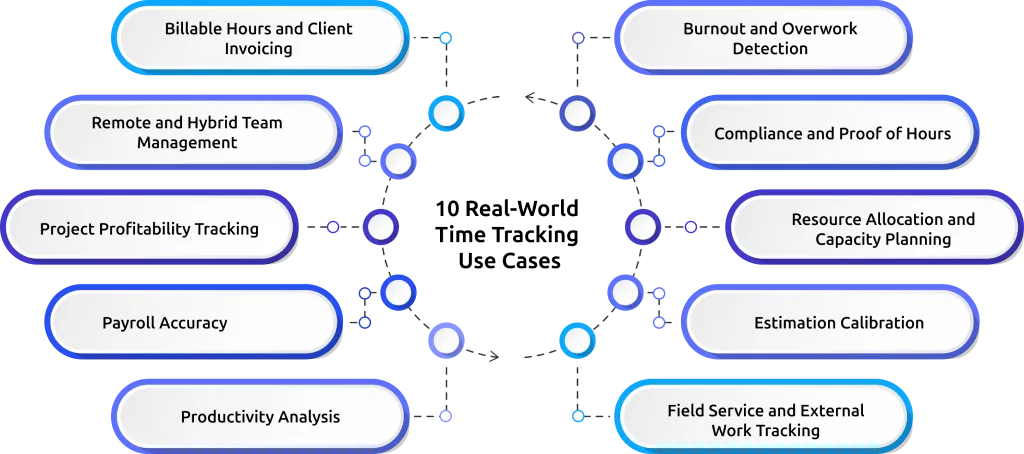
Use Case 1: Billable Hours and Client Invoicing
If your business charges clients based on time spent, every untracked hour can directly impact revenue. Manual time entries often lead to missed billable hours, inaccurate invoices, and delayed payments. Over time, these small gaps can add up to significant losses.
Automatic time capture allows you to link work hours directly to clients, projects, and tasks. This creates a clear record of billable work, making invoicing faster and more accurate. It also gives clients greater transparency into how project time is spent, helping build trust and reduce billing disputes.
Use Case 2: Remote and Hybrid Team Management
Managing a team across multiple locations can make it difficult to understand how work is progressing. Without visibility into workloads and work patterns, you often rely on frequent check-ins that can disrupt productivity.
Clear visibility into work hours and project activity makes it easier to understand how work is progressing with balanced workloads. Instead of focusing on where employees work, you can focus on outcomes and productivity. This creates greater accountability while giving employees the flexibility they need to succeed in remote and hybrid environments.
To learn more about managing remote and hybrid employees effectively, read our guide on Managing Hybrid Teams!
Use Case 3: Project Profitability Tracking
A project may seem successful based on its outcomes, but without accurate time data, it can be difficult to know whether it was actually profitable. When teams spend more hours than expected, project margins can shrink quickly.
Accurate time records show exactly how much effort is invested in each project. Comparing labor costs against project revenue makes it easier to identify profitable projects, spot budget overruns early, and make adjustments before costs get out of control. This information also helps you price future projects more accurately.
Use Case 4: Payroll Accuracy
Payroll mistakes can lead to employee dissatisfaction, compliance issues, and unnecessary administrative work. Manual timesheets increase the risk of incorrect work hours, missed overtime calculations, and payroll disputes.
Automated records of work hours, breaks, and overtime create a reliable foundation for payroll processing. This helps HR and payroll teams pay employees accurately and on time while reducing administrative burden. Payroll errors can be costly, right? Learn how to calculate payroll hours accurately.
Use Case 5: Productivity Analysis
Without clear data, it's difficult to understand where time is being spent or what factors are affecting productivity. Teams may appear busy while important work gets delayed due to distractions, meetings, or inefficient processes.
Detailed insights reveal how employees spend their time across tasks, projects, applications, and activities. These insights help you identify bottlenecks, improve workflows, and support employees more effectively. Among all time tracking use cases, productivity analysis often provides some of the fastest and most actionable insights for business improvement.
Pro Tip
Time tracking becomes even more valuable when paired with workforce analytics. Use tools like Time Champ to help you gain deeper insights into employee work patterns, productivity trends, and project performance.
Use Case 6: Burnout and Overwork Detection
Employee burnout often develops gradually and can go unnoticed until productivity declines or employees decide to leave. Long hours, excessive workloads, and constant overtime are common warning signs.
Work hour trends make it easier to identify employees who are consistently working late or taking on excessive workloads. With this information, you can redistribute workloads, encourage healthy work habits, and support employee well-being before burnout becomes a serious problem.
Use Case 7: Compliance and Proof of Hours
Many industries require accurate records of employee work hours, overtime, and attendance. During audits, employee disputes, or regulatory compliance checks, you need clear documentation to demonstrate compliance.
Accurate records of hours worked, schedule changes, breaks, and overtime provide the documentation needed for compliance. This documentation enables you to meet labor regulations, reduce compliance risks, and provide proof when questions arise about employee time records.
Use Case 8: Resource Allocation and Capacity Planning
Uneven workload distribution can lead to employee burnout, missed deadlines, and inefficient use of available resources. Without visibility into workloads, it becomes difficult to allocate resources effectively.
Workload and resource allocation data help you understand who is available, overloaded, or underutilized. This allows you to balance workloads, plan projects more effectively, and ensure resources are used efficiently across the organization.
Use Case 9: Estimation Calibration
Many teams struggle with inaccurate project estimates because they rely on assumptions rather than historical data. Underestimating work can result in missed deadlines and budget overruns.
Time tracking provides real-world data on how long tasks, projects, and activities actually take. Comparing estimated hours with actual hours helps improve future planning, create more accurate timelines, and support better business decisions.
Use Case 10: Field Service and External Work Tracking
When employees work outside the office, it can be challenging to verify attendance, track work hours, and ensure accurate payroll. This is especially common in industries such as construction, field services, logistics, and sales.
GPS-based workforce management tools help you record work hours from any location while giving you greater visibility into attendance and job-site activity. When combined with location verification, it helps improve accountability, streamline payroll, and maintain accurate records for field teams.
Still losing valuable time and revenue to hidden inefficiencies?
Time Champ helps you track time, optimize resources, and turn workforce insights into measurable business growth.
5 Industries Where Time Tracking Delivers the Highest ROI
Time tracking can benefit any business, but some industries see faster results and a higher return on investment than others. The industries below rely heavily on accurate time data to improve profitability, optimize resources, and support day-to-day operations.
Agencies and Professional Services
For agencies and professional service firms, every billable hour directly contributes to revenue. Every missed billable hour can reduce profitability and impact project margins.
Time tracking helps you accurately capture client work, improve invoicing, and identify projects that generate the highest returns. It also provides visibility into team utilization, helping you allocate resources more effectively.
Law and Accounting Firms
Law and accounting firms often bill clients based on time spent on specific tasks and cases. Even small gaps in time records can lead to lost revenue and billing disputes.
Time tracking helps you maintain accurate records, simplify invoicing, and create detailed audit trails that support compliance requirements and client transparency.
IT Services and BPO
IT service providers and BPO companies manage multiple projects, clients, and teams simultaneously. Time tracking helps you monitor project costs, measure productivity, and understand how resources are being utilized.
With accurate time data, you can identify inefficiencies, improve project profitability, and make better staffing decisions.
Construction and Field Services
Construction companies and field service businesses often have employees working across multiple locations and job sites. Tracking hours manually can lead to payroll errors, attendance issues, and compliance challenges.
Time tracking helps you accurately record work hours, verify attendance, and simplify payroll while providing greater visibility into field operations.
Software Development Teams
Software development projects often involve complex tasks, changing priorities, and tight deadlines. Time tracking helps you understand how long work actually takes, improve project estimates, and allocate resources more effectively.
Over time, this data helps development teams plan projects more accurately and avoid costly delays.
How Time Champ Solves Your Time Tracking Challenges
Choosing the right tools helps you get better results from time tracking. Whether you're trying to improve productivity, manage remote teams, streamline payroll, or track project profitability, you need a solution that provides accurate data and actionable insights.
Time Champ helps you address these challenges with its automated time tracking features. Time Champ is a time tracking software that helps you capture work hours automatically, track project time accurately, and maintain reliable attendance records. Its time tracking features give you the visibility needed to improve efficiency, reduce administrative work, and make better use of every working hour.
Key Features of Time Tracking:
- Automatic Time Tracking: Automatically records work hours, eliminating manual entries and reducing timesheet errors.
- Project and Task Tracking: Tracks time spent on projects and tasks to improve resource allocation and profitability.
- Attendance Management: Track employee attendance, work hours, breaks, and overtime with accurate and automated records.
- Productivity Tracking: Measures productive, unproductive, and idle time to help you identify inefficiencies.
- App and Website Usage Monitoring: Tracks app and website usage to show how work time is spent.
- Employee Monitoring: Offers visibility into employee activities to support accountability and efficiency.
- Cross-Platform Support: Tracks work hours across Windows, macOS, Linux, and other devices.
Ready to improve productivity and make smarter decisions?
See how Time Champ helps you track time, improve productivity, and drive real ROI.
Conclusion
Time tracking goes beyond simply recording work hours. It helps you improve productivity, control costs, optimize resources, and make smarter business decisions.
The key is choosing the right use case and the right tool. With Time Champ, you can turn time data into actionable insights that improve productivity, optimize resources, and drive better business results.

Guna Lakshmi

Table of Content
 What Is Time Tracking?
- The Biggest Time Tracking Mistake Businesses Make
- 10 Real-World Time Tracking Use Cases Every Business Should Know
- 5 Industries Where Time Tracking Delivers the Highest ROI
- How Time Champ Solves Your Time Tracking Challenges
- Conclusion
Related Blogs

Learn what time tracking is, why it matters in 2026, the best methods, and how to implement it without team pushback. A practical guide for modern teams.
Jahnavi Pulluri | May 19, 2026
Discover the pros and cons of time tracking software, its key features, and how it can improve productivity, accountability, and overall team performance.
Jahnavi Pulluri | Jun 05, 2026
Looking for the best freelance time tracking software? Explore the top free and paid tools to track work hours, manage projects, and improve productivity.
Guna Lakshmi | May 18, 2026
Learn how time tracking improves remote team productivity through better visibility, accountability, performance tracking, and smarter team management.
Anjali | May 16, 2026
Explore the top benefits of productivity tracking software for better visibility, balanced workloads, smarter planning, and improved business decisions.
Guna Lakshmi | Apr 30, 2026
A practical guide to choosing productivity tracking software for your team, with comparisons of features, pricing, privacy, security, and rollout risks.
Jahnavi Pulluri | May 01, 2026


 4.7/5 avg.
Ready to Manage Your Workforce Smarter?
Join our family of 1500+ companies using smart insights to redefine workforces!

Free Trial
No Credit Card Required