How to Detect Mouse Jiggler Activity in the Workplace
Learn how to detect mouse jigglers using activity patterns, system logs, and monitoring tools to uncover insider threats and ensure productivity.
What if an employee seems active for long hours but shows little actual work output? Mouse jigglers make this possible by simulating activity and keeping systems from going idle. The detail here sits inside a wider conversation covered in our enterprise employee monitoring guide.
While they may seem harmless, but these tools can disturb productivity data and create blind spots in monitoring systems. In some cases, they also leave systems exposed when devices remain active but unattended. Detecting mouse jiggler activity requires more than basic activity tracking, it involves analyzing patterns, system logs, and overall work output.
This blog explains what mouse jigglers are and how to detect their use, along with key indicators of insider threats in the workplace.
What Is a Mouse Jiggler?
A mouse jiggler is a device or software that simulates small mouse movements to keep a computer from becoming idle. By subtly moving the cursor at regular intervals, it tricks the system into thinking that the user is active, which can stop screensavers from kicking in, notifications about inactivity, or automatic logouts.
Originally, mouse jigglers were invented for legitimate purposes such as keeping systems active during presentations or long processes. However, they are now often used to make it appear as if someone is working when they are not.
Types of Mouse Jigglers
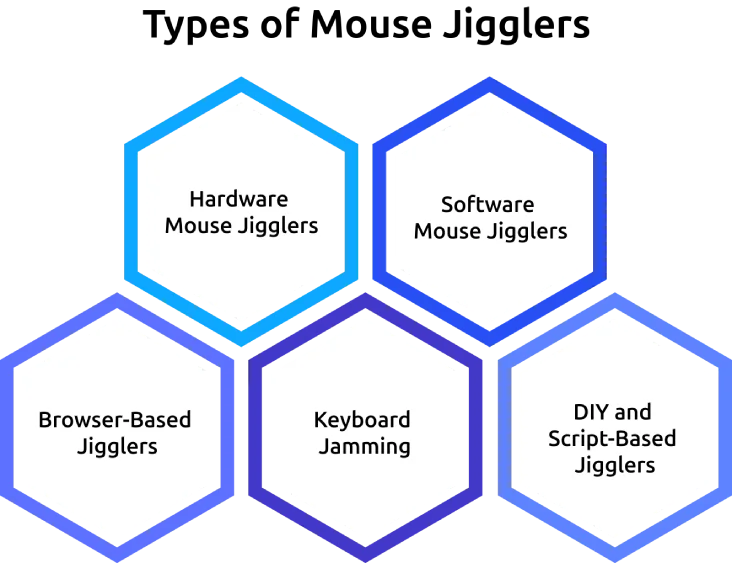
Understanding the different types of mouse jigglers is the first step in knowing how to detect them. Each type leaves a different footprint, and each requires a slightly different detection approach.
1. Hardware Mouse Jigglers
Hardware jigglers, also called manual mouse jigglers, are small physical devices that plug into a computer’s USB port. Once connected, they automatically move the cursor without needing any software. Because they require no app to run, employees often prefer them in environments where software installation is restricted.
The downside here is visibility. In an office, a physical device connected to a computer can often be noticed by others. In remote work setups, however, they are harder to spot through visual checks alone. Even so, USB connections are recorded at the system level, and some tools make it possible to track hardware jigglers even without physically checking the device.
2. Software Mouse Jigglers
Software jigglers are applications installed directly on the computer. They run in the background and control the mouse cursor, mimicking natural movement patterns. Because there is no physical device, they are harder to spot visually. However, they still leave traces in system logs.
A software jiggler that runs continuously will show up in app usage reports as an always-active background process. Even when the application is designed with stealth features to hide from task managers, cross-referencing mouse activity data with keyboard output and task completion exposes the discrepancy.
3. Browser-Based Jigglers
Browser-based jigglers are extensions added directly to a web browser. Their function is limited to keeping the employee's status active within the browser, maintaining an 'online' indicator on web-based platforms. They are easy to install, require no admin rights, and leave the least obvious clue. However, they are the weakest form of jiggler, they have no effect on the OS or other applications, and they appear in browser extension logs that monitoring tools can access.
4. Keyboard Jamming
Keyboard jamming is a technique often used along with mouse jigglers. Instead of moving the cursor, it simulates typing by sending repeated keystrokes to the computer. This creates the appearance of active typing, which can mislead basic time-tracking tools that rely only on counting keystrokes.
The difference between real typing and keyboard jamming can be seen by checking what the user is actually doing on the system. A real user typing will produce visible work in documents, emails, or messaging apps. In contrast, a keyboard jammer may send keystrokes without producing any meaningful output or may send them to inactive or background windows.
5. DIY and Script-Based Jigglers
Some technically skilled employees may create their own solutions, such as custom scripts, macros, or simple devices made from basic parts. These are harder to detect than commercial tools because they don’t follow recognized software patterns. However, their behavior is usually repetitive and consistent activity without real work being done.
In these cases, behavioral analysis is more effective than signature-based detection, as it focuses on activity patterns rather than known tool signatures.
What Is an Insider Threat & How to Detect Them
Insider threat detection starts with understanding what an insider threat actually is. An insider threat is a security risk that originates from within the organization, an employee, contractor, or business partner who misuses authorized access to harm the company, whether intentionally or through negligence.
There are three primary categories:
- Malicious Insiders: Employees who intentionally steal data, sabotage systems, or defraud the organization.
- Negligent Insiders: Employees who create risk through carelessness, policy violations, or poor judgment, not necessarily with harmful intent.
- Compromised Insiders: Employees whose credentials or devices have been taken over by an external attacker, making them an unwitting vector for a breach.
How to Identify Insider Threats in the Workplace
Detecting insider threats requires looking at both behavior and system activity over time. There is no single signal that confirms a threat, so organizations rely on patterns, inconsistencies, and unusual actions across multiple data points.
A recent study shows that the average annual cost per organization rose to $17.4 million in 2025, up from $16.2 million in 2023.
Some common ways to detect insider threats include:
1. Monitor User Activity Patterns
Track login times, session duration, and usage behavior. Unusual activity, such as working at odd hours, frequent logins from different locations, or sudden changes in behavior, can indicate risk.
2. Track Data Access and Movement
Keep an eye on files being accessed, copied, or transferred. Large or unusual data transfers, especially to external drives or unknown locations, can be a warning sign.
3. Review Application and System Usage
Check which tools and applications are being used. Accessing software or systems outside an employee’s role may indicate suspicious activity.
4. Analyze Device and USB Activity
Monitor USB connections and external device usage. Unauthorized devices connected to company systems can lead to data exposure.
5. Look for Behavior Changes Over Time
Sudden drops in productivity, changes in work patterns, or consistent irregular activity may signal disengagement or potential misuse of access.
6. Use Alerts and Anomaly Detection
Set up systems that flag unusual behavior automatically, such as repeated access violations, abnormal login attempts, or activity outside normal patterns.
7. Correlate Activity with Actual Work Output
Compare user activity with completed tasks or deliverables. High activity with little or no output can indicate artificial activity or misuse of tools.
Why Do Employees Use Mouse Jigglers
Understanding why employees use mouse jigglers is important for preventing insider risks. Focusing only on punishment often fails because it addresses the result, not the reason behind the behavior.
Common reasons employees use mouse jigglers include:
- Strict productivity tracking that marks quiet but productive work (like reading or thinking) as inactivity
- “Always online” expectations in remote or hybrid teams, where employees feel pressure to appear active
- Fear of unfair evaluation, especially for those who do focused work with less mouse movement
- Burnout and overwork, where employees try to avoid looking disengaged
- Intentional misuse, where some employees use jigglers to fake activity or work hours
The first four reasons are related to workplace culture and management practices, while only the last one involves deliberate misuse. Monitoring tools can help identify these patterns, but addressing the root cause requires the right workplace approach.
How to Detect Mouse Jiggler Activity and Insider Threats
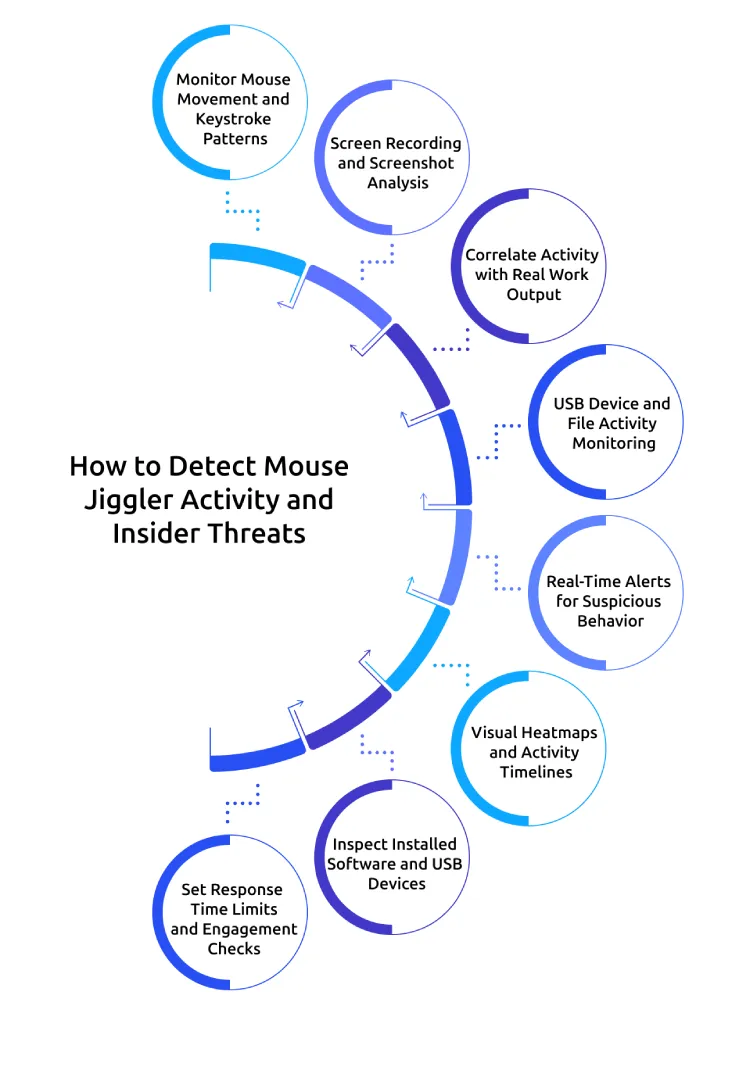
1. Monitor Mouse Movement and Keystroke Patterns
Start by analyzing how the mouse and keyboard are actually used, not just whether they appear active.
Look for natural human behavior. Real users move the mouse unevenly, they vary speed, pause frequently, and change direction in an unpredictable way. In contrast, mouse jigglers produce steady, repetitive movements at fixed intervals with little or no variation.
Also, review keyboard activity carefully. Identify cases where typing activity appears high but does not lead to meaningful output in applications. For example, if keystrokes increase but no real content is created in documents, emails, or tools, treat this as a potential sign of abnormal behavior.
2. Screen Recording and Screenshot Analysis
Use screen recordings or periodic screenshots to validate activity data.
Compare activity reports with what actually appears on the screen. If reports show constant movement but screenshots display idle screens, unchanged windows, or no visible work, investigate further.
Also, use screenshots to identify insider risk indicators such as:
- Sensitive files left open
- Unauthorized applications running
- Active sessions left unattended
These visual signals provide context that raw activity data alone cannot reveal.
3. Correlate Activity with Real Work Output
Always compare activity levels with actual work outcomes.
Establish simple checks:
- High activity + completed tasks → normal behavior
- High activity + no progress → potential concern
Focus on whether work is getting done, not just whether activity appears high. This approach improves accuracy and avoids false assumptions, as it measures productivity rather than surface-level behavior.
4. USB Device and File Activity Monitoring
Track USB usage closely, especially to detect hardware-based jigglers.
Watch for systems that remain active without user presence. In such cases, someone could connect a USB device and access or copy data without detection.
Use monitoring tools to:
- Track USB insertions in real time
- Identify unknown or unauthorized devices
- Monitor file creation, modification, and deletion
- Maintain detailed logs for audits
If USB activity appears alongside unusual mouse behavior, it can be a potential data security risk and should be investigated immediately.
5. Real-Time Alerts for Suspicious Behavior
Set up real-time alerts to detect unusual activity as it happens. Do not rely only on reports, as they may delay your response. Configure alerts for key risk signals such as:
- Sudden spikes in activity after long idle periods
- Access to restricted or blocked websites
- Use of unauthorized applications
- USB device connections
- Access to sensitive files outside assigned roles
- Continued activity during idle periods
These alerts helps you to respond quickly and reduce the impact of potential threats.
6. Visual Heatmaps and Activity Timelines
Review activity heatmaps to understand user behavior patterns throughout the day. Expect natural variation in human work patterns, including breaks, changes in intensity, and fluctuations in activity. In contrast, mouse jigglers often create flat, consistent activity patterns with little variation.
If you notice continuous, uniform activity over long periods without breaks, consider this a possible indicator of automated input rather than genuine user interaction.
7. Inspect Installed Software and USB Devices
Conduct regular system audits to identify unauthorized tools.
Check for software jigglers running in the background. These tools often use generic names such as “mouse mover” or “cursor tool,” which may stand out during application reviews.
Also review USB logs to detect hardware jigglers. Identify when unknown devices connect to systems and verify whether they are authorized. Regular inspection helps maintain control over both software and hardware risks.
8. Set Response Time Limits and Engagement Checks
Introduce simple engagement checks to confirm real user activity.
For example:
- Ask employees to respond to messages within a defined time
- Assign quick check-in tasks during work hours
A mouse jiggler can simulate movement, but it cannot respond to communication or complete meaningful tasks. Use these checks alongside monitoring tools to validate activity and identify disengagement early.
Mouse movement alone won’t tell you the truth.
Start analyzing behavior, patterns, and output before risks go unnoticed.
What to Do After Detecting Mouse Jiggler Activity
Detection is just the first step, what you do next determines whether the situation gets resolved or escalates. Here’s a simple five-step response framework you can follow:
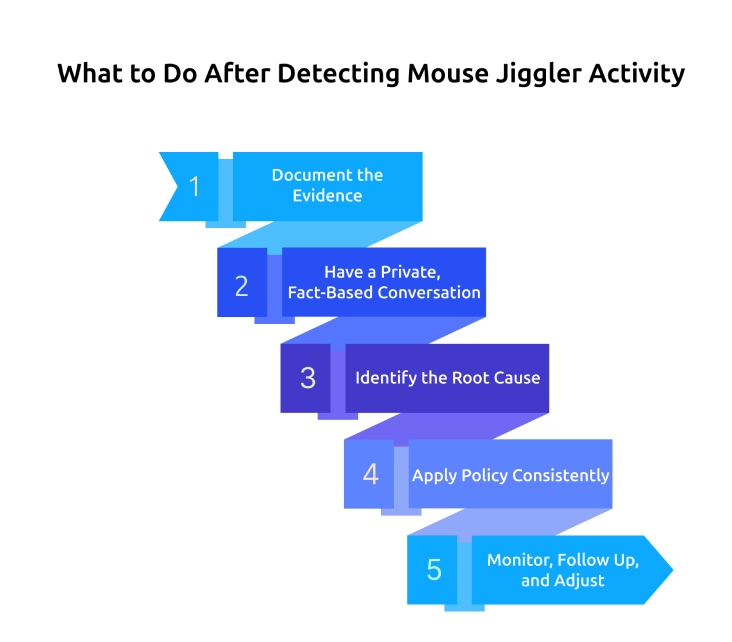
Step 1: Document the Evidence
Before speaking to the employee, gather all relevant evidence. This may include activity logs, screenshots, USB connection reports, heatmaps, and task completion records.
This step is important because it gives you a clear, factual basis for the discussion, which helps protect the organization if further action is needed, and ensures the conversation is not based on assumptions.
Step 2: Have a Private, Fact-Based Conversation
Meet with the employee privately. Present the evidence without accusation. Ask open questions such as:
- Were you aware of this activity on your device?
- Is anything affecting your ability to stay active during work hours?
The goal here is to understand the situation, whether it’s intentional misuse or something caused by stress, burnout, or unclear expectations.
Step 3: Identify the Root Cause
The conversation should help clarify intent. A burned-out employee using a jiggler due to workload pressure is very different from someone intentionally trying to fake work hours. Your response should match the situation: support and workload adjustment for one, and a formal performance or disciplinary process for the other.
Step 4: Apply Policy Consistently
Whatever your organization's policy states, verbal warning, formal write-up, termination for repeat offenses, apply it consistently across roles and seniority levels. Inconsistent enforcement destroys trust faster than the original incident.
H3: Step 5: Monitor, Follow Up, and Adjust
After the discussion, continue monitoring to see if behavior improves. Use monitoring tools as they can help you track activity patterns, task progress, and engagement levels over time.
If the behavior continues, take further action according to your company policy.
So, these are the actions you can take when mouse jiggler activity is detected.
Insider Threat Policy: What Your Guidelines Should Include
If your organization doesn’t already have a clear policy, it’s important to create one that covers insider threat detection and prevention.
A good policy should include:
- A clear list of prohibited tools and behaviors (like mouse jigglers, keyboard jammers, and activity simulators)
- What type of monitoring is in place, and on which devices and time periods
- How monitoring data is stored, accessed, and used
- The consequences of policy violations, based on severity and intent
- A disclosure statement informing employees that monitoring is conducted
It’s always best to have HR and legal teams review the policy before putting it into practice.
So far, we’ve explored the methods to detect mouse jigglers and insider threats, and precautions to take. But the key question remains: which tool can actually help organizations implement these detections effectively? Let’s take a closer look at the solution that brings all of this together.
How Time Champ Identifies Insider Risks and Unusual Activity
Time Champ is a workforce intelligence platform designed to help organizations understand how work is actually being performed across teams. It captures and analyzes activity signals, keystrokes, mouse clicks, application usage, USB connections, and file operations, to measure real user engagement and surface anomalies that manual reviews would miss.
Here is how Time Champ maps directly to each detection method:
| Detection Method | Feature |
|---|---|
| Mouse movement pattern analysis | Activity monitoring captures cursor data and flags fixed-interval, repetitive patterns that differ from human behavior |
| Screen recording and screenshot analysis | Optional screenshot capture reveals whether "active" sessions show real work or an idle screen |
| Activity-vs-output correlation | Productivity analytics compare active time against task completion, exposing high-activity, low-output patterns |
| USB device monitoring | Device tracking logs every USB connection and sends real-time alerts for unauthorized hardware |
| Real-time suspicious behavior alerts | Configurable alert system notifies administrators immediately when policy thresholds are crossed |
| Application and software audit | App usage reports surface background processes like software jigglers, even ones using stealth naming |
Beyond mouse jiggler detection, Time Champ's Data Loss Prevention (DLP) capabilities strengthen overall security posture:
- Website access violations track access to restricted or unauthorized sites
- USB access violations monitor external storage connections
- File monitoring logs record file creation, modification, and access events
- Upload/download violations detect unauthorized data transfers across systems or networks
By combining activity monitoring, behavioral insights, real-time alerts, and DLP capabilities, Time Champ gives organizations a centralized view of workforce activity, helping security, IT, and HR teams stay ahead of both productivity issues and insider risks without relying on guesswork.
Detect mouse jigglers, identify insider risks, and get real visibility into how your team works.
Start your free Time Champ trial today, no credit card required.
Conclusion
Mouse jigglers are simple tools, but they can create complex problems when used to falsify activity or leave systems unattended. Detecting them requires more than basic idle tracking. A combination of behavioral analysis, system logs, and clear policies helps organizations identify both jiggler use and broader insider risks. Understanding why employees use these tools is important so that you can address the underlying issues.

Jahnavi Pulluri

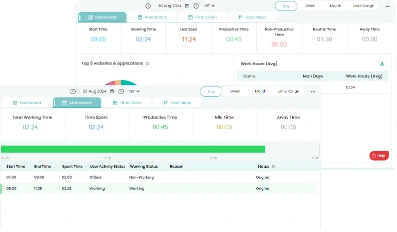
Table of Content
-
 What Is a Mouse Jiggler?
-
Types of Mouse Jigglers
-
What Is an Insider Threat & How to Detect Them
-
Why Do Employees Use Mouse Jigglers
-
How to Detect Mouse Jiggler Activity and Insider Threats
-
What to Do After Detecting Mouse Jiggler Activity
-
How Time Champ Identifies Insider Risks and Unusual Activity
-
Conclusion
Related Blogs
Uncover security insights with keyloggers. Explore the technology behind every key for robust PC monitoring and ensure secure data management.
Mounika Sai | Jan 06, 2024
Stay ahead of cyber threats with our expert guide on endpoint security protection. Explore essential tips and tools to protect your devices, data, and network.
Shabana Shaik | Jan 23, 2025
Discover the risks of internal security threats and how to spot, prevent, and address them to keep your business secure and your data safe.
Thasleem Shaik | Jan 21, 2025
Master PC monitoring software with our comprehensive guide. Discover benefits, best practices, and expert insights for enhancing security and productivity.
Thasleem Shaik | Dec 15, 2023
Enhance your security with endpoint data loss prevention solutions that guard against data breaches and protect your most valuable assets.
Shabana Shaik | Jan 23, 2025
Discover the top 10 Data Loss Prevention tools to safeguard sensitive information and ensure workplace security with essential features and practical tips for selection.
Tarun Kumar Reddy | Jan 21, 2025


 4.7/5 avg.
Ready to Manage Your Workforce Smarter?
Join our family of 1500+ companies using smart insights to redefine workforces!

Free Trial
No Credit Card Required