10 Best Remote Desktop Monitoring Software in 2026
Compare the 10 best remote desktop monitoring software in 2026 by features, pricing, and team fit to quickly identify the right tool for your workflow.

When your team is distributed, visibility becomes your biggest challenge. You can track results, but not the process behind them. Remote desktop monitoring software fills that gap, but choosing the right tool is what makes the difference.
In this blog, I’ll cover the 10 best remote desktop monitoring software for 2026, what they’re good at, where they fall short, and how to pick the right fit for your team. It also clears up the confusion between monitoring, remote access, and RMM.
What is Remote Desktop Monitoring Software?
Remote desktop monitoring software tracks how employees use their computers while working remotely. It captures app and website usage, active and idle time, and can include screenshots or live screen views, then turns that data into reports you can actually act on. It does not control the system, that’s what remote access tools are for.
A complete remote desktop monitoring tool typically covers five key areas:
- Tracks app and website usage with timestamps
- Captures screenshots or live screen view (with privacy controls)
- Measures active, idle, and break time
- Categorizes activity as productive, neutral, or distracting
- Generates reports at the user, team, and project levels
If a tool only handles one of these, it’s more of a point solution than full monitoring software.
How is Remote Desktop Monitoring Different from Remote Access and RMM?
Remote desktop monitoring shows you how work is happening on an employee’s computer. Remote access lets you take control of that computer and operate it as if you were sitting in front of it. RMM (remote monitoring and management) is designed for IT teams to manage, update, and secure company devices at scale.
There is some feature overlap, but each tool is built for a different purpose and a different user.
| Remote desktop monitoring | Remote access | RMM |
|---|---|---|
| Tracks employee activity | Lets you take control of a device | Manages, patches, and secures devices |
| Provides reports and analytics | Supports live sessions and file transfers | Handles deployment and system updates |
| Used by managers and operations teams | Used by IT support and helpdesk teams | Used by IT teams and MSPs |
| Examples: Time Champ, Teramind | Examples: TeamViewer, AnyDesk | Examples: NinjaOne, Atera |
If you’re looking for a single tool that covers all three, expect more complexity and higher costs. Most teams start with a monitoring-focused tool and add remote access only when needed.
Why Does Remote Desktop Monitoring Matter in 2026?
According to Forbes, around 16% of companies already operate fully remotely, without a physical office, showing how quickly work models are shifting. Remote work is no longer the exception; it’s becoming the norm. As a result, you’re managing output without always seeing the process behind it. That’s why accurate visibility has become essential for billing, compliance, IT oversight, and fair workload management across teams.
Here’s why it has become essential:
Remote-First Is the Norm: You can’t walk over to a desk to check progress, so visibility has to come from data.
Billable Accuracy Needs Proof: If you bill by the hour, you need clear, defensible records of how time is spent.
Compliance Expectations are Higher: Many industries now require activity tracking on remote devices for audits and reporting.
Workload Fairness Depends on Visibility: Without data, the most visible employee often looks the busiest, which isn’t always true.
10 Best Remote Desktop Monitoring Software in 2026
Not every tool tracks remote desktops the same way. Here are the 10 best options in 2026, with what each does well, where it falls short, and who it fits best.
1. Time Champ
Time Champ is a remote desktop monitoring software with a built-in workforce intelligence layer. It doesn’t just track activity on employee devices, it helps you understand how that activity translates into productivity, focus time, and workload balance across your team.
Key Features:
Real-Time Activity Tracking
Tracks app and website usage across employee devices in real time, giving you a complete view of how work flows during the day. You can see which tools are being used, how long they’re active, and where time is being spent across different tasks.
Screenshots and Live Screen Monitoring
Captures screenshots at configurable intervals or access live screen views when needed. This helps you understand the context behind the work without depending only on activity logs, while still allowing you to control how often and how much is captured.
Productivity Classification
Allows you to classify apps and websites as productive, neutral, or non-productive based on roles, departments, or projects. This ensures that productivity insights are relevant and fair, since what counts as productive varies across teams.
Automated Time Tracking
Automatically records active and idle time without requiring employees to manually start or stop timers. This improves accuracy, reduces manual effort, and ensures consistent time data across the team.
Reports and Productivity Trends
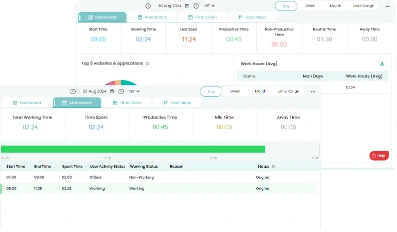
Provides clear dashboards that highlight productivity patterns, focus time, top applications, and team trends over time. These insights make it easier to identify bottlenecks, track performance, and make quick, data-backed decisions.
Location Tracking
Tracks employee location during work hours using GPS and geo-based data. This is especially useful for remote and field teams, helping you ensure accountability, verify work locations, and manage distributed teams more effectively.
Cross-Platform and Remote Support
Works seamlessly across Windows, macOS, Linux, Android, iOS, and Chrome OS. This maintains consistent monitoring across remote, hybrid, and distributed teams without gaps in visibility.
Best for: Teams that need remote desktop monitoring with clear productivity insights, not just raw activity data.
Pricing: Plans start at $3.9/ user/month (annually) with a 7-day free trial.
Work Model Fit: Remote, hybrid, in-office, and field teams
Watch-outs: Spend time upfront labeling apps based on roles. This improves the accuracy of productivity insights significantly.
2. Teramind
Teramind is an insider risk platform that combines remote desktop monitoring with insider threat detection and data loss prevention.
Key Features:
- View user screens in real time or replay recorded sessions.
- Tracks applications, websites, file activity, emails, and user behavior across systems.
- Uses behavior analytics to identify unusual or risky activity patterns and triggers alerts before issues escalate.
- Monitors file transfers, downloads, and sensitive data movement to prevent data leaks.
- Set rules to trigger alerts for specific actions or policy violations.
Best for: Enterprises that want monitoring with security and compliance controls.
Pricing: Starts around $ 13.35 /user/month (annually), with higher-tier plans increasing significantly based on features.
Work Model Fit: Remote and hybrid enterprise teams.
Watch-outs: Default settings can feel overly intrusive. It requires careful configuration, clear policies, and employee communication to avoid trust issues.
3. ActivTrak
ActivTrak is a time tracking software that also works for remote teams to provide productivity insights. It focuses more on trends and patterns rather than individual-level monitoring, making it a good option.
Key Features:
- Tracks how time is spent across tools and platforms to give a clear view of daily work activity.
- Categorizes activity into productive and non-productive segments based on customizable rules.
- Highlights work periods, interruptions, and work habits across the day.
- Provides reports to understand overall team performance and trends.
- Avoids invasive tracking like screenshots in lower-tier plans, focusing on insights over surveillance.
Best for: Remote and hybrid teams that want visibility.
Pricing: Free plan available (up to 3 users), paid plans start at $10/user/month (annually) with a 14-day free trial.
Work Model Fit: Remote and hybrid knowledge teams.
Watch-outs: Limited time tracking and billing features, may require pairing with another tool for full visibility.
4. Time Doctor
Time Doctor combines time tracking with monitoring features, making it a good option for remote teams that need structured accountability and clear visibility into work hours.
Key Features:
- Tracks time spent on tasks along with app and website usage.
- Notifies users when they spend time on non-work-related sites.
- Takes screenshots at intervals to verify work activity.
- Provides insights into time usage and efficiency.
- Links tracked time directly to payroll and project workflows.
Best for: Remote teams and outsourced operations that require strict monitoring.
Pricing: Starts at $6.67/user/month (annually) with a 14-day free trial.
Work Model Fit: Remote-first teams, BPOs, and outsourced operations.
Watch-outs: Alerts and screenshots can feel intrusive if not configured carefully, especially for senior roles.
5. Hubstaff
Hubstaff is a time tracking and remote monitoring tool that pairs hours with screenshots, activity rates, and GPS for field crews. Agencies and service businesses use it heavily.
Key Features:
- Tracks work hours with optional screenshots.
- Measures activity levels based on keyboard and mouse usage.
- Tracks employee location, useful for field and remote teams.
- Monitors time spent across projects and tracks budgets.
- Connects tracked time directly to billing and payments.
Best for: Agencies and service-based teams that need time tracking with monitoring.
Pricing: Starter from $4.99 /user/month (annually) with a 14-day free trial.
Work Model Fit: Remote, hybrid, and field service teams.
Watch-outs: Productivity insights rely heavily on activity levels, which may not reflect deep or thinking-based work accurately.
6. Insightful
Insightful is a work intelligence platform built for large organizations that need visibility into productivity and engagement across distributed teams, with a good focus on analytics.
Key Features:
- Provides live insights into employee activity and performance.
- Monitors tool usage across teams.
- Identifies burnout risks and workload imbalances.
- Tracks time spent across different projects and tasks.
- Supports large teams across multiple regions and setups.
Best for: Enterprises managing large remote or hybrid teams.
Pricing: Starts at $10/user/month with a 7-day free trial.
Work Model Fit: Enterprise remote and hybrid teams.
Watch-outs: Can feel complex for smaller teams and requires setup time to fully utilize.
7. SentryPC
SentryPC is a long-running remote desktop monitoring tool that focuses on activity logging, content filtering, and time-based usage policies. It leans toward the surveillance side of the spectrum.
Key Features:
- Tracks application and website usage in detail, including time spent and frequency.
- Allows you to block or restrict access to specific apps, websites, or categories.
- Let’s you set schedules for when devices, apps, or websites can be accessed.
- Captures screen activity at intervals, giving you visual context.
- Provides a centralized dashboard that you can access remotely.
Best for: Small businesses or environments that need strict control over device usage.
Pricing: Per-device pricing from around $69.95 per device per year, with volume discounts.
Work Model Fit: Remote and in-office small businesses, schools.
Watch-outs: The product leans heavily on filtering and blocking, which is fine for tightly controlled environments but a poor fit for senior knowledge workers.
8. Controlio
Controlio is a cloud-based remote desktop monitoring tool that combines screenshots, screen recording, and policy alerts. It is good for small to mid-size remote teams that want strong visual evidence.
Key Features:
- Captures screen activity either continuously or at set intervals.
- Allows you to view employee screens in real time when needed.
- Tracks usage across applications and websites.
- Provides basic productivity classification and reports based on activity patterns.
- Cloud-based, so you can access dashboards, reports, and live monitoring from any browser.
Best for: Teams that want visual proof of work activity, especially in remote setups.
Pricing: Startsfrom $6.67 /user/month (annually), with a 14-day free trial.
Work Model Fit: Remote and hybrid SMBs.
Watch-outs: Continuous recording is bandwidth-heavy. If your team has spotty internet, set it to event-based recording or screenshots only.
9. Veriato
Veriato (now Veriato Cerebral) is a remote desktop monitoring tool with a strong insider threat angle. It uses AI to score risky behavior and surfaces it to security teams before damage happens.
Key Features:
- Tracks activity across applications, websites, emails, and file systems.
- Analyzes behavior patterns over time to identify anomalies or risky actions.
- Captures screen activity for audits, investigations, and compliance purposes.
- Triggers real-time alerts for unusual behavior, policy violations, or suspicious activity.
- Integrates with enterprise security tools like SIEM systems.
Best for: Security-led teams that want behavior analytics on top of monitoring.
Pricing: Starts at $18/user/month (annually).
Work Model Fit: Enterprise remote and hybrid teams with a security mandate.
Watch-outs: Implementation takes more setup time than the simpler tools on this list. Plan for two to four weeks of policy tuning.
10. Splashtop
Splashtop is best known for remote access, and its monitoring add-on (Splashtop Enterprise with session recording and audit logs) earns it a place on this list. Most teams use it where IT support and end-user monitoring overlap.
Key Features:
- Allows you to securely access and control remote devices as if you were physically present.
- Records remote sessions so you can review actions taken during support or maintenance tasks.
- Maintains detailed logs of who accessed which device, when, and for how long.
- Works across multiple operating systems and devices.
- Includes features like multi-factor authentication, access permissions, and encryption to ensure secure remote connections.
Best for: IT teams that need remote access with basic monitoring capabilities.
Pricing: Starts at$6/user/month.
Work Model Fit: IT-led remote support and hybrid teams.
Watch-outs: Activity-level reporting is thin compared with the dedicated monitoring tools above. Pair Splashtop with Time Champ if you need both remote control and productivity signals.
How to Pick the Right Remote Desktop Monitoring Software?
You can choose the right remote desktop monitoring software by aligning three things: how much visibility your team needs, how you handle privacy, and how deeply you want to analyze the data. If you miss any one of these, the tool either goes unused or creates resistance.
Here’s a simple way to approach it:
Define the Decision
Be clear on the outcome. Are you trying to improve capacity planning, ensure billing accuracy, strengthen security, or all three? The answer shapes your shortlist.
Match the Tool to Your Team Type
Different teams need different setups. Knowledge workers, BPO teams, agencies, IT support, and field teams all work differently, so the tool should reflect that.
Review Privacy Settings Upfront
Look for tools that give control over data capture. Check if screenshots are optional, if sensitive data can be blurred, and whether employees can see their own dashboards.
Estimate Cost at Scale
Pricing might look simple at first, but it changes as your team grows. Always evaluate the total cost at 50 or 100 users, not just the base price.
Run a Short Pilot
Test the tool with a small team for a couple of weeks. This helps you validate usability, data accuracy, and whether the insights actually lead to decisions.
Common Mistakes to Avoid When Monitoring Remote Desktops
Most mistakes here aren’t technical, they’re about how the tool is introduced and used. A poor rollout, too much tracking, or unclear intent can quickly break trust and reduce adoption.
Here are five mistakes to avoid:
- Rolling it out without telling employees clearly. If employees find out through the tool instead of a proper announcement, it creates immediate resistance.
- Treating low activity as low productivity. Not all valuable work shows up as clicks or typing, especially in roles that involve thinking, reading, or collaboration.
- Capturing more data than you actually need. Excessive screenshots or tracking adds noise, increases cost, and makes the system feel intrusive.
- Keeping visibility one-sided. When only you can see the data, it turns into surveillance instead of a shared performance view.
- Collecting data but not using it. If the insights don’t lead to regular decisions or improvements, the tool quickly loses its purpose.
Conclusion
Remote desktop monitoring works best when it brings clarity into how work actually happens. The right tool will fit in your team’s workflow instead of forcing change, while also respecting privacy and keeping visibility shared. It gives you a clear view of time, focus, and workload across your team. When used properly, it turns everyday activity into insights you can act on. The real value comes from using those insights to improve how your team works.

Jahnavi Pulluri

Table of Content
 What is Remote Desktop Monitoring Software?
- How is Remote Desktop Monitoring Different from Remote Access and RMM?
- Why Does Remote Desktop Monitoring Matter in 2026?
- 10 Best Remote Desktop Monitoring Software in 2026
- How to Pick the Right Remote Desktop Monitoring Software?
- Common Mistakes to Avoid When Monitoring Remote Desktops
- Conclusion
Related Blogs
Discover how remote employee tracking can enhance data leak prevention strategies while maintaining privacy and compliance with global regulations.
Thasleem Shaik | Jan 17, 2025
Discover how to monitor remote employees effectively, boost productivity, and address challenges while respecting privacy.
Tarun Kumar | Aug 09, 2024
Discover the secrets of a remote workforce management with maximum efficiency. Our expert guide offers proven strategies to boost productivity and success.
Mounika Sai | Jun 06, 2023
Discover the Benefits of Establishing a Fully Remote Company and Get Essential Tips for a Smooth Transition to Remote Work.
Mounika Sai | May 30, 2023
Create a clear and effective Remote Work Policy with our guide and template. Set expectations, boost productivity, and ensure smooth communication.
Tarun Kumar | Nov 13, 2024
Discover insights on remote work productivity, engagement levels, and trends to enhance your team
Thasleem Shaik | Nov 09, 2024


 4.7/5 avg.
Ready to Manage Your Workforce Smarter?
Join our family of 1500+ companies using smart insights to redefine workforces!

Free Trial
No Credit Card Required