How Predictive Workforce Analytics Improves Capacity Planning
Predictive workforce analytics helps forecast trends, reduce risks, and improve planning. See how it works, its benefits, limitations, and examples.
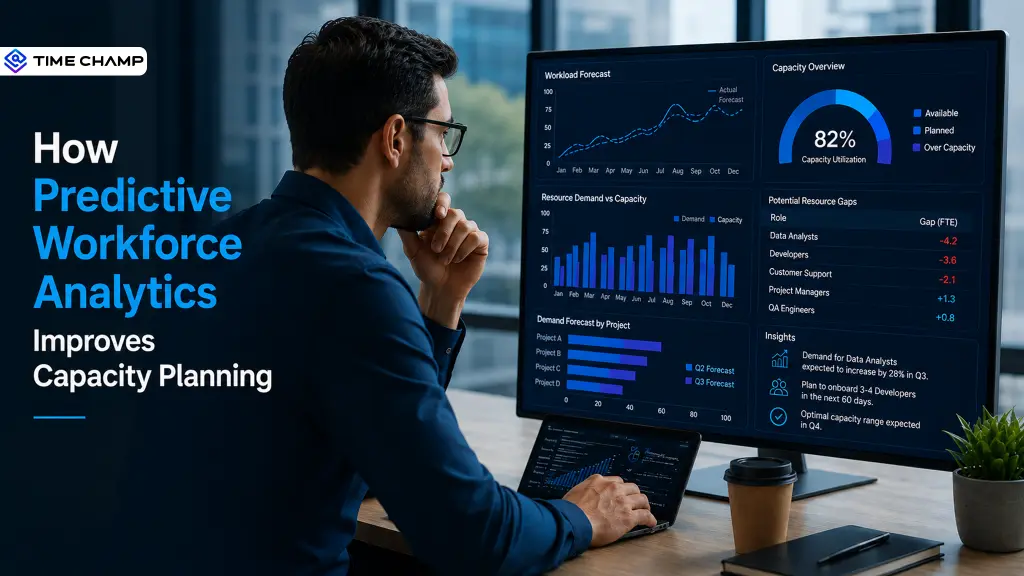
Here's something most businesses don't realize. Your workforce data isn't just a record of the past. It can also reveal what may happen next.
Predictive workforce analytics uses your workforce data to forecast outcomes such as capacity needs, attrition, and skills gaps before they happen.
Every completed task, work pattern, attendance trend, and productivity change adds another piece to the puzzle. The challenge is putting those pieces together before small issues grow into bigger ones.
That's exactly what predictive workforce analytics helps you do. Keep reading to see how it works, what it can predict, and how it supports smarter workforce planning.
What Is Predictive Workforce Analytics?
Predictive workforce analytics uses historical and current workforce data to forecast future workforce outcomes. Instead of showing what has already happened, it estimates the likelihood of future events, helping you make better workforce planning decisions.
Rather than waiting for turnover, skills shortages, or workload issues to affect your business, predictive analytics identifies patterns that indicate what may happen next. This allows you to take action earlier, allocate resources more effectively, and address potential challenges before they grow.
How Does Predictive Workforce Analytics Work?
Every prediction follows a structured process. Here's how it works from start to finish.
1. Collects Data from Every System That Supports Work
The process begins by gathering data from the systems you already use every day. This may include HR platforms, attendance records, project management tools, productivity software, time tracking systems, and collaboration applications.
Bringing this information together creates a complete view of how work happens instead of relying on isolated reports.
2. Turns Raw Data into Meaningful Signals
Raw data alone doesn't help a predictive model make accurate forecasts. A login time is simply a data point, while the percentage change in after-hours activity over the last 30 days is a meaningful signal.
This step, known as feature engineering, converts timestamps, task counts, app usage logs, and other raw data into patterns the model can understand and learn from. It is often the most time-consuming stage of the entire process because the quality of these signals directly affects the accuracy of the predictions.
3. Trains the Model Using Historical Workforce Data
The next step is training the model with historical workforce data. You feed it years of past outcomes, such as who left, who stayed, and who received promotions, so it can identify the patterns behind those results.
Several machine learning techniques support this process. Logistic regression estimates the probability of a binary outcome, such as whether an employee is likely to leave or stay. Decision trees group employees based on the factors that have the biggest impact on those outcomes. Random forest builds on this approach by combining hundreds of decision trees and averaging their predictions to deliver more stable and reliable results.
4. Generates Predictions and Assigns Risk Scores
After training, the model analyzes current workforce data and estimates the probability of future events.
Instead of producing a simple yes-or-no answer, it assigns a probability or risk score. For example, it may estimate the likelihood of employee turnover, workforce shortages, or an increasing workload. You can then decide which predictions need attention based on your business priorities rather than reacting to every alert.
Ready to move beyond historical reports and plan with confidence?
Try Time Champ to gain the workforce insights that support proactive planning and better business outcomes.
What Are the Benefits of Predictive Workforce Analytics?
The value of predictive workforce analytics goes far beyond forecasting future events. It helps you make informed decisions, prepare for workforce changes, and use your resources more effectively. Let's break down the practical benefits it offers.
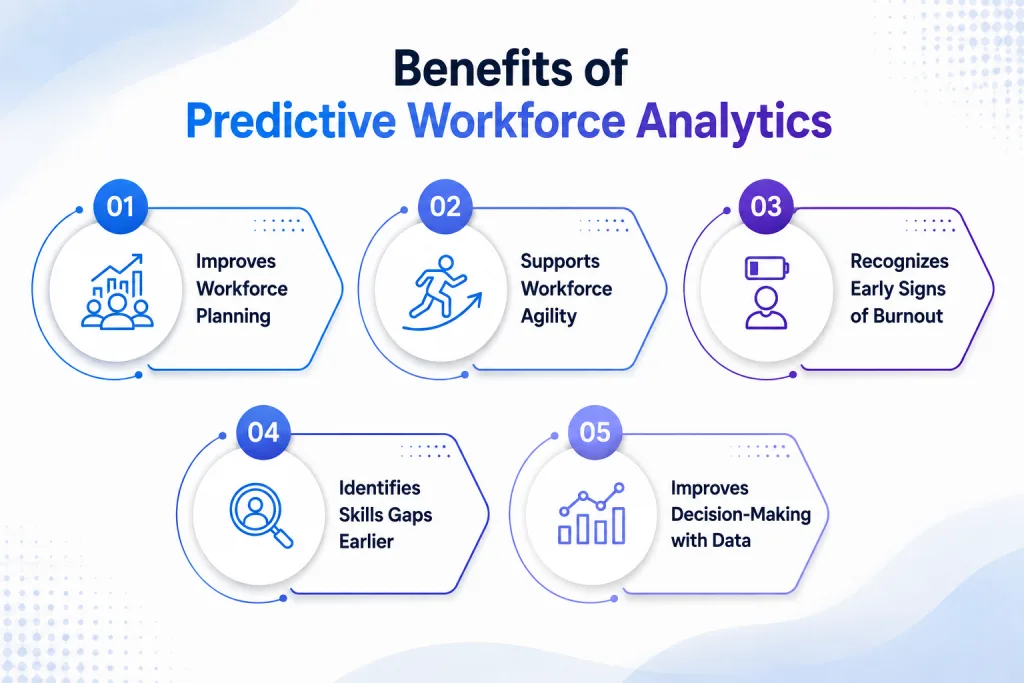
1. Improves Workforce Planning
Planning becomes much easier when you have a clearer view of future workforce needs. By identifying expected changes in staffing, workloads, and skills, predictive workforce planning helps you plan resources more effectively and make informed hiring and workforce decisions.
2. Supports Workforce Agility
Responding quickly becomes much easier when you know what's changing across your workforce. Predictive analytics improves workforce agility by revealing emerging trends early, allowing you to make timely workforce decisions instead of reacting after problems arise.
3. Recognizes Early Signs of Burnout
Small changes in work habits can reveal early signs of burnout. Increased after-hours work, heavier workloads, and noticeable drops in productivity provide valuable signals that help you step in before burnout begins to affect your workforce.
4. Identifies Skills Gaps Earlier
Future projects often require skills that may not exist within your current workforce. Predictive analytics in workforce planning provides early visibility into emerging skill gaps, giving you enough time to plan training, reskilling, or hiring before they affect your business goals.
5. Improves Decision-Making with Data
Instead of relying only on assumptions or historical reports, workforce analytics provides evidence that supports better workforce decisions. This allows you to evaluate potential risks, compare different planning options, and act with greater clarity.

Did You Know?
Organizations that adopt predictive analytics achieve 14.9% lower employee turnover than those that don't, demonstrating the clear business value of investing in workforce analytics.
What Can Predictive Workforce Analytics Predict?
It can forecast a wide range of workforce outcomes by analyzing historical and current workforce data. While predictions are based on probabilities rather than guarantees, they give you early visibility into workforce trends that support better planning and decision-making.
Predictive Workforce Analytics Can Forecast
- Employee attrition and flight risk
- Workforce capacity and future workload demand
- Emerging skills gaps before they affect projects
- Employee burnout and disengagement risk
- Hiring success and time to productivity
- Future workforce demand and staffing requirements
- Project staffing and resource allocation needs
- Workforce productivity trends
- Absenteeism and attendance patterns
- Succession planning opportunities
What Are the Limitations of Predictive Workforce Analytics?
Predictive workforce analytics can uncover valuable workforce insights, but it has its limits. The accuracy of its predictions depends on the quality of the data, the patterns it learns, and how the results are interpreted. Knowing these limitations helps you use predictive insights more effectively.
1. Predicts What Might Happen, Not Why It Happens
A predictive model can identify who may have a higher risk of leaving or experiencing burnout, but it cannot explain the exact reason behind that prediction. The results should serve as an early warning, while the underlying causes still require careful review before making any workforce decisions.
2. Struggles to Predict Rare Events
Predictive models learn from historical patterns. When an event happens only occasionally, such as sudden resignations or unexpected workforce disruptions, there may not be enough historical data for the model to recognize reliable patterns. As a result, predictions for these events may be less accurate.
3. Reflects the Quality of Your Historical Data
A predictive model only learns from the data you provide. If historical workforce data is incomplete, inaccurate, or biased, those issues can influence future predictions. Maintaining clean, reliable, and unbiased data is essential for producing meaningful insights.
Not sure what your workforce data is telling you?
Use Time Champ to turn everyday work data into actionable insights for better workforce planning.
How Can You Implement Predictive Workforce Analytics Successfully?
Implementing predictive workforce analytics begins with a clear business objective, reliable workforce data, and a practical rollout plan. Breaking the process into manageable steps makes adoption easier and leads to more meaningful results.
Follow these steps to build a strong implementation strategy.
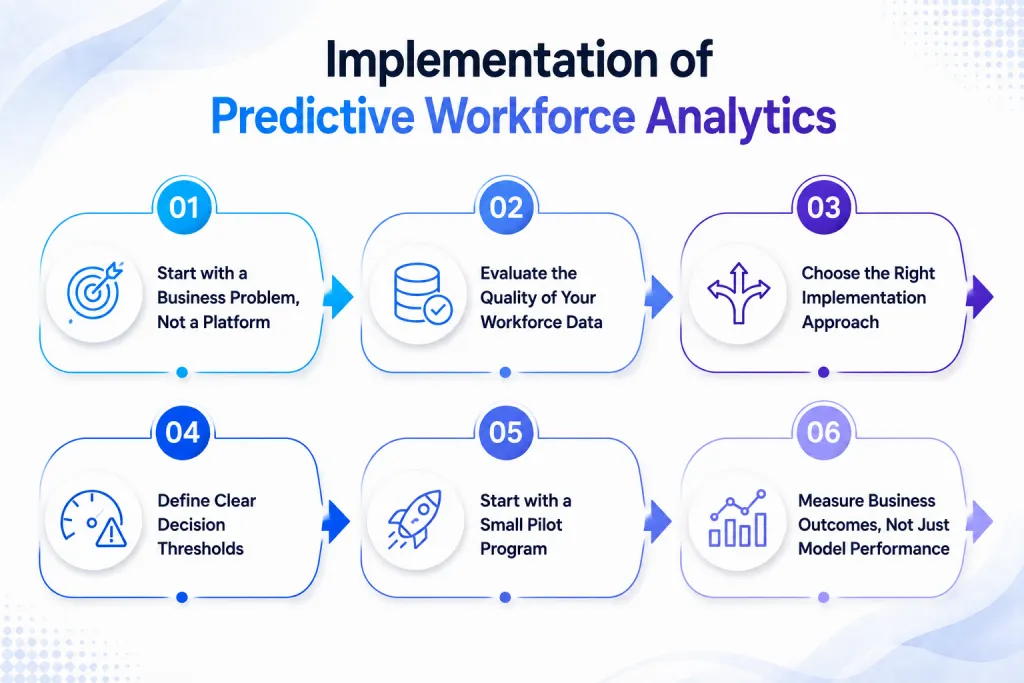
1. Start with a Business Problem, Not a Platform
Avoid choosing a platform before defining what you want to solve. Start with a specific workforce challenge, such as reducing employee turnover, improving workforce planning, identifying skills gaps, or balancing workloads.
A clear objective makes it easier to choose the right data, measure progress, and evaluate whether your implementation delivers meaningful results.
2. Evaluate the Quality of Your Workforce Data
Reliable predictions begin with reliable data. Review the workforce data available across your HR systems, time tracking tools, project management platforms, and productivity applications.
Look for missing records, duplicate entries, or outdated information before building predictive models. Better data leads to more accurate forecasts.
3. Choose the Right Implementation Approach
The best approach depends on your business needs, available resources, and technical expertise.
- Build if you have an experienced data science team and need a fully customized solution.
- Buy if you want advanced analytics with dedicated people analytics software.
- Use an existing workforce management platform if you prefer built-in predictive capabilities without managing complex models yourself.
Choose the option that fits your long-term workforce goals rather than the most advanced technology.
4. Define Clear Decision Thresholds
Predictions should guide decisions, not replace them. Before using predictive insights, decide what level of risk requires action.
For example, determine when a turnover risk score should trigger a review or when workload forecasts should prompt resource planning. Clear thresholds create consistent decision-making across your workforce.
5. Start with a Small Pilot Program
Instead of rolling out the solution across your entire workforce, begin with one department, team, or business unit. Running a pilot allows you to validate predictions, gather feedback, and refine your approach before expanding further.
6. Measure Business Outcomes, Not Just Model Performance
The success of your implementation depends on more than prediction accuracy. Measure whether the actions you take lead to better business outcomes. For example, look at improvements in employee retention, hiring success, or workforce planning instead of focusing only on model performance. Real value comes from the decisions you make, not just the predictions shown in a dashboard.
Successful implementation doesn't happen all at once. The roadmap below highlights the key milestones to focus on during your first 90 days.
| Timeline | Focus | What you deliver |
|---|---|---|
| Days 1 to 30 | Scope the problem and audit your data | One named decision, a data readiness check, a build/buy/use choice |
| Days 31 to 60 | Configure the model and set thresholds | A working score, a threshold agreed with the business, a pilot team and control group selected |
| Days 61 to 90 | Run the pilot and review results | A comparison of pilot versus control outcomes, a decision on whether to scale |
What Are Real-Life Examples of Predictive Workforce Analytics?
The value of predictive workforce analytics becomes much easier to understand when you see how leading companies use it to solve real workforce challenges. The examples below show how workforce data supports better planning, improves retention, and strengthens decision-making across different business scenarios.
| Company | What they predicted | Data used | Result | Source |
|---|---|---|---|---|
| HP | Employee flight risk across the entire workforce | Two years of employee records covering pay, promotions, and performance ratings | Estimated $300 million in potential savings on attrition and productivity loss | Siegel, 2013, Analytics Magazine |
| IBM | Which employees were likely to quit, using its Watson platform | Multiple undisclosed HR data points fed into a "predictive attrition program" | IBM reported that 95 percent prediction accuracy and roughly $300 million saved in retention costs | CNBC |
| Experian | Flight risk tied to team structure, commute, and supervisor performance | Around 200 employee attributes pulled from HR, payroll, and talent systems | Global attrition down 4 percent, saving $14 million over two years | Experian UK case study |
| Credit Suisse | Likelihood of departure within the next year | More than 40 variables narrowed down to 10 to 11 core predictors | Around $70 million saved annually in hiring and onboarding costs | AIHR |
One thing becomes clear from these examples. Every model relies on HRIS data, such as performance scores, tenure, and team size. However, they often overlook the data your workforce generates every day through actual work, including login patterns, application usage, and meeting loads. This is where predictive workforce monitoring tools fill the gap by combining day-to-day activity data with traditional HR records to deliver more complete workforce insights.
Turn Predictive Workforce Analytics into Better Decisions with Time Champ
Making accurate workforce predictions starts with accurate workforce data. The more complete and reliable your workforce data is, the easier it becomes to identify patterns, recognize emerging trends, and make informed planning decisions. That's exactly where Time Champ adds value by capturing the day-to-day work insights that strengthen workforce predictions.
The capabilities below support better workforce planning by providing the visibility and data needed to make more informed decisions.
- Track Time Across Projects and Tasks: Capture accurate time data across projects, tasks, and daily activities to identify work patterns, measure productivity trends, and support more reliable workforce planning.
- Monitor Productivity Trends: Measure productive time, idle time, application usage, and work habits to uncover changing productivity patterns before they begin to affect business performance.
- Identify Workload Imbalances: Compare workloads across teams and individuals to recognize uneven work distribution, prevent resource bottlenecks, and support better workforce planning.
- Analyze Attendance and Work Patterns: Review attendance trends, working hours, overtime, and schedule consistency to identify workforce changes that may require early attention.
- Plan Workforce Capacity with Confidence: Forecast workforce capacity by tracking work hours, resource availability, and project workloads. Identify potential capacity gaps early so you can balance workloads and prepare for upcoming business demands.
- Recognize Early Signs of Burnout: Monitor workload trends, extended working hours, idle time, and after-hours activity to identify early signs of burnout. Take timely action to rebalance workloads and support employee well-being before burnout affects performance.
- Identify Attrition Risks Earlier: Analyze changes in work patterns, attendance, and productivity to detect attrition risks before they lead to employee turnover. Early visibility allows you to address concerns and improve retention.
- Generate Workforce Reports: Turn workforce data into detailed reports that reveal long-term trends, operational patterns, and planning opportunities across your workforce.
- Capture Real-Time Workforce Data: Collect continuously updated workforce data that supports more accurate forecasting and enables timely workforce planning decisions.
Looking for clearer workforce insights before making important decisions?
Start with Time Champ and use reliable workforce data to plan ahead with greater clarity.
Conclusion
Predictive workforce analytics gives you the ability to prepare for workforce changes instead of reacting after they happen. When you combine reliable workforce data with the right insights, planning becomes more proactive, and every decision becomes more informed. Time Champ makes that possible by giving you clear visibility into workforce activities, productivity, and work patterns that strengthen future workforce planning.

Thasleem Shaik

Table of Content
 What Is Predictive Workforce Analytics?
- How Does Predictive Workforce Analytics Work?
- What Are the Benefits of Predictive Workforce Analytics?
- What Can Predictive Workforce Analytics Predict?
- What Are the Limitations of Predictive Workforce Analytics?
- How Can You Implement Predictive Workforce Analytics Successfully?
- What Are Real-Life Examples of Predictive Workforce Analytics?
- Turn Predictive Workforce Analytics into Better Decisions with Time Champ
- Conclusion
Related Blogs

Learn why workforce analytics is essential for process reinvention, how it reinvents key business processes, best practices & how to measure success.
Anjali | Apr 02, 2026
Learn why workforce analytics drives business value, how to measure ROI with formulas, strategies for measurable returns, challenges, & business impact.
Thasleem Shaik | Feb 11, 2026
Discover the fundamentals of HR analytics, learn about its best practices, and explore its benefits for businesses.
Shabana Shaik | May 24, 2024
User behavior analytics detects insider threats and improves security. Explore UBA benefits, real-world use cases, and tools to protect your business.
Jahnavi Pulluri | Apr 15, 2026
Learn why filtering workforce data is essential, how to filter data for effective workforce intelligence step-by-step, and how it supports better outcomes.
Guna Lakshmi | Feb 18, 2026
Learn what workforce engagement management (wem) is, why it matters in contact centres, components, benefits, and how to choose the right software.
Shabana Shaik | October 01, 2025


 4.7/5 avg.
Ready to Manage Your Workforce Smarter?
Join our family of 1500+ companies using smart insights to redefine workforces!

Free Trial
No Credit Card Required