Is It Ethical to Monitor Remote Employees
Companies are watching remote workers more than ever. But is it ethical? We break down where monitoring is justified and where it crosses the line.

Monitoring remote employees is ethical, but only when your team knows about it. A 2025 ExpressVPN survey found that 73% of US-based employers now use online monitoring tools. If you’re considering monitoring your team, or if your employees are unsure about it, that’s completely normal. The way you handle it makes all the difference. It can either support your team and improve work or make them feel stressed and uncomfortable. Anyone weighing this decision usually starts with our enterprise employee monitoring guide for the full landscape.
In this article, you’ll understand when monitoring helps, when it starts to cause issues, and how to handle it without losing trust.
Why Companies Started Monitoring Remote Workers
In a traditional office, you didn’t need special tools to understand your team’s work. You could see people working, have quick conversations, and notice problems early. But remote work changed everything. You no longer have the same level of visibility, and it becomes harder for you to understand who needs help, who is overloaded, and how work is actually progressing.
To fill this gap, many companies started using monitoring tools. These tools help you stay informed and manage your remote team more effectively, especially if you handle sensitive data, work with remote teams, or depend on hourly billing. At the same time, these tools have become more advanced. What started as simple time tracking has grown into systems that can show app usage, productivity patterns, website activity, idle time, and overall work behavior.
Not sure if your team is actually working or just appearing active?
Time Champ gives you clear insights into real productivity without guesswork.
When Monitoring Actually Helps Your Business
There are real situations where monitoring your remote team makes sense. If your team works with financial data, client information, or other sensitive details, tracking access and activity helps you protect your business. Security risks are not rare; in fact, the 2024 Insider Threat Report by Cybersecurity Insiders states that 71% of organizations say insider threats are a major concern.
Monitoring is also useful when your business depends on hourly work. If you bill clients based on time, you need accurate records. Manual timesheets are often unreliable because people may forget or estimate their hours. Automated tracking helps you avoid billing issues and keeps payroll accurate.
At the same time, monitoring can support your team’s well-being. When you have visibility into work patterns, you can notice if someone is consistently working long hours. This gives you a chance to step in early, adjust workloads, and prevent burnout. When you use it this way, it becomes a tool that helps you protect your business, improve accuracy, and support your team.
Common Concerns and Risks of Employee Monitoring
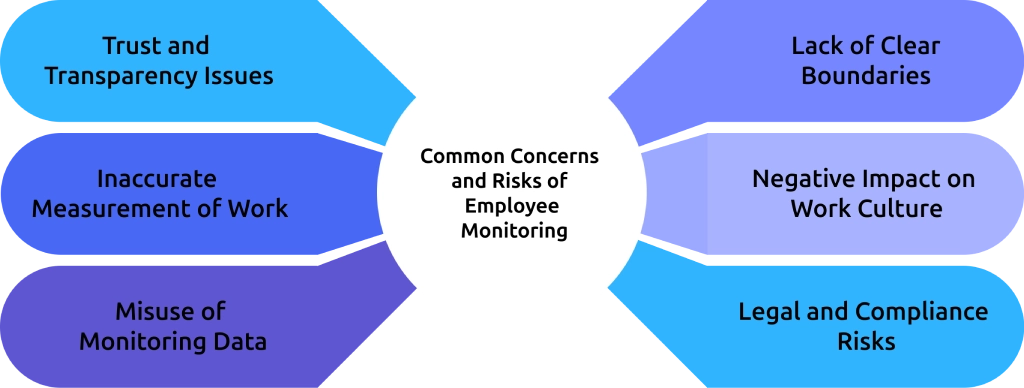
While monitoring can be useful, your team may have real concerns about how it affects them. If you want to implement it successfully, you need to understand these concerns and address them properly.
Trust and Transparency Issues
If you monitor your team without clearly informing them, it can break trust. Your employees may feel that you didn’t trust them from the beginning. This can affect how they view you and the company. In fact, a study by the American Psychological Association reveals 56% of workers who experience monitoring by their employer typically feel tense or stressed out at work.
Inaccurate Measurement of Work
Employee monitoring software track activity such as time spent, mouse movement, or app usage. However, these metrics do not always reflect real productivity. Employees who spend time thinking, planning, or solving complex problems may appear less active, even though they are doing valuable work. If you rely only on activity data, you may misjudge performance.
Misuse of Monitoring Data
Monitoring data does not always show the full picture. A drop in activity could happen due to personal reasons, temporary workload changes, or different working styles. If you make decisions based only on raw data without understanding the context, it can create unfair pressure and lead to wrong conclusions.
Lack of Clear Boundaries
Another common concern is when monitoring does not have clear limits. If your team feels like they are being watched all the time, even beyond work hours or on personal devices, it can create discomfort and frustration. Employees need to feel that their personal space is respected. Without clear boundaries, monitoring can quickly feel intrusive.
Negative Impact on Work Culture
If monitoring is not handled carefully, it can affect your workplace culture. Employees may start focusing more on “looking busy” rather than doing meaningful work. This can reduce creativity, discourage deep thinking, and create unnecessary pressure. Instead of improving productivity, it may lead to stress and lower overall performance.
Legal and Compliance Risks
Monitoring without proper policies can also create legal issues for your business. Different regions have strict rules about employee privacy and data collection. If you track data without clear consent or purpose, it can lead to compliance problems, penalties, or legal disputes. This is why having a clear and transparent policy is important before implementing any monitoring system.
Worried that monitoring might stress your employees?
Time Champ lets you monitor ethically with full transparency and control.
When Employee Monitoring Crosses the Line
You don’t need a complicated framework to understand this. The real question is simple: are you using monitoring to support your team, or to control them? The line between ethical monitoring and unethical surveillance is clear, and you need to stay on the right side of it.
| Ethical Monitoring (What You Should Do) | Unethical Surveillance (What You Must Avoid) |
|---|---|
| Clearly tell your team what is being tracked before it starts | Installing monitoring without informing your team |
| Track only work-related activity during working hours | Tracking personal accounts, devices, or off-hours activity |
| Have a clear business reason for every type of data you collect | Collecting data without any clear purpose |
| Give access to your team to view their own data | Enabling only management to see the data |
| Use data to support performance and remove blockers | Using data to build cases against employees |
| Ensure your monitoring setup matches your written policy | Collecting more data than your policy explains |
Beyond the table, watch out for these clear red flags:
- Monitoring your team without telling them
- Tracking personal emails or social media
- Monitoring outside agreed working hours
- Collecting more data than you actually need
If you’re doing any of these, then you’re crossing into surveillance. And that’s where trust breaks, and legal risks begin.
So, Is Employee Monitoring Ethical? Here’s the Clear Answer
Monitoring is ethical when your team knows what you are tracking before it starts, understands why you are doing it, and can see their own data. Many employees are okay with this approach. But the moment you hide it, everything changes. If monitoring happens without your team knowing, if personal activities are tracked, or if data is used to pressure or judge employees without context, trust breaks quickly. What was meant to improve productivity starts creating stress, fear, and disengagement.
At that point, monitoring stops helping your team and starts working against you. A study by ExpressVPN says, in their survey, 59% report feeling stress and/or anxiety about their employer surveilling their online activity. If you are honest and fair, monitoring supports your team. If you are not, it damages trust and creates bigger problems than it solves.
How Time Champ Helps You Monitor Your Team the Right Way
When you decide to monitor your remote team, the biggest challenge is doing it in a way that builds trust. The tool you choose plays a huge role in this. Time Champ is an employee monitoring tool that goes a step further with workforce intelligence, bringing it into the same dashboard. It is designed to help you monitor your team in a clear, fair, and supportive way. It helps you create transparency, improve productivity, and take better care of your team.
Full Transparency for Your Team
With Time Champ, your team can see exactly what you see. Every employee gets access to their own activity data through a personal dashboard. There are no hidden reports or secret tracking. This openness helps you build trust and reduces the stress that usually comes with monitoring.
Flexible Monitoring Based on Your Needs
You don’t have to track everything. Time Champ lets you choose what to monitor based on your actual business needs. You can enable features like time tracking, productivity insights, or activity monitoring only where they are required. This keeps your monitoring simple, relevant, and aligned with your company policies.
Keeps Your Monitoring Ethical and Compliant
Time Champ helps you follow ethical and legal practices by allowing you to collect only the data you truly need. Since you control the tracking scope, your monitoring stays limited and purpose-driven. This ensures you are not overstepping boundaries or collecting unnecessary data.
Helps You Prevent Employee Burnout
Time Champ helps you understand how your team is working. You can identify patterns like long working hours, lack of breaks, or constant workload pressure. This allows you to step in early and support your team before employee burnout becomes a problem.
Turns Monitoring into a Support Tool
Time Champ helps you use monitoring as a way to support your team. You can easily identify blockers, improve work balance, and create a healthier work environment. This approach makes monitoring more meaningful and beneficial for everyone.
Want to improve productivity without micromanaging your team?
Time Champ helps you focus on outcomes instead of constant supervision.
Conclusion
Monitoring your remote employees depends on how you approach it. When you are open with your team, focus only on what truly matters, and use the data to support them, it helps build trust and clarity in your workplace. When these things are missing, it can lead to mistrust and create more problems over time.

Guna Lakshmi

Table of Content
-
 Why Companies Started Monitoring Remote Workers
-
When Monitoring Actually Helps Your Business
-
Common Concerns and Risks of Employee Monitoring
-
When Employee Monitoring Crosses the Line
-
So, Is Employee Monitoring Ethical? Here’s the Clear Answer
-
How Time Champ Helps You Monitor Your Team the Right Way
-
Conclusion
Related Blogs

Managing an async team? Learn how asynchronous work employee monitoring works and what to track to keep your team productive.
Guna Lakshmi | Apr 16, 2026
Explore how to implement employee monitoring software effectively with clear steps, legal tips, best practices, ROI metrics, and key pitfalls to avoid.
Anjali | Apr 15, 2026
Choose the right employee monitoring tool for your team with this 2026 guide. Explore types, key features, a 5-step framework, and top software options.
Jahnavi Pulluri | Apr 13, 2026
Learn how to choose the right remote employee monitoring software with the right features, scalability, and usability to manage remote teams effectively.
Guna Lakshmi | Apr 14, 2026
Managing digital nomads? Learn how digital nomad employee monitoring works, what to track, and how to stay fair while keeping your team productive.
Guna Lakshmi | Apr 15, 2026
Understand employee monitoring legal compliance, key laws, and best practices to track work activity while protecting privacy and avoiding legal risks.
Thasleem Shaik | Apr 14, 2026


 4.7/5 avg.
Ready to Manage Your Workforce Smarter?
Join our family of 1500+ companies using smart insights to redefine workforces!

Free Trial
No Credit Card Required