Impact of Data Loss on Business: The Complete Guide
Learn about the impact of data loss on business, including its consequences, real-world examples, and ways to reduce its impact.

Imagine losing years of customer records, financial data, or confidential business files in just a few minutes. A single data loss incident can affect every part of your business, from day-to-day operations and recovery costs to customer trust, compliance, and long-term growth.
To help you protect your business, we've included everything you need to know about the impact of data loss on business, including its consequences, real-world examples, the industries most affected, and ways to reduce its impact.
What Is the Impact of Data Loss in Business?
The impact of data loss on business refers to the financial, operational, legal, and reputational challenges that arise when important business data is lost, stolen, or becomes inaccessible. Whether caused by cyberattacks, hardware failures, accidental deletion, data theft, or human error, data loss can affect every part of your organization.
The extent of the damage depends on factors such as the type of data involved, how quickly you recover it, and the security measures you already have in place. While any organization can be affected, small and mid-sized businesses often face greater challenges because they have fewer resources to recover from major incidents. Understanding the different types of data loss can help you identify potential risks before they disrupt your business.
What Are the 8 Major Impacts of Data Loss in Business?
A single data loss incident can interrupt daily operations, increase costs, damage customer relationships, and expose your business to legal and regulatory risks. Depending on the type of data involved, the consequences may continue for months or even years. Here are the eight major ways data loss can affect your business.
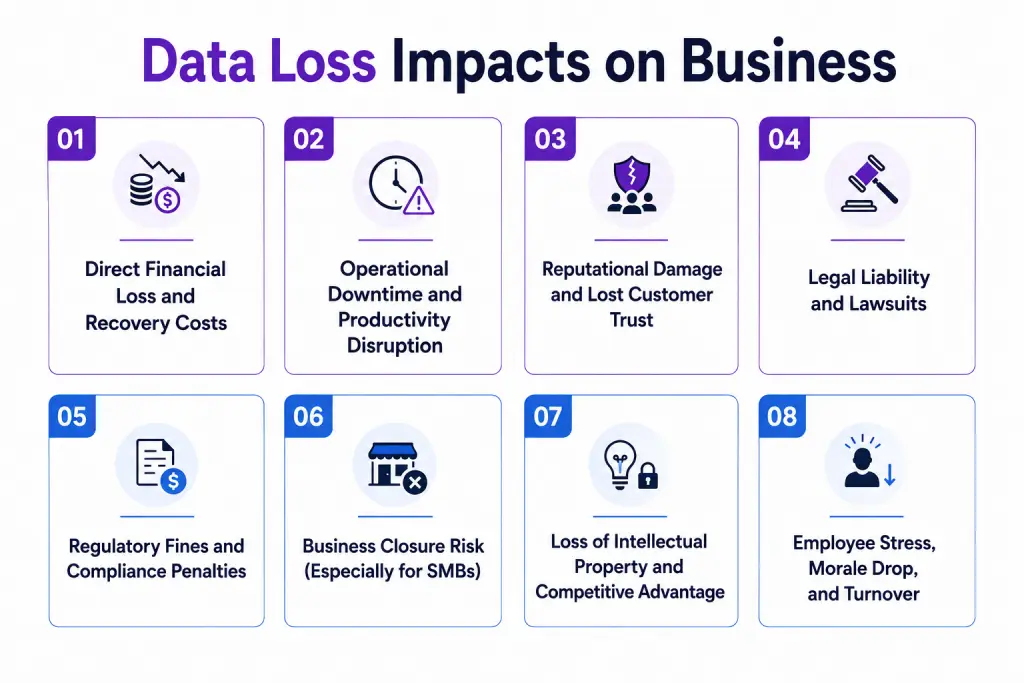
Direct Financial Loss and Recovery Costs
One of the first impacts you'll notice is the financial cost. Recovering lost data often requires spending on IT support, forensic investigations, backup restoration, new security tools, and system repairs. If your business cannot operate during recovery, you may also lose sales and revenue.
In addition to these direct expenses, you may face compensation claims, higher cyber insurance premiums, or the cost of notifying affected customers. The longer recovery takes, the more these costs continue to grow.
Operational Downtime and Productivity Disruption
When critical business data becomes unavailable, everyday work slows down or stops completely. Your employees may lose access to files, customer records, or business applications, making it difficult to complete their tasks.
Projects can be delayed, customer requests may go unanswered, and important deadlines can be missed. Even after restoring your systems, your teams often spend days recreating lost work and finishing incomplete tasks, which reduces overall productivity.
Reputational Damage and Lost Customer Trust
Your customers trust you to protect their personal and business information. A data loss incident can quickly weaken that trust, especially if sensitive information is exposed or services are disrupted.
Negative publicity, customer complaints, and poor online reviews can affect your brand image long after the incident is resolved. Some customers may decide to switch to competitors, while potential clients may hesitate to do business with you because of concerns about data security.
Legal Liability and Lawsuits
If lost data contains customer, employee, or business information, your organization may face legal action. Customers, business partners, or employees who suffer losses because of the incident may seek compensation through lawsuits or legal claims.
Defending these cases often requires significant time, legal expertise, and financial resources. Even if the case is settled outside court, the legal costs and reputational impact can be substantial.
Regulatory Fines and Compliance Penalties
Many industries must comply with regulations that require organizations to protect sensitive information. Losing regulated data can lead to investigations, financial penalties, and mandatory audits by regulatory authorities.
Depending on your industry, you may also need to report the incident to customers or government agencies. Failing to meet compliance requirements can result in additional penalties and make it harder to maintain customer confidence.
Business Closure Risk (Especially for SMBs)
For small and medium-sized businesses, a major data loss incident can threaten long-term survival. Limited budgets, fewer recovery resources, and prolonged downtime make it difficult to recover from significant financial losses.
If customers leave, operations remain disrupted, or recovery costs become too high, some businesses struggle to regain stability. Preparing for data loss before it happens is often far less expensive than recovering after the damage is done.
Loss of Intellectual Property and Competitive Advantage
Your business data includes valuable assets such as product designs, source code, research, business strategies, pricing information, and customer databases. Losing this information can weaken your competitive position.
If confidential information falls into the wrong hands, competitors may gain insights that took your organization years to develop. Recovering the loss of intellectual property is often far more difficult than replacing ordinary business files.
Employee Stress, Morale Drop, and Turnover
Data loss impacts both your systems and your employees. Employees may feel frustrated when they lose important work or spend hours recreating missing files. They may also worry about being blamed for the incident or feel uncertain about the company's future.
These challenges can reduce morale, lower productivity, and increase workplace stress and employee burnout. If similar incidents happen repeatedly without proper safeguards, employee satisfaction and retention may also decline.
Impact of Data Loss on Business: Summary Table
The table below gives you a quick overview of how data loss can affect different areas of your business, from immediate disruptions to long-term consequences.
| Business Impact | How It Affects Your Business | Potential Long-Term Outcome |
|---|---|---|
| Financial Loss | Recovery expenses, lost revenue, and system restoration costs | Reduced profits and higher operating costs |
| Operational Downtime | Interrupted workflows, delayed projects, and lower productivity | Slower business growth and missed opportunities |
| Reputation & Customer Trust | Negative publicity, customer complaints, and loss of customer confidence | Customer churn and reduced brand loyalty |
| Legal Liability | Lawsuits, legal investigations, and compensation claims | Costly settlements and ongoing legal expenses |
| Compliance & Regulatory Risks | Regulatory fines, audits, and mandatory breach notifications | Increased regulatory scrutiny and financial penalties |
| Business Continuity | Cash flow disruptions and prolonged recovery efforts | Business closure, especially for small and mid-sized businesses |
| Intellectual Property Loss | Exposure of trade secrets, product designs, or business strategies | Loss of competitive advantage and market position |
| Employee Impact | Stress, frustration, and time spent recovering lost work | Lower morale, reduced productivity, and higher turnover |
Which Industries Face the Biggest Impact from Data Loss?
No matter what industry you're in, losing critical business data can have serious consequences. However, businesses that handle sensitive customer information, financial records, and healthcare data often face greater financial losses and higher reputational risks.
Healthcare
Healthcare organizations manage highly sensitive patient records, making them one of the most targeted industries for cyberattacks. Data loss can delay patient care, interrupt hospital operations, and expose organizations to strict regulatory penalties.
According to IBM's Cost of a Data Breach Report 2024, the highest average data breach cost of any industry at $9.77 million.
Financial Services
Banks, insurance companies, and other financial institutions process confidential financial and payment data every day. A data loss incident can result in fraud, regulatory investigations, and a loss of customer confidence.
IBM reports that the average cost of a data breach in the financial sector reached $6.08 million in 2024, making it the second most expensive industry for data breaches.
Technology and SaaS
Technology companies rely on customer data, source code, and intellectual property to deliver their products and services. Losing these assets can delay product development, expose proprietary information, and damage customer trust. Since SaaS providers often store data for thousands of customers, a single incident can affect multiple organizations at once.
Retail and E-commerce
Retailers collect large volumes of customer and payment data, making them attractive targets for cybercriminals. Data loss can interrupt sales, trigger compliance issues, and reduce customer confidence. During busy shopping seasons, even a short disruption can result in significant revenue loss.
Small and Mid-Sized Businesses (Across All Industries)
Small and mid-sized businesses often have fewer resources to recover from a major data loss incident. Recovery costs, business interruptions, and customer loss can quickly become overwhelming.
According to a 2025 Guardz survey, 43% of small and mid-sized businesses have experienced a cyberattack, yet only 34% have a formal incident response plan. Businesses with a documented response plan were significantly more likely to avoid major damage after an attack.
What Are Real-World Examples of Data Loss Impact on Business?
Data loss can affect organizations of any size, including some of the world's largest companies. Here are three real-world examples that show how data loss can affect businesses.
Yahoo (2013-2014)
Yahoo experienced one of the largest data breaches in history, with 3 billion user accounts ultimately found to be affected across two separate incidents. The breach was disclosed while Verizon was in the process of acquiring Yahoo, leading to a $35 million reduction in the acquisition price. Yahoo also faced regulatory action and multiple class-action lawsuits, causing lasting damage to its reputation.
Equifax (2017)
Equifax exposed the personal information of approximately 147 million consumers, including Social Security numbers, birth dates, and addresses. By 2020, the company had spent more than $1.4 billion on recovery efforts, legal costs, and cybersecurity improvements. It also agreed to a settlement of up to $700 million with U.S. regulators and affected consumers, while several senior executives resigned following the incident.
Microsoft Exchange (2021)
In 2021, attackers exploited multiple zero-day vulnerabilities in Microsoft Exchange Server, compromising more than 30,000 organizations in the United States within days. Thousands of businesses had to patch vulnerable systems, investigate compromised servers, and strengthen their security controls. The incident demonstrated how vulnerabilities in widely used enterprise software can disrupt operations across entire industries.
How to Reduce the Impact of Data Loss on Your Business
While no business can completely eliminate the risk of data loss, you can significantly reduce its impact with the right preparation. A combination of strong security practices, reliable backups, employee awareness, and a well-defined incident response plan can help you recover faster and minimize financial and operational damage.
Here are some effective ways to reduce the impact of data loss:
- Back up your data regularly to ensure you can restore critical information quickly after an incident.
- Implement data loss prevention (DLP) tools to detect and block unauthorized access, transfers, or sharing of sensitive data.
- Train your employees regularly to recognize phishing attempts, follow security best practices, and handle business data responsibly.
- Restrict access to sensitive information by giving employees access only to the data they need for their roles.
- Create and test an incident response plan so your team knows exactly how to respond when data loss occurs.
- Monitor file activity and user behavior to identify unusual actions early and investigate potential risks before they escalate.
- Keep your software and systems updated to reduce the risk of vulnerabilities being exploited by attackers.
Taking these steps won't prevent every incident, but they can help you recover more quickly, reduce business disruption, and protect your customers, employees, and reputation. If you'd like a detailed guide on preventing data loss, explore our Data Loss Prevention (DLP) Guide.
How Does Time Champ Reduce the Impact of Data Loss on Your Business?
The best way to reduce the impact of data loss is to prevent it before it happens. That's where Time Champ comes in. By combining Data Loss Prevention (DLP) with workforce intelligence, it gives you greater visibility into how sensitive data is accessed, used, and shared across your organization.
As an employee monitoring and data loss prevention (DLP) software, Time Champ helps you detect suspicious file activity, prevent unauthorized data transfers, and maintain detailed audit trails.
Detect Potential Risks Before They Escalate
Identify suspicious activities before they become costly incidents with suspicious activity alerts and file access logging. These features help you detect unusual actions, such as bulk downloads or unauthorized file access, so you can respond quickly and limit potential damage.
Protect Sensitive Data Across Multiple Channels
Protect confidential business data from unauthorized transfers using website blocking, USB blocking, and upload & download blocking. These controls help prevent sensitive information from leaving your organization through risky websites, removable devices, or unapproved file transfers.
Reduce Downtime with Faster Incident Response
Investigate incidents faster with file access logging, which records every file access and modification. This gives your security team the visibility needed to identify the source of an incident and restore normal operations with minimal disruption.
Strengthen Compliance and Audit Readiness
Maintain detailed records of file and user activities. Detailed audit trails simplify compliance reporting, support investigations, and make regulatory audits easier to manage.
Improve Employee Awareness and Accountability
Encourage responsible data handling with suspicious activity alerts and file access logging. These features help identify risky behaviors early, giving you the opportunity to address potential issues before they lead to data loss.
Conclusion
Understanding the impact of data loss on business is the first step toward protecting it. When you invest in the right security practices and data loss prevention tools, you can protect your data, operations, reputation, and long-term growth.
With Time Champ, you can detect suspicious activities early, protect sensitive business data, and respond faster to potential threats, helping you keep your business secure and resilient.

Guna Lakshmi

Table of Content
 What Is the Impact of Data Loss in Business?
- What Are the 8 Major Impacts of Data Loss in Business?
- Impact of Data Loss on Business: Summary Table
- Which Industries Face the Biggest Impact from Data Loss?
- What Are Real-World Examples of Data Loss Impact on Business?
- How to Reduce the Impact of Data Loss on Your Business
- How Does Time Champ Reduce the Impact of Data Loss on Your Business?
- Conclusion
Related Blogs

Protect your business from insider risks with insider threat prevention best practices for monitoring, access control, employee security, and data protection.
Guna Lakshmi | May 08, 2026
Protect your business from BYOD security risks like data breaches and phishing. Learn practical ways to secure employee devices and reduce security threats.
Guna Lakshmi | May 07, 2026
Protect sensitive business data in hybrid work environments with strong security controls and practical strategies to prevent data breaches.
Guna Lakshmi | Jun 10, 2026
Learn how to ensure data privacy in productivity tracking with key controls, vendor evaluation, and setup steps that reduce risk and protect employee data.
Guna Lakshmi | May 02, 2026
Stay ahead of data threats! Discover the best practices for data loss prevention and safeguard your organization’s sensitive information.
Shabana Shaik | Jan 18, 2025
Find answers to common questions about Data Loss Prevention, including how it works, its benefits, and how to choose the right solution for your business.
Jahnavi Pulluri | Jan 20, 2025


 4.7/5 avg.
Ready to Manage Your Workforce Smarter?
Join our family of 1500+ companies using smart insights to redefine workforces!

Free Trial
No Credit Card Required