Insider Threat Program: How to Build a Stronger Security Approach
See what an insider threat program is, its core components, key goals, and practical steps to build a stronger approach to insider risk and data security.
Protecting your business from cyber threats does not stop with securing your network and external systems. You also need a plan for risks that can arise from trusted access to sensitive information and critical resources.
An insider threat program helps you create that plan. It brings policies, awareness, training, detection, assessment, and response together so you can address insider risks in a structured way. This guide shows you how to build one and strengthen your overall security approach.
What Is an Insider Threat Program?
An insider threat program is a structured, cross-functional effort that helps you deter, detect, and respond to risks created by trusted access to your systems, data, and facilities. This includes your employees, contractors, vendors, and other trusted users with credentials or physical access.
Unlike a firewall or antivirus tool, your insider threat program is not a single piece of software. It combines policies, processes, and technology around one goal: catching harmful behavior early. The risk can come from deliberate actions, careless mistakes, or an account that an outsider has quietly taken over.

A Quick Note
CISA and NIST both provide a structured foundation for an insider threat program. CISA focuses on detecting and identifying concerning activity, assessing the risk, and managing the threat, while NIST sets minimum standards and maturity guidance to help you build and strengthen your program over time. These frameworks give you a clear foundation for creating an approach that fits your security needs and legal requirements.
What Are the Core Components of an Insider Threat Program?
A strong insider threat plan needs clear ownership, practical policies, workforce awareness, reliable monitoring, and a defined response process. These elements help you spot risks early and take the right action when concerns arise.
Here are the key components you need to build a complete program.
- Clear Policies and Program Scope: Define which systems, data, facilities, and access points need protection. Set clear rules for collecting, reviewing, sharing, and retaining relevant information so your program follows your security requirements and applicable privacy obligations.
- Risk Detection and Analysis: Bring activity signals together to spot unusual patterns instead of reacting to isolated events. This helps you identify potential risks early, assess the situation, and decide when to take action.
- Monitoring and Detection Technology: Technology provides the visibility you need to track activity across networks, applications, files, and endpoints. Tools such as user activity monitoring, DLP, and UEBA can help you spot unusual behavior and potential risks. Set clear thresholds for suspicious activity so your team knows when to investigate further.
- Insider Threat Awareness and Training: Give your workforce clear guidance on insider risks, warning signs, reporting channels, and secure data-handling practices. Regular insider threat training helps your team recognize potential risks and respond to them appropriately.
- Incident Response and Mitigation: Create a clear response process for confirmed threats that covers escalation, investigation, containment, remediation, documentation, and follow-up. Effective insider threat mitigation limits the impact of an incident and prevents similar risks from causing further damage.
What Are the Goals of an Insider Threat Program?
You already have firewalls, endpoint protection, and access controls in place. But these measures cannot stop a trusted employee from taking your customer database or clicking the wrong link in a phishing attack. That is the gap an insider threat program addresses.
Below, you’ll find the core goals behind a well-built program and why each one matters for your business.
1. Identify Risky Activity Early
The first goal is early detection. You need to spot unusual activity, such as a sudden increase in file downloads or unexpected access to sensitive systems, before it leads to a data leak. Early detection gives you more time to assess the risk, take action, and limit potential damage.
Regular insider threat monitoring gives you better visibility into activity across critical systems and data. This makes it easier to spot unusual patterns and investigate potential risks before they grow into larger security incidents.
2. Protect Sensitive Information
Your sensitive data needs protection from unauthorized access, disclosure, and misuse. An insider threat protection strategy gives you a structured way to control access to critical information and identify activity that could put it at risk. This becomes especially important for customer data, financial records, intellectual property, credentials, and other high-value assets.
3. Meet Security and Compliance Requirements
Meeting relevant laws, regulations, contracts, and industry standards is an important goal of an insider threat program. Requirements such as GDPR, HIPAA, NIST SP 800-53, NISPOM, and PCI DSS can require appropriate safeguards around data access, security controls, monitoring, and incident response. A defined approach to access control, activity monitoring, recordkeeping, and incident response supports your compliance efforts and reduces the risk of fines, penalties, and other consequences of non-compliance.
A confirmed insider incident requires more than detection. You need a defined process for investigation, containment, recovery, and follow-up. Your insider threat mitigation approach should reduce the impact of an incident, restore affected systems or data, and capture what you can improve after the event.
Worried about sensitive data leaving your business without warning?
Use Time Champ to spot risky activity early and protect your critical data.
How to Build an Effective Insider Threat Program
Building an effective insider threat plan takes more than adding another security tool. You need clear ownership, defined policies, the right security controls, and a process for handling risks from detection through response. A well-structured approach also considers privacy, reporting, and continuous improvement.
Here are the key steps to build a practical insider threat program that fits your security needs.
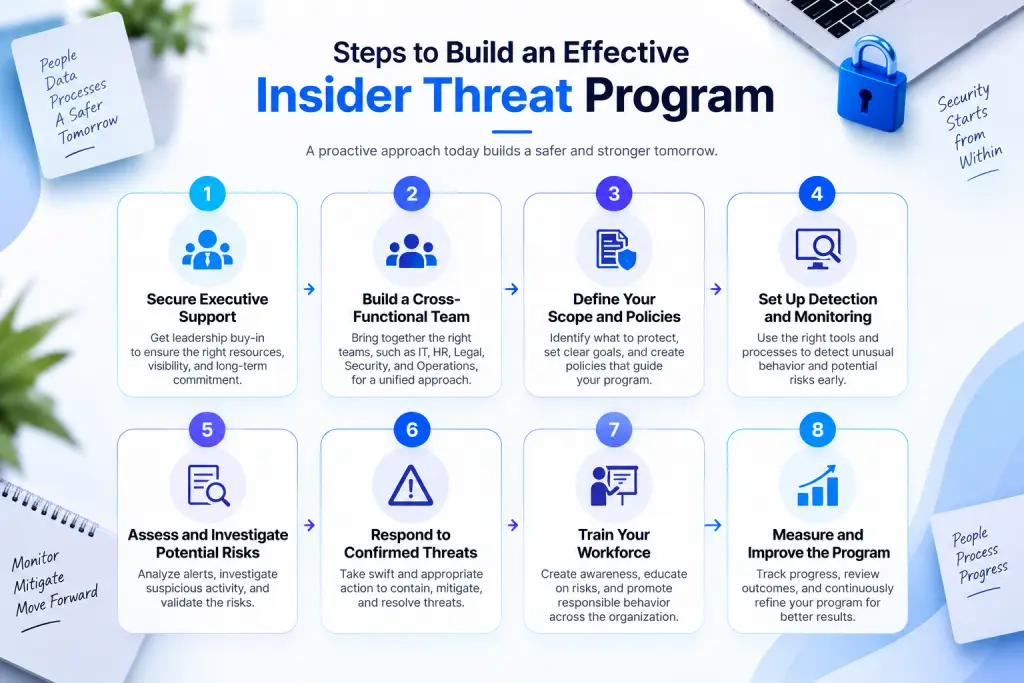
1. Secure Executive Support
Start by getting clear support from senior leadership. Define who owns the program, who can make decisions, and how you will measure its progress. Strong leadership gives your security team the authority and resources to address insider risks consistently.
2. Build a Cross-Functional Team
Bring together security, IT, HR, legal, and other relevant functions to create a cross-functional team with the right expertise. Each team can contribute a different view of the risk. Security can review threats, IT can provide technical context, HR can add workplace context, and legal can guide privacy and compliance decisions.
3. Define Your Scope and Policies
Decide which data, systems, applications, accounts, and facilities need protection. Then create clear policies for access, monitoring, reporting, investigation, and incident handling. A defined insider threat program plan gives your team a consistent framework for managing these risks.
4. Set Up Detection and Monitoring
Create visibility into activity across the systems and data that matter most. Tools such as user activity monitoring, data loss prevention, and UEBA can help you identify unusual access, data movement, and other risk signals. Set clear thresholds so your team knows when activity requires further review.
5. Assess and Investigate Potential Risks
Treat an alert as a starting point rather than a final conclusion. Review the activity, access level, affected resources, and surrounding context before deciding what it means. Clear investigation procedures let you separate genuine risks from normal activity and determine when a case requires escalation.
6. Respond to Confirmed Threats
Create a defined process for handling confirmed incidents. Set clear actions for escalation, access restriction, containment, investigation, recovery, and documentation. A structured insider threat response process lets you respond consistently and reduce the impact of a security incident.
7. Train Your Workforce
Give your team practical guidance on insider risks, secure data handling, warning signs, and reporting procedures. Regular insider threat training keeps security responsibilities clear and encourages your team to report concerns when they notice unusual activity.
8. Measure and Improve the Program
Review your program regularly to see how well it performs. Track measures such as reported concerns, investigation time, confirmed incidents, response time, and training completion. Use these insights to identify gaps, update controls, and strengthen your insider risk program as your security needs change.
Strengthen Your Insider Threat Security with Time Champ
Building the full program requires policies, governance, training, investigation, and response processes. Time Champ can support the detection and monitoring layer by giving you visibility into user activity, file movement, device usage, and policy violations. Here are the features that can support your insider threat security efforts.
- User Activity Monitoring: Track activity across applications, websites, files, and USB devices to identify unusual patterns and potential risks.
- File Activity Monitoring: Monitor file creation, editing, deletion, movement, uploads, and downloads to identify unusual file activity and potential data movement.
- USB Activity Monitoring: Track USB connections and file transfers, and restrict unauthorized devices when required. This gives you greater control over potential data transfers through external devices.
- Policy Violation Alerts: Receive alerts for restricted USB use, unauthorized file access, unsafe website activity, uploads, downloads, and other policy violations.
- Suspicious Activity Detection: Identify suspicious activity patterns and receive alerts for repeated violations or suspicious actions. This gives your security team timely signals for further review.
- Screenshots and Screen Recordings: Review screenshots and screen recordings when you need additional context around unusual activity. Anomaly detection can also highlight sudden changes in screen activity.
- Role-Based Access Control: Control who can view, download, or manage monitoring data. Role-based permissions keep sensitive activity records accessible only to authorized users.
- Detailed Security Reports: Generate reports covering file activity, access violations, data transfers, and other security events. These records can support investigations, audits, and compliance reviews.
Are hidden insider risks putting your systems and data at risk?
Try Time Champ to gain visibility into activity and identify potential threats early.
Conclusion
Protecting your business from insider threats requires more than a single security tool. A strong insider threat program brings policies, training, access controls, detection, and response together so you can manage insider risk at every stage. If you need deeper visibility into user activity and potential data risks, Time Champ can strengthen the detection and monitoring side of your security approach.
Table of Content
 What Is an Insider Threat Program?
- What Are the Core Components of an Insider Threat Program?
- What Are the Goals of an Insider Threat Program?
- How to Build an Effective Insider Threat Program
- Strengthen Your Insider Threat Security with Time Champ
- Conclusion
Related Blogs

Learn what unintentional insider threats are, the top causes, real examples of accidental data leaks, and how to prevent security risks at work effectively.
Anjali | May 09, 2026
Learn the top 10 insider threat indicators for 2026, including warning signs, suspicious activity, and detection best practices for modern teams today.
Anjali | May 08, 2026
Learn who becomes a malicious insider, why they act, and how attacks unfold. A 2026 field guide with real cases, warning signs, and prevention strategies.
Jahnavi Pulluri | May 08, 2026
Find the best Insider Threat Detection Tools for 2026. Compare features, pricing, pros & cons to reduce internal risk and secure workforce activity data.
Tarun Kumar | Apr 02, 2026
Protect your business from insider risks with insider threat prevention best practices for monitoring, access control, employee security, and data protection.
Guna Lakshmi | May 08, 2026
Data loss prevention helps protect sensitive business data from leaks, theft, and misuse. See how DLP works, its benefits, challenges, and best practices.
Thasleem Shaik | Aug 21, 2026


 4.7/5 avg.
Ready to Manage Your Workforce Smarter?
Join our family of 1500+ companies using smart insights to redefine workforces!

Free Trial
No Credit Card Required