What Is a Malicious Insider? Threats, Motives, & Prevention
Learn who becomes a malicious insider, why they act, and how attacks unfold. A 2026 field guide with real cases, warning signs, and prevention strategies.

When sensitive information starts appearing in a competitor’s hands, most teams assume an external breach first, but in many cases, the real threat is much closer, someone inside the organization.
In many cases, malicious insiders are actually behind these incidents.
These are trusted employees or collaborators who misuse their access, intentionally or unintentionally, to cause harm.
In this blog, I’ll explain who malicious insiders are, why they act against their organizations, and how businesses can detect and prevent internal threats before they escalate.
What is a Malicious Insider?
A malicious insider is an employee or trusted individual within an organization who intentionally uses their access to systems, data, or resources to harm the organization, by performing actions like stealing, damaging, or leaking sensitive information.
This is different from accidental insiders, who cause harm by mistake, and compromised insiders, whose accounts are hijacked by external attackers.
What are the 5 Archetypes of a Malicious Insider
Instead of complex textbook categories, real-world insider threat cases usually fall into a few clear behavior patterns. Across industry reports and investigations, five common archetypes appear again and again. Each has its own trigger, behavior pattern, and target type.

1. Disgruntled Employee
A disgruntled employee is someone who feels unfairly treated at work, often due to being passed over for promotion, denied a raise, or affected by organizational changes. Over time, this frustration can lead to disengagement and, in some cases, intentional misuse of access. They may start accessing or copying data that is outside their normal responsibilities, especially sensitive files like source code, customer data, or internal business documents.
2. Financially Stressed Insider
A financially stressed insider is an employee dealing with personal financial pressure, such as debt, medical expenses, divorce, or addiction. These pressures can push them toward risky behavior. Warning signs may include visible stress or unusual financial requests, followed by gradual access to sensitive information. Their targets are usually financial records, customer data, or information that can be sold or misused.
3. Recruited Insider
A recruited insider is an employee who is influenced or bribed by an external party such as a competitor, cybercriminal group, or nation-state actor. They may appear completely normal in their day-to-day work, which makes them harder to detect. However, unusual data access or communication with external contacts can be warning signs. Their targets depend on the recruiter’s goals, often including intellectual property, credentials, or customer data.
4. Ideological Insider
An ideological insider is driven by personal beliefs or grievances, which may be political, ethical, or social. Some begin as whistleblowers raising concerns through internal channels. However, if they feel ignored or strongly motivated, they may leak sensitive information externally. Their focus is usually on documents or data that support their beliefs or expose organizational actions.
5. Opportunistic Insider
An opportunistic insider is someone who does not plan to cause harm in advance but takes advantage of a situation when it arises. This may happen due to weak access controls, exposed files, or accidental permissions. Since their actions are often unplanned, there may be little or no warning. They typically exploit whatever sensitive data is easily accessible at the moment.
What Motivates Malicious Insiders?
Understanding insider archetypes is only part of the picture. To truly identify and prevent insider threats, you need to understand what motivates employees to act against their company.
- Money – Stealing or selling sensitive data, committing fraud, or providing unauthorized access for financial gain.
- Revenge or Grievance – Acting out after workplace conflicts, missed promotions, layoffs, or unfair treatment.
- Ideology – Political, ethical, religious, or activist beliefs that motivate data leaks or exposure.
- Coercion – Pressure, blackmail, or threats from criminals, competitors, or external actors.
- Ego or Recognition – Misusing access to prove technical skills, bypass security, or gain attention.
- Career Advancement – Stealing intellectual property or confidential information to benefit a competitor or future employer.
Understanding these motivations is important because every insider threat requires a different response and prevention approach.
The 7 Phases of a Malicious Insider Attack
Most insider attacks do not happen suddenly. They usually develop in stages, and each phase can leave warning signs behind.
1. Trigger
The attack often begins with a triggering event such as workplace conflict, financial stress, recruitment by an outsider, or dissatisfaction within the organization. Early signs are usually behavioral rather than technical.
2. Rationalization
At this stage, the insider starts justifying their actions with thoughts like, “The company owes me,” or “It’s just one file.” This phase rarely produces visible technical indicators.
3. Reconnaissance
The insider begins to explore which systems, files, or data they can access. Unusual searches or access to unrelated folders often appear during this phase.
4. Preparation
The attacker prepares tools or methods for the activity. This may involve personal cloud storage, external email accounts, USB devices, or encryption tools.
5. Action
This is the actual attack phase, where data is stolen, leaked, modified, or systems are sabotaged. It usually creates the strongest technical warning signs.
6. Cover-Up
After the action, the insider may try to hide evidence by deleting logs, changing records, or making their activity appear normal.
7. Departure
In many cases, the insider leaves the organization shortly before or after the incident. Unusual activity during the final days or weeks of employment is often a major warning sign.
Understanding these phases helps you focus on detecting patterns early rather than reacting only after damage has occurred.
Insider Threats Don’t Break In, They Already Have Access
Stop insider risks before they lead to data breaches
Common Techniques Used by Malicious Insiders
Once malicious insiders decide to act, they usually rely on a few common techniques to steal data, misuse access, or damage systems.
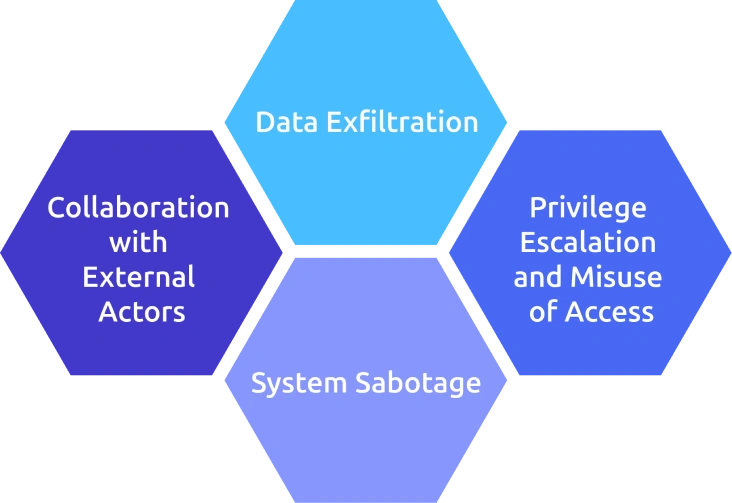
1. Data Exfiltration
One of the most common methods is moving sensitive files to personal cloud accounts, external drives, or USB devices. This allows insiders to quietly remove company data without immediate detection.
2. Privilege Escalation and Misuse of Access
Some insiders try to gain higher access privileges or misuse existing credentials to reach data they are not authorized to access. This may involve using shared admin credentials or requesting unnecessary permissions.
3. System Sabotage
In some cases, insiders intentionally delete files, modify configurations, damage databases, or disrupt systems. Although less common than data theft, these attacks cause serious operational damage.
4. Collaboration with External Actors
Certain insiders work with competitors, cybercriminals, or external attackers by sharing sensitive data or internal access. These cases are often harder to detect because the insider already has legitimate access to company systems.
Understanding these techniques helps you strengthen monitoring, access control, and early threat detection before serious damage occurs.
Real-World Examples of Malicious Insider Attacks
These real-world examples show how serious insider threats can become and the level of damage they can cause. They reveal how trusted individuals can misuse their access in ways that impact not only finances but also a company’s reputation, customer trust, and long-term security.
1. The Senior Engineer Who Walked Away with Sensitive Code
A senior engineer at a tech company secretly uploaded confidential infrastructure files to a personal cloud account before joining a competitor. The activity continued for months before security teams noticed unusual data access patterns that did not match his project role. The case showed how trusted employees can misuse legitimate access without raising immediate suspicion.
2. Tesla Data Leak (2023)
In 2023, two former Tesla employees leaked around 100 GB of confidential company data, exposing sensitive information belonging to over 75,000 employees. The breach also included customer details, internal complaints, and production secrets. The incident highlighted the risks of insider access to large volumes of sensitive data.
3. Medical Supply Company Sabotage (2020)
In March 2020, after being fired, a former employee at a medical supply company illegally accessed internal systems and altered or deleted nearly 120,000 records. The attack disrupted operations during a critical period for hospitals and exposed the dangers of failing to revoke access immediately after termination.
4. Taco Bell Employee Credit Card Theft (2022)
In June 2022, a Taco Bell employee was caught photographing customers’ credit cards at the drive-through and later using the stolen information for personal purchases. The case showed how insider threats can occur even in everyday customer-facing roles.
5. Twitter Insider-Assisted Attack (2020)
In 2020, attackers manipulated Twitter employees through social engineering to gain access to internal admin tools. They then hijacked high-profile accounts to promote a Bitcoin scam. The incident demonstrated how insider access can amplify the impact of external attacks.
These incidents show that even the world’s biggest companies can be severely affected by malicious insiders. A single trusted individual with the wrong intent, or the wrong access, can lead to massive financial, operational, and reputational damage.
How to Prevent Malicious Insider Attacks
Preventing malicious insider attacks requires more than just monitoring employees. You need a balanced approach that strengthens security without creating distrust among the workforce. The following practices can significantly reduce insider risk while maintaining a healthy work environment.
- Only give employees access to the systems and data they need for their roles. Any extra access increases the risk of misuse or data exposure.
- Conduct quarterly access reviews to identify and remove outdated or unnecessary permissions.
- Limit sensitive data access to approved roles and require additional approval for bulk exports or other high-risk actions.
- When an employee resigns or is terminated, immediately review and revoke their access to all critical systems.
- Be transparent about what you are monitoring and why. Clear communication helps maintain trust while strengthening security.
- Do not handle insider threat response in isolation. Involve HR, IT, and security teams together for faster and better decisions.
- Provide employees with a safe, anonymous way to report suspicious activity or security concerns.
- Ensure your offboarding process is immediate and strict, as delays in access removal can increase risk.
- Recognize that financial stress, workplace conflict, or personal issues can increase insider risk, and offer employee support programs where possible.
- Conduct annual reviews and simulated insider threat drills to test how well your systems can detect and respond to real scenarios.
An effective insider threat program is not about treating every employee like a suspect. It’s about finding risks early, reducing unnecessary access, and protecting systems before problems escalate.
Is Your Organization at Risk of an Insider Threat?
Answer the questions below with a simple Yes or No. Give yourself 1 point for every “No.”
If your score is above 3, your organization may have gaps that increase the risk of insider threats.
- Do you have clear access control policies for all sensitive systems?
- Do you regularly review employee access and remove outdated permissions?
- Do HR, Security, and Legal teams follow a defined process when employees leave the company?
- Do you monitor for unusual data downloads or large file transfers?
- Do employees have a safe way to report suspicious behavior without fear of retaliation?
- Do you track unusual user behavior or account activity over time?
- Have you tested your insider threat response plan within the last year?
Most organizations do not score perfectly, but the more “No” you have, the higher the chances that an insider threat could go unnoticed until real damage is done.
How Does Time Champ Help Detect Malicious Insider Activity?
Time Champ is an employee monitoring software with a built-in workforce intelligence layer that helps you detect risky behavior, prevent insider threats, and protect sensitive business data. With employee monitoring, behavior insights, and Data Loss Prevention (DLP) controls working together, you get real-time visibility into suspicious activity before it turns into a serious security incident.
Data Loss Prevention (DLP)
Time Champ’s DLP features help prevent sensitive company information from being leaked, stolen, or misused by insiders.
The platform includes:
- USB Device Control to block or monitor external storage devices
- Website Access Control to restrict unsafe or unauthorized websites
- File Monitoring Logs to track file activity and detect suspicious behavior
- Attachment Control to prevent unauthorized uploads and downloads
- Upload & Download Violation Detection with instant alerts for risky file transfers
- Real-Time Suspicious Activity Alerts for repeated violations or abnormal actions
These alerts are customizable as well, so you can get alerts for any action that you set. These controls help you monitor data movement, reduce unauthorized access, and detect insider threats early.
Employee Monitoring and Behavioral Insights
It provides real-time employee monitoring features that help security and management teams identify unusual behavior patterns.
You can:
- Capture screenshots at customizable intervals
- Record live screens and monitor activity in real time
- Track app and website usage
- Monitor activity timelines and work patterns
- Detect unusual idle behavior or abnormal activity spikes
Custom behavioral alerts can also be configured based on company policies, helping you respond quickly to suspicious actions.
Attrition Risk and Early Warning Signals
Insider risks often increase when employees become disengaged or plan to leave the organization. Time Champ provides attrition risk insights and early warning signals that help you identify employees who may be at higher risk of disengagement or resignation.
This helps you to:
- Take preventive action early
- Reduce unnecessary access during high-risk periods
- Monitor sensitive systems more carefully when warning signs appear
Overall, Time Champ is designed to improve visibility and reduce security blind spots without disrupting normal workflows. Instead of reacting after a breach happens, you can proactively detect risky behavior, monitor sensitive activity, and protect critical business data before damage occurs.
Stop Insider Threats Before Data Leaves Your Organization!
Secure sensitive information with Time Champ’s advanced DLP solution
Conclusion
Malicious insider threats are difficult to detect because they come from trusted individuals with legitimate access to company systems and data. If ignored, they can cause serious financial, operational, and reputational damage. When you identify warning signs early and tighten access controls, reducing insider risk becomes much easier. With proactive monitoring and the right security tools, you can protect sensitive data before serious damage occurs.

Jahnavi Pulluri

Table of Content
 What is a Malicious Insider?
- What are the 5 Archetypes of a Malicious Insider
- What Motivates Malicious Insiders?
- The 7 Phases of a Malicious Insider Attack
- Common Techniques Used by Malicious Insiders
- Real-World Examples of Malicious Insider Attacks
- How to Prevent Malicious Insider Attacks
- Is Your Organization at Risk of an Insider Threat?
- How Does Time Champ Help Detect Malicious Insider Activity?
- Conclusion
Related Blogs
Learn what an Insider Threat Program is and how it helps protect data from internal risks. Get key strategies to safeguard your organization effectively.
Sai Keerthi Uppala | Mar 12, 2025
Discover how to reduce idle time and boost productivity with Time Champ. Learn key differences between idle time and downtime for improved team efficiency.
Tarun Kumar Reddy | Sep 17, 2024
Find the best Insider Threat Detection Tools for 2026. Compare features, pricing, pros & cons to reduce internal risk and secure workforce activity data.
Tarun Kumar | Apr 02, 2026
Your perimeter won't stop insiders. Learn how real-time insider threat monitoring, anomaly detection, SIEM, and response workflows work together to prevent risk.
Jahnavi Pulluri | Apr 14, 2026
Learn how to spot and handle suspicious activity to keep your organization secure. Discover essential tips and strategies for effective response.
Thasleem Shaik | Aug 09, 2024
Discover the risks of internal security threats and how to spot, prevent, and address them to keep your business secure and your data safe.
Thasleem Shaik | Jan 21, 2025


 4.7/5 avg.
Ready to Manage Your Workforce Smarter?
Join our family of 1500+ companies using smart insights to redefine workforces!

Free Trial
No Credit Card Required