What Is Sensitive Data? Types, Regulations, & Best Practices
Sensitive data requires stronger protection. See its types, key regulations, identification methods, and best practices to safeguard critical information.
Sensitive data includes information that could cause financial, legal, or reputational harm if someone accesses, shares, or exposes it without authorization. Do you know exactly which information in your business deserves the highest level of protection?
Many businesses focus on securing customer records but overlook employee files, financial documents, API keys, product designs, and other valuable assets. Without knowing what data is sensitive, protecting it becomes much harder.
This article covers what sensitive data is, its different categories, the regulations that govern it, and the best practices that help reduce security risks before they turn into costly problems.
What Is Sensitive Data?
Sensitive data is any information that requires extra protection because unauthorized access, disclosure, alteration, or misuse could harm business or the individuals connected to it. The harm may include financial loss, identity theft, privacy violations, legal penalties, reputational damage, or the loss of valuable business information.
Sensitive Data vs Personal Data: What’s the Difference?
You'll often hear personal data and sensitive data used as if they mean the same thing, but they don't. Personal data is any information that can identify an individual, such as a name or an email address. Sensitive data covers a broader range of information. It includes certain types of personal data as well as confidential business information, financial records, and login credentials that may not identify an individual.
In other words, not all sensitive data is personal data, and not all personal data qualifies as sensitive data under privacy laws. The table below highlights the key differences.
| Feature | Sensitive Data | Personal Data |
|---|---|---|
| Definition | Sensitive data is information that requires a higher level of protection because unauthorized access or disclosure can cause serious harm. | Personal data is any information that identifies or can identify an individual. |
| Purpose | Requires enhanced security controls due to its higher risk. | Identifies an individual for business, legal, or operational purposes. |
| Scope | Includes sensitive personal information, financial records, health data, login credentials, biometric data, trade secrets, and other confidential business information. | Includes names, email addresses, phone numbers, postal addresses, employee IDs, IP addresses, and other identifying information. |
| Risk if Exposed | Can lead to identity theft, financial fraud, regulatory penalties, intellectual property theft, or significant business losses. | May result in privacy concerns or identity risks, depending on the type of information exposed. |
| Level of Protection | Requires stronger security measures such as encryption, strict access controls, continuous monitoring, and data loss prevention. | Requires appropriate security controls, but not every type of personal data needs the same level of protection as sensitive data. |
| Regulatory Treatment | Many regulations, including GDPR, HIPAA, CCPA, and PCI DSS, impose stricter requirements for protecting specific categories of sensitive data. | Protected under privacy regulations, although the security requirements vary based on the type of personal data collected. |
| Examples | Medical records, credit card details, bank account information, passwords, biometric data, API keys, source code, trade secrets, and tax records. | Full name, email address, phone number, mailing address, customer ID, employee number, or IP address. |
| Business Impact | Exposure can cause financial losses, legal action, reputational damage, compliance violations, and operational disruption. | Exposure may affect individual privacy, but the overall impact often depends on the type of personal data involved. |
Worried about sensitive data leaving your business without anyone noticing?
Use Time Champ to spot risky activities early and help prevent data loss.
What Are the Types of Sensitive Data?
Sensitive data falls into six main categories, and most businesses handle several of them every day. Understanding which category a piece of information belongs to helps you determine the level of protection it needs. Let's look at each type in detail.
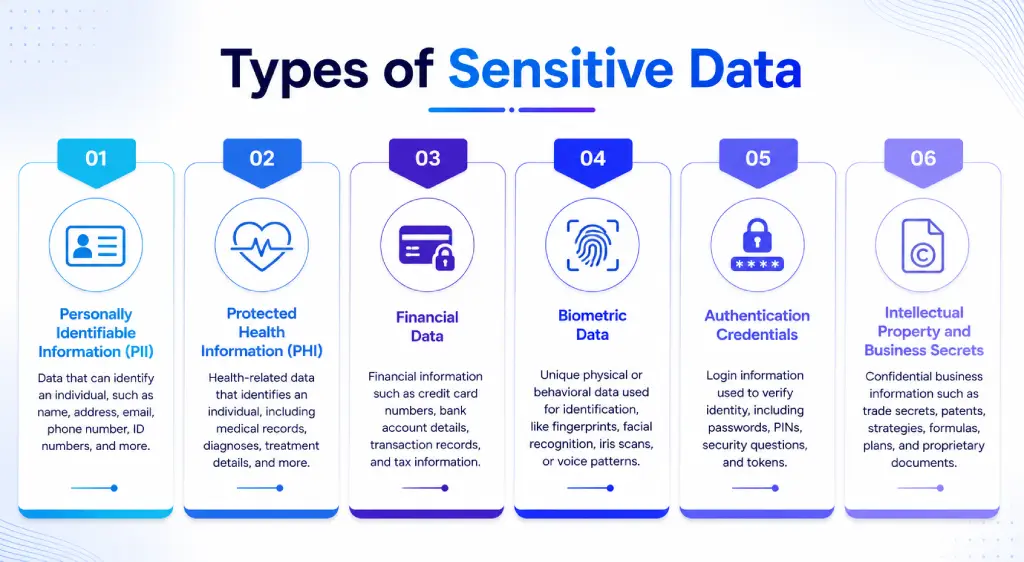
1. Personally Identifiable Information (PII)
PII is any information that can identify a specific individual, either on its own or when combined with other details. This is one of the most common types of sensitive data because it exists in almost every system your business uses.
- Direct identifiers like names, Social Security numbers, passport numbers, and driver's license numbers
- Indirect identifiers like date of birth, ZIP code, gender, and job title
- Contact details like home addresses, phone numbers, and personal email addresses
- Employee IDs and account numbers
A single piece of information may not cause harm on its own. For example, a ZIP code alone does not identify anyone. However, when you combine a ZIP code with a birth date and gender, it can identify a specific individual. That's why you should protect PII as a complete set of information rather than protecting each field separately. For a detailed explanation, check out our guide on What Is PII?
2. Protected Health Information (PHI)
PHI is health-related data, and it's technically a subset of PII, but it gets its own category because HIPAA treats it differently and punishes exposure harder.
- Medical records and treatment history
- Health insurance information and claims
- Diagnosis and prescription records
- Mental health records
- Genetic information and test results
3. Financial Data
Financial data includes any information related to money, financial accounts, or transactions. It is one of the most valuable types of sensitive data because unauthorized access can quickly lead to financial fraud, identity theft, and significant financial losses.
- Bank account numbers and routing information
- Credit card and debit card numbers
- Financial statements and tax records
- Salary and income information
- Investment accounts and portfolios
- Cryptocurrency wallet addresses and keys
You store this in more places than you'd expect. Payroll systems, expense platforms, vendor payment records, and your own revenue forecasts all fall under this category.
4. Biometric Data
Biometric data identifies an individual based on unique physical or behavioral characteristics. Unlike passwords or PINs, you cannot simply replace biometric information after someone gains unauthorized access to it, which makes it one of the most sensitive types of data.
- Fingerprints and palm prints
- Facial recognition data
- Retina and iris scans
- Voice patterns and voiceprints
- DNA samples and genetic profiles
- Behavioral biometrics like typing patterns and gait
If your business uses fingerprint scanners for building access or facial recognition for device logins, you generate biometric data every day. If someone gains unauthorized access to this information, you cannot reset or replace it like a password. That makes protecting biometric data especially important.
5. Authentication Credentials
Authentication credentials control access to your systems, applications, and data. If someone steals a password or an API key, they don't just access one piece of information. They gain access to everything that credential protects.
- Passwords and passphrases
- Security questions and answers
- Multi-factor authentication codes and backup codes
- API keys and access tokens
- Session cookies and tokens
- SSH keys and certificates
Credential theft plays a role in many major data breaches. A single stolen password can give attackers access to your customer database, financial systems, and source code at the same time.
6. Intellectual Property and Business Secrets
Intellectual property and business secrets protect the information that gives your business a competitive advantage. Unlike the other categories, this type of sensitive data focuses on the valuable information your business creates.
- Trade secrets and formulas
- Source code and algorithms
- Product designs and blueprints
- Customer lists and pricing strategies
- Business plans and financial models
- Research data and prototypes
A competitor doesn't need to steal your customers to damage your business. Gaining access to your pricing strategy or product roadmap can provide a significant competitive advantage. For more ways to protect these assets, check out our guide on how to protect intellectual property.
What Data Privacy Regulations Apply to Sensitive Data?
Many privacy laws require you to protect sensitive data and handle it responsibly. The regulations below explain how you should collect, process, store, and secure different types of information.
- The General Data Protection Regulation (GDPR) applies if you process the personal data of individuals in the European Union or the United Kingdom, regardless of where your business operates. It requires you to protect sensitive data, respect individual privacy rights, and report certain data breaches within 72 hours.
- The California Consumer Privacy Act (CCPA) and the California Privacy Rights Act (CPRA) apply if your business serves California residents and meets specific legal requirements. These laws give consumers greater control over their personal information and require you to handle sensitive data responsibly.
- The Health Insurance Portability and Accountability Act (HIPAA) sets the standards for protecting health information in the United States. If you handle protected health information, you must follow HIPAA's security and privacy requirements.
- The Payment Card Industry Data Security Standard (PCI DSS) applies if you accept, process, store, or transmit payment card information. It helps protect cardholder data and reduce payment fraud through a set of security requirements.
- Digital Personal Data Protection Act (DPDP Act, India), it establishes the framework for processing and protecting digital personal data while defining the rights of individuals and the responsibilities of businesses.
International Regulations You Might Also Face
If you operate globally, you're likely juggling more than one law at once:
- PIPEDA (Canada) - Office of the Privacy Commissioner of Canada
- LGPD (Brazil) - Brazil's data protection authority
- POPIA (South Africa) - Information Regulator South Africa
- PDPA (Singapore) - Personal Data Protection Commission Singapore
Not sure where your biggest data loss risks are?
Use Time Champ to see where sensitive information is moving across your business.
How Do You Identify Sensitive Data in Your Business?
Identifying sensitive data is the first step toward protecting it. It helps reduce security risks, meet compliance requirements, and focus your security efforts on the information that matters most.
Follow these four practical steps to identify sensitive data in your business.
Step 1: Identify Where Your Sensitive Data Is Stored
Start by identifying every location where your business stores sensitive data. Check systems such as your CRM, HR software, cloud storage, employee devices, email accounts, and backup drives. Sensitive information can also exist in forgotten files, old spreadsheets, or email attachments. If your business manages large volumes of data, using a data discovery tool can help you locate sensitive information more accurately and efficiently.
Step 2: Classify Your Data Based on Its Sensitivity
After identifying your data, group it based on the level of risk it could create if someone accesses or shares it without authorization.
- Public Information that anyone can access without causing any risk.
- Internal Information meant only for use within your business. Unauthorized access has limited impact.
- Confidential Information that requires strong protection, such as customer records, contracts, or financial data.
- Restricted - Your most sensitive information that could cause serious financial, legal, or reputational damage if exposed.
Classifying your data helps you understand which information needs the highest level of protection and makes it easier to apply the right security measures.
Step 3: Label Your Data Clearly
After classifying your data, label it so your employees and security tools can easily recognize its sensitivity. Use clear labels, headers, or watermarks to show the sensitivity level of each file and guide employees on how to use and share it. You can also add metadata to support automated data classification and protection.
Review your labels regularly to ensure they remain accurate and your DLP system can recognize them correctly. This helps employees handle sensitive data securely, reduces unauthorized access, and prevents unauthorized transfers.
Step 4: Assign Ownership for Each Data Category
Assign an owner to every data category. The owner should decide who can access the data, how long to keep it, and when to delete it. Without clear ownership, data classification often becomes a one-time task instead of an ongoing process.
Review data ownership regularly as employees change roles or responsibilities. Include teams such as HR, Finance, Legal, and IT, since they all manage different types of sensitive data.
Following these four steps helps you identify sensitive data, classify it correctly, and assign clear responsibility for protecting it.
How to Protect Sensitive Data: Best Practices
Knowing where your sensitive data exists is only the first step. You also need the right security measures to prevent unauthorized access, reduce the risk of data breaches, and meet compliance requirements. The following best practices can help you build a stronger sensitive data protection strategy.
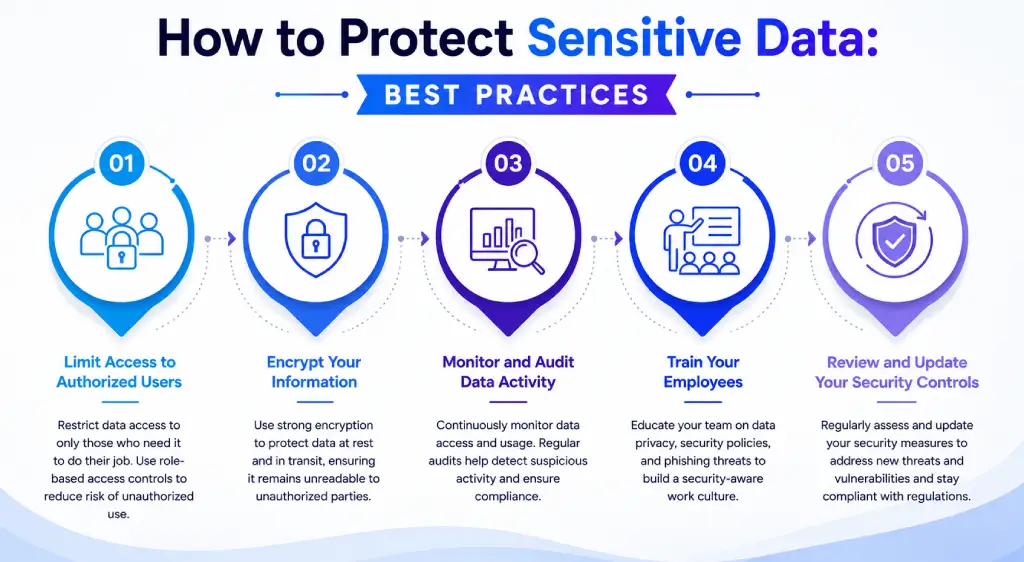
1. Limit Access to Authorized Users
Follow the principle of least privilege by giving employees access only to the information required for their roles. This minimizes the chances of accidental exposure and misuse. Review user permissions regularly, especially when employees change roles, join new teams, or leave the organization. Removing outdated or unnecessary access helps reduce security risks and ensures only authorized users can view or modify critical information.
2. Encrypt Your Information
Encryption converts your information into unreadable code, allowing only authorized users with the correct decryption key to read it. Encrypt your data before you store it and whenever you transfer it across networks. This adds an extra layer of security and helps prevent unauthorized access, even if attackers intercept your data.
3. Monitor and Audit Data Activity
Keep track of who accesses sensitive information, when they access it, and what actions they perform. Continuous monitoring helps you detect unusual behavior early and respond before a security incident grows into a major breach.
4. Train Your Employees
Many data breaches happen because of human mistakes rather than technical failures. Regular security awareness training helps your employees recognize phishing attacks, create stronger passwords, and handle sensitive information responsibly.
5. Review and Update Your Security Controls
Review your security controls regularly to keep them effective against new risks and changing business needs. Update access permissions, security policies, and protection measures whenever you adopt new tools, expand your cloud environment, or handle new types of sensitive data. Regular reviews help you identify security gaps early and keep your sensitive information protected.
Prevent Sensitive Data Exposure with Time Champ
A strong security strategy requires more than policies and employee training. You also need visibility into how information moves across your business and the ability to identify suspicious activity as it happens.
Time Champ helps you monitor important employee activities, detect unusual file movements, and receive alerts when risky actions occur. This allows you to investigate issues quickly and respond before they lead to data loss or compliance problems.
Whether your team works from the office, remotely, or in a hybrid setup, Time Champ helps you protect your business information with greater confidence.
Looking for a smarter way to reduce data loss risks?
Use Time Champ to track file activity and take action before data leaves your business.
Conclusion
Keeping sensitive data secure is an ongoing responsibility. Clear policies, strong security controls, and regular monitoring work together to reduce risks and protect valuable business information. Time Champ gives you detailed insights into file activity and user actions, helping you detect suspicious behavior and strengthen your data protection efforts.

Thasleem Shaik

Table of Content
 What Is Sensitive Data?
- Sensitive Data vs Personal Data: What’s the Difference?
- What Are the Types of Sensitive Data?
- What Data Privacy Regulations Apply to Sensitive Data?
- How Do You Identify Sensitive Data in Your Business?
- How to Protect Sensitive Data: Best Practices
- Prevent Sensitive Data Exposure with Time Champ
- Conclusion
Instant Signup
Thank you for your request!
We have received your signup request and our team will get back to you soon. In the meantime, you can book a demo to see Time Champ in action.
Book a DemoFree trial. No credit card required. Prefer a walkthrough? Book a demo.
Related Blogs
Protect your sensitive data with Time Champ's Data Loss Protection. Detect, prevent, and respond to potential data leaks in real-time, keeping your business secure and compliant!
Shabana Shaik | Jan 23, 2025
Explore why employee data theft happens and how smart, proactive steps can help protect your organization.
Jahnavi Pulluri | July 01, 2025
Data encryption in employee monitoring is non-negotiable. Learn the standards, certifications, and six questions to ask before signing with any vendor.
Sai Keerthi Uppala | May 07, 2026
Learn how AI-powered workplace productivity monitoring affects employee data privacy, compliance, transparency, accountability, and trust in organizations.
Jahnavi Pulluri | May 11, 2026
Protect your business from data leaks! Learn effective data exfiltration prevention practices to secure sensitive information and stop cyber threats.
Sai Keerthi Uppala | Mar 12, 2025
Learn how remote employee tracking and DLP work together to prevent data leaks, secure remote teams, and support privacy, compliance, and safer workflows.
Anjali | May 09, 2026


 4.7/5 avg.
Ready to Manage Your Workforce Smarter?
Join our family of 1500+ companies using smart insights to redefine workforces!

Free Trial
No Credit Card Required