How to Protect Intellectual Property & Trade Secrets
Learn how to protect intellectual property and trade secrets with practical strategies and best practices to keep your business assets secure.

Copying homework might have worked in school, but it can be a costly problem in business. Imagine spending months building a product, designing a logo, or creating software, only to see someone else copy it. Without the right protection, your ideas and confidential information are at risk.
That's why protecting your intellectual property and trade secrets matters. In this guide, you'll learn how to protect your valuable business assets, secure confidential information, and reduce the risk of theft or misuse.
What Is Intellectual Property, and Why Does It Need Protection?
Intellectual property (IP) refers to the ideas and creations you develop, such as inventions, software, brand names, logos, designs, written content, music, and other original work. Unlike physical assets, intellectual property is intangible, but it can be one of your business's most valuable assets.
Without proper protection, others can copy, use, or profit from your work without your permission. This can result in financial losses, damage to your brand, and even legal disputes. Protecting your intellectual property gives you legal rights over your creations, helping you control how they're used while preserving your competitive advantage.
Whether you're an entrepreneur, startup founder, creator, or business owner, safeguarding your intellectual property helps you:
- Prevent unauthorized use or copying of your work.
- Protect your brand reputation and business identity.
- Maintain your competitive advantage.
- Generate revenue through licensing or commercialization.
- Reduce the risk of legal disputes and intellectual property theft.

Did You Know?
According to the World Intellectual Property Organization (WIPO), innovators filed approximately 3.7 million patent applications worldwide in 2024, highlighting the growing importance of protecting new ideas and inventions in an increasingly competitive global economy.
Common Types of Intellectual Property
Different types of intellectual property require different protection methods. Depending on what you've created, you may need a patent, trademark, copyright, or trade secret protection. Understanding these four types helps you choose the right legal protection for your ideas, products, and business assets.
Type 1. Patents
Patents protect new inventions, processes, machines, and product designs. They give you exclusive rights to make, use, or sell your invention, preventing others from using it without your permission.
To obtain a patent, you must apply through the appropriate patent office, such as the USPTO in the United States. Utility patents generally last 20 years, while design patents typically last 15 years.
Type 2. Trademarks
Trademarks protect the elements that identify your brand, including business names, logos, slogans, symbols, and product names. They help customers recognize your business and prevent competitors from using confusingly similar branding.
Although trademark rights can exist through use, registering your trademark provides stronger legal protection. A registered trademark lasts 10 years and can be renewed indefinitely as long as it remains in use.
Type 3. Copyrights
Copyrights protect original creative works such as books, articles, music, artwork, photographs, videos, software code, and marketing content. In many countries, copyright protection begins automatically when the work is created, although registration offers additional legal benefits.
In most cases, copyright lasts for the author's lifetime plus 70 years, while works created for businesses may have different protection periods.
Type 4. Trade Secrets
Trade secrets protect confidential business information that gives your company a competitive advantage. This can include formulas, manufacturing processes, customer lists, pricing strategies, source code, business methods, and internal workflows.
Unlike patents or trademarks, trade secrets don't require registration. Their protection depends on keeping the information confidential through measures such as non-disclosure agreements (NDAs), access controls, and internal security policies. As long as the information remains secret, the protection can last indefinitely.
Did You Know?
The OECD notes that intellectual property rights help businesses protect innovation, compete more effectively, attract investors, generate revenue through licensing, and access new markets.
IP Protection Types at a Glance
The table below highlights the four main types of IP, what they cover, whether registration is required, how long they last, and common examples to help you quickly identify the best protection for your business assets.
| IP Type | What It Protects | Registration | Protection Duration | Example |
|---|---|---|---|---|
| Patents | New inventions, processes, machines, and product designs | Required through the patent office (e.g., USPTO) | 20 years (utility patents) or 15 years (design patents) | New medical device, manufacturing process, product formula |
| Trademarks | Brand names, logos, slogans, symbols, and product names | Optional, but registration provides stronger legal protection | 10 years, renewable indefinitely | Company name, logo, brand slogan |
| Copyrights | Original creative works, including books, software, music, artwork, videos, and marketing content | Automatic upon creation (registration recommended for stronger enforcement) | Author's life + 70 years (varies for corporate works) | Software code, blog articles, training videos |
| Trade Secrets | Confidential business information that provides a competitive advantage | No registration required | As long as the information remains confidential | Customer lists, pricing strategies, formulas, source code |
8 Proven Strategies to Protect Intellectual Property
Protecting your intellectual property requires more than just legal registration. You also need clear policies, employee awareness, and technical safeguards to reduce the risk of theft, misuse, or unauthorized access. Here are eight proven strategies to help you build a strong IP protection program.
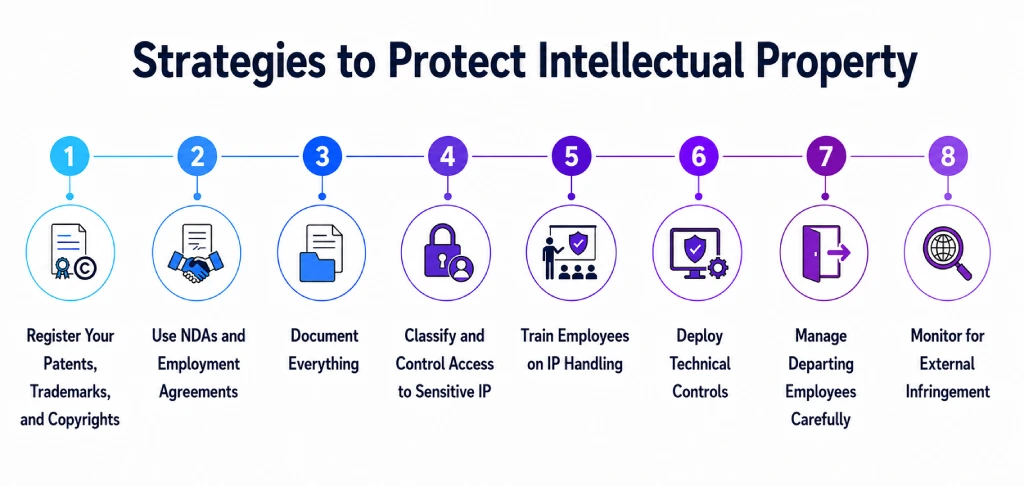
Strategy 1: Register Your Patents, Trademarks, and Copyrights
Registering your intellectual property gives you stronger legal rights and makes it easier to enforce ownership if disputes arise.
- File patents for inventions and product designs through the appropriate patent office (such as the USPTO).
- Register trademarks to protect your brand names, logos, and slogans.
- Register copyrights for creative works to strengthen legal protection.
- Work with an IP attorney to identify what should be registered and when.
- File for international protection if you operate in multiple countries.
Did You Know?
WIPO publishes intellectual property data from around 150 national and regional IP offices, demonstrating the global importance of patents, trademarks, industrial designs, and copyrights in supporting innovation and economic growth.
Strategy 2: Use NDAs and Employment Agreements
Legal agreements help protect confidential information before it's shared with employees, contractors, vendors, or business partners.
- Require employees, contractors, and partners to sign Non-Disclosure Agreements (NDAs).
- Include intellectual property assignment clauses in employment agreements.
- Add non-compete clauses where legally permitted.
- Update agreements when employees change roles or gain access to sensitive information.
- Have legal professionals review agreements regularly.
Strategy 3: Document Everything
Maintaining accurate records helps prove ownership and supports your claims if intellectual property disputes occur.
- Record invention dates, contributors, and development milestones.
- Maintain version histories for software, documents, and product designs.
- Track who accesses trade secrets and when.
- Keep detailed documentation as evidence of ownership.
- Store time-stamped digital records securely.
Strategy 4: Classify and Control Access to Sensitive IP
Not every employee needs access to every business asset. Limiting access reduces the risk of accidental or intentional exposure.
- Classify intellectual property based on sensitivity.
- Apply least-privilege access controls.
- Use role-based permissions to manage access.
- Review user access regularly.
- Restrict highly confidential information to authorized personnel only.
Strategy 5: Train Employees on IP Handling
Employees play a critical role in protecting intellectual property. Regular training helps them recognize sensitive information and handle it responsibly.
- Educate employees on what qualifies as intellectual property.
- Conduct regular IP awareness training.
- Provide guidelines for handling emails, cloud storage, and AI tools.
- Reinforce training during onboarding, promotions, and offboarding.
- Encourage employees to report potential security risks.
Strategy 6: Deploy Technical Controls
Technology adds another layer of protection by preventing unauthorized access and data leaks.
- Use Data Loss Prevention (DLP) solutions to prevent sensitive data from leaving your organization.
- Monitor systems where intellectual property is accessed.
- Set alerts for suspicious activities like bulk downloads or external transfers.
- Encrypt sensitive data both in storage and during transmission.
- Regularly review security logs for unusual behavior.
Strategy 7: Manage Departing Employees Carefully
Employee departures are one of the highest-risk periods for intellectual property theft. A structured offboarding process helps minimize that risk.
- Monitor unusual file activity during notice periods.
- Remove system access immediately after employment ends.
- Recover company devices and accounts.
- Conduct exit interviews with confidentiality reminders.
- Confirm all confidential information has been returned or deleted.
Strategy 8: Monitor for External Infringement
Protecting intellectual property doesn't stop after registration. Regular monitoring helps you identify misuse before it becomes a larger problem.
- Monitor competitors for similar trademarks or branding.
- Track patent filings within your industry.
- Watch for unauthorized use of trade secrets or copyrighted content.
- Respond quickly to potential infringement.
- Work with an intellectual property attorney when enforcement is required.
Ready to put these strategies into action?
Time Champ helps you monitor sensitive file activity, prevent data leaks, and reduce insider risks with real-time visibility.
Why Are Insider Threats the Biggest Risk to Your Intellectual Property?
When people think about intellectual property theft, they often picture hackers or competitors. However, many IP breaches originate from within an organization. Employees, contractors, and business partners already have access to sensitive information, making insider threats one of the biggest risks to your intellectual property.
Who Is Most Likely to Steal Intellectual Property?
Not every insider poses a threat, but certain situations increase the risk of IP theft. Understanding these high-risk groups helps you strengthen your security measures before problems arise.
- Employees who are leaving the company and moving to a competitor may take confidential information with them.
- Employees who are unhappy with the company may misuse confidential information.
- Careless employees who unintentionally expose confidential information.
- Employees using company intellectual property for personal projects or side businesses.
How Does Insider IP Theft Happen?
Intellectual property theft doesn't always happen through complex cyberattacks. In many cases, it happens through everyday actions that seem harmless but can expose sensitive business information.
- Uploading confidential files to personal cloud storage.
- Sending business documents to personal email accounts.
- Copying files to USB drives or external storage devices.
- Taking screenshots or photos of confidential information.
- Sharing sensitive data with AI tools such as ChatGPT or Claude.
- Printing confidential documents before leaving the company.
Early Warning Signs of Intellectual Property Theft
Spotting unusual behavior early gives you a better chance to prevent data loss before it becomes a serious issue. Watch for these common indicators:
- Sudden increases in file downloads or cloud sync activity.
- Accessing confidential files unrelated to current responsibilities.
- Unusual after-hours system activity.
- Requests for broader access rights shortly before resignation.
- Frequent use of USB drives or other external storage devices.
Protect Intellectual Property in Remote and Hybrid Work
Remote and hybrid work have made collaboration easier, but they've also created new ways for intellectual property to be exposed. Here are the key steps you can take to protect your intellectual property in a distributed work environment.
Set Clear Remote Work Policies
Create clear policies that explain how employees should handle intellectual property outside the office. Set clear rules for remote access. Specify which information employees can access outside the office and how they should handle confidential data while working remotely.
Secure Remote Access
Protect remote connections by requiring VPN access and multi-factor authentication (MFA) for systems containing intellectual property. Limiting downloads and offline access to sensitive files also helps reduce the risk of unauthorized use.
Monitor Remote Activity
Monitor how sensitive files are accessed, downloaded, and shared on company devices. Alerts for unusual activities, such as bulk downloads or transfers to personal accounts, can help you detect potential threats early.
Manage AI-Related Risks
Generative AI tools can improve productivity, but they also increase the risk of exposing confidential information. Set clear guidelines for using AI tools, restrict sharing sensitive data with public AI platforms, and educate employees on responsible AI usage.
Protect your intellectual property beyond the office walls.
Time Champ helps you detect insider risks and protect intellectual property across remote and hybrid teams.
Common Mistakes to Avoid While Protecting Intellectual Property
Avoiding these common mistakes can significantly reduce the risk of intellectual property theft and strengthen your overall protection strategy.
- Delaying IP registration for patents, trademarks, or copyrights.
- Assuming trade secrets are automatically protected without security measures.
- Skipping Non-Disclosure Agreements (NDAs) with employees, contractors, or business partners.
- Giving employees unrestricted access to sensitive intellectual property.
- Failing to train employees on handling confidential information.
- Ignoring remote work and AI-related risks, such as sharing sensitive data through public AI tools.
- Using weak passwords or skipping multi-factor authentication (MFA) for systems containing intellectual property.
- Not monitoring file access or unusual employee activity, making it harder to detect potential threats.
- Overlooking regular security reviews and failing to update access permissions as roles change.
- Waiting too long to act when you discover intellectual property infringement or unauthorized use.
How Does Time Champ Help You Protect Intellectual Property?
Protecting intellectual property requires more than legal agreements. You also need visibility into how sensitive information is accessed, shared, and used. Time Champ gives you that visibility.
Time Champ is an employee monitoring and Data Loss Prevention platform that helps you monitor file activity, prevent data leaks, and reduce insider risks with real-time visibility and security controls.
Key Features of Time Champ DLP Module
- Monitor File Activity: Track file access, downloads, uploads, and modifications to identify suspicious activity before it leads to data loss.
- Control Website and Application Access: Restrict access to unauthorized websites and applications that could expose confidential business information.
- Prevent Unauthorized Data Transfers: Block USB devices and external storage to reduce the risk of employees copying or transferring sensitive files.
- Receive Real-Time Security Alerts: Get instant notifications for unusual activities such as bulk downloads, unauthorized file transfers, or policy violations.
- Track Employee Activity: Monitor employee activity to detect unusual behavior that may indicate insider threats or misuse of intellectual property.
- Protect Remote and Hybrid Teams: Maintain visibility into how confidential information is accessed and shared, regardless of where employees work.
- Generate Audit-Ready Reports: Access detailed activity logs and reports to support compliance, internal investigations, and security audits.
With Time Champ, you can proactively protect your intellectual property, minimize insider threats, and keep your valuable business assets secure.
Ready to strengthen your intellectual property protection?
Try Time Champ to gain real-time visibility into employee activity, prevent data leaks, and protect your valuable business information.
Conclusion
Protecting intellectual property is an ongoing effort. The right combination of people, processes, and technology can help you stay ahead of threats before they lead to costly data loss.
Time Champ helps you take the next step with employee monitoring and Data Loss Prevention (DLP) features that give you real-time visibility, detect insider risks, and help you protect intellectual property.
Legal Disclaimer: This guide provides general business information about intellectual property protection. It is not legal advice. IP law varies significantly by jurisdiction, industry, and specific business circumstances. For legal matters involving IP registration, disputes, or enforcement, consult a qualified intellectual property attorney in your jurisdiction.

Guna Lakshmi

Table of Content
 What Is Intellectual Property, and Why Does It Need Protection?
- Common Types of Intellectual Property
- 8 Proven Strategies to Protect Intellectual Property
- Why Are Insider Threats the Biggest Risk to Your Intellectual Property?
- Protect Intellectual Property in Remote and Hybrid Work
- Common Mistakes to Avoid While Protecting Intellectual Property
- How Does Time Champ Help You Protect Intellectual Property?
- Conclusion
Instant Signup
Thank you for your request!
We have received your signup request and our team will get back to you soon. In the meantime, you can book a demo to see Time Champ in action.
Book a DemoFree trial. No credit card required. Prefer a walkthrough? Book a demo.
Related Blogs
Learn what Email Data Loss Prevention (DLP) is, how it works, key features, benefits, and best practices to protect email data from leaks.
Guna Lakshmi | Aug 19, 2026
Learn how to ensure data privacy in productivity tracking with key controls, vendor evaluation, and setup steps that reduce risk and protect employee data.
Guna Lakshmi | May 02, 2026
Discover what a threat actor is and how they target your business. Learn simple and effective strategies to protect your company from cyber threats.
Sai Keerthi Uppala | Jan 22, 2025
Protect sensitive business data in hybrid work environments with strong security controls and practical strategies to prevent data breaches.
Guna Lakshmi | Jun 10, 2026
Stay ahead of cyber threats with our expert guide on endpoint security protection. Explore essential tips and tools to protect your devices, data, and network.
Shabana Shaik | Jan 23, 2025
A data breach is unauthorized access to private data. Learn the common causes, the real impact on people and companies, and what to do in the first 72 hours.
Shabana Shaik | Jul 31, 2026


 4.7/5 avg.
Ready to Manage Your Workforce Smarter?
Join our family of 1500+ companies using smart insights to redefine workforces!

Free Trial
No Credit Card Required