What Is Personally Identifiable Information (PII)? Meaning & Types
PII plays a critical role in data privacy. Get a clear breakdown of PII types, legal requirements, common examples, and effective protection methods.
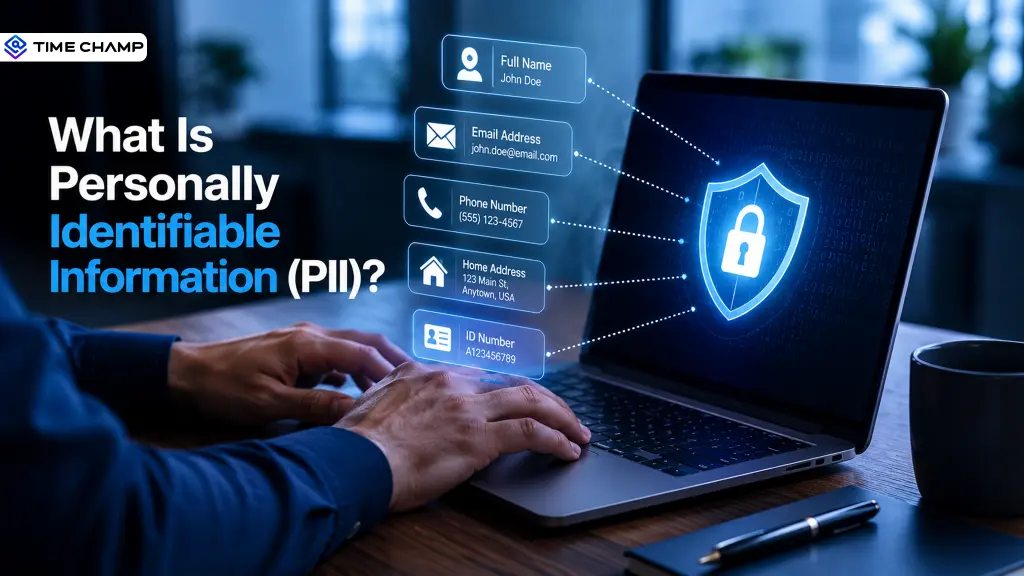
Personally Identifiable Information (PII) refers to any information that can identify an individual, either on its own or when combined with other data. It includes details such as names, email addresses, phone numbers, government-issued IDs, financial information, and biometric data.
If you are unsure what PII stands for, what is considered personally identifiable information, or which information qualifies as PII, this guide provides clear answers. You'll learn the different types of PII, common PII examples, and why understanding them matters for your business.
What Is Personally Identifiable Information (PII)?
Personally Identifiable Information (PII) is any information that can identify a specific individual, either on its own or when combined with other data. If a piece of information can directly identify someone or make them identifiable when linked with additional details, it qualifies as PII. The PII definition may vary slightly across privacy laws, but the core concept remains the same.
There isn't a fixed list that determines what is considered PII. The easiest way to identify Personally Identifiable Information (PII) is to ask one question. Can this information identify a specific individual on its own or when combined with other data? If the answer is yes, it qualifies as PII.
Here are some common PII examples that most businesses collect or process every day.
| Directly Identifies an Individual | Can Identify When Combined with Other Information |
|---|---|
| Full name | Date of birth |
| Email address | ZIP code or postcode |
| Phone number | IP address |
| Passport number | Device identifier |
| Driver's license number | GPS location |
| Social Security number | Browser cookies |
| Bank account details | Employment details |
| Credit card information | Purchase history |
| Biometric data | Demographic information |
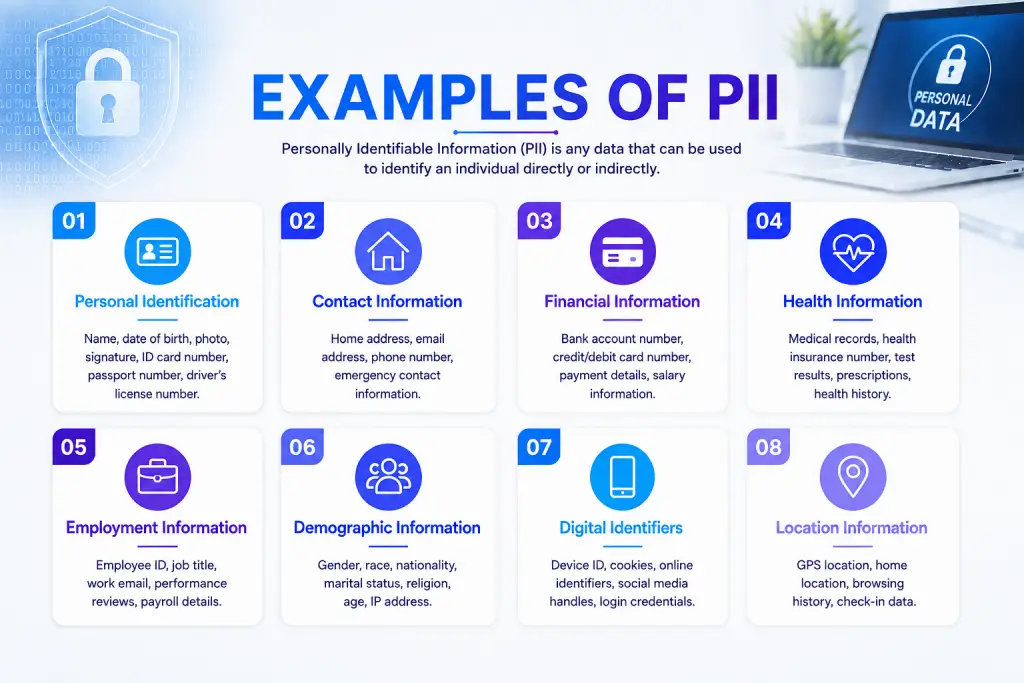
It is also important to remember that PII data is not limited to obvious personal details. As technology evolves, digital information such as device identifiers, online activity, location history, and behavioral data can also qualify as personal identifying information when combined with other information that reveals someone's identity.
Not sure where your sensitive information is being accessed or shared?
Use Time Champ to see who is accessing, moving, and sharing files that contain personal data.
Sensitive Vs Non-Sensitive PII
Not all Personally Identifiable Information (PII) carries the same level of risk. Some information can lead to identity theft, financial fraud, or serious privacy issues if exposed, while other information poses a lower risk on its own. Understanding the difference helps you classify PII data correctly and apply the right level of protection.
The table below compares Sensitive PII and Non-Sensitive PII to help you understand how they differ.
| Feature | Sensitive PII | Non-Sensitive PII |
|---|---|---|
| What it means | Data that puts someone at serious risk if exposed | Data that carries lower risk if exposed, on its own |
| Examples | SSN, passport number, financial account numbers, medical records, biometric data, criminal history, sexual orientation, religious beliefs | Full name in a public directory, business email, business phone number, job title, general work location, social media handle |
| Protection level you need | Encryption, strict access limits, active monitoring | Basic safeguards, access logging |
| Breach notification | Often mandatory under GDPR, HIPAA, and state laws | Rarely mandatory on its own |
| Regulatory attention | High, this is where regulators focus enforcement | Lower, unless combined with other data |
| Risk when combined | Already high risk standalone | Can become sensitive fast when paired with other PII |
| Where you'll usually find it | HR files, payment systems, medical records | CRM entries, business directories, public profiles |
The distinction between these two categories is not always fixed. For example, a name or business email address may seem harmless on its own. However, when combined with financial details, government-issued identification, or authentication credentials, the same information becomes far more sensitive.
Instead of looking at a single piece of data in isolation, consider how it connects with other information you collect or store. That approach helps you identify PII more accurately and reduces the risk of handling sensitive data incorrectly.

Did You Know
Latanya Sweeney's landmark study at Carnegie Mellon found that ZIP code, gender, and date of birth together could uniquely identify 87% of the US population using 1990 census data. A 2006 replication using 2000 census data put the figure at 63%. Either way, three pieces of data most people would call harmless are enough to single out most of a country.
Direct Vs Indirect Identifiers
Direct and indirect identifiers serve different purposes, but both can reveal an individual's identity. Understanding how they work helps you recognize which information identifies someone immediately and which information becomes identifying only when combined with other data.
The table below highlights the key differences between direct and indirect identifiers and explains how each contributes to identifying an individual.
| Feature | Direct Identifiers | Indirect Identifiers |
|---|---|---|
| Identifies someone alone | Yes, on its own | No, only in combination |
| Also known as | Key identifiers | Quasi-identifiers |
| Risk level | High, immediate exposure | Lower alone, high once combined |
| Common examples | SSN, passport number, biometric records | ZIP code, date of birth, job title |
| Protection level needed | Strongest controls (encryption, restricted access) | Moderate alone, strict once combined with other data |
| Consequence if exposed | Identity theft, fraud, impersonation | Re-identification, profiling, privacy violation |
| Where you typically find it | Government IDs, financial records, HR systems | Demographic fields, CRM entries, browsing logs |
| How you should handle it | Isolate and encrypt at the highest tier | Track combinations, not just individual fields |
The difference becomes clearer with a simple example. A passport number or Social Security number identifies an individual immediately, making it a direct identifier. In contrast, a ZIP code or date of birth may not identify someone on its own, but when combined with a name or address, it acts as an indirect identifier that can identify a specific individual.
PII Regulations and Privacy Laws You Should Know
Privacy laws for PII compliance vary from one country to another. The regulations that apply to your business depend on your location, your industry, and the type of personal information you collect or process. Here are some of the most important regulations you should know.
1. GDPR (General Data Protection Regulation)
- Applies to any business that collects or processes the personal data of individuals living in the European Union, even if your business is not located in Europe.
- Defines personal data more broadly than PII, covering any information that relates to an identified or identifiable individual.
- Requires you to have a legal basis for collecting personal data, respond to access and deletion requests, and report eligible data breaches within 72 hours.
- Imposes some of the highest privacy fines in the world. Violations can result in penalties of up to €20 million or 4% of your annual global turnover.
2. CCPA and CPRA (California Consumer Privacy Act and California Privacy Rights Act)
- Gives California residents the right to know what personal information you collect, ask you to delete it, and stop you from selling their personal information.
- Applies to you if you do business in California and meet certain revenue or data collection limits.
- Enforced by the California Privacy Protection Agency (CPPA), which has fined businesses millions of dollars for not giving consumers a proper way to opt out of the sale of their personal information.
3. HIPAA (Health Insurance Portability and Accountability Act)
- Applies if you are a healthcare provider, health insurer, or a business that handles health information on their behalf.
- Protects Protected Health Information (PHI), including medical records, treatment history, and health insurance information.
- Requires you to use strong security measures, such as access controls and encryption, and report data breaches involving health information when required.
4. PIPEDA (Personal Information Protection and Electronic Documents Act)
- Canada's federal privacy law that explains how private-sector businesses can collect, use, and share personal information.
- Requires you to obtain meaningful consent, clearly explain why you are collecting personal information, and use security measures that match the sensitivity of the data.
If you collect PII from customers or employees across multiple states or countries, you may need to follow more than one privacy law. A good approach is to follow the strictest regulation that applies to your business and then meet any additional requirements of other applicable laws.
How Does Time Champ Help You Protect PII?
Protecting PII starts with understanding how sensitive information moves across your business every day. You need clear visibility into who accesses, transfers, and uses that information to reduce risks and support compliance.
Reliable data loss prevention (DLP) software gives you better visibility into sensitive data activity and helps reduce the risk of data exposure. Time Champ builds on that visibility by helping you monitor important file activity, identify suspicious behavior, and maintain detailed records that support your privacy and compliance efforts.
Whether you want to reduce unnecessary data exposure or improve accountability across your business, Time Champ provides the visibility you need to make informed decisions.
Is your sensitive information more exposed than you think?
Try Time Champ to see who is accessing and sharing personal data and reduce the risk of data loss.
Conclusion
Understanding Personally Identifiable Information (PII) helps you recognize which data needs extra care and why it matters. Once you know what qualifies as PII, its different types, and the privacy laws that apply, you can make better decisions when handling sensitive information. Time Champ helps you monitor file activity, detect unusual behavior, and maintain detailed activity records, making it easier to protect sensitive information and support your privacy and compliance efforts.

Thasleem Shaik

Table of Content
 What Is Personally Identifiable Information (PII)?
- Sensitive Vs Non-Sensitive PII
- Direct Vs Indirect Identifiers
- PII Regulations and Privacy Laws You Should Know
- How Does Time Champ Help You Protect PII?
- Conclusion
Instant Signup
Thank you for your request!
We have received your signup request and our team will get back to you soon. In the meantime, you can book a demo to see Time Champ in action.
Book a DemoFree trial. No credit card required. Prefer a walkthrough? Book a demo.
Related Blogs
A data breach is unauthorized access to private data. Learn the common causes, the real impact on people and companies, and what to do in the first 72 hours.
Shabana Shaik | Jul 31, 2026
Protect sensitive business data in hybrid work environments with strong security controls and practical strategies to prevent data breaches.
Guna Lakshmi | Jun 10, 2026
Learn how to ensure data privacy in productivity tracking with key controls, vendor evaluation, and setup steps that reduce risk and protect employee data.
Guna Lakshmi | May 02, 2026
Get a complete overview of data protection acts in India, including the DPDP Act, key features, compliance requirements, penalties, and business impact.
Thasleem Shaik | August 3, 2026
Explore the different types of data loss and learn how they can impact your information. Understand the risks and protect your data effectively.
Thasleem Shaik | Jan 17, 2025
Discover the top 10 Data Loss Prevention tools to safeguard sensitive information and ensure workplace security with essential features and practical tips for selection.
Tarun Kumar Reddy | Jan 21, 2025


 4.7/5 avg.
Ready to Manage Your Workforce Smarter?
Join our family of 1500+ companies using smart insights to redefine workforces!

Free Trial
No Credit Card Required