Data Protection Acts in India: Complete Guide to the DPDP Act
Get a complete overview of data protection acts in India, including the DPDP Act, key features, compliance requirements, penalties, and business impact.

Data protection in India is no longer just a legal topic you can keep in the background. With the Digital Personal Data Protection Act, your business now needs a clear way to collect, use, store, and protect digital personal data with consent, transparency, and accountability. Whether you handle customer details, employee records, vendor information, or user data through digital tools, this law directly shapes how you manage that data every day.
This guide gives you a simple and practical understanding of the DPDP Act, why it matters for your company, what changed in India’s data protection framework, and what steps you need to take to stay compliant. By the end, you will know the key rules, rights, duties, penalties, and secure data practices that can help your business build trust while reducing compliance risks.
What Is the Data Protection Act in India?
The Digital Personal Data Protection (DPDP) Act, 2023, is India's primary data protection law. It sets clear rules for how you can collect, use, store, share, and delete digital personal data. The act also gives individuals greater control over their personal information while allowing you to process data for lawful purposes.
The DPDPA introduces a consent-first approach. Before you collect or process personal data, you must clearly explain why you need it and obtain valid consent unless the law allows for another legal basis. The act also requires you to protect personal data with appropriate security measures, respond to data breaches, and respect individual rights such as accessing, correcting, or deleting personal information.
- Protects Customer Trust: Customers expect you to keep their personal information safe. When you follow the DPDP Act, you show that you value privacy and handle data responsibly. This builds confidence and strengthens long-term relationships.
- Helps You Meet Legal Requirements: The act defines clear rules for collecting and processing personal data. Following these requirements helps you reduce legal risks and avoid compliance issues as your business grows.
- Reduces the Risk of Financial Penalties: Data breaches, weak security measures, or failure to meet legal obligations can result in significant penalties. Strong compliance practices help you lower these risks and protect your business from unnecessary costs.
- Improves Data Security: The act encourages you to apply appropriate safeguards to protect personal data from unauthorized access, misuse, or loss. Better security also helps you respond more effectively to evolving cyber threats.
Reduce workplace security gaps before they become serious problems.
Choose Time Champ for better data protection controls.
Evolution of Data Protection Laws in India
India did not build its data protection framework overnight. The country moved through more than two decades of legislation, court rulings, and draft bills before it landed on the law that governs your data today. The timeline below shows how data protection and privacy laws in India evolved over time and shaped the current framework.
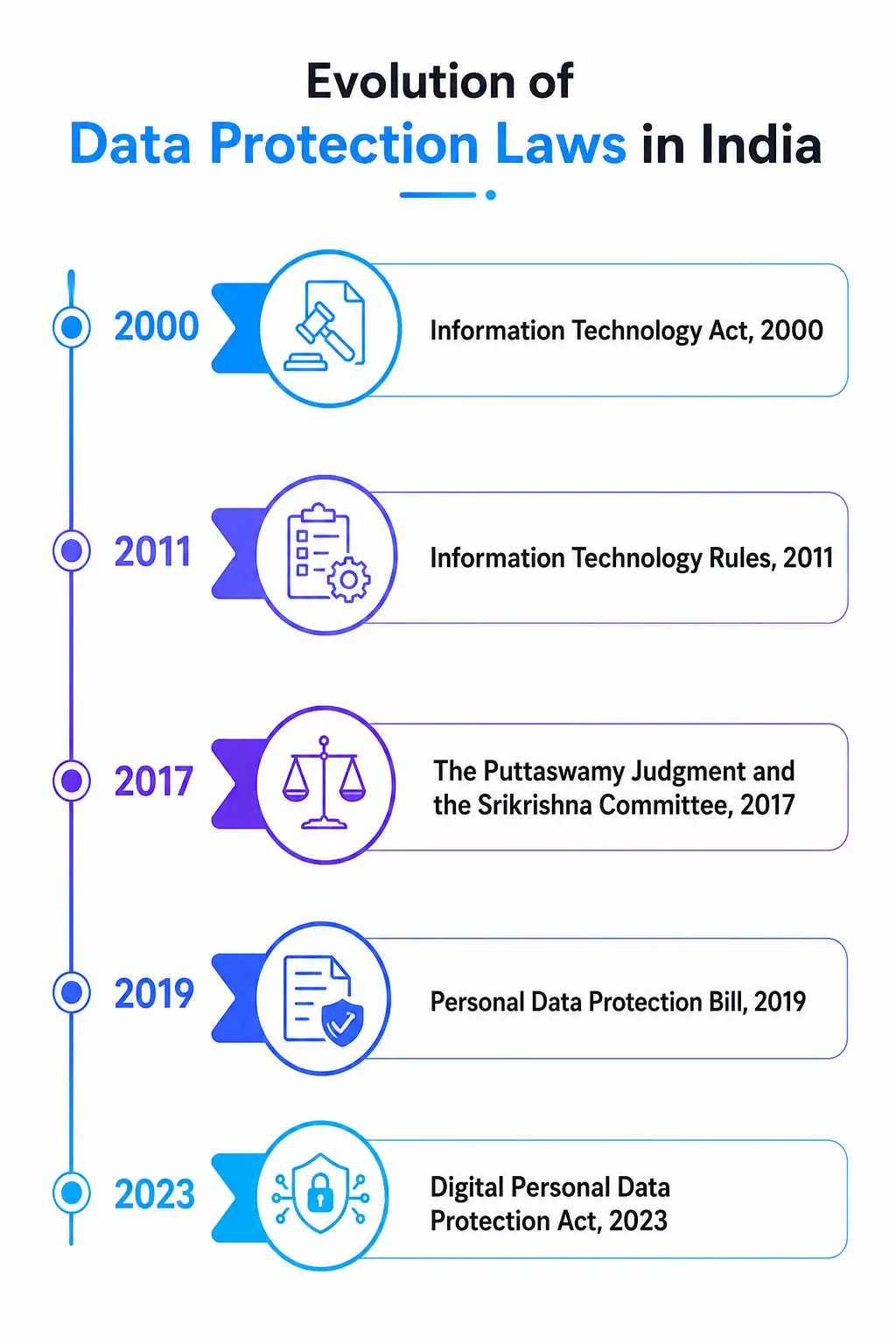
1. Information Technology Act, 2000
The Information Technology Act, 2000, started as India's law for digital signatures, e-commerce, and cybercrime. It did not say much about personal data protection because it was written when India had fewer than 20 million internet users and privacy was not a main concern.
The government added Section 43A through a 2008 amendment, and it came into force on 27 October 2009. This section said that a company must pay compensation if careless handling of sensitive personal data causes loss to someone. Section 43A and Section 72A of the IT Act came into force on 27 October 2009. However, this rule applied only to companies, so government agencies were not covered.
2. Information Technology Rules, 2011
In 2011, the government issued the Information Technology (Reasonable Security Practices and Procedures and Sensitive Personal Data or Information) Rules, known as the SPDI Rules. The SPDI Rules came into force on 11 April 2011. These rules clearly defined sensitive personal data as passwords, financial details, health records, sexual orientation, and biometric data. They required you to maintain a privacy policy, take consent before collecting this data, and follow reasonable security practices. For more than a decade, this was the closest thing India had to a real data protection act
3. The Puttaswamy Judgment and the Srikrishna Committee, 2017
The Supreme Court case Justice K.S. Puttaswamy vs. Union of India brought the issue of privacy in India directly before the courts. While the case was still pending, the government decided to act in advance. In July 2017, the Ministry of Electronics and Information Technology formed a committee led by retired Supreme Court judge Justice B.N. Srikrishna and asked it to create a modern privacy law in India that addressed digital personal data.
A few weeks later, on 24 August 2017, a nine-judge bench gave its judgment and declared privacy a fundamental right under the Constitution. This decision gave strong constitutional support to the work of the Srikrishna Committee and made data protection an urgent priority instead of just a precaution.
The committee then spent the next year studying the issue and submitted its report in July 2018, along with a draft Personal Data Protection Bill. This draft became the foundation for all later versions, including the DPDP Act that we follow today.
4. Personal Data Protection Bill, 2019
The government introduced the Personal Data Protection Bill, 2019, to establish a dedicated legal framework for protecting personal data. The Bill proposed rights for individuals, obligations for businesses, and the creation of a Data Protection Authority. After a detailed parliamentary review, the government withdrew the Bill in 2022 to prepare a revised framework. This Bill marked India's first major step toward a comprehensive personal data protection act.
5. Digital Personal Data Protection Act, 2023
In August 2023, Parliament passed the Digital Personal Data Protection Act, commonly known as the DPDP Act. This law provides a dedicated framework for collecting, processing, storing, and protecting digital personal data in India. It also defines the rights of individuals, establishes the responsibilities of businesses, and introduces financial penalties for non-compliance, making it India's first comprehensive data privacy law.
If you're interested in how similar regulations work in another region, you can also explore our guide on employee monitoring privacy laws in the USA.
Penalties Under the DPDP Act
The Digital Personal Data Protection Act includes strict financial penalties to encourage responsible data handling. The amount depends on the type of violation, its impact, and the steps you take to reduce the consequences. The points below explain the major penalties you should know and the factors that influence them.
- Failure to Protect Personal Data: If you fail to implement reasonable security safeguards and a personal data breach occurs, the DPDP Act allows a penalty of up to ₹250 crore.
- Failure to Report a Personal Data Breach: When a personal data breach occurs, you must notify the Data Protection Board of India and the affected individuals as required under the Act. Failure to provide this notification can attract a penalty of up to ₹200 crore.
- Failure to Meet Obligations as a Significant Data Fiduciary: Businesses classified as Significant Data Fiduciaries must comply with additional requirements, such as conducting periodic audits and meeting extra governance obligations. Failure to comply can result in penalties of up to ₹150 crore.
How the Data Protection Board Decides the Penalty
The Data Protection Board of India does not automatically impose the maximum penalty. Before deciding the amount, it considers several factors, including:
- The seriousness and duration of the violation.
- The type and sensitivity of the personal data involved.
- Whether the same violation occurred repeatedly.
- Any financial benefit gained from the non-compliance.
- The steps you took to reduce the impact of the incident.
- Whether the penalty remains fair, proportionate, and effective.
These factors help the Board determine a penalty that matches the severity of each case instead of applying the same amount to every violation.
How Time Champ Supports Secure Data Management Under the DPDP Act
Time Champ is an employee monitoring and productivity tracking software that helps you monitor work activities, improve visibility, and strengthen data security across your workforce. Along with productivity insights, it includes data loss prevention and security features that help you monitor sensitive data, reduce security risks, and maintain better control over business information. While compliance depends on your internal policies and processes, these capabilities can support your DPDP Act compliance efforts. Here are some of the ways Time Champ helps you manage data more securely.
- Monitor File Access and Activity: File activity logs help you track when files are created, modified, deleted, or accessed. This visibility makes it easier to review data handling practices, investigate incidents, and maintain accountability across your business.
- Prevent Unauthorized Data Transfers: USB blocking, upload and download controls, and website restrictions help you reduce the risk of unauthorized data transfers. These controls protect sensitive business information from accidental or intentional data leaks.
- Receive Instant Security Alerts: Real-time alerts notify you when suspicious activities or policy violations occur. Early detection allows you to respond quickly before a small issue turns into a larger security incident.
- Maintain Detailed Audit Records: Activity logs, file access records, website usage, and security reports provide a clear audit trail. These records support internal reviews, security investigations, and compliance documentation whenever you need them.
- Control Access with Role-Based Permissions: Role-based access controls help you limit access to sensitive information based on job responsibilities. Restricting unnecessary access reduces security risks and supports stronger data governance.
Keep sensitive data safe across every workday activity.
Use Time Champ for stronger security and compliance.
Conclusion
Following data protection acts in India helps you protect personal data, strengthen customer trust, and reduce compliance risks as privacy regulations continue to evolve. Building clear data handling practices today also prepares your business for future requirements under the DPDP Act.
If you want better visibility into work activities while protecting sensitive business information, Time Champ provides employee monitoring, productivity tracking, and data loss prevention features that support secure data management and stronger compliance efforts. The DPDP Act establishes a comprehensive framework for responsible data handling while balancing privacy rights with lawful data processing.

Thasleem Shaik

Table of Content
 What Is the Data Protection Act in India?
- Evolution of Data Protection Laws in India
- Penalties Under the DPDP Act
- How Time Champ Supports Secure Data Management Under the DPDP Act
- Conclusion
Related Blogs

Curious about how much people earn across industries? Get the latest insights on the average salary in India by role, sector, and experience level.
Thasleem Shaik | June 30, 2025
"Discover the top 10 offshore companies in India and explore the myriad benefits of outsourcing, from cost savings to access to a skilled workforce. Time Champ
Mounika Sai | Nov 29, 2023
Looking for top job portals in India for 2025? Discover the best platforms to find jobs and boost your career in today’s competitive market.
Jahnavi Pulluri | July 24, 2025
Explore the best employee monitoring software in India like Time Champ, Hubstaff, and ActivTrak. Compare pricing, features, and choose the best in 2026.
Sai Keerthi Uppala | Jun 02, 2026
Learn about employee monitoring laws, what they mean for businesses, and how they protect employee privacy and rights.
Shabana Shaik | Jul 10, 2024
Stay informed on employee GPS tracking laws and policies, including state regulations, device compliance rules, and how to create a legal tracking policy.
Thasleem Shaik | October 09, 2025


 4.7/5 avg.
Ready to Manage Your Workforce Smarter?
Join our family of 1500+ companies using smart insights to redefine workforces!

Free Trial
No Credit Card Required