Employee Attrition Prediction: How It Works, Signals, and Risks
Employee attrition prediction uses workforce patterns to flag potential turnover and guide retention efforts. See how it works, key signals, and limitations.
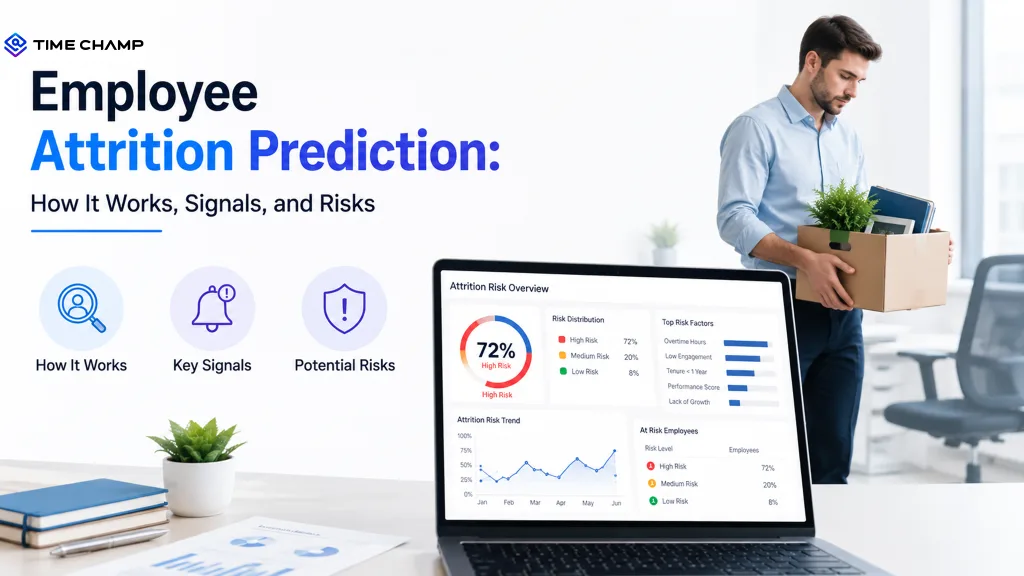
An employee does not suddenly become a flight risk on the day they resign. The pattern can start much earlier, hidden inside changes that look ordinary when viewed one at a time.
Employee attrition prediction connects those changes and estimates the likelihood of turnover. The value is not in predicting the future with certainty. It is in giving you an earlier signal that something may need attention.
In this guide, we will explore how this approach works and how you can use it to identify and reduce attrition risk more effectively.
What is Employee Attrition Prediction?
Employee attrition prediction is the process of using workforce data, work patterns, and other relevant signals to estimate how likely an employee is to leave. Instead of looking only at past turnover, you can use predictive analytics to identify patterns that may point to future attrition risk.
Attrition Prediction Vs Turnover Reporting
A turnover report tells you what has already happened. Employee attrition prediction looks ahead by using existing data to estimate where turnover risk may emerge. This makes prediction a leading indicator, while a turnover report remains a lagging measure.
Why Is Employee Attrition Prediction Important?
Waiting for a resignation means you are already dealing with the outcome. Employee attrition prediction gives you an earlier view of potential turnover by bringing together signals that may otherwise go unnoticed. That extra time can help you investigate what is changing, address concerns, and make more informed retention decisions.
Here are the key reasons why attrition prediction matters for your workforce:
- Reduce Preventable Turnover: Gallup found that 42% of employees who voluntarily left said their departure could have been prevented. Early risk signals give you an opportunity to act before concerns turn into an exit.
- Lower Turnover Costs: Replacing an employee can involve significant hiring, onboarding, and productivity costs. Identifying risk early helps you direct retention efforts toward employees who are most at risk of leaving, making your interventions more targeted and effective.
- Spot Early Warning Signs: Changes in workload, attendance, engagement, or work activity can appear before an employee resigns. Prediction helps you connect these changes instead of viewing them separately.
- Plan for Workforce Changes: Early visibility into potential turnover can help you prepare for staffing gaps, workload shifts, and knowledge loss before they disrupt your plans.
- Address Concerns Early: A risk score can prompt you to look more closely at workload, career growth, recognition, or other factors that may affect retention.
Do you know when everyday work patterns start pointing to turnover risk?
Use Time Champ to uncover early changes in workload, activity, and productivity that may signal attrition risk.
How Do You Predict Employee Attrition?
How to predict employee attrition starts with a simple idea. You look at historical workforce data to identify patterns that often appear before someone leaves, then use those patterns to estimate the likelihood of future attrition. The process combines workforce information, relevant signals, and a predictive model to produce an attrition risk score.
Here is how the process typically works.
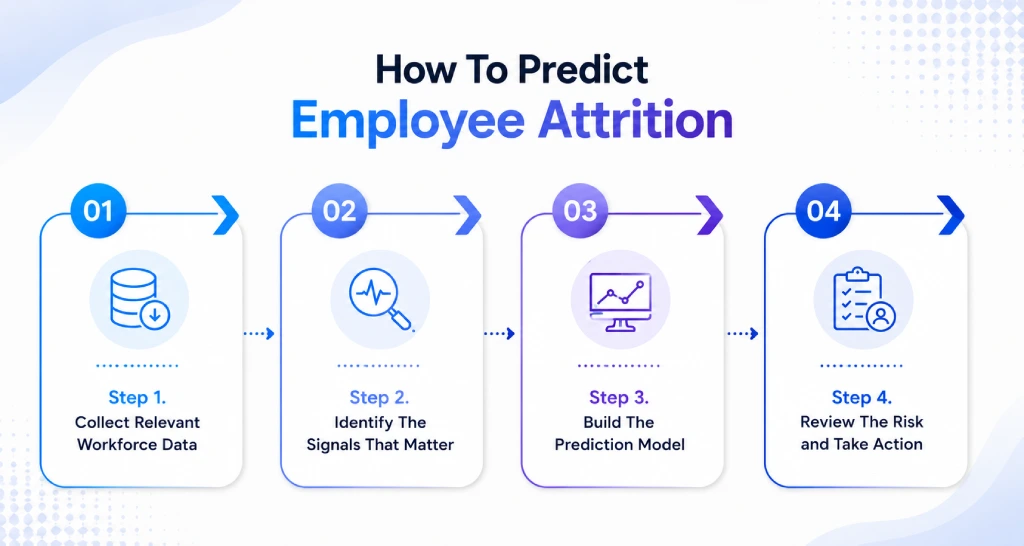
Step 1. Collect Relevant Workforce Data
Everything starts with what you already have. First, pull basic HRIS data such as tenure, pay history, performance ratings, and promotion timelines. If you run engagement or pulse surveys, include those responses as well. Then add behavioral and activity data like login patterns, after-hours work, idle time, and task completion rates.
This last category is often more important than most guides suggest. HRIS data shows who an employee is on paper, while activity data shows how they are actually performing day to day. In many cases, these activity signals change weeks before survey scores do.
Step 2. Identify The Signals That Matter
Not every data point helps predict attrition. You need to identify the patterns that show a meaningful relationship with turnover.
These can include rising overtime, changes in attendance, declining productivity, reduced engagement, workload shifts, or limited career progression. Commonly used factors include tenure, pay, job satisfaction, workload, and overtime, as they often influence attrition decisions.
This stage helps you decide which inputs should contribute to the employee attrition prediction model.
Step 3. Build The Prediction Model
Next, use the selected signals to build a model that can estimate attrition risk. Common approaches include logistic regression, decision trees, random forests, and other ensemble methods.
You do not need to treat the model as a black box. At a practical level, it compares current workforce patterns with patterns from historical cases and estimates how closely they match known attrition outcomes.
The result can appear as a probability, risk score, or flight-risk category.
Step 4. Review The Risk and Take Action
A prediction becomes useful only when you know what to do with it. A higher risk score does not mean someone will definitely leave. It indicates that the available data shows a pattern that should be reviewed.
You can then look at the factors behind the score, check whether the pattern reflects a genuine concern, and decide what support or follow-up makes sense. This keeps predicting employee attrition focused on early action rather than treating a prediction as a final judgment.
What Signals Indicate Attrition Risk?
Attrition does not come from a single change. It becomes more noticeable when shifts in work patterns, workload, attendance, engagement, or career progress start to appear together. Attrition risk signals help you identify these patterns early.
Here are the key attrition risk signals to watch across your workforce.
| Signal Category | What To Watch |
|---|---|
| Behavioral and Engagement | Declining productivity, reduced participation, lower focus, disengagement, changes in activity patterns, and increased after-hours work |
| Attendance and Workload | Rising absenteeism, sustained overtime, workload imbalance, overutilization, and changes in regular attendance patterns |
| HR and Career | Tenure milestones, limited career growth, promotion gaps, compensation concerns, and recurring negative feedback |
The important part is the pattern, not a single change. A short-term drop in activity or one period of overtime does not indicate that someone will leave. When several signals change consistently, you have a stronger reason to look closer and understand what may be driving the risk.

Did You Know
Close to one-third of new hires leave within their first 12 months, according to Work Institute. This shows why early visibility into attrition risk can help you take timely action before a new hire decides to leave.
How To Act on Attrition Predictions
Here are practical ways to turn attrition insights into action.
1. Look at What Is Driving the Risk
Start with the factors behind the prediction instead of focusing only on the risk level. A rise in overtime may point to workload pressure, while a long gap in career progression may need a different response. Understanding these factors helps you choose a more relevant action.
2. Start Career Conversations
A lack of growth can influence retention. If the data shows a connection between attrition risk and limited progression, discuss career goals, skill development, future responsibilities, or possible growth opportunities.
3. Reset the 1:1 Rhythm
A flight risk flag often appears after several missed or rushed check-ins. Bring the cadence back to weekly or biweekly and use this time to listen properly, not just go through status updates. Keeping the meetings consistent helps rebuild the trust that can weaken during busy periods.
4. Recognize the Contribution, Not Just the Risk
It is easy to treat a risk score as a negative signal. Try to balance it by also recognizing the employee’s strengths and contributions. Before discussing any concerns, acknowledge the specific work they are doing well. Employees are more likely to stay when you notice and appreciate their effort, not only when you review or manage their performance.
What if you could spot attrition risk before the resignation arrives?
Try Time Champ to track workforce patterns and uncover early signs of turnover risk.
Limitations and Ethics of Attrition Prediction
Employee attrition prediction can give you useful early signals, but it cannot tell you with certainty who will leave. The quality of your data, the way you build the model, and how you use its results all influence how reliable the predictions are in practice.
Here are the key limitations and ethical considerations to keep in mind.
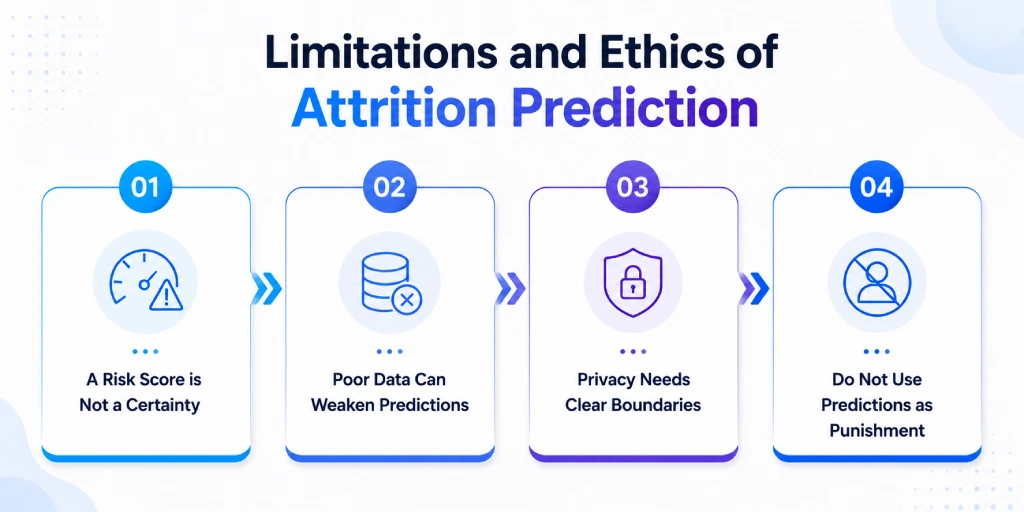
1. A Risk Score is Not a Certainty
A high attrition score does not mean an employee will resign. The model estimates likelihood from patterns in historical data, so you need to treat the result as a signal that needs further review rather than a final judgment.
2. Poor Data Can Weaken Predictions
Incomplete, outdated, or inconsistent data can produce unreliable results. If your historical data does not reflect current work patterns or contains gaps and errors, the model may identify the wrong patterns and produce misleading risk scores.
3. Privacy Needs Clear Boundaries
Attrition prediction can involve sensitive workforce data, including activity and behavioral information. You need to collect only relevant data, protect it properly, explain how you use it, and respect applicable privacy requirements. The Organization for Economic Co-operation and Development (OECD) identifies workplace data collection and worker privacy as major concerns around AI-supported workforce systems.
4. Do Not Use Predictions as Punishment
An attrition score should never become a reason to penalize someone, reduce opportunities, or make an automatic employment decision. Use it to start a conversation and investigate possible concerns. Keep human judgment in the process and give employees a fair opportunity to provide context that the data may not capture.
How Does Time Champ Predict Attrition Risk?
Predicting attrition becomes more useful when you can see changes in day-to-day work, not just past HR records. Time Champ brings behavioral and activity signals together to identify patterns that may point to rising attrition risk. This includes changes in app usage, idle time, activity intensity, workload, and productivity over time.
Time Champ uses these patterns to create a unified attrition risk index that gives you a consolidated view of potential turnover risk. It also looks for early signs of burnout, such as sustained overwork combined with declining productivity, along with overutilization or underutilization that may indicate a work-life balance concern.
The goal is to help you notice changes early before they are easily missed. Instead of waiting for a resignation or relying only on periodic surveys, you can use Time Champ’s attrition prediction software to identify early signs of disengagement and understand what may be driving the risk. This gives you more time to address workload concerns, have meaningful conversations, and take timely steps to improve retention.
Turnover can start with small changes that are easy to miss.
Try Time Champ to spot those changes early and identify potential attrition risk.
Conclusion
Employee attrition prediction gives you an earlier view of turnover risk, helping you spot meaningful changes and respond before they lead to an exit. The goal is not to predict every resignation, but to give you enough insight to take thoughtful action at the right time.
With Time Champ, you can identify early signs of attrition risk by tracking workforce and activity patterns. It helps you notice changes in work behavior and engagement over time. This gives you a clearer view of potential concerns before they turn into actual turnover.

Thasleem Shaik

Table of Content
 What is Employee Attrition Prediction?
- Why Is Employee Attrition Prediction Important?
- How Do You Predict Employee Attrition?
- What Signals Indicate Attrition Risk?
- How To Act on Attrition Predictions
- Limitations and Ethics of Attrition Prediction
- How Does Time Champ Predict Attrition Risk?
- Conclusion
Related Blogs

Attrition rate refers to the percentage or numerical representation of employees who leave a company over a specified period
Vijaya Lakshmi | Feb 13, 2024
Learn what workforce engagement management (wem) is, why it matters in contact centres, components, benefits, and how to choose the right software.
Shabana Shaik | October 01, 2025
Need to accept a resignation professionally? Get 10+ resignation acceptance letter/email templates, expert tips, and formatting examples to respond correctly.
Chetana Choudary | July 24, 2025
Understand what employee performance tracking is, along with proven methods, metrics that matter, and the best tools to track performance fairly in 2026.
Shabana Shaik | Jul 15, 2026
Learn why workforce analytics is essential for process reinvention, how it reinvents key business processes, best practices & how to measure success.
Anjali | Apr 02, 2026
Learn what workflow automation is, why it’s important, its types, examples, benefits, challenges, and how it differs from business process automation.
Anjali | Apr 08, 2026


 4.7/5 avg.
Ready to Manage Your Workforce Smarter?
Join our family of 1500+ companies using smart insights to redefine workforces!

Free Trial
No Credit Card Required