Employee Performance Tracking: Methods and Best Software
Understand what employee performance tracking is, along with proven methods, metrics that matter, and the best tools to track performance fairly in 2026.
There are a dozen working methods nowadays, yes, I understand the “Gen Z Impact”, but how do you efficiently track your employee performance through every working model?
You sit in a performance review meeting and end up rewarding the green dot instead of the productive one, obviously, that’s going to discourage a lot of people and their sincere efforts too.
Gut feeling is great, but when you use it for performance tracking, that’s the gravest mistake one could ever commit, because the gut does not always know whose hard work resulted in prompt project delivery, it only sees activity as work.
I’ll tell you how to track employee performance: yes, it’s simple, efficient and accurate. I’ll also explain which metrics actually matter, so you don’t end up tracking everything and anything. Let’s get straight to it.
What is Employee Performance Tracking?
Employee performance tracking is the ongoing process of measuring how well people do their jobs, using goals, output, quality, and behavior data. It replaces once-a-year guesswork with a steady, fair picture of who is thriving, who needs support, and how the whole team is really doing against its targets.
In simple terms, tracking employee performance means gathering real information instead of relying on memory or vibes. That can come from goals and check-ins, from task and output data, or from software that captures activity automatically. The point is not to catch people out. It is to give both managers and employees a clear, shared view of how work is actually going.
Traditional Performance Monitoring Methods
Long before performance monitoring tools came to light, businesses used traditional tracking and monitoring methods to evaluate employee performance.
Let’s take a look at some of the traditional performance monitoring methods.
1. The Annual Performance Review
Think of this as the big year-end recap with each person on your team. Once a year, you sit down with an employee and look back at everything from the last twelve months.
- You walk through what they did well and where there is room to grow.
- You give honest feedback on their strengths and the blind spots they might not see.
- Together, you set clear goals for the year ahead.
The only problem with an annual performance review is that it is a long time to wait, and by review season, you are most likely to forget what happened back in March. That is why this works best when you back it up with the smaller, more frequent conversations coming up next.
2. Regular Check-Ins
This is how you catch a steady rhythm of everything as a manager. Instead of saving everything for one big meeting, you talk with each team member often, maybe weekly, every two weeks, or once a month.
- You give quick feedback on recent work while it is still fresh.
- You spot roadblocks early, before they turn into missed deadlines.
- You keep setting goals for what is coming next.
The personal touch here is momentum, a few regular chats keep your whole team aligned and take a lot of the pressure off that once-a-year review.
3. Informal Feedback Sessions
You can also do an informal feedback session, in fact, some of your best coaching happens in those moments (right after a task or project wrap-ups).
- It is casual and can happen anytime.
- You point out what worked on a specific piece of work.
- You offer quick, practical tips so they can sharpen things next time.
Because it is low-key, this kind of feedback lands as a nudge rather than a verdict, which makes people far more open to it.
4. Continuous Feedback (the mindset, not the meeting)
The first three are formats, this one’s more of a habit, and it is what ties them all together. Continuous feedback simply means the feedback never goes quiet (More like a loop that’s always happening).
- Your people get consistent input on how they are doing, not just once in a while.
- You catch areas to improve early and adjust goals as priorities shift.
- Performance becomes something you track over time, not something you judge in a single sitting.
This is where good performance tracking earns its bread. When you have a clear, ongoing view of how work is actually going, feedback steps away from being guesswork, and growth turns into something that happens all year instead of a yearly festival.
5. One-on-One Meetings
Last but definitely not least, the one-on-one. This is a private conversation between you and a team member, and one-on-ones are honestly one of the most valuable tools you have as a manager.
- It covers their performance, your feedback, their goals, and any challenges they are facing.
- Because it is private, people find it easier to be open and honest with you.
- Over time, it builds trust, clears up expectations, and keeps your team genuinely engaged.
A good one-on-one is not just a status update. It is a space where your employee feels heard, and that does more for performance than most managers expect.
Fun Fact
Gallup found that only 29 percent of employees strongly agree that their performance is managed in a way that motivates them, and only about 14 percent say their reviews inspire them to actually improve.
Why Employee Performance Monitoring Software is Better than Traditional Methods
Gallup’s study is a testament to the fact that employees were unsatisfied with the traditional performance appraisals.
Because A manager's gut feeling,
A spreadsheet someone updated when they remembered,
And one big review at the end of the year, where everyone tried to recall what happened back in March.
All of this kind of worked, but it leaned heavily on memory, mood, and guesswork.
Employee monitoring software changes this inaccuracy and drama around perfect appraisals, so you get a clear picture that is built on actual work rather than impressions. Let me tell you the best part, it is the fairest way you can track performance because the data shuts every no.
Here’s what this kind of software actually tracks:
- Task Completion: Shows how much work gets finished in a certain period, and whether it gets done on time and meets the given brief.
- Time Tracking: Tracks where hours really go across tasks and projects, so you can spot where time leaks and where people are overburdened.
- Attendance and Punctuality: Gives you a clean record of who is working and when, so you can identify schedule issues early before they quietly build up.
- Productivity Levels: Shows you the work completed that is measured against time spent, which gently surfaces both your quiet high performers and the people who might need a little support.
- Goal Progress: Surfaces how close someone is to the targets you set together, so goals stay visible instead of always being forgotten.
- Quality of Work: Lets you measure output against agreed standards, not just volume.
- Behavior and Engagement: Provides real signals like meeting participation, collaboration with teammates, and sticking to company policies.
- Support for Reviews: Gives real data to ground your feedback and one-on-ones, so performance conversations start from facts instead of vibes.
So why does this beat the old way? Let me list out a few reasons quickly:
- Spot issues now in the present, while you can still help.
- Data does not play favorites, so workload and recognition calls are fairer.
- Full visibility across the office or across time zones, and with 74% of US employers now using online tracking tools, it is the standard, not the exception.
- Less manual tracking, fewer spreadsheets, cleaner records for compliance.
These benefits make it an invaluable tool for managing and enhancing employee performance in modern workplaces.
How to Track Employee Performance?
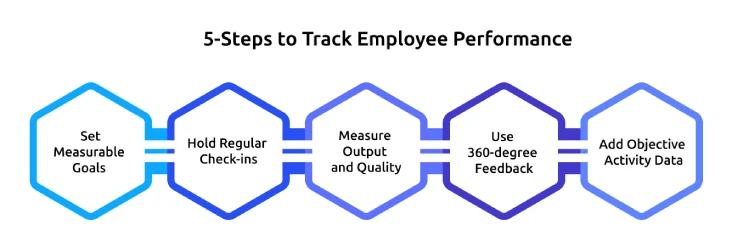
Here’s a simple 5-step ritual for you to track employee performance, right off the bat:
You do not need all of these at once. Pick the mix that fits your team the best:
1. Set Clear, Measurable Goals:SMART goals or an MBO approach gives everyone a target to track against. Involve people in setting them, that is where real engagement comes from.
2. Hold Regular Check-ins: Short, frequent conversations beat one dreaded annual review. They catch problems early and keep feedback timely.
3. Measure Output and Quality: Track tasks completed, deadlines met, and the standard of the work, not just how busy someone looks on the surface.
4. Use 360-degree Feedback: Take input from peers and reports so you round out your manager’s view and reduce blind spots.
5. Add Objective Activity Data: Usesoftware to capture time, tasks, and patterns automatically, giving you facts to pair with the human side.
Want to know more about performance monitoring?
Which Metrics Matter, and Which Mislead You?
The metrics that matter measure outcomes and value: goals hit, quality, and impact. The ones that mislead measure activity: hours logged, keystrokes, or time online. Being busy is not the god mode productivity, so tracking activity as if it is the real performance only appreciates show-off behavior, and discourages the best and most efficient people.
This is the part almost every guide gets wrong. They hand you a giant list of metrics without warning that some of them actively lie to you. Here is the honest split, let’s see it in three layers:
| Layer | What it Measures | Use it or Lose it? |
|---|---|---|
| Inputs (activity) | Hours logged, keystrokes, time online | Weak alone (busy is not productive) |
| Outputs (what got done) | Tasks done, deadlines met, volume | Useful, but only half the story |
| Outcomes (the value it created) | Quality, goals hit, impact, value | This is what actually matters |
Your fastest employee who finishes in six hours looks "worse" than the one who stretches the same work to ten, if you only count time online.
So, use activity data for context but never as the verdict. If you want to go through a fuller breakdown of the right numbers, read our guide on employee performance metrics.
One Question to Ask Before You Track Anything
For every metric you plan to track, ask: "Does this measure value, or just motion?" If it only measures motion, keep it as background context, not as a scorecard. That single filter will save you from rewarding the wrong people.
Track what actually matters, not just what is easy to count
Time Champ turns activity into real performance insight, goals, quality, and outcomes in one clear view.
What are the Best Employee Performance Tracking Tools?
The best employee performance tracking tools combine time and activity tracking, goal and task management, and clear reporting in one place. Look for accuracy, ease of use, and insight you can act on, not just raw logs. The right tool fits your team size, budget, and how much you value context over surveillance.
There are plenty of employee performance tracking tools out there, and honestly, most cover the basics. The real difference is whether a tool gives you insight or just data.
Here I have listed a few tools, what it is best for, along with their G2 ratings.
| Software | Best For | G2 Rating |
|---|---|---|
| Time Champ | All-in-one tracking plus workforce intelligence | 4.8 / 5 |
| Insightful | Productivity classification | 4.7 / 5 |
| Time Doctor | Time tracking for distributed teams | 4.4 / 5 |
| ActivTrak | Activity analytics | 4.4 / 5 |
| Hubstaff | Remote workforce management | 4.5 / 5 |
Here’s why Time Champ takes the first position:
- It’s an employee monitoring software that also presents employee performance with valuable insights.
- It captures attendance, time, tasks, and app usage automatically,
- Sorts activity into productive, neutral, and unproductive,
- And it turns into reports you can act on,
- It also handles goals and recognition, so you can spot your top performers and support the ones who are struggling, all from one place.
Most employee monitoring software stops at activity logs, Time Champ adds the workforce intelligence layer that answers the question raw logs cannot: not just what people did, but how the team is really performing.
How to Track Performance Without Killing Trust?
Tips to not kill trust in this whole process, because we want everything to be fair and transparent.
Since employee tracking can feel like surveillance, how you introduce it decides everything:
1. Be Transparent from Day One: Tell people what you track and why, because secret monitoring is the fastest way to lose the room.
2. Measure Outcomes, Not Motion: Judge results and quality, so efficient people are rewarded, not penalized for finishing early.
3. Share the Data Both Ways: Let employees see their own numbers. It turns tracking into a tool that helps them, not a spy.
4. Act on it Kindly: Use the insight to coach, recognize, and rebalance workloads, not just to catch mistakes.
Implement employee performance tracking ethically with Time Champ!
Transparent tracking that wins employee trust
Wrap Up
Finally, employee performance tracking is not about constantly watching people and their actions. It is about exchanging mere guesswork with a fair, clear view of how work is really going, so the right people get recognized, and the struggling ones get help early.
Set clear goals, measure outcomes over activity, blend human check-ins with objective data, and be open about the whole thing. Do that, and the next surprise-filled review becomes a very calm, honest conversation backed by facts. I mean that’s definitely a win for everyone in the room.

Shabana Shaik

Table of Content
 What is Employee Performance Tracking?
- Traditional Performance Monitoring Methods
- Why Employee Performance Monitoring Software is Better than Traditional Methods
- How to Track Employee Performance?
- Which Metrics Matter, and Which Mislead You?
- What are the Best Employee Performance Tracking Tools?
- How to Track Performance Without Killing Trust?
- Wrap Up
Related Blogs
Elevate your team's performance with productivity intelligence. Explore how data-driven insights can boost productivity and drive success.
Mounika Sai | Feb 24, 2025
Invest in employees to supercharge performance! Learn strategies for boosting productivity and loyalty to optimize your workforce.
Shabana Shaik | Mar 27, 2025
Boost team productivity and performance with effective tracking methods. Enhance productivity through data-driven insights and actionable strategies.
Shabana Shaik | Mar 17, 2025
Want to improve employee performance and retention? A strong performance appraisal system can make all the difference. See how to get it right!
Shabana Shaik | Feb 25, 2025
Find the 10 best performance management software for 2026. Compare features, pricing, pros & cons to boost employee performance.
Tarun Kumar Reddy | Apr 02, 2026
Align business goals with employee performance using productivity tracking. Close the visibility gap and keep strategy in sync with daily work.
Thasleem Shaik | May 11, 2026


 4.7/5 avg.
Ready to Manage Your Workforce Smarter?
Join our family of 1500+ companies using smart insights to redefine workforces!

Free Trial
No Credit Card Required