How to Align Business Goals with Employee Performance
Align business goals with employee performance using productivity tracking. Close the visibility gap and keep strategy in sync with daily work.

Many businesses set ambitious targets at the start of the year, but daily work slowly moves in a different direction. Your teams stay busy, tasks keep moving, and reports look active, yet the actual business strategy execution never fully connects to everyday performance. This gap usually appears when you cannot clearly see whether employee effort supports the goals your business wants to achieve. Without clear visibility, goal alignment turns into assumptions instead of measurable progress.
In this guide, you will learn how to align business goals with employee performance through a clear top-down approach that connects company strategy, team priorities, and individual work. You will also see how productivity tracking helps you monitor daily execution and identify misaligned work patterns early. It improves employee performance tracking through real work data and continuous visibility.
Why Do Most Companies Fail to Align Goals with Employee Performance?
Setting goals at the top feels easy. Keeping your teams focused on those goals through their daily work is the real challenge. In most cases, the problem is not the goal itself. The problem starts when there is a gap between the business strategy and the work your teams handle every day. Here is why that gap keeps happening.
1. Teams Stay Busy but Work on the Wrong Priorities
Many teams complete tasks all day without contributing to the actual business strategy. Employees often focus on urgent requests, meetings, or repetitive work instead of high-impact activities tied to business goals. As a result, teams stay busy throughout the day, but the business still struggles to make meaningful progress toward its goals.
2. Employees Do Not Clearly Understand What Success Looks Like
When expectations are unclear, employees start making their own assumptions about priorities. According to Gallup, only 47% of employees strongly agree they clearly understand what their role requires at work. If employees cannot connect their daily work to company goals, goal alignment weakens quickly.
3. Teams Lose Focus on the Original Business Goals
Strategic goals often become unclear as they move from departments to teams and then to individual employees. A study by Harvard Business Review found that 90% of senior executives from companies with annual revenues above one billion dollars failed to achieve all their strategic goals because of poor execution. In many cases, teams continue working hard, but daily activities slowly disconnect from the original business priorities.
4. The Cost of Misalignment Is Real
According to Betterworks, employees become 35% more efficient and productive when they clearly understand how their work contributes to organizational goals. When that connection is missing, teams often spend time on tasks that do not support business priorities. Over time, this affects productivity, slows execution, and reduces the overall impact of your business strategy.
Stop losing visibility between business strategy and daily work execution.
Time Champ helps you identify performance gaps early and keep your teams focused on the goals that matter most.
How Do You Cascade Business Goals Down to Individual Work?
Many teams set business goals at the top, but daily work slowly moves in a different direction. This usually happens when employees cannot clearly connect their tasks to business priorities. To align business goals with employee performance, you need a clear process that connects company goals to everyday work. Below are the key steps that make this process work effectively.
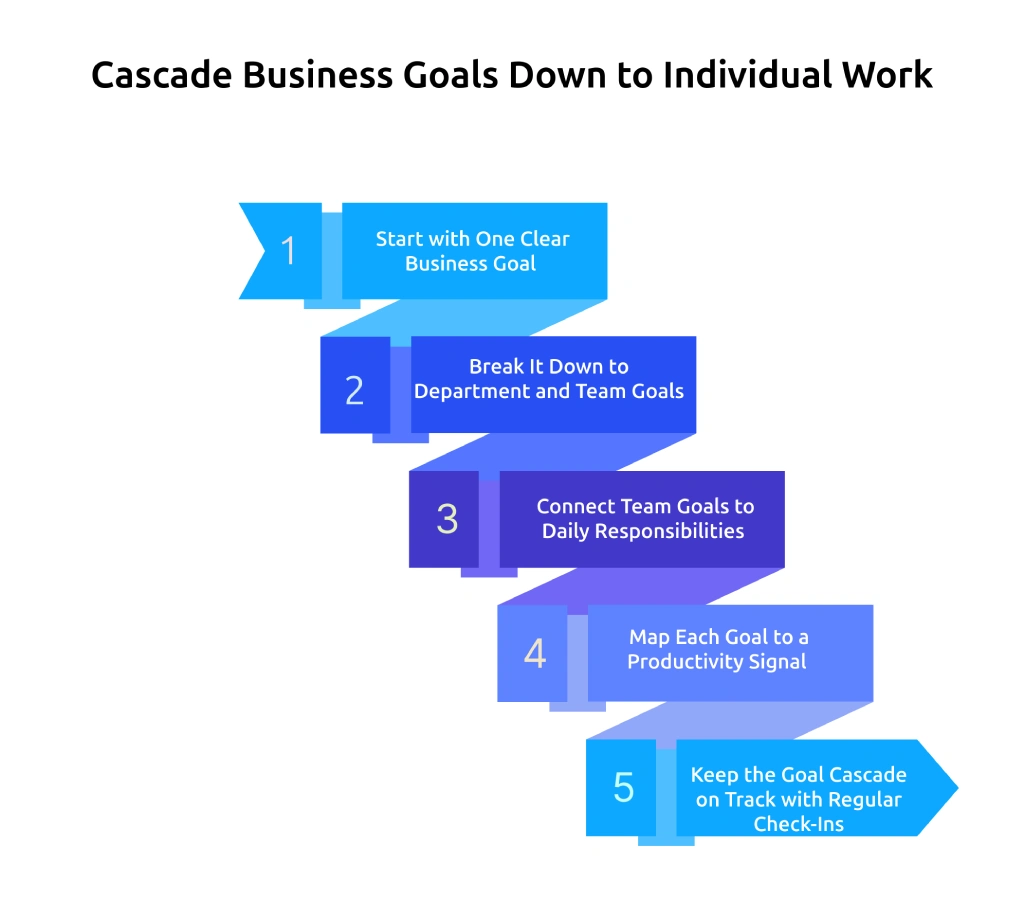
1. Start with One Clear Business Goal
Choose one strategic priority your business wants to achieve this year. Keep it specific and measurable. “Grow revenue” sounds broad, while “increase customer retention by 15% by Q4” gives your teams a clear direction to follow. This goal becomes the starting point of your goal cascade, and every team objective and daily activity should connect back to it. If you use SMART goals or OKRs for goal setting, both can help you create a structured approach. For ready-to-use formats, check out our goal-setting templates guide.
2. Break It Down to Department and Team Goals
Once you define the business goal, each department should translate it based on its responsibilities. Your customer success team and sales team may work differently, but both should contribute to the same company objective. Here is how a simple top-down goal cascade works in practice:
| Level | Who Owns It | Time Frame | Example |
|---|---|---|---|
| Business goal | Executive team | Annual | Increase customer retention by 15% by Q4 |
| Department goal | VP / Director | Quarterly | Customer Success reduces churn to under 5% this quarter |
| Team goal | Team lead | Monthly | CS team completes 50 proactive outreach calls this month |
| Individual goal | Each employee | Weekly | Each rep reaches out to 10 at-risk accounts twice a week |
| Daily signal | Productivity tracking | Daily | Time spent on outreach calls, CRM updates, and account research |
3. Connect Team Goals to Daily Responsibilities
Each team goal should clearly connect to the day-to-day work employees perform. If your customer success team needs to reduce churn, daily priorities may include proactive follow-ups, account reviews, or faster response handling. This step helps employees understand how their work contributes to business results.
4. Map Each Goal to a Productivity Signal
Many teams set goals but fail to track the right work connected to those goals. After setting individual goals, you need to identify which productivity tracking signals actually show progress, such as time spent on high-priority tasks, proactive customer outreach, task completion trends, or project activity. Without this visibility, it becomes difficult to understand whether daily work truly supports your business priorities.
Not all productive time contributes to the same outcome. For example, a customer success representative may spend hours handling support tickets and still appear productive in a general report. But if the actual goal is customer retention, tracking proactive outreach activity gives you a much clearer view of progress. This is where employee performance tracking helps you connect daily work to real business results.
5. Keep Business Goals and Daily Work Aligned with Regular Check-Ins
A goal cascade needs regular reviews to stay effective. Weekly check-ins help you identify gaps early, while monthly reviews give you time to adjust priorities before they start affecting quarterly goals. Without regular follow-ups, teams can slowly move away from the original business priorities.
The data from productivity tracking software makes these conversations more focused and practical. Instead of asking, “How is everything going?”, you can review actual work patterns and ask, “You spent most of this week on low-priority tasks. What needs to improve?” These conversations help teams stay aligned with business priorities and daily goals.
How Does Productivity Tracking Keep the Goal Cascade Honest Over Time?
Setting goals and connecting them to each team member is only the first step. The real challenge starts when you try to maintain that alignment during daily work. Without clear visibility into how teams spend their time, priorities slowly shift, and important goals lose focus before you notice the impact. Productivity tracking helps you monitor daily execution, identify gaps early, and keep work aligned with business priorities over time. Here are the key ways productivity tracking helps you maintain goal alignment across your teams.
1. Shows How Teams Actually Spend Their Time
Many teams believe they focus on the right priorities until the data shows otherwise. Productivity tracking helps you see whether employees spend time on work that supports business goals or on activities that pull attention away from key objectives.
2. Helps You Catch Misalignment Early
Without regular visibility, small execution gaps can continue for weeks before anyone notices them. Productivity tracking helps you identify changing work patterns early so you can correct priorities before they start affecting team performance and business goals.
3. Makes Performance Conversations More Specific
General check-ins often lead to vague updates and unclear next steps. With clear employee performance tracking data, you can discuss actual work patterns, workloads, and priority shifts instead of relying on assumptions or memory.
4. Keeps Teams Aligned with Business Priorities
Daily work can easily shift toward urgent tasks and low-priority activities. Regular productivity tracking helps your teams stay focused on the work that supports business goals and prevents important priorities from getting ignored over time.
5. Creates a Continuous Improvement Loop
Goal alignment works better when you review and adjust it regularly. Productivity data helps you identify what supports performance, what slows progress, and where teams need changes in priorities, workflows, or workload distribution.
Finding it difficult to keep teams aligned across changing priorities?
Use Time Champ to monitor work patterns, improve accountability, and support better execution every day.
Where Do SMART Goals and OKRs Fit into Goal Alignment?
Before you build a goal cascade or set up productivity tracking, you need goals that give your teams clear direction. That is where SMART goals and OKRs come in.
SMART goals give you a clear structure for writing goals that are Specific, Measurable, Achievable, Relevant, and Time-bound. Instead of "improve customer retention," a SMART goal looks like "reduce churn to under 5% by the end of Q3." Many teams also use a Google Sheets OKR template to organize these goals, track ownership, and monitor progress across departments in one shared workspace. That specificity is what makes a goal possible to cascade down to teams and individuals.
OKR alignment works slightly differently. You set an objective (the direction you want to move) and attach key results (the numbers that show your progress). OKRs are useful at the company and department level because they help you connect business goals with measurable results.
Both frameworks do one thing well. They help you define what a good goal looks like. But here is what they do not do.
Neither SMART goals nor OKR alignment shows what happens after you set the goal and before you review the results. You could create a strong OKR in January and still reach your Q2 review without knowing whether daily work actually supported that goal. That gap is exactly what employee productivity tracking helps you identify.
SMART goals and OKRs define the destination. Productivity tracking shows whether your teams are moving toward that goal right now instead of waiting three months to find out.
So, both work together, not against each other. You use goal alignment frameworks to set direction at each level of the goal cascade. Then you use productivity tracking software to monitor execution in real time and identify gaps before they turn into missed goals.
How Does Time Champ Connect Business Goals to Daily Performance?
Keeping goals aligned becomes difficult when you cannot clearly see how teams spend their time every day. This is where Time Champ helps you connect business priorities with actual work patterns through continuous productivity tracking and performance visibility. Time Champ is an employee monitoring platform with built-in workforce intelligence, which helps you understand whether teams focus on the activities that support your business goals instead of relying only on periodic reviews or status updates.
With features like productivity tracking, activity insights, and real-time performance dashboards, you can monitor how work moves across teams and departments. Instead of looking only at logged hours, you can identify which activities contribute to business outcomes, where priorities start shifting, and which teams need support before performance gaps begin affecting results.
Conclusion
To align business goals with employee performance, you need more than goal-setting frameworks and periodic reviews. You need a clear connection between business priorities and the work your teams handle every day. When you combine structured goals with consistent productivity tracking, it becomes easier to identify gaps early, keep teams focused on the right priorities, and improve execution across the organization. The stronger that connection becomes, the easier it is to turn business strategy into measurable results.
Tired of discovering performance gaps only during quarterly reviews?
Use Time Champ to track execution continuously and keep your teams focused on high-impact work.

Thasleem Shaik

Table of Content
 Why Do Most Companies Fail to Align Goals with Employee Performance?
- How Do You Cascade Business Goals Down to Individual Work?
- How Does Productivity Tracking Keep the Goal Cascade Honest Over Time?
- Where Do SMART Goals and OKRs Fit into Goal Alignment?
- How Does Time Champ Connect Business Goals to Daily Performance?
- Conclusion
Related Blogs
Learn effective remote team alignment strategies to enhance communication, boost productivity, and keep your team connected.
Thasleem Shaik | Mar 13, 2025
Productivity metrics are becoming a norm for businesses and organizations of all sizes, but only because it gives managers, executives, some insight
Sai Keerthi Uppala | May 30, 2023
Master time budgeting to boost productivity and manage priorities. Create an effective time budget and optimize your workflow and efficiency with Time Champ.
Tarun Kumar Reddy | Oct 04, 2024
Align employee performance with productivity tracking using a practical framework, clear metrics, and a 90-day plan to turn your data into measurable growth.
Jahnavi Pulluri | Apr 30, 2026
Discover the real pros and cons of employee productivity tracking, how it impacts your team, and the right way to use it to support trust and performance.
Anjali | May 02, 2026
Address employee concerns about productivity tracking with clear communication, rollout steps, and practical scripts that build trust and transparency.
Thasleem Shaik | May 01, 2026


 4.7/5 avg.
Ready to Manage Your Workforce Smarter?
Join our family of 1500+ companies using smart insights to redefine workforces!

Free Trial
No Credit Card Required