Ethical Considerations in Employee Monitoring: Build Trust at Work
Learn the key ethical considerations in employee monitoring. Know what to track, how to stay transparent, and how to build trust with your team.

When you decide to monitor your team, the first question you face is not just whether it is legal. It is whether it is right. Employee monitoring ethics sit at the center of every decision you make. You decide what to track, how to communicate it, and how you act on the insights you get. If you make poor decisions here, your team starts to question your intent and pull back. Programs that take responsible monitoring practices seriously tend to see far less pushback once monitoring goes live.
Employee tracking software shows you how your team spends work time. Your choices define the outcome. You decide what data to collect, whether your team understands it, and how you use that data to guide actions and decisions. When you handle this well, monitoring brings clarity and direction. When you do not, it creates doubt and pushes your best workers away.
This guide helps you think through the key ethical questions before you start. It also shows the standards you need to follow once you put employee monitoring in place.
What Are the Ethical Considerations in Employee Monitoring?
Employee monitoring ethics go beyond legal limits. The law shows what you can track, but ethics defines how you handle it. Your choices around tracking, communication, and data use shape how your team responds. Get it right, and you build trust. Get it wrong, and your team starts to question your intent. Here are the key areas you need to consider before using employee tracking software.
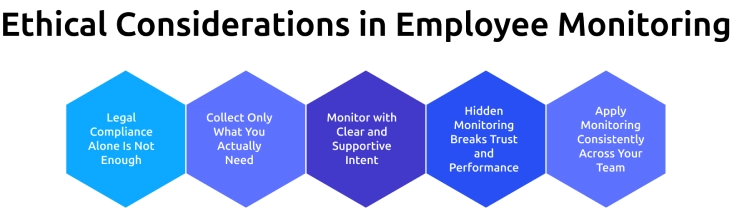
1. Legal Compliance Alone Is Not Enough
Most monitoring laws set only a basic standard. You can add a disclosure in a contract, meet the requirement, and move on. But that does not mean your team understands or accepts it. Clear communication matters more than ticking a box. Many workers feel uneasy about monitoring, so you need to explain what you track and why. When you stay open about your intent, your team is more likely to accept it. Legal compliance may start the process, but employee monitoring ethics is what keeps trust in place.
2. Collect Only What You Actually Need
Modern employee tracking software can capture a wide range of activity. But you should track only what supports productivity and security. When you collect more than necessary, it starts to feel intrusive. The more excess data you gather, the faster trust begins to break.
3. Monitor with Clear and Supportive Intent
The reason behind monitoring employees shapes how your team responds. When you use it to understand work and support progress, it builds clarity. When you use it to catch mistakes, it creates pressure. Monitoring should guide better decisions and protect data, not create fear. Your team can sense your intent through your actions.
4. Hidden Monitoring Breaks Trust and Performance
Hidden or unclear monitoring of employees creates distrust and reduces engagement. Research shows that heavily monitored workers are 49% more likely to pretend to work instead of focusing on real tasks. When you do not explain how and why monitoring happens, uncertainty turns into anxiety. This affects not just morale, but also retention, output, and your ability to attract the right talent.
5. Apply Monitoring Consistently Across Your Team
Selective monitoring of employees creates confusion and tension. When you track only certain individuals or teams, it feels targeted and raises doubt about your intent. This can create a negative environment and affect how your team works together. You need to apply the same standards across your entire setup. Consistency keeps expectations clear and helps maintain trust.
Know how work moves across your teams without overstepping.
Get started with Time Champ and keep your approach balanced and clear.
What Makes Employee Monitoring Ethical or Unethical?
Not every monitoring setup crosses a line. And not every setup that follows the rules stays on the right side either. The difference between ethical employee monitoring ethics and practices that damage trust depends on four areas: why you monitor, how clearly you communicate it, what you collect, and who can access the data. Each of these can either build trust or weaken it over time. The table below breaks this down in simple terms.
| Area | Ethical Monitoring | Unethical Monitoring |
|---|---|---|
| Purpose | You track activity to understand workloads, spot support needs, and help your team do better work. | You track activity to catch mistakes, document failures, or build a case against someone. |
| Transparency | Your team knows what you monitor, why you monitor it, and what you do with the data before monitoring starts. | Monitoring runs in the background without any disclosure to your team. |
| Scope | You collect only the data that directly relates to the job, nothing beyond that. | You collect as much data as possible by default, including activity that has nothing to do with work. |
| Device Boundaries | You monitor activity on company-owned devices and work accounts only. | You access personal devices, home networks, or private accounts that your team uses outside of work. |
| Data Access | Only the right roles in your business can view monitoring data, based on what they need to do their job. | Monitoring data sits open to anyone in the business, with no controls over who sees what. |
| How Data Gets Used | You use data to coach your team, balance workloads, and recognize strong performance. | Data only comes up when something goes wrong, turning monitoring into a tool for discipline. |
| Consistency | The same monitoring rules apply across your whole team, regardless of role or seniority. | Monitoring targets specific individuals or teams, while others face no oversight at all. |
| Off-Hours Activity | Monitoring covers work hours on work systems only. | You track your team's activity outside of work hours or on personal accounts. |
| Data Retention | You set a clear timeline for how long you keep monitoring data and share that with your team. | No one knows how long data gets stored, or how long data sits on your systems indefinitely. |
What Are the Most Common Ethical Problems in Employee Monitoring?
Most businesses that face issues with monitoring do not plan to cross a line. The problems come from gaps such as unclear policies, undefined scope, or poor handling of data in daily use. When you ignore these areas, small issues turn into larger trust problems over time. Here are the most common areas where these gaps appear and how they affect your setup.
1. Monitoring Without Clear Communication
Running employee monitoring without telling your team creates an immediate trust issue. When your team does not know what you track or when it runs, every data point becomes questionable. You need to clearly explain what you monitor on company systems and why. Without that, you risk legal issues in some regions and damage the trust your team relies on. If you cannot be open about monitoring, you need to rethink your approach.
2. Collecting Irrelevant or Excessive Data
Tracking keystrokes, frequent screenshots, personal messages on work devices, or location outside work hours does not give useful insight into job performance. When you do not define clear boundaries, data collection goes beyond what the role actually needs. You should collect data only when it directly supports a clear work-related purpose. If the data does not help you make a decision or improve work, you should avoid collecting it.
3. Monitoring Personal Devices or Accounts
Your monitoring rights apply only to your own systems. Even if work happens on personal devices, you should limit tracking to work-related tools only. Accessing personal email, social media, or off-duty activity crosses an ethical line. In many cases, it also goes beyond legal limits.
4. Using Monitoring Data to Punish Rather Than Support
The difference between monitoring and surveillance comes down to intent. Monitoring should help you identify gaps and support better work. When data appears only during disciplinary actions, it creates fear and resistance. Use insights from employee tracking software in regular discussions, such as workload reviews and performance support, not just in warnings.
How Does Ethical Employee Monitoring Build Trust Instead of Breaking It?
Monitoring does not reduce trust on its own. Lack of clear communication is what creates doubt. When you explain what you track, why you track it, and how you use the data, you remove uncertainty. Your team understands the setup and focuses on work. When you apply monitoring employees clearly and consistently, it becomes part of how work operates instead of feeling like pressure.
Trust also grows when your team sees value in the data. When you use it to support workload balance or recognize strong output, it feels fair and useful. Data should guide everyday discussions, not appear only during issues. When you follow this approach consistently, employee tracking software becomes easier for your team to accept and work with.
What Are the Ethical Considerations for Remote Employee Monitoring?
Monitoring a remote team brings a different set of challenges than monitoring an office-based one. When your team works from home, the line between their work life and personal life sits closer together. That changes what counts as reasonable monitoring and what crosses into territory that damages trust and, in some cases, breaks the law. Here are the key areas you need to consider when handling remote monitoring employees.
1. Limit Monitoring to Company Devices and Work Accounts
Remote work often happens on personal devices, but you should not track them. Monitoring personal devices can capture sensitive data that has nothing to do with work. Your rights apply only to company devices and work accounts. Keep employee tracking software limited to your own systems and avoid personal devices completely.
2. Monitor Only During Work Hours
You should track activity only during defined work hours. Monitoring beyond that crosses into personal time and feels invasive. Your team has a life outside work, and that boundary must stay clear. Tracking after work hours creates ethical concerns and, in some cases, legal risk.
3. Avoid Tools That Go Further Than You Need
Some monitoring tools collect far more data than necessary, including keylogging, webcam access, and microphone capture. Just because a tool offers these features does not mean you need them. If your goal is to understand how your team spends time across projects, time tracking and app usage data are enough. You do not need frequent screenshots or keystroke-level logs to manage work effectively. Choose tools that match your purpose, not the ones with the widest reach.
4. Get Written Confirmation Before Monitoring Starts
Ask your team to give written consent before monitoring begins and explain clearly what you plan to track. Do not hide this in a general contract. Create a separate document that outlines what remote monitoring employees cover, what it does not cover, and how you will use the data. Written consent protects you legally and ensures your team agrees to the process in a clear and informed way.
Set clear boundaries before you start tracking remote work.
Use Time Champ to monitor with control, clarity, and respect for personal space.
How Should You Write an Ethical Employee Monitoring Policy?
Without clear employee monitoring policies in place, monitoring creates confusion and weakens trust. In some cases, it can also lead to legal risk. A well-written policy does the opposite. It sets clear expectations before monitoring begins and gives your team a clear reference for how it works. Here are the key areas your policy should cover.
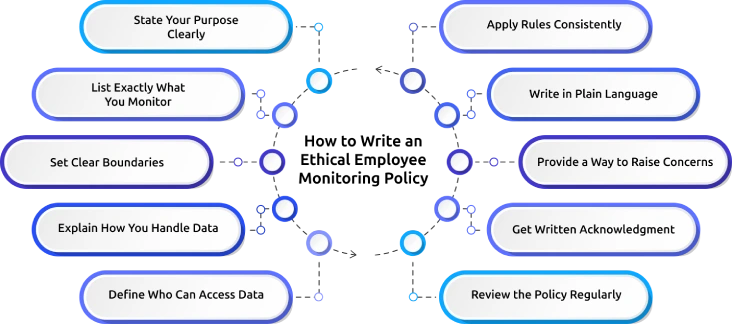
- State Your Purpose Clearly: Define why you monitor. Mention the exact need, such as productivity visibility, data security, compliance, or workload balance. Avoid vague reasons and make the purpose directly connected to work.
- List Exactly What You Monitor: Clearly name each activity you track, such as work email, app usage, task time, or location for field roles. Do not use broad terms. Your team should clearly understand what you track.
- Set Clear Boundaries: Specify what you do not monitor. Personal devices, activity outside work hours, and private accounts should stay out of scope. This shows respect for personal space.
- Explain How You Handle Data: Describe how you store data, who can access it, and how long you keep it. Also, explain how your team gives consent and what that consent covers.
- Define Who Can Access Data: Limit access based on roles. Only those who need the data for work should see it. This reduces misuse and keeps control clear.
- Clarify How You Use the Data: State how you use monitoring data in practice. Focus on support, fairness, and decision-making. Avoid using it only for disciplinary actions.
- Apply Rules Consistently: Use the same standards across your setup. Avoid exceptions for specific individuals or groups. Consistency maintains fairness.
- Write in Plain Language: Keep the policy simple and direct. Avoid legal complexity. Your team should understand it without extra explanation.
- Provide a Way to Raise Concerns: Give a clear contact or process for questions. This keeps communication open and shows accountability.
- Get Written Acknowledgment: Ask your team to confirm in writing that they understand the policy before monitoring starts. Keep this record.
- Review the Policy Regularly: Check your policy from time to time as tools, rules, or team setup change. Update it so it always reflects how you currently monitor work.
How Does Time Champ Support Ethical Employee Monitoring?
When you use employee monitoring software, the tool you choose shapes how fair and transparent your monitoring feels. Time Champ gives you clear visibility into how work happens without turning it into surveillance. You decide what to track, which teams to include, and who can access the data. This keeps your monitoring focused on actual work needs and avoids unnecessary tracking.
Every team member in Time Champ can view their own activity data in real time, the same data you review. This removes guesswork and shows exactly what the system tracks. Role-based access ensures only the right individuals can view specific reports, and the platform restricts data access within defined roles. When your team can see their data, raise questions, and trust how you handle it, employee monitoring ethics becomes part of daily work, not just a written policy.
Bring clarity to how work happens without crossing limits.
Start with Time Champ and keep your monitoring clear and trusted.
Conclusion
Employee monitoring ethics come down to how you make decisions around visibility, data, and communication. When you stay clear about what you track, keep boundaries in place, and use data to support work, you create a system your team can understand and trust. The goal is not just to monitor work, but to do it in a way that feels fair, transparent, and aligned with how your team actually operates.

Thasleem Shaik

Table of Content
-
 What Are the Ethical Considerations in Employee Monitoring?
-
What Makes Employee Monitoring Ethical or Unethical?
-
What Are the Most Common Ethical Problems in Employee Monitoring?
-
How Does Ethical Employee Monitoring Build Trust Instead of Breaking It?
-
What Are the Ethical Considerations for Remote Employee Monitoring?
-
How Should You Write an Ethical Employee Monitoring Policy?
-
How Does Time Champ Support Ethical Employee Monitoring?
-
Conclusion
Related Blogs
Get answers to the most asked questions about employee monitoring laws, including legal considerations and privacy rights for compliant workplace monitoring.
Thasleem Shaik | 17 August 2024
Learn what employee email monitoring is, how it works, why companies use it, its legality, and how to implement it step by step, ethically and effectively.
Jahnavi Pulluri | 13 April 2026
Understand whether employee monitoring a Boon or Bane for Modern Workplaces. Discover ho
Jahnavi Pulluri | 06 August 2024
Learn about the detailed pros and cons of employee monitoring to better understand its overall impact on employees and employers.
Shabana Shaik | 16 October 2024
Explore the comprehensive guide on employee laptop monitoring software for businesses. Enhance security, productivity, management with advanced practices.
Mounika Sa | 17 December 2023
Explore the top 10 remote desktop monitoring software to enhance your team's productivity. Find the perfect tool with detailed features, pricing, and ratings.
Tarun Kumar Reddy | 09 August 2024


 4.7/5 avg.
Ready to Manage Your Workforce Smarter?
Join our family of 1500+ companies using smart insights to redefine workforces!

Free Trial
No Credit Card Required