How to Legally Implement Employee Monitoring Software?
Learn how to legally implement employee monitoring software. Covers legal requirements, policy steps, best practices, and what to tell your employees.

You need to see how your team spends work hours, but employee monitoring often raises concerns around trust, privacy, and legal limits. You may feel unsure about what you can track, how far you should go, or how to measure productivity without crossing a line. When these questions stay unclear, your approach to monitoring becomes inconsistent and difficult to rely on. Skipping over lawful screen recording can turn a useful tool into a legal liability overnight.
If you ignore these challenges, you risk compliance issues, employee resistance, and decisions based on incomplete data. This guide on how to legally implement employee monitoring software gives you a clear path forward. It explains what you can track, how to stay within legal boundaries, and how to set up monitoring in a way that respects privacy while still giving you accurate insights.
What Is Employee Monitoring Software?
Employee monitoring software is a digital tool that tracks how work happens across devices, applications, and tasks during working hours. It records activity such as app usage, website visits, time spent on tasks, and attendance, so you can understand where time goes and how work progresses.
But what does this tracking actually help you achieve?
Employee monitoring tool turns raw activity data into clear insights you can act on. It shows patterns in productivity, highlights delays or idle time, and helps you make better decisions around workload, performance, and accountability. When you use it with the right approach, it supports visibility without crossing privacy or legal boundaries.
Why Businesses Choose to Implement Employee Monitoring?
When you do not have clear visibility into how work happens, it becomes difficult to understand where time goes, what slows progress, and how your team completes tasks. You may end up relying on assumptions instead of real data, which leads to missed issues and inconsistent decisions. This is why many businesses choose to implement employee monitoring. It helps you see work clearly, identify gaps early, and make decisions based on accurate insights. Here are the key reasons behind it.
- Accurate Time and Attendance Tracking: Manual timesheets rely on memory and self-reporting, which often leads to errors. Monitoring software records clock-in and clock-out data automatically, giving you reliable records for payroll, billing, and compliance.
- Productivity Visibility Across Remote and Hybrid Teams: When your team works across locations, you lose direct visibility. Monitoring tools show how your team uses time across tasks and tools, so you can identify bottlenecks, uneven workloads, and early signs of disengagement.
- Data Security and Insider Threat Protection: A significant number of data risks originate from internal actions such as accidental data sharing, misuse of access, or intentional data leaks. Activity tracking and file monitoring help you detect unusual behavior early, such as unauthorized access or sensitive data transfers.
- Compliance and Audit Trail Requirements: In industries with strict regulations, such as finance, healthcare, and legal services, you need clear proof of how work happens. Monitoring software creates detailed activity records that support audits, investigations, and employee monitoring legal compliance.
- Workload Management and Burnout Prevention: Monitoring data shows who handles excessive work and who has capacity. You can rebalance tasks early and reduce the risk of burnout or disengagement.
- Fair, Evidence-Based Performance Conversations: Instead of relying on assumptions, you can use real activity data. This makes feedback clearer, consistent, and easier to support.
- Project Cost Accuracy and Client Billing: Monitoring connects work activity with project time. You get accurate records that support invoicing, prevent billing errors, reduce disputes, and keep project budgets on track.
Need a compliant way to monitor your team?
Time Champ gives you real-time monitoring with built-in policy controls and role-based access.
What Are the Legal Requirements for Implementing Employee Monitoring Software?
Employee monitoring legal requirements come from multiple laws that define what you can track, how you can track it, and what you must communicate to your team. These rules vary based on location and type of data, which means you need to follow different legal frameworks at the same time. To make this clear, let’s break down the key legal requirements you need to understand.
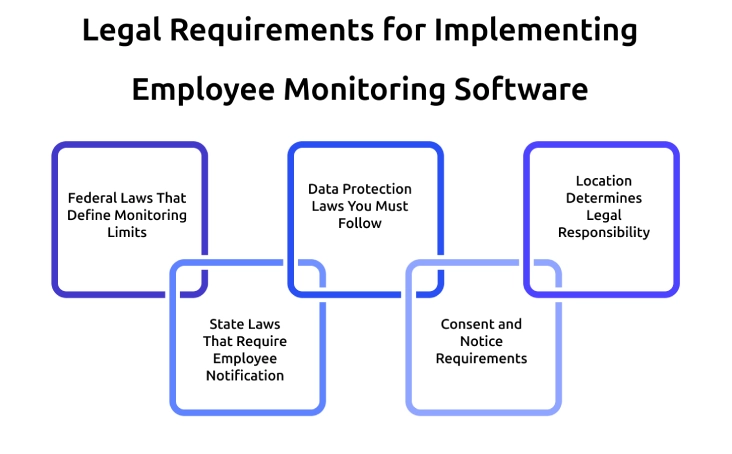
1. Federal Laws That Define Monitoring Limits
When you look at employee monitoring laws in the USA, three key federal laws define what you can monitor and where the limits apply:
- Electronic Communications Privacy Act (ECPA): This law allows you to monitor work-related communications on company systems when you have a valid business purpose. It does not allow you to monitor private personal communications.
- Computer Fraud and Abuse Act (CFAA): This law restricts unauthorized access to systems and data. You must ensure your monitoring does not cross into unauthorized access or misuse.
- Fair Labor Standards Act (FLSA): This law becomes relevant when you use monitoring data for time tracking, wages, and overtime calculations. Your records must remain accurate and defensible.
2. State Laws That Require Employee Notification
Some states go further and require you to inform employees before monitoring begins.
- New York requires written notice and employee acknowledgment before monitoring starts.
- Connecticut and Delaware require prior notice for email and internet monitoring.
- Texas and California include additional data privacy and disclosure requirements.
If your team works in these states, you must follow these rules regardless of where your business operates.
3. Data Protection Laws You Must Follow
Data protection laws control how you collect, store, and use monitoring data:
- CCPA (California) requires you to disclose what data you collect, why you collect it, and how you use it.
- GDPR (EU) requires a lawful basis for data collection, clear notice, and strict data minimization.
These laws treat monitoring data as personal data, which means you must handle it with clear limits and accountability.
4. Consent and Notice Requirements
In most US states, you do not need explicit consent to monitor company devices, but you must inform employees through a written policy. In some regions and international jurisdictions, you must obtain explicit consent before monitoring begins. A written policy with employee acknowledgment covers most notice and consent requirements.
5. Location Determines Legal Responsibility
Employee monitoring laws depend on where your employees work, not where you register your business. A remote employee in a different state or country brings a different set of legal obligations that you must follow.
What Issues Should You Consider Before You Implement Employee Monitoring?
Employee monitoring does not fail because of the tool. It fails when decisions remain unclear before implementation. If you skip these considerations, you create legal risks, employee resistance, and data that does not help you make better decisions. Before you move forward, here are the key issues you need to think through.
1. Which Devices Will You Monitor
You need to decide whether you will monitor company-owned devices, personal devices, or both. You have broader rights on company devices once you inform employees. On personal devices, your limits are strict. You can only track work-related apps and accounts covered under a clear BYOD policy. Personal data always stays off-limits.
2. What Type of Monitoring Do You Actually Need
You should define what you want to track before choosing a tool. Time tracking, app usage, and attendance may be enough for productivity. If your focus is security, you may need file access tracking. Avoid enabling features without a clear purpose. If you cannot explain why you need a data point, you should not collect it.
3. Where Your Employees Work
Your legal obligations change based on employee location. A remote team across states or countries means you must follow multiple laws at once. For example, a team member in California brings CCPA requirements, while someone in Europe falls under GDPR. Always map your team locations before implementation.
4. How You Will Store and Protect Data
Monitoring data is sensitive. You need to decide where you store it, who can access it, and how long you keep it. Without clear controls, you increase the risk of internal misuse and data breaches. Use role-based access, encryption, and defined retention periods to stay compliant.
5. What Happens If an Employee Objects
You need to handle objections with a clear process before you launch monitoring, not after concerns arise. When someone questions monitoring, you should provide a defined point of contact, a clear response timeline, and a transparent explanation of how you handle such cases. Without this structure, you risk making rushed decisions that create confusion and legal exposure.
This becomes more critical when you look at employee sentiment. 54% of employees say they would consider leaving if workplace monitoring increases without proper communication. This does not mean you should avoid monitoring. It means you need to implement it with clarity, transparency, and a process that builds trust instead of resistance.
Build a monitoring system your team can understand and trust.
Use Time Champ to track work with clarity, control, and compliance.
How Do You Legally Implement Employee Monitoring Software Step by Step?
Legal implementation requires a structured process that aligns your purpose, policy, and system setup. When you follow these steps in order, you reduce legal risk and create a monitoring approach your team can clearly understand and accept.
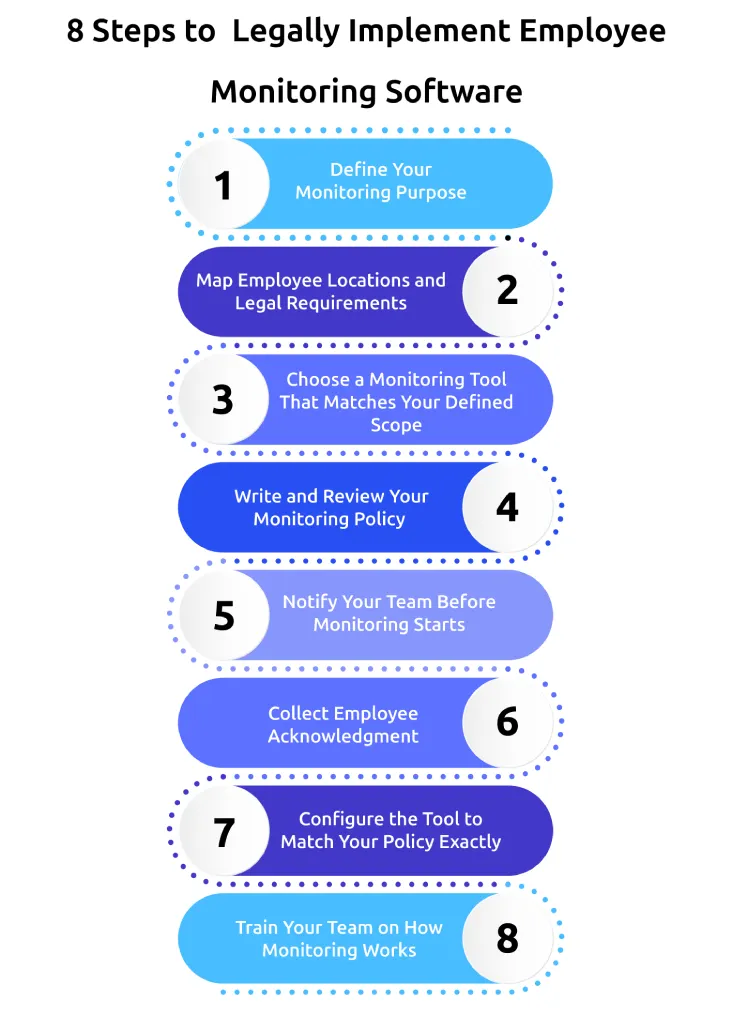
Step 1: Define Your Monitoring Purpose
Start by writing down why you want to monitor work activity. Connect each purpose to a clear outcome, such as productivity visibility, time tracking, or data security. This becomes the foundation for every decision that follows.
Step 2: Map Employee Locations and Legal Requirements
List where your team works and identify the laws that apply in each location. Requirements change based on employee location, so you need to check notice rules, consent requirements, and data protection laws before moving forward.
Step 3: Choose a Monitoring Tool That Matches Your Defined Scope
Check the monitoring tool that you choose gives you configurable monitoring controls so you can enable only what your policy covers. Confirm it offers role-based access controls so that monitoring data reaches only the people who need it for their role. Check that it stores data securely and can meet the data protection requirements of every jurisdiction where your employees work. If you have EU employees, confirm the vendor handles data in a GDPR-compliant manner.
Step 4: Write and Review Your Monitoring Policy
A written employee monitoring policy is the legal foundation of your entire implementation. Without it, your monitoring is difficult to defend and impossible to communicate fairly to your team. Write a policy that explains what you track, why you track it, how you store data, and who can access it. Keep it specific and easy to understand so there is no confusion later.
Step 5: Notify Your Team Before Monitoring Starts
Share the policy with your team before you begin monitoring. Make sure they understand what is being tracked and why. In some regions, written notice is mandatory, so timing and documentation matter.
Step 6: Collect Employee Acknowledgment
Ask each employee to sign or digitally confirm that they have received and read the monitoring policy. Store these records as proof that you followed notice requirements. For new hires, build the acknowledgment into your onboarding process so it happens before their first day of monitored work. For existing employees, run a separate acknowledgment process when you introduce monitoring for the first time. Do not skip this step or treat it as a formality.
Step 7: Configure the Tool to Match Your Policy Exactly
Go through your monitoring software settings and enable only the features that your written policy covers. If your policy does not mention screenshot monitoring, screenshots stay off. If it does not cover keystroke logging, that feature stays disabled. If monitoring applies only during working hours for remote employees, configure the time parameters to match.
Step 8: Train Your Team on How Monitoring Works
Train your team before monitoring starts so everyone understands how to use and interpret the data correctly. You need to explain what you track, why you track it, how employees can access their own data, and who they can contact for concerns. Clear training prevents misuse, reduces confusion, and helps your team adapt to monitoring with confidence.
How Does Time Champ Help You Implement Employee Monitoring Legally?
Implementing employee monitoring legally requires more than just knowing the rules. You need a system that lets you control what you track, align it with your policy, and manage data access without creating risk. This is where a tool like Time Champ, an employee monitoring software, supports your setup by giving you control over the monitoring scope, so you only collect data that matches your defined purpose and legal requirements.
Time Champ also helps you stay transparent and compliant in daily use. Each employee can view the same activity data that the system records about their work, so there is no confusion about what you track. You can restrict data access based on roles, maintain audit logs for accountability, and ensure your monitoring setup stays aligned with your written policy. This allows you to manage monitoring in a structured way that supports both compliance and clarity.
Turn employee monitoring into a clear, compliant process.
Start using Time Champ to monitor work accurately and stay aligned with your policy.
Conclusion
Implementing employee monitoring legally requires a clear approach from the start. You need to understand the laws that apply, define what you will track and why, inform your team before monitoring begins, and ensure your setup matches your policy. When you follow this structure, you reduce legal risk, improve transparency, and create a monitoring system that supports both compliance and better decision-making.

Thasleem Shaik


Table of Content
-
 What Is Employee Monitoring Software?
-
Why Businesses Choose to Implement Employee Monitoring?
-
What Are the Legal Requirements for Implementing Employee Monitoring Software?
-
What Issues Should You Consider Before You Implement Employee Monitoring?
-
How Do You Legally Implement Employee Monitoring Software Step by Step?
-
How Does Time Champ Help You Implement Employee Monitoring Legally?
-
Conclusion
Instant Signup
Thank you for your request!
We have received your signup request and our team will get back to you soon. In the meantime, you can book a demo to see Time Champ in action.
Book a DemoFree trial. No credit card required. Prefer a walkthrough? Book a demo.
Related Blogs
Discover the ins and outs of employee monitoring: from its benefits to ethical considerations. Everything you need to know in one comprehensive guide.
Mounika Sai | 08 December 2023
Explore the possible ethical considerations of monitoring employee's activities to increase their productivity while respecting their privacy.
Jahnavi Pulluri | 31 July 2024
Get answers to the most asked questions about employee monitoring laws, including legal considerations and privacy rights for compliant workplace monitoring.
Thasleem Shaik | 17 August 2024
Choose the right employee monitoring tool for your team with this 2026 guide. Explore types, key features, a 5-step framework, and top software options.
Jahnavi Pulluri | 13 April 2026
Explore the top questions about employee monitoring, including legal requirements and best practices to ensure compliance and protect privacy.
Thasleem Shaik | 29 July 2024
Discover the ultimate guide to remote employee monitoring software, including its features, benefits, and how to choose the best one for your business.
Mounika Sai | 29 August 2023


 4.7/5 avg.
Ready to Manage Your Workforce Smarter?
Join our family of 1500+ companies using smart insights to redefine workforces!

Free Trial
No Credit Card Required