Employee Monitoring Privacy Policy: Trust and Compliance
Explore how an employee monitoring privacy policy protects employee rights, maintains compliance, and supports transparent workplace monitoring.
Are your employees starting to ask how much you track their work? Or do you feel unsure about how far monitoring must go without crossing privacy boundaries? Many organizations struggle to strike a balance between visibility and trust, especially as work shifts beyond the office. As monitoring tools become more advanced and remote work grows, concerns about employee monitoring rise because many businesses rely on productivity tracking, while employees often feel uncomfortable with it. Programs that overlook GDPR employee monitoring often run into avoidable disputes once enforcement starts. Anyone weighing this decision usually starts with our enterprise employee monitoring guide for the full landscape.
This is where an employee monitoring privacy policy becomes essential. It helps you set clear expectations, protect employee rights, and stay legally compliant without losing employee trust. In this guide, you will learn how to approach monitoring the right way, understand key privacy considerations, and build a policy that works for both your organization and employees.
What Is an Employee Monitoring Privacy Policy?
An employee monitoring privacy policy is a formal document that explains how an organization tracks employee activities, what data it collects, and why it collects it to maintain transparency and legal compliance. It also outlines monitoring methods such as email, internet use, or system activity while protecting employee privacy.
This policy works by setting clear boundaries on how monitoring happens and what remains private. It explains how tools like time tracking, screen monitoring, email checks, or GPS tracking operate while transparently outlining consent, data use, and access rules.
It plays a crucial role in maintaining trust and staying compliant with legal standards. Without clear guidelines, monitoring can feel unclear, but a well-defined policy creates fairness, accountability, and confidence across the workplace.

Did You Know?
Research from the American Psychological Association shows that 56% of monitored employees feel stressed or tense at work, highlighting the emotional impact of workplace surveillance.
Employee Monitoring Privacy Policy vs General Workplace Policy
Many teams assume one workplace policy can cover everything, but that approach often leads to gaps. Monitoring brings legal and privacy responsibilities that standard policies do not address. You require a clear distinction to avoid risk and set the right expectations.
| Aspect | General Workplace Policy | Monitoring Privacy Policy |
|---|---|---|
| Focus | Employee conduct and behavior | Data collection through technology tools |
| Legal Framework | Employment law, labor regulations | ECPA, state notification laws, GDPR, BIPA |
| Consent Requirement | Implied through employment | Explicit written consent often required |
| Data Rights | Not typically addressed | Access, correction, deletion, portability |
| Update Frequency | Annual or as needed | With every tool change, law change, or annually |
What Laws Govern Employee Monitoring Privacy Policies?
An employee monitoring privacy policy operates within a layered legal framework that includes federal laws, state-level rules, and international standards. You need to understand these regulations to reduce legal risk while protecting employee rights and maintaining transparency.
Federal Laws: ECPA and Stored Communications Act
The Electronic Communications Privacy Act (ECPA) forms the backbone of employee monitoring laws in the United States. It limits the interception of electronic communications but allows monitoring when a clear business purpose exists or when employees have given prior consent through a documented agreement, such as an employee monitoring privacy policy.
The Stored Communications Act (SCA) governs access to stored data like emails and files on company systems, while the Computer Fraud and Abuse Act (CFAA) addresses unauthorized system access. At the same time, the National Labor Relations Act (NLRA) protects employee rights, preventing employers from using monitoring to interfere with workplace discussions or collective activities.
State-Specific Employee Monitoring Notification Laws
State laws introduce additional requirements beyond federal rules and also focus on transparency and consent.
| State | Requirement | Key Detail | Penalty |
|---|---|---|---|
| Connecticut | Written notice required | Notify employees before monitoring begins | Up to $500 per violation |
| Delaware | Written notice required | Provide details of monitoring practices | Up to $100 per violation |
| New York | Written notice required | Display notice of electronic monitoring | Up to $500 per violation |
| California | Privacy constitution | State-level privacy rights apply | Civil lawsuit damages |
| Colorado | Privacy protection | Covers off-duty conduct protections | Varies by case |
| Illinois (BIPA) | Biometric consent | Written consent for biometric data | $1,000–$5,000 per violation |
| Texas | Biometric data | Similar biometric safeguards as Illinois | Up to $25,000 per violation |
Note: Laws in these areas continue to evolve, with new regulations introduced and existing rules updated over time. Always review current legal requirements with qualified legal counsel before implementing your employee monitoring privacy policy.
International Standards: GDPR, PIPEDA, and Global Frameworks
When your organization operates across borders, privacy obligations become stricter and more detailed. The General Data Protection Regulation (GDPR) requires a lawful basis for processing employee data, enforces impact assessments for high-risk monitoring, and mandates breach reporting within 72 hours.
Canada’s Personal Information Protection and Electronic Documents Act (PIPEDA) emphasizes meaningful consent and limits data collection to what is reasonable and necessary. Australia’s Privacy Act follows a similar approach through its Privacy Principles, focusing on responsible data handling and clear accountability.
How Do You Write an Employee Monitoring Privacy Policy?
Creating an employee monitoring privacy policy takes more than listing rules. You need to explain the intent, define clear limits, and communicate everything in a way employees understand. When you approach it with clarity and fairness, you can reduce confusion and build trust from the start.
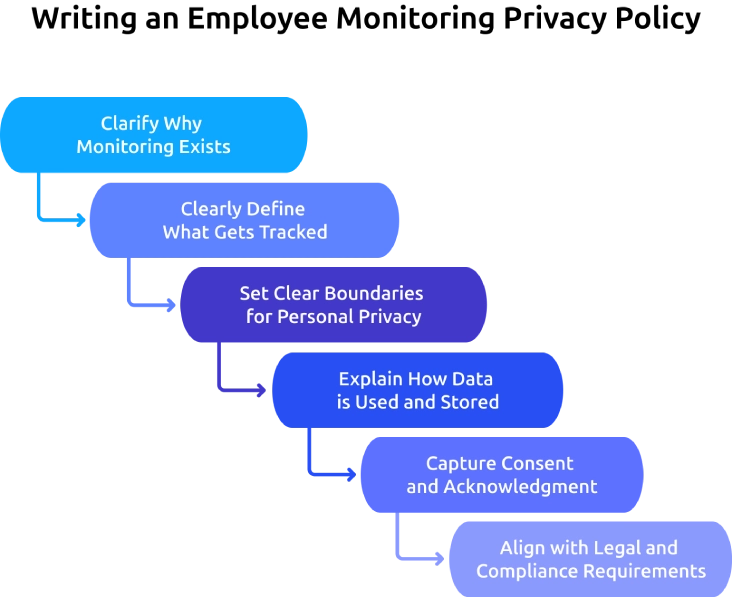
Clarify Why Monitoring Exists
Start by defining the real purpose behind monitoring. Focus on business needs like productivity, security, or compliance, and connect each reason to a clear outcome. When employees understand why monitoring exists, they are less likely to question it. This step sets the tone for the entire employee monitoring privacy policy.
Clearly Define What Gets Tracked
Be specific about what data you collect and which tools you use. Mention areas like app usage, work hours, or system access, and avoid vague descriptions. A Clear scope prevents misunderstandings and removes the feeling of hidden tracking. Then, employees can see exactly what falls within monitoring and what does not.
Set Clear Boundaries for Personal Privacy
Draw a strong line between work-related tracking and personal space. Make it clear what remains private, especially in remote or hybrid environments. This clarity reduces discomfort and builds confidence in your approach. A well-defined boundary strengthens the credibility of your employee monitoring privacy policy.
Explain How Data is Used and Stored
Describe how you handle the data after collection. Share who can access it, how long you keep it, and how you protect it from misuse. When employees know their data is secure and used only for clear reasons, they feel more comfortable and confident. Transparency here directly supports trust and accountability.
Capture Consent and Acknowledgment
Document employee awareness through clear consent and acknowledgment processes. Use written agreements or digital confirmations to record acceptance. This step creates a shared understanding between the organization and employees and also adds a layer of legal clarity to your monitoring practices.
Align with Legal and Compliance Requirements
Match your policy with applicable laws and regulations across regions where you operate. Keep track of updates in privacy rules and reflect them in your policy language. A legally aligned employee monitoring privacy policy protects your organization from risk and helps you respect employee rights at every stage.
Struggling to create a clear employee monitoring privacy policy?
Time Champ helps you build transparent and compliant monitoring.
What Privacy Considerations Apply to Remote Employee Monitoring?
Remote and hybrid work have reshaped how employee monitoring works today. When employees work from home, managing privacy becomes more sensitive and needs clear boundaries. You need clear rules to protect employees while maintaining visibility through your employee monitoring privacy policy.
Home Office Privacy Boundaries
Set clear limits on what you monitor inside a home workspace. Define when webcams can be used, such as during scheduled meetings, and avoid continuous camera access. Keep screen tracking limited to working hours with clear start and end times. An employee monitoring privacy policy also needs to make it clear that no tracking happens outside work hours, helping employees feel secure in their personal space.
BYOD Device Monitoring Privacy Limits
When employees use personal devices, privacy risks increase. Monitoring tools can capture personal data if boundaries are not clearly defined. Use a setup that separates work and personal data so only business-related activity stays visible. A strong employee monitoring privacy policy explains that personal apps, messages, and files remain private and gives employees clarity on what data gets tracked.
Monitoring Across Multiple Jurisdictions
Remote teams often work from different states or countries, each with its own privacy laws. You need to follow the rules based on where the employee works, not just where your company operates. Your policy must reflect stricter requirements where they apply and stay updated as laws change. Building your approach around the highest standard helps you stay compliant across all locations.
How Does AI-Powered Monitoring Affect Employee Privacy?
AI-powered monitoring changes how organizations collect and use employee data. It goes beyond basic tracking and brings deeper insights into behavior and identity. This shift raises new privacy concerns that require clear explanation and careful handling.
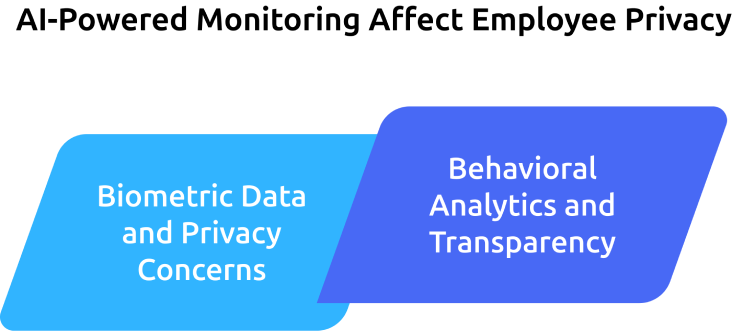
Biometric Data and Privacy Concerns
Many organizations now collect biometric data such as fingerprints, facial recognition, voice patterns, or typing behavior. These details are highly sensitive and demand strict control. Laws like the Biometric Information Privacy Act (BIPA) require clear written consent before collecting such data and impose heavy penalties for violations. A strong policy explains what biometric data is collected, how it is stored, how long it is retained, and what rights employees have regarding its use.
Behavioral Analytics and Transparency
AI tools for employee monitoring, like Time Champ, also analyze work patterns to measure employee productivity, detect unusual activity, or predict risks like disengagement. While this offers useful insights, it can create concerns around fairness and clarity. Employees need to understand how these systems evaluate them and how those results influence decisions. Clear communication about data use, scoring methods, and safeguards helps reduce bias and builds confidence in AI-driven monitoring.
How Does Time Champ Support Privacy-First Employee Monitoring?
Struggling to balance visibility and privacy in your employee monitoring privacy policy? Many tools push excessive tracking, which creates discomfort and compliance risks. Time Champ takes a different approach by focusing on meaningful insights, while keeping data collection limited and purposeful, helping you manage teams without crossing privacy boundaries.
Time Champ supports this approach with built-in compliance and audit trail features that give you full control over data access and usage. It records every access event, applies approval workflows for sensitive data, and allows you to manage data storage and retention based on your requirements. At the same time, it delivers clear visibility by highlighting workload patterns, identifying overwork risks, and helping you distribute tasks fairly, so you gain clarity while maintaining trust and respecting employee privacy.
Want to build a monitoring approach that your employees feel comfortable with?
Time Champ helps you run transparent, compliant monitoring that your team can trust.
Conclusion
An employee monitoring privacy policy helps you bring clarity, fairness, and trust into how you manage your workforce. When you define clear boundaries, explain data use, and follow legal requirements, employees feel more secure and confident in your approach. Then, monitoring becomes a support system for productivity. As workplaces continue to evolve, your focus must stay on transparency and responsible data use. A well-structured employee monitoring privacy policy protects your organization while respecting employee rights, creating a balanced environment where both performance and trust can grow together.

Anjali

Table of Content
-
 What Is an Employee Monitoring Privacy Policy?
-
Employee Monitoring Privacy Policy vs General Workplace Policy
-
What Laws Govern Employee Monitoring Privacy Policies?
-
How Do You Write an Employee Monitoring Privacy Policy?
-
What Privacy Considerations Apply to Remote Employee Monitoring?
-
How Does AI-Powered Monitoring Affect Employee Privacy?
-
How Does Time Champ Support Privacy-First Employee Monitoring?
-
Conclusion
Instant Signup
Thank you for your request!
We have received your signup request and our team will get back to you soon. In the meantime, you can book a demo to see Time Champ in action.
Book a DemoFree trial. No credit card required. Prefer a walkthrough? Book a demo.
Related Blogs

Understand employee monitoring legal compliance, key laws, and best practices to track work activity while protecting privacy and avoiding legal risks.

Learn the key ethical considerations in employee monitoring. Know what to track, how to stay transparent, and how to build trust with your team.
Discover how to create an effective employee monitoring policy with our comprehensive guide. Enhance productivity while respecting privacy. Learn best practices today!
Explore the possible ethical considerations of monitoring employee's activities to increase their productivity while respecting their privacy.
Explore the top questions about employee monitoring, including legal requirements and best practices to ensure compliance and protect privacy.

Change management makes employee monitoring adoption smoother. Learn strategies to reduce resistance, communicate transparently, and roll out in phases.


 4.7/5 avg.
Ready to Manage Your Workforce Smarter?
Join our family of 1500+ companies using smart insights to redefine workforces!

Free Trial
No Credit Card Required