Time Wasting Habits: 9 Sneaky Productivity Killers
Discover 9 time wasting habits that quietly drain productivity at work. Learn why they stick, how to break them, and reclaim more focused, productive hours.

Most employees don't waste time because they're lazy. They waste time because modern work makes it easy to stay busy without actually being productive.
A quick Slack reply turns into ten minutes of switching between chats. One meeting breaks your focus for the next hour. And that's just the beginning, many everyday habits quietly drain your time without you noticing.
These hidden productivity killers often look harmless, and some even feel productive in the moment. That's what makes them so difficult to spot.
And the good news is,
Once you recognize these productivity killers, they're easier to fix than you think. In this blog, I’ll break down 9 common time wasting habits and practical ways to stop them from stealing your workday.
What is a Time Wasting Habit?
A time wasting habit is a repeated behavior that takes attention away from important work without delivering meaningful results. Unlike a one-time distraction, it happens regularly and often becomes automatic over time.
The reason these habits are difficult to identify is that they often feel productive. Responding to emails, organizing tasks, or making small edits to a document can create a sense of progress. However, when these activities repeatedly replace high-priority work, they become a hidden drain on productivity.
How Much Time Do These Habits Actually Cost You?
Most time wasting habits don't seem like a big deal when they happen, but when these small interruptions occur repeatedly throughout the day, the lost time adds up faster than most people realize.
The real cost isn't just the minutes spent on the distraction itself. Every interruption forces your brain to stop, switch context, and refocus on the task at hand. Over time, this constant start-and-stop cycle can significantly reduce productivity and make even simple tasks take longer than they should.
Here's what the research shows:
- According to a workplace productivity survey highlighted by ElectroIQ, nearly 9 out of 10 employees admit to spending at least 30 minutes of their workday on activities unrelated to their jobs.
- Research by Gloria Mark found that it takes an average of 23 minutes and 15 seconds to refocus after an interruption.
- Microsoft WorkLab reports that employees are interrupted approximately every two minutes by meetings, emails, messages, and notifications during the workday.
These numbers don't necessarily point to poor work habits. Instead, they show how easily small distractions can accumulate over time. A few minutes here and there may seem harmless, but repeated throughout the day, they can take hours away from essential work and reduce overall productivity.
The 9 Time Wasting Habits Quietly Hurting Your Productivity
Time rarely disappears all at once. More often, it's lost through small habits that seem harmless in the moment but slowly eat away at your focus and productivity.
Here are nine common time wasting habits and practical ways to overcome them.
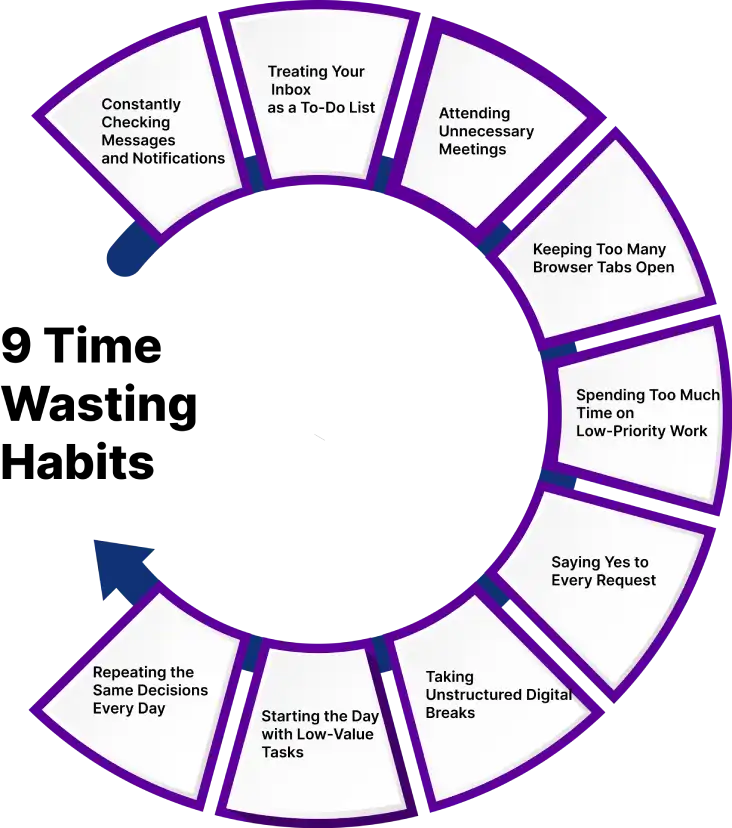
1. Constantly Checking Messages and Notifications
If you check Slack, Teams, email, or other communication tools every time a notification appears, you're constantly interrupting your own workflow. While each interruption may seem harmless, repeatedly switching your attention between tasks can make it harder to concentrate and significantly reduce your productivity throughout the day.
How to fix it: Instead of responding to every notification immediately, set specific times to check and reply to messages. You can also turn off non-essential notifications to minimize distractions and stay focused on your most important work.
2. Treating Your Inbox as a To-Do List
Your inbox is meant for communication, not task management. When you spend most of your day reacting to incoming emails, it's easy to let other people's priorities dictate your schedule. As a result, your essential work often gets pushed aside while you focus on tasks that feel urgent but add little value.
How to fix it: Before opening your inbox, identify the most important tasks you need to complete for the day. Check and respond to emails during specific time blocks, and move any actionable items to your task list instead of leaving them in your inbox.
3. Attending Unnecessary Meetings
If your calendar is packed with meetings, you may struggle to find enough uninterrupted time for your priority work. While meetings can improve collaboration and alignment, not every discussion needs a scheduled call. Status updates, routine check-ins, and simple questions can often be handled through email, chat, or shared documents.
How to fix it: Before accepting a meeting invite, ask yourself whether the meeting has a clear purpose, agenda, and expected outcome. If the information can be shared more efficiently through another channel, consider suggesting an alternative instead. Protecting your focus time can help you get more important work done throughout the day.
4. Keeping Too Many Browser Tabs Open
If you keep dozens of browser tabs open throughout the day, it can become harder to stay focused on the task in front of you. Every open tab competes for your attention, making it tempting to jump between tasks instead of completing one thing at a time. Over time, this constant switching can reduce concentration and slow down your productivity.
How to fix it: Close tabs you no longer need and keep only the resources relevant to your current task open. For articles, research, or references you want to revisit later, save them to a bookmark folder or a read-later app instead of leaving them open indefinitely.
5. Spending Too Much Time on Low-Priority Work
If you spend too much time refining tasks that don’t really move the needle, you can easily lose valuable hours in the name of “doing it well.” Perfectionism often feels productive in the moment, but it becomes a time wasting habit when you apply the same level of effort to every task, regardless of its importance or impact.
How to fix it: Match your effort to the task's importance. Focus on delivering real value instead of perfecting every detail, especially for low-priority work. Set time limits for simpler tasks, so you know when “good enough” is actually enough.
6. Saying Yes to Every Request
If you say yes to every request from coworkers, managers, or clients, your focus can get broken throughout the day. Each interruption may seem small, but constantly shifting your attention makes it harder for you to complete high-priority work.
How to fix it: Set clear boundaries around your focus time and block specific time blocks in your day to handle questions, requests, and administrative tasks. This allows you to stay responsive without losing control of your priorities.
7. Taking Unstructured Digital Breaks
If you take a “quick” break on social media or start browsing random content online, it often ends up lasting much longer than you planned. These unstructured digital breaks can break your momentum and make it harder for you to get back into focused work afterward.
How to fix it: Instead of defaulting to your phone or browser, take intentional breaks away from screens. Step away from your desk, stretch, walk around, or get some fresh air so you can actually recharge your focus before returning to work.
8. Starting the Day with Low-Value Tasks
If you begin your day by clearing emails, updating trackers, or handling small administrative tasks, it may feel like you’re getting things done, but in reality, you’re spending your best energy on work that doesn’t move your priorities forward.
How to fix it: Plan your most important task first and complete it during your peak focus hours. Once that is done, move on to lower-priority tasks like emails and routine updates.
9. Repeating the Same Decisions Every Day
If you find yourself making the same small decisions every day, like where to save files, how to format reports, or which process to follow, it slowly drains your mental energy. These choices may seem minor, but repeated constantly, they add unnecessary friction to your workday.
How to fix it: Create simple templates, checklists, and standard workflows for recurring tasks. This reduces decision fatigue and helps you complete work faster with fewer distractions.
Why Are Time Wasting Habits So Hard to Break?
Time wasting habits are hard to break because they’re not really conscious decisions. Most of them run in a loop, there’s a cue (like a notification, boredom, or a short pause), a routine (checking, scrolling, switching tasks), and a reward (a quick sense of relief or completion).
Your brain starts repeating this loop automatically, which is why willpower alone usually doesn’t work. Over time, these loops get stronger. Each repetition makes the habit more automatic, until it starts happening without you noticing.
That’s also why “just focus more” rarely works. You’re trying to override a trained pattern using effort alone.
The real fix isn’t more discipline, it’s changing the environment. Remove the cue, and the habit loses its trigger. Turn off notifications, log out of distracting apps, or move your phone out of reach. Make the productive choice easier and the distracting one slightly inconvenient.
See How Your Workday Actually Looks with Real Data, Not Guesses!
Spot time leaks, improve focus, and get more done.
How Time Champ Helps You Overcome Time Wasting Habits
Time Champ is a time tracking and employee monitoring software designed to help you understand how work actually happens. It goes beyond basic tracking to show where time is being spent, what’s affecting focus, and which patterns lead to time wasting habits, so you can take action to improve productivity and reduce distractions.
Here’s how Time Champ supports you:
- Tracks Your Time
Tracks the work hours and how much time you spent on tasks and projects, so you can clearly find distractions like excessive browsing or app switching.
- Identifies Productivity Vs Idle Time
Separates active work time from idle or low-focus time, helping you understand when your time wasting habits are happening.
- Highlights App and Website Usage
Reveals which tools or sites are eating up your attention so you can reduce or block them if needed.
- Shows Focus Time Patterns
Helps you understand how much of your day is spent in focused work, compared to multitasking and collaboration activities.
- Supports Better Planning and Scheduling
Helps you structure your day around real data instead of guesswork, so your priority tasks get more focused time.
- Work-Life Balance Insights
Provides insights on how balanced your workday is by tracking productive hours, focused hours, break time, and workload distribution across the week.
- Activity Trend Comparison Insights
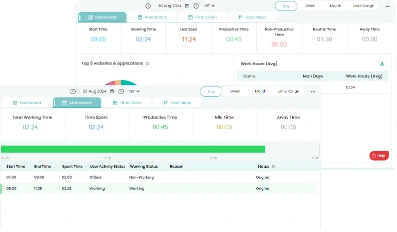
Shows increases or decreases in activity with arrow indicators and change values by comparing working, productive, and non-productive time across yesterday and last week.
- Generates Detailed Reports
Provides detailed reports on productivity, time usage, and work patterns, and also allows scheduling these reports to help improve efficiency and decision-making.
Time Champ helps you understand how your day is going, where your time is being spent, what is pulling your focus away, and how balanced your work-life actually is, so you can make small improvements that boost productivity and reduce wasted time.
Understand Your Time Wasting Habits Clearly
Track focus time, identify distractions, and improve productivity with real insights.
Conclusion
Time wasting habits often build up quietly, but their impact on productivity is significant over time. By recognizing these patterns and making small changes, you can regain control of your focus and daily output. The key is not perfection, but awareness and consistency. Once you start managing your time better, you’ll notice more essential work getting done with less effort and stress.

Jahnavi Pulluri

Table of Content
 What is a Time Wasting Habit?
- How Much Time Do These Habits Actually Cost You?
- The 9 Time Wasting Habits Quietly Hurting Your Productivity
- Why Are Time Wasting Habits So Hard to Break?
- How Time Champ Helps You Overcome Time Wasting Habits
- Conclusion
Related Blogs

Learn about time management for employees, its challenges, and effective tips to improve productivity, work efficiency, and overall workplace performance.
Jahnavi Pulluri | May 21, 2026
Discover the top 10 time management apps to boost productivity, stay organized, and achieve your goals efficiently. Try them today!
Shabana Shaik | Sep 17, 2024
Learn how to create an effective time management plan in 6 simple steps. Boost productivity with easy tips to organize your day and achieve your goals.
Jahnavi Pulluri | July 24, 2025
Learn 20 time management techniques to help you stay organized, boost productivity, and achieve your goals more effectively.
Thasleem Shaik | Aug 23, 2024
Learn what time management skills are, compare key skills, explore examples with stats, and see how they differ from time management techniques.
Thasleem Shaik | Apr 08, 2026
Discover the top 9 time management challenges and practical strategies to overcome them. Boost productivity with these smart solutions for better time control.
Shabana Shaik | Sep 19, 2024


 4.7/5 avg.
Ready to Manage Your Workforce Smarter?
Join our family of 1500+ companies using smart insights to redefine workforces!

Free Trial
No Credit Card Required