What Are Rotating Shifts? Types, Benefits, Tips, and Examples
See how rotating shifts work, compare schedule types, weigh the benefits and challenges, and use practical tips to manage shift rotations effectively.

Managing a workplace that runs beyond the usual 9-to-5 can get tricky, especially when teams need to cover mornings, evenings, nights, weekends, or round-the-clock operations. That’s where rotating shifts come in. Instead of keeping employees on the same shift every day, this schedule moves them through different time slots, keeps coverage balanced, and distributes workloads more fairly.
In this guide, you’ll learn what rotating shifts mean, how they work, the common schedule types, their pros and cons, and practical tips to manage them effectively while keeping schedules organized and easy to follow.
What Are Rotating Shifts?
A rotating shift is a work schedule where you move between different shifts based on a set of rotation pattern. Instead of working the same hours every day, you rotate through shifts such as mornings, evenings, or nights over a specific period. A rotating shift schedule can change weekly, biweekly, monthly, or according to your business requirements.
A rotating shift schedule can follow different rotation patterns. The two most common approaches are:
- Forward Rotating Shifts: A forward rotation moves employees from day shifts to evening shifts and then to night shifts. Many organizations prefer this approach because it aligns more closely with the body's natural sleep cycle and often feels easier to adjust to over time.
- Backward Rotating Shifts: A backward rotation moves employees from night shifts to evening shifts and then to day shifts. Since this pattern requires employees to adjust their sleep schedule more quickly, it can feel more challenging to maintain a consistent routine.
How Do Rotating Shifts Work?
A rotating shift schedule follows a structured rotation pattern that determines when employees move from one shift to another. It helps you keep operations running continuously while sharing different shifts among employees.
Here’s a simple way to understand how this type of work pattern operates. Let’s break it down clearly.
- Structured Rotation Cycle: Work hours change in a fixed sequence over time. You may start with early hours, then move to later ones, and eventually cover overnight duties before the cycle repeats.
- Shift Distribution: The full day is split into separate time blocks, with different groups assigned to each. After completing their assigned period, teams switch to the next time slot in the sequence.
- Rotation Frequency: Changes in timing can occur at different intervals, such as every week, every two weeks, or even monthly, depending on how your organization plans its operations.
- Common Scheduling Formats: Some workplaces use shorter daily hours, while others prefer longer shifts with fewer working days. Patterns like alternating workdays and rest days are also commonly used.
- Preferred Rotation Direction: Many systems move from earlier to later hours in a forward sequence. This progression helps individuals adjust more comfortably compared to reversing the order.
Tired of juggling shift changes, overtime, and last-minute scheduling issues?
Use Time Champ to manage rotating shifts with greater visibility, control, and consistency.
Common Types of Rotating Shift Schedules
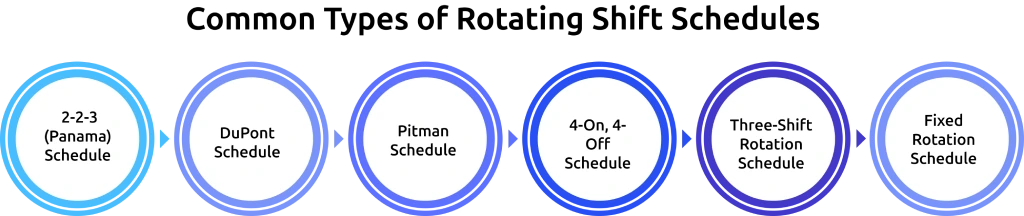
Different businesses use different rotating shift schedules based on operating hours, staffing needs, and workload requirements. Some schedules focus on longer shifts with more days off, while others rotate employees more frequently to distribute work evenly. Here are some of the most common examples of rotating shift schedules.
1. 2-2-3 (Panama) Rotating Shift Schedule
The 2-2-3 schedule, also known as the Panama schedule, follows a repeating two-week pattern where employees work two days, take two days off, work three days, then switch to nights with the same pattern. This 12-hour rotating shift schedule provides every other weekend off and is widely used in manufacturing, healthcare, and emergency services.
2. DuPont Schedule
The DuPont schedule uses four teams that rotate through day and night shifts over a four-week cycle. Employees work a series of 12-hour shifts followed by several consecutive days off, including a longer break at the end of the cycle. This schedule helps to maintain continuous coverage while providing extended rest periods.
3. Pitman Schedule
The Pitman schedule follows a 14-day cycle with 12-hour shifts. Employees work seven days in total, with a mix of shorter and longer work periods. This schedule helps you maintain continuous operations while ensuring workers get regular days off. It also supports capacity planning by helping you plan staffing more efficiently and balance workloads across teams.
4. 4-On, 4-Off Schedule
In this shift rotation schedule, employees work four consecutive shifts followed by four days off. Typically based on 12-hour shifts, this pattern is popular because it offers a consistent cycle and predictable time off for recovery.
5. Three-Shift Rotation Schedule
A three-shift rotation divides the day into morning, evening, and night shifts, usually in 8-hour blocks. Teams rotate between these shifts on a weekly or biweekly basis. This type of rotating shift work is common in industries that operate around the clock, such as healthcare and manufacturing.
6. Fixed Rotation Schedule
A fixed rotation follows a structured sequence where employees move between shifts after a set period, such as weekly or monthly. This approach provides predictability while still allowing you to distribute shift work evenly.
What are the Pros of Rotating Shifts?
It is estimated that more than 15% of workers in the US are involved in shift work, which includes evening, night, early morning, or rotating schedules. This highlights how common non-traditional work hours have become in modern work environments. Now, let’s take a closer look at the advantages of shift rotation.

1. Fair Distribution of Shifts
A rotating shift schedule ensures that the same team does not always work nights, weekends, or holiday shifts. Everyone shares less desirable shifts over time, which helps create a fairer work schedule and reduces scheduling conflicts. You can also distribute overtime opportunities evenly across teams instead of assigning them repeatedly to the same group.
2. Better Coverage Across Different Hours
This is the main reason rotating shifts exist. Hospitals, manufacturing plants, power stations, call centers, and logistics hubs cannot stop operations at 6 pm, so rotating shifts help keep services and production running at all times.
A hospital needs nurses at night, and a power plant needs engineers even at 3 am. Unlike fixed 24/7 staffing, rotating schedules do not rely on people working night shifts permanently. Instead, they share night and weekend shifts among all employees, making the workload more balanced.
3. Greater Workforce Flexibility
As employees work different shifts, they gain experience with different workflows, responsibilities, and team members. This flexibility makes it easier to handle absences, shift swaps, and changing workloads without disrupting operations. Organizations with flexible scheduling policies also see about a 12% higher employee retention rate compared to those without, showing how adaptable schedules can support long-term workforce stability.
4. Broader Skill Development
Different shifts often involve different tasks, challenges, and priorities. Rotating work shifts expose employees to a wider range of responsibilities, helping them build new skills and gain experience across different parts of the operation. This broader exposure strengthens their understanding of overall workflows and prepares them to handle different responsibilities more effectively.
5. Improves Team Collaboration
A shift rotation schedule allows employees to work with different teams over time. This interaction strengthens communication, encourages knowledge sharing, and helps teams stay connected across shifts.
Struggling to maintain productivity across changing shifts and work schedules?
Use Time Champ to track attendance, monitor performance, and manage shifts with confidence.
What are the Cons of Rotating Shifts?
While rotating shifts help maintain coverage and distribute work fairly, they can also create challenges when you do not plan them carefully. Frequent changes in work hours can affect sleep, personal routines, and overall employee wellness. Let's look at some of the common challenges that can arise with rotating shift schedules.
1. Circadian Rhythm Disruption and Sleep Loss
Brain and body functions follow a circadian rhythm that promotes alertness during the day and sleep at night. Working at night makes it difficult to get enough sleep, and sleep after night work is usually shorter and less refreshing than sleep during normal nighttime hours. Many studies show that shift work can disrupt the body’s natural rhythm, which is linked to health problems such as heart and metabolic diseases, cancer, digestive issues, and worsening mood and depression.
2. Long-Term Health Risks
Research suggests that long-term shift work can increase the risk of several health conditions. However, the level of risk varies based on factors such as how often employees work shifts, how many years they continue shift work, and their overall lifestyle.
- Cancer Risk: Rotating shifts are associated with greater overall cancer risk. The International Agency for Research on Cancer (IARC) has classified night shift work as "probably carcinogenic to humans" (Group 2A carcinogen).
- Cardiovascular Disease: A research study involving more than 173,000 participants found that shift workers had a higher risk of cardiovascular disease. The study also reported that the risk increased by about 7.1% for every five additional years of shift work
- Mental Health: A study involving 175,543 participants reported that employees who worked shifts had a higher likelihood of developing depression and anxiety.
- Digestive Issues: Gut dysfunction can result from sleep deprivation associated with shift work. Shift workers are also more likely to eat processed food, whose additives can alter the gut microbiome.
3. Communication Gaps Between Shifts
When teams work at different times, important updates may not always pass smoothly from one shift to the next. Miscommunication can affect productivity, service quality, and coordination, especially in workplaces that depend on continuous operations.
4. Work-Life Balance Challenges
Rotating shifts can make it difficult to maintain a consistent daily routine, which directly affects work-life balance. Family events, social activities, and personal commitments become harder to plan when the schedule keeps changing. Over time, this can lead to missing important moments and spending less time with loved ones, which may impact personal relationships.
5. Scheduling Complexity
Managing a rotating shift schedule requires careful planning. You need to balance staffing levels, rest periods, shift preferences, overtime, and coverage requirements. Without a clear shift management process, conflicts and last-minute adjustments can become more common.
Pro Tip
If you're still figuring out overtime by hand, make things easier with our free overtime calculator.
Rotating Shifts vs Fixed Shifts vs Swing Shifts
Choosing between rotating shifts, fixed shifts, and swing shifts depends on your operational needs, staffing requirements, and the level of flexibility you want. While all three schedules help organize work hours, they differ in how often shift timings change and how employees move between shifts.
| Feature | Rotating Shifts | Fixed Shifts | Swing Shifts |
|---|---|---|---|
| Work Hours | Change based on a shift rotation schedule | Remain the same every day | Usually covers the period between day and night shifts |
| Schedule Pattern | Employees rotate through different shifts | Employees stay on one shift permanently | Employees work a specific afternoon or evening shift |
| Flexibility | High | Low | Moderate |
| Shift Coverage | Includes day, evening, and night shifts | Limited to one assigned shift | Primarily afternoon and evening hours |
| Common Examples | 2-2-3 (Pitman), DuPont, 4 on 4 off, 12-hour rotating shift schedule | 8-hour fixed day, fixed night, or fixed evening crews | 3 PM–11 PM or 4 PM–midnight fixed blocks in retail, hospitality, or manufacturing |
| Best For | Businesses that need continuous coverage and fair shift distribution | Businesses with standard operating hours | Businesses that experience higher demand during the afternoon and evening hours |
Fast vs Slow Rotating Shifts: Key Differences
The speed of shift rotation plays an important role in employee comfort, scheduling flexibility, and operational efficiency. In a fast-rotating shift schedule, employees switch shifts more frequently, while a slow rotation keeps them on the same shift for a longer period before changing. The right choice depends on your workload, staffing needs, and how quickly your team can adapt to schedule changes.
| Feature | Fast Rotating Shifts | Slow Rotating Shifts |
|---|---|---|
| Rotation Frequency | Changes every few days or every week | Changes every few weeks or months |
| Employee Adjustment | Less time on one shift, but more frequent changes | More time to adapt to a specific shift |
| Sleep Pattern Impact | Frequent schedule changes can affect routines | Fewer schedule changes help maintain a stable routine for longer |
| Flexibility | Higher flexibility for workforce planning | Lower flexibility but greater consistency |
| Coverage Distribution | Shares day, evening, and night shifts more frequently | Shares shift over a longer cycle |
| Best Suited For | Dynamic operations with changing staffing needs | Operations that prefer predictable schedules |
| Common Example | 2-2-3 (Pitman/Panama), 3 on 3 off | DuPont (28-day), Southern Swing (7-day blocks) |
Industries That Commonly Use Rotating Shifts
Rotating shifts are common in industries that need coverage across multiple shifts, extended operating hours, or continuous operations. These schedules help you distribute workloads more evenly while ensuring the right staff remains available when needed.
- Healthcare: Hospitals, clinics, and emergency care centers use rotating shifts to provide patient care during the day, evening, night, and weekends.
- Manufacturing: Manufacturing facilities often run multiple production shifts to meet demand, reduce equipment downtime, and keep operations moving efficiently.
- Logistics and Warehousing: Distribution centers and warehouses rely on rotating shift schedules to manage inventory, process orders, and support shipping activities throughout the day.
- Emergency Services: Police departments, fire stations, and emergency response teams use rotating shift work to maintain coverage at all hours.
- Customer Support and Call Centers: Businesses that serve customers across different regions and time zones often use shift rotation schedules to provide timely support.
- Transportation: Airlines, railways, public transit systems, and freight companies use rotating work shifts to keep services running according to schedules.
- Hospitality and Tourism: Hotels, resorts, restaurants, and entertainment venues use rotational shifts to support guests during peak hours, weekends, and holidays.
- Energy and Utilities: Power plants, water treatment facilities, and utility providers depend on rotating shift work schedules to monitor systems and respond to issues without interruption.
How To Build a Rotating Shift Schedule (Step-By-Step)
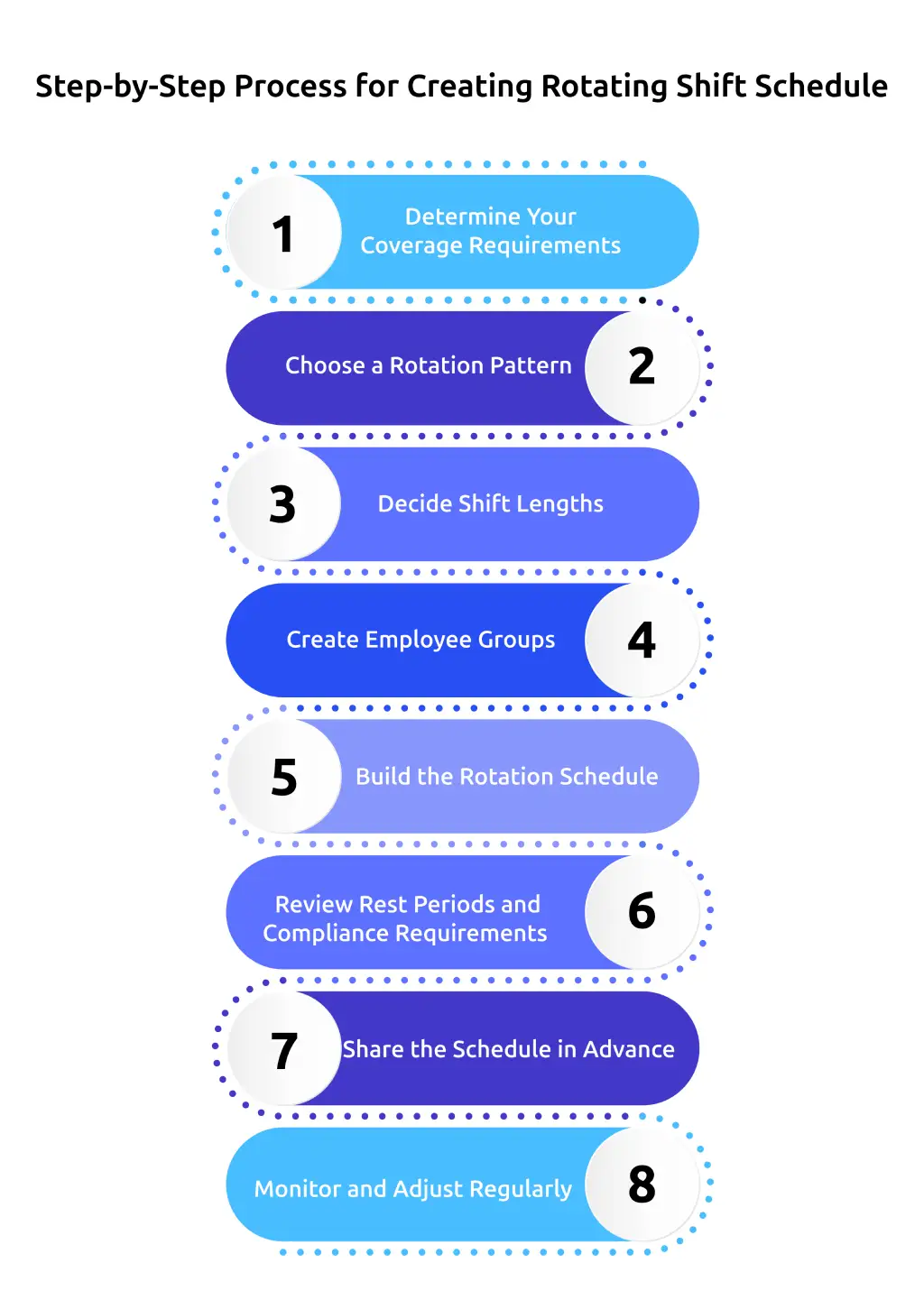
Creating an effective rotating shift schedule requires more than assigning employees to different time slots. You need a schedule that balances staffing needs, employee well-being, and operational requirements. Follow these steps to build a rotating shift schedule that works for your team.
Step 1: Determine Your Coverage Requirements
Start by identifying the hours you need to cover each day. Consider operating hours, peak workload periods, customer demand, and the number of employees required for each shift.
Step 2: Choose a Rotation Pattern
Select a shift rotation schedule that fits your operational needs. You can use a 2-2-3 schedule, DuPont schedule, Pitman schedule, 4-on 4-off schedule, or another rotating shift pattern based on your workforce requirements.
Step 3: Decide Shift Lengths
Determine whether you want 8-hour, 10-hour, or 12-hour shifts. Longer shifts can reduce the number of handovers, while shorter shifts may help employees maintain a more consistent routine.
Step 4: Create Employee Groups
Divide employees into teams based on staffing requirements. Make sure each group has the right mix of skills and experience to handle the workload during every shift.
Step 5: Build the Rotation Schedule
Assign each team to a specific shift and define when they will rotate. A clear rotation cycle helps distribute day, evening, night, weekend, and holiday shifts more fairly.
Step 6: Review Rest Periods and Compliance Requirements
Check that your schedule provides adequate time between shifts and follows labor laws, overtime regulations, and company policies. This step helps reduce fatigue and scheduling issues.
Step 7: Share the Schedule in Advance
Publish the rotating shift schedule early, so employees have enough time to plan their work and personal commitments. Advance notice also reduces confusion and last-minute schedule changes.
Step 8: Monitor and Adjust Regularly
Review attendance, workload distribution, overtime, and employee feedback regularly. Small adjustments can help you improve shift coverage and maintain a balanced schedule over time.
Pro Tip
Looking for better ways to track shift performance? See our guide on shift monitoring systems.
Rotating Shift Scheduling Tips
A well-planned rotating shift schedule helps you maintain coverage, reduce scheduling conflicts, and create a better work experience for everyone. Let’s look at some simple tips that can make shift rotation easier to manage and understand.
Tips for Managers
- Plan Schedules Early: Share schedules in advance so employees have enough time to plan their work and personal commitments.
- Keep Rotations Predictable: Follow a consistent shift rotation pattern to reduce confusion and help employees adjust more easily.
- Balance Workloads Fairly: Distribute night, weekend, and holiday shifts evenly to avoid placing extra pressure on the same group.
- Allow Adequate Rest Time: Schedule sufficient breaks between shifts to help employees recover and stay productive.
- Use Shift Monitoring Wisely: Track attendance, overtime, and workload trends regularly to identify issues before they affect operations.
Tips for Employees
- Maintain a Consistent Sleep Routine: Adjust your sleep schedule gradually when moving to a different shift.
- Prepare for Shift Changes Ahead of Time: Plan meals, commuting, and daily activities before a new rotation begins.
- Take Breaks Seriously: Use break times to rest and recharge, especially during longer shifts.
- Communicate Scheduling Concerns Early: Discuss availability issues or shift conflicts before they become larger problems.
How Time Champ Helps Manage Rotating Shifts
Managing rotating shifts becomes much easier when you have the right tools in place. Time Champ is an employee monitoring and shift scheduling software that helps you organize schedules, track attendance, monitor shift performance, and maintain better visibility across your workforce, making shift management more structured and less time-consuming.
Here are the key features that help manage rotating shifts:
- Shift Scheduling: Create and manage rotating shift schedules with greater clarity. Assign shifts, update schedules, and keep everyone informed about upcoming rotations.
- Attendance Tracking: Monitor clock-ins, clock-outs, break times, and attendance records in one place to ensure accurate shift tracking.
- Automated Time Tracking: Automatically track work hours without manual entries, ensuring accurate time records for every shift
- Real-Time Monitoring: View employee activity during assigned shifts and identify attendance issues, idle time, or missed schedules quickly.
- Workload Visibility: Track how work is distributed across different shifts so you can identify imbalances and make better scheduling decisions.
- Overtime Tracking: Monitor overtime hours across teams and prevent excessive workloads that can lead to fatigue and burnout.
- Detailed Reports: Access reports on attendance, working hours, shift performance, and utilization to support better planning and resource allocation.
- Leave and Availability Management: Track employee availability and time-off requests to reduce scheduling conflicts and maintain proper shift coverage.
With Time Champ, you can simplify rotating shift management, reduce scheduling challenges, and maintain better control over attendance, workloads, and shift coverage from a single platform.
Frequent shift changes can lead to missed hours, workload imbalances, and reduced efficiency.
Try Time Champ to simplify shift management and keep your team performing at its best.
Conclusion
Rotating shifts can help you maintain consistent coverage, distribute workloads fairly, and support business operations across different hours. The key is choosing the right rotating shift schedule and managing it effectively.
Using shift management tools like Time Champ, you can simplify shift scheduling, track attendance, monitor workloads, and keep your team aligned with changing schedules, making rotating shift management easier and more organized.

Thasleem Shaik

Table of Content
 What Are Rotating Shifts?
- How Do Rotating Shifts Work?
- Common Types of Rotating Shift Schedules
- What are the Pros of Rotating Shifts?
- What are the Cons of Rotating Shifts?
- Rotating Shifts vs Fixed Shifts vs Swing Shifts
- Fast vs Slow Rotating Shifts: Key Differences
- Industries That Commonly Use Rotating Shifts
- How To Build a Rotating Shift Schedule (Step-By-Step)
- Rotating Shift Scheduling Tips
- How Time Champ Helps Manage Rotating Shifts
- Conclusion
Related Blogs

Struggling with employee shift scheduling? Explore the best types, benefits, and strategies to streamline shifts, boost productivity, and keep your team happy!
Tarun Kumar Reddy | Mar 13, 2025
Struggling with shift planning for field employees? Discover how to organize schedules, handle last-minute changes, and keep your team running smoothly.
Jahnavi Pulluri | July 24, 2025
Get free hybrid work schedule templates, real-world examples, and expert tips. Learn how to create & manage hybrid teams in 2026 to boost productivity.
Jahnavi Pulluri | Jun 22, 2026
Find the 10 best employee scheduling software for 2025. Compare features, pricing, pros & cons to boost productivity and manage teams better.
Chethana Choudary | Nov 14, 2025
Learn what workforce scheduling is, why it matters, types, optimisation tips, best practices for 2025, and how to choose the right system for your business.
Guna Lakshmi | September 15, 2025
Explore the essence of flexible work schedules, the various types available, and their benefits and disadvantages for a modern workforce.
Hima Bindhu Nara | Feb 26, 2024


 4.7/5 avg.
Ready to Manage Your Workforce Smarter?
Join our family of 1500+ companies using smart insights to redefine workforces!

Free Trial
No Credit Card Required